

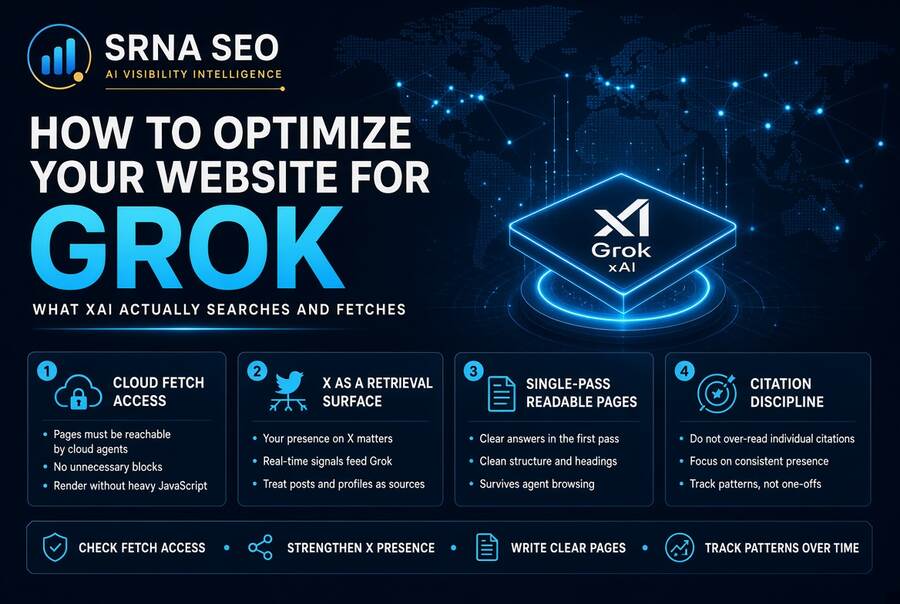
Your team says “we need to be in Grok”, and the first question nobody can answer is what Grok actually reads. Grok is the one engine in this series where xAI documents posts on X as a retrieval source next to web pages, and it is also the one where xAI documents nothing about how its search reaches your website. So optimizing for Grok means treating your X presence as part of your visibility, making sure your own site is not blocking cloud-based fetching, writing pages that can be understood on first read, and being honest that the controls other engines give you are, as far as I can document, missing here.
What is in This Series
This article is part of cluster How to Measure Your Presence in AI Search Engines, the series hub containing the: AI Search Visibility Share of Voice, How to Optimize Your Website for ChatGPT, How to Measure Your Presence in ChatGPT, How to Optimize Your Website for Perplexity, How to Measure Your Presence in Perplexity, How to Optimize Your Website for Claude, How to Measure Your Presence in Claude, How to Optimize Your Website for Gemini, How to Measure Your Presence in Gemini, How to Optimize Your Website for Copilot, How to Measure Your Presence in Copilot. The measurement half is How to Measure Your Presence in Grok.
What “Optimizing for Grok” Means
Optimizing for Grok is the work of making your brand findable in the places Grok searches, and your pages readable when it fetches them. Grok is xAI’s AI assistant, and the word covers several products. I use these terms:
- Grok (the assistant): xAI’s consumer assistant. xAI’s Grok page describes it as informed by real-time insights from X.
- The xAI API’s search tools: server-side tools that let a developer’s application give Grok live web search and X search. xAI’s tools overview says the model decides at each step whether to call a tool or answer.
- Grok Bot: xAI’s agent that works for a user on a cloud computer with a browser. It is an agent acting on someone’s behalf, not a search crawler, though that conclusion is my reading of xAI’s description.
- Grounding: supplying the model with retrieved content at the moment it answers, so the answer is not from memory alone.
This matters because each of these has different evidence behind it, and I would rather show you where the documentation stops than fill the gaps with folklore.
Which Grok Are We Talking About?
The table is built from xAI’s documentation. The last column is my judgment.
| Surface | What xAI documents | What you can control | My read |
|---|---|---|---|
| Consumer Grok | Real-time insights tied to X. DeepSearch was announced in February 2025 as an agent that gathers facts and writes a summary | Not documented | Treat as web plus X. How it cites is Not enough available data |
| API web search tool | Searches the web in real time and browses pages. Returns citations | Nothing on your side that I found | You can only be retrievable |
| API X search tool | Searches X posts, accounts and threads, with citations | Your own account and posts | The distinctive part |
| Grok Bot | An agent that browses with a cloud computer for a user | Your normal bot defenses | Acts for a person, so it behaves like one |
Treat Grok as two retrieval surfaces, the open web and X, and notice that you only have documented influence over one of them. For consumer Grok I found no xAI page that explains how it chooses sources or whether it shows them: Not enough available data.
Step 1: Check That Cloud-Based Fetching Can Reach You
This comes first because it is the only step with a clear before and after, and it comes with an honest warning. xAI’s web search documentation says the tool searches the web and browses pages. It does not describe a crawler, a user agent, robots.txt handling or IP ranges, and neither does the tools overview. So I cannot tell you which robots.txt line controls Grok’s search. Some third-party bot directories list user agent strings. I am not treating them as authority, and you should not either. Check your own logs.
What I can say from xAI’s own pages: Grok Bot’s FAQ says some sites block traffic from cloud computers, and that sites may block automation or show a CAPTCHA. In those cases the Bot should hand the step back to the user and not bypass it. My inference for the search tools: if your web application firewall or CDN challenges traffic from data centers, you may be locking out any cloud-based fetcher, Grok’s included. So the audit is about what your own organization may have switched on:
- Bot protection rules that challenge or block data-center traffic by default.
- Login or consent walls in front of content you want read.
- Pages that render nothing without JavaScript. Whether Grok’s browsing executes it, xAI does not say: Not enough available data.
- Blanket “block all AI” rules copied from a template, which may or may not touch Grok. You cannot verify that from xAI’s pages, so look at your logs before and after.
If nobody can say who set a rule or why, you have found your first fix. For a structured check of crawl and indexation, start with my Indexation and Crawl Diagnostic.
Step 2: Treat Your X Presence as a Retrieval Surface
Here is the part no other engine in this series offers. xAI’s X Search documentation describes four functions the model can call: keyword search using X’s advanced search operators, sorted by Top or Latest; semantic search, which finds posts by meaning; user search, which finds accounts by name or bio; and thread fetch, which retrieves a post with its parent posts and replies. The model chooses which to call and how often. Results come back with citations.
I can only tell you what that implies as inference, not as a documented ranking rule:
- Your account name and bio are searchable. If a buyer asks about your category and Grok searches for accounts, a vague bio gives it nothing to match. State plainly what you do, for whom and where.
- Posts are matched by keywords and by meaning. A post that makes a specific, checkable statement in plain words is easier to match than one that is clever but vague.
- Threads can be fetched whole, with replies. So what people reply under your posts is part of what Grok can read about you. That is a reputation point as much as an SEO point.
- Recency has a place, since keyword search can be sorted by Latest. A brand that posted once in 2021 is not a fresh source.
What xAI does not say, in anything I read, is how Top is calculated, whether verified accounts or follower counts matter, or how consumer Grok weighs X against the web: Not enough available data. I will not guess.
If you want a straight read on whether your gap is access, your X footprint, your content or your authority, that is the kind of work I do in Enterprise Search Advisory, and you can talk to me here.
Step 3: Write Pages That Survive a Single Pass
xAI describes the web search tool as searching and browsing pages in real time. It says nothing about how pages are chosen, summarized or cached. So I fall back on one principle: assume your page is read once, quickly, by a model that has a question.
In practice that means a clear statement of what the page is in the first paragraph, a definition where a term needs one, headed sections for the obvious follow-ups (cost, risk, alternatives, who it is for), and specific claims that someone could check. It is the same work a good page already does. It is not chunking and it is not a Grok-specific format. The writing side is in How to Write a Blog Post for AI SEO and Citations, and the structure side in AI Content Structure for Enterprise Visibility. For what each engine does to your visibility more broadly, see What ChatGPT Search, Perplexity, Gemini, Copilot, and Meta AI Actually Do to Your Enterprise Visibility, and for the traffic side, Zero-Click Visibility.
Step 4: Do Not Over-Read a Citation
xAI’s Citations documentation contains two caveats worth building into how you think. First, enabling inline citations does not guarantee the model cites sources in every answer, because the model decides when to include them. Second, the full list of citations can include sources the agent looked at but did not use in its final answer.
Both cut the same way. Being retrieved is not the same as being used, and being listed is not the same as being quoted. I come back to this in the measurement article, because it changes what you should count.
What Is Documented vs What Is Guesswork
| Tactic | Evidence level | My read |
|---|---|---|
| Make sure cloud fetching is not blocked by your own rules | Inference from xAI’s Grok Bot FAQ | Do first. Check logs |
| Clear account name and bio on X | Documented that user search matches name or bio | Cheap. Do it |
| Specific, plain-language posts | Documented that posts are matched by keyword and meaning | Cheap. Do it |
| Pages that are clear on one read | Inference | The baseline |
| robots.txt rules aimed at Grok | xAI documents none | Not enough available data |
| Format tricks for Grok citations | Nothing documented | Do not buy the hype |
What This Is NOT
This is not a ranking guide. xAI documents no ranking for citations, and says the model decides when to cite. It is not a claim that posting more raises your visibility, because nothing I read says so. It is not a robots.txt recipe, since xAI documents no crawler for me to name. And it is not finished when your site is reachable. You change something, then you check whether the picture changed, which is what How to Measure Your Presence in Grok covers, and what turns those mentions into a competitive number is AI Search Visibility Share of Voice.
Estimated Gain After Implementation
Not enough available data, and I will not invent a range. There is one case where the before and after is clear: if your own firewall or login wall was stopping fetches, removing it changes what can be read at all. Everything else, including your X footprint, is cumulative, and anyone promising a percentage on it is guessing.
The Uncomfortable Part
For Grok, the honest optimization advice is thin, because the vendor has not published the controls that would make it thick. A confident Grok playbook right now would have to be built on third-party guesses. What xAI does document is that posts and accounts on X are searched directly. That makes your social profile part of your search presence, and most B2B teams have not audited theirs with that in mind. Start with what they can see, which is their bio.
FAQ
No. xAI documents the consumer assistant, the API search tools for web and X, and Grok Bot as separate things. Consumer Grok’s source selection is not documented in anything I could read.
Per xAI’s documentation, the web search tool searches the web in real time and browses pages. The model decides when to use tools.
Per xAI, the X Search tool searches posts, accounts and threads with keyword, semantic, user and thread functions, and returns citations.
I found no xAI page that documents a crawler, a user agent or robots.txt handling for its search tools: Not enough available data. Check your own server logs for what actually arrives.
Per xAI, user search finds accounts by name or bio. How results are ranked is not documented, so a clear bio is a cheap fix and not a proven lever.
Not necessarily. xAI says the full citation list can include sources the agent looked at but did not use in its final answer.
No. xAI says the model decides when to include inline citations.
No. Not enough available data exists for an honest range. Promise a baseline, a fixed set of changes and repeated measurement.
Where to Go From Here?
Start with the AI Visibility Inspector for a first read. When you want a baseline and a method for tracking AI engines over time against named competitors, look at NovaX (my AI Visibility Intelligence Platform). And if you want the access, X and content gaps scoped for your organization, contact me.
This article was researched and drafted with the assistance of AI tools and reviewed and edited by author prior to publication.
