
NovaX: The AI Visibility Intelligence Platform That Shows You Why – Not Just Whether
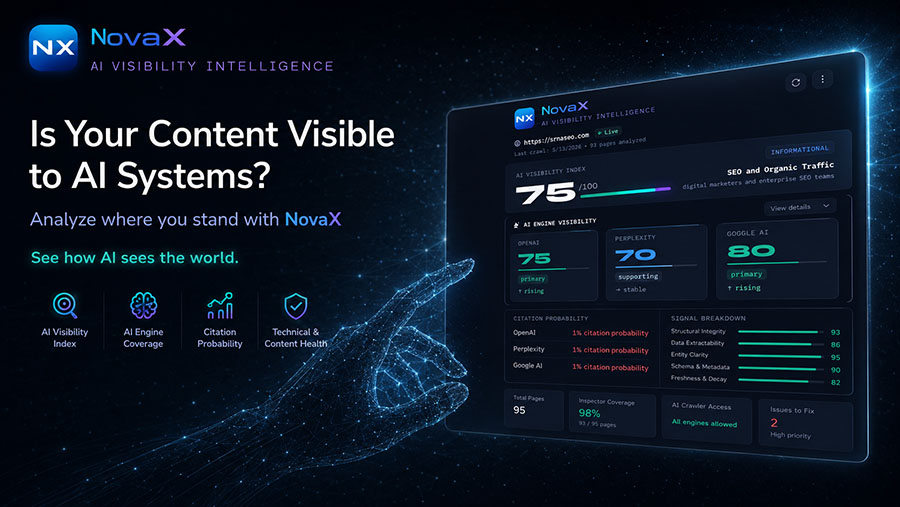
Engineered for 2026 Generative Search Standards.
In This Article
NovaX – Beyond Rankings: Own Your Presence in the Age of Generative Search
The search landscape has shifted from “blue links” to “AI citations.” While legacy SEO tools focus on where you rank in a list, NovaX is the world’s first AI Visibility Intelligence platform designed to analyze how LLMs, including Perplexity, ChatGPT, Claude, and Gemini, perceive, extract, and credit your content. It is not a tracker; it is an innovative diagnostic engine.
Today, NovaX contains 23 screens and 100+ features in total, giving you the best experience and presenting all relevant data in a well-organized, easily accessible way, not in chaos.
We are giving the honest review of AI Visibility Inspector and NovaX, with all strengths and weaknesses, and compare them against competitors in articles like: NovaX vs Semrush, Ahrefs, Conductor & BrightEdge, Which AI Visibility Tool Is Best for SEO, Best AI Visibility Tools: What They Do and Who They’re For, Which AI Visibility Tool Is Best for SME, Which AI Optimization and Visibility Tools Are Actually Built for Agencies, AI Visibility Inspector and NovaX vs BrightEdge, AI Visibility Inspector and NovaX vs Conductor, NovaX vs Ahrefs, Best Tool to Optimize and Track ChatGPT Citations, AI Visibility Inspector vs Ahrefs, NovaX vs Semrush, AI Visibility Inspector vs Semrush, and when competitor is better than us, we say it clearly and loudly.
See How AI Sees the World
NovaX moves past the “black box” of AI search by providing a transparent look at the structural, semantic, and technical signals that dictate visibility. Instead of waiting for a citation to appear (or disappear), NovaX allows you to engineer your content’s “extractability” so that AI models can confidently verify and cite your brand as a primary source of truth.
The Blind Spot in Your Current SEO Strategy
Most brands are flying blind in generative search. Traditional SEO tools are designed for “Outcome Monitoring”—they tell you that you weren’t cited, but they cannot tell you why. By the time you notice a drop in AI-driven traffic, the structural decay has already set in. You are measuring the shadow when you should be fixing the object.
Why AI Ignores High-Quality Content
AI search engines don’t just “read” your pages; they attempt to extract and verify data. If your site suffers from technical friction, such as fragmented entity relationships, poor data extractability, or hidden schema errors, LLMs will skip your content in favor of a “cleaner” source. NovaX eliminates this guesswork by shifting the focus from tracking results to diagnosing the technical signals that determine whether you are a “citable” authority.
The Forensic Intelligence Engine: Five Dimensions of AI Visibility
NovaX doesn’t give you a generic “SEO score.” It breaks your visibility down into five mission-critical dimensions that determine your compatibility with modern AI models.
| Forensic Pillar | Meaning |
|---|---|
| Structural Integrity | Analyzes heading hierarchy and HTML clarity to ensure LLMs can follow your logic without “hallucinating” context. |
| Data Extractability | Measures how easily AI can pull data from your tables, lists, and paragraph structures. |
| Entity Clarity | Audits how well your brand is anchored to the global Knowledge Graph, ensuring you are recognized as a distinct entity. |
| Schema & Metadata Intelligence | Goes beyond simple validation to check JSON-LD completeness and semantic alignment. |
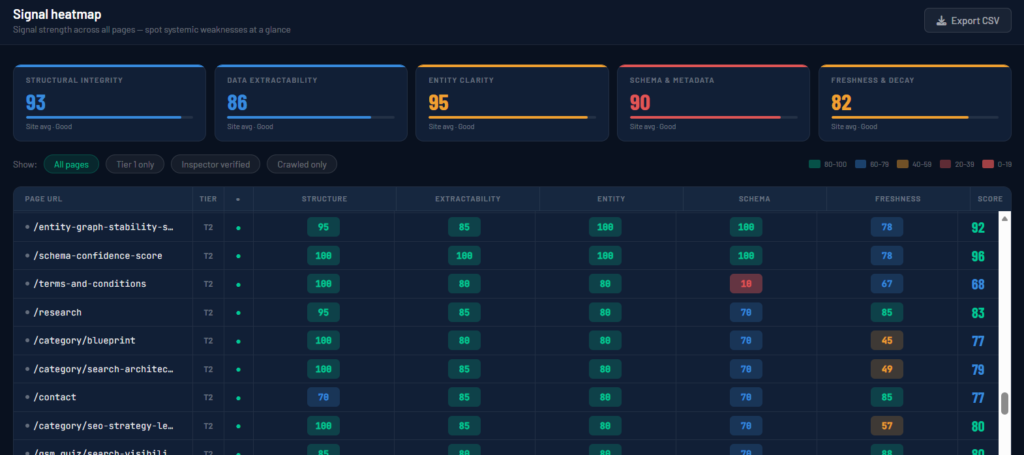
| Freshness & Structural Decay | Tracks content age and update signals to prevent your “authority” from expiring in the eyes of real-time AI crawlers. |
Actionable Intelligence for High-Stakes Decisions
No-click data pipeline: Syncs live Forensic analysis directly from Inspector into your NovaX dashboard in <1 second.
NovaX is more than a dashboard; it is a command center that converts technical noise into a prioritized work queue. By identifying the specific points of “Structural Decay,” the platform allows your team to stop fixing everything and start fixing first what matters to AI visibility.
Precision Tools for Every Level of the Organization
Our specialized modules are designed to bridge the gap between technical execution and executive strategy
| Module | Importance |
|---|---|
| The AI Visibility Inspector (The Foundation) | Our frontline scout performs the deep intelligence analysis in real-time, feeding live signal data directly into your NovaX workspace for immediate diagnosis. |
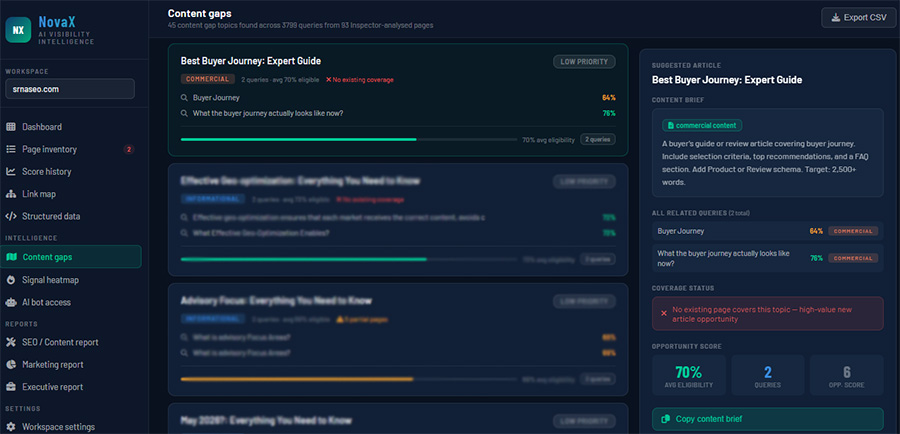
| Content Gap Intelligence | Automatically identifies high-opportunity topics where competitors are being cited, providing detailed content briefs to help you reclaim the citation. |
| Signal Heatmap | A bird’s-eye view of your entire site’s technical and semantic health, allowing you to spot systemic weaknesses across thousands of pages at a single glance. |
| Automated Link Mapping | Visualizes your internal authority flow, excluding navigation menus, to ensure your most important “Tier 1” entities are properly supported for AI discovery. |
| Entity & Schema Intelligence | A dedicated audit of how your brand is anchored to the Knowledge Graph, ensuring your JSON-LD isn’t just valid, but semantically rich. |
| Multi-Stakeholder Reporting | Tailored reports for every department, from granular technical fixes for SEO teams to high-level “Citation Gap” estimates for the C-suite, and with a management-level report in between them |
Your Data, Your Infrastructure: NovaX is a self-hosted platform. Your forensic intelligence never leaves your environment.
Ready to see how AI sees you?
If your team is tracking AI mentions but cannot explain why your citation rate is flat – that is the gap NovaX closes.
Built for the Future of Search
NovaX was developed by a search architect to solve the “last mile” problem of generative SEO. Our own production environment at srnaseo.com serves as a live proof-of-concept, maintaining a ~90/100 average AI-readiness score across nearly 100 mission-critical pages. We don’t just build the tool; we use its forensic findings to dominate the AI citation landscape.
Secure Your AI-First Future
As search shifts from “ranking lists” to “verified citations,” the cost of technical debt increases every day. Whether you are an enterprise SEO looking for forensic data or a CEO needing to protect your brand’s digital presence, NovaX provides the clarity required to win in 2026 and beyond.
What is Your “Missing Citation” Gap Costing You?
In 2026, the buyer’s journey begins with a question to an AI. When an LLM answers that question using your competitor’s data instead of yours, it isn’t just a missed “click”; it is a lost customer. Traditional SEO tools tell you your traffic is down, but they can’t show you the revenue escaping through the “Citation Gap”.
| The Pain Points | Consequence |
|---|---|
| The Recommendation Void | If your Entity Clarity is low, AI models cannot verify you as a reputable source. You are excluded from “Top 10” lists and product comparisons before the human user ever sees your URL. |
| Structural Decay & Brand Erosion | Outdated content and broken heading hierarchies signal to AI that your brand is no longer an authority. As your Freshness Grade drops, your competitors move in to claim your historical “source of truth” status. |
| The “Hallucination” Tax | When AI can’t easily extract your data due to poor Data Extractability, it often misrepresents your offerings or omits your key benefits entirely. You aren’t just losing traffic; you are losing control of your brand’s narrative. |
| Wasted Content Investment | You spend thousands on high-quality content that AI simply cannot “see.” Without Structural Integrity and proper Schema Intelligence, your best assets remain trapped behind technical friction. |
Turn Forensic Data into Financial Recovery
NovaX’s Executive Report translates these technical failures into business logic. By calculating Missed Citation Estimates and Improvement Potential, we show you exactly where revenue is leaking and provide the forensic roadmap to claw it back.
Ready to see how AI sees you?
The content gap feature alone has replaced a full month of keyword research for early users.
Beyond Monitoring: Why Tracking Citations Isn’t Enough
Most “AI SEO” tools on the market today are purely reactive; they tell you when you’ve been mentioned. By the time you get that notification, the opportunity has passed. NovaX is the only platform that works proactively. We don’t just count your wins; we diagnose your technical signals so you can engineer them.
| Feature | Legacy AI Tracking | NovaX Forensic Intelligence |
|---|---|---|
| Primary Goal | Count brand mentions | Diagnose visibility causes |
| Data Source | Search Engine Results (SERPs) | Deep Forensic & Entity Analysis |
| Analysis | Surface-level brand tracking | 5 Signal Forensic Dimensions |
| Action | “You missed a citation.” | “Fix this block to win the citation.” |
Intelligence Scaled for Your Ambition
Whether you are a solo search architect or an enterprise marketing team, NovaX provides a clear path to AI dominance. Our tiers are designed to scale with your domain complexity and reporting needs.
Tested in the Trenches: The NovaX Performance Standard
We don’t just build visibility intelligence; we live it. NovaX was forged during the full-scale rebuild of srnaseo.com, where we applied our forensic signal analysis to move from zero to an industry-leading benchmark in under 90 days.
Our production environment serves as a live demonstration of what NovaX achieves for its users. By following the platform’s “Quick Win” recommendations and eliminating structural decay, we maintain a ~90/100 average AI-readiness score across 95+ mission-critical pages.
- 98% Inspector Coverage: Every high-value page is deep-audited for entity clarity and extractability.
- 0% AI Bot Blockage: Full accessibility across GPTBot, ClaudeBot, PerplexityBot, and Google-Extended.
- Top-Tier Compatibility: Consistent 90+ scores across Perplexity, ChatGPT, Claude, and Gemini.
- 85% of total pages ranking on Google’s SERP first page
Don’t Wait for the Next AI Update to Find Your Blind Spots
The citation landscape is winner-take-all. As LLMs become the primary interface for search, the gap between “visible” and “invisible” brands will only widen. You can continue monitoring your traffic decay, or you can start diagnosing the technical signals that reverse it.
Key Takeaways
- Every major AI visibility tool monitors outcomes – citation counts, brand mentions, share of voice. NovaX is the only platform that analyses causes – the structural signals that determine whether AI cites your content.
- AI citation is determined by five measurable signals: structural integrity, data extractability, entity clarity, schema and metadata, and freshness and decay. NovaX scores every page on all five and averages them into a single AI Visibility Score.
- The content gap feature clusters your site’s query eligibility data into topic opportunities and generates content briefs with format, title, and word count guidance.
- Structural decay detection surfaces pages where content is ageing in ways AI systems penalise – stale dates, missing modification signals, and degrading internal link equity.
- NovaX is self-hosted. Your data stays on your server. One licence covers your entire installation.
- Organisations that close signal gaps typically see citation probability improve by 15–25 percentage points within 60 days.
- The cost of inaction is measurable: every percentage point of citation gap is a competitor appearing in your buyer’s AI answer instead of you.
Visibility Intelligence: Your Questions Answered
AI visibility monitoring tracks whether your brand appears in AI-generated answers, a measurement of outcomes. AI visibility intelligence analyses the structural signals that determine those outcomes, entity clarity, schema validity, content freshness, structural integrity, and data extractability. NovaX is an intelligence platform: it tells you why AI reads your pages the way it does, not just whether your brand appears in responses.
NovaX scores five signal dimensions on a 0–100 scale: structural integrity, data extractability, entity clarity, schema and metadata, and freshness and decay, and averages them into an overall score per page. Site-wide averages are calculated across all Inspector-analysed pages. Each engine (Perplexity, ChatGPT, Claude, Gemini) receives a separate compatibility score based on the signal weights those engines are known to prioritise.
Structural decay is the degradation of content freshness signals over time, missing or outdated publication dates, absent modification timestamps, stale statistics, and declining internal link authority. AI systems weigh recency. A page with strong original content but no updated signals reads as stale to retrieval models. NovaX detects decay with a grade (A through F), an age-in-days calculation, and specific recommendations to reverse it.
NovaX analyses query eligibility data from every Inspector-analysed page and clusters related queries by topic. For each cluster, it calculates average eligibility, identifies dominant intent type (informational, how-to, FAQ, comparative, commercial), detects whether any existing page covers the topic, and generates a content brief with title suggestion, format guidance, word count target, and all related queries ranked by eligibility. The briefs are exportable and copyable directly into a content workflow.
No – and the distinction matters. Otterly and Peec AI monitor outcomes: how often your brand appears in AI responses. NovaX analyses causes: why your pages are or are not being selected. The two layers are complementary. You can use NovaX to improve your signal quality and citation probability, and use a monitoring tool to confirm that the improvement shows up in actual AI answers.
Standard agency reports are “Rearview Mirror” metrics – they show you what happened last month. NovaX is a “Windshield” tool; it diagnoses the technical and semantic health of your site in real-time, showing you exactly what to fix today to ensure you are cited by AI tomorrow.
Not at all. NovaX is a self-hosted intelligence platform that works alongside your existing site. Once your workspace is active, the AI Visibility Inspector extension allows you to sync deep forensic data to your dashboard without a single click.
Yes. Unlike cloud-based trackers that store your data on their servers, NovaX is a self-hosted environment. Your workspace, crawl history, and “Forensic Intelligence” remain under your control, ensuring your competitive edge stays private.
No, but you can use the AI Visibility Inspector. It allows you to perform live forensic audits on any URL. You can compare your competitors’ Entity Clarity and Extractability against your own to find the gaps where you can win. In NovaX, we now have a section dedicated to competitor analysis (V2.01), but it only analyses a small portion of their website.
Self-hosted means NovaX installs on your own server. All crawl data, Inspector analysis, scores, entities, recommendations, and query eligibility data stay on your infrastructure. Nothing is sent to a third-party platform. For enterprise organisations with data residency requirements, this is a critical distinction from every SaaS-based alternative.
NovaX identifies “Quick Wins” immediately. By resolving Structural Decay and Schema Metadata errors highlighted in your work queue, you can often see shifts in AI engine compatibility and citation probability within days of re-indexing.
NovaX silently ignores it. The Inspector performs its normal analysis and displays results in its own shell, but no data is stored in NovaX. This domain security feature means you can safely audit competitor pages or client research without affecting your workspace data.ion probability within days of re-indexing.
NovaX is part of the Srna SEO Frameworks – built from real enterprise experience, not agency theory.
Author: Ivica Srncevic
Enterprise SEO strategist specializing in search architecture and AI-driven visibility. With 25+ years of experience across global organizations including Adecco Group and Atlas Copco, he works on designing, diagnosing, and optimizing how complex digital ecosystems are structured, understood, and surfaced by search engines and AI systems.