

In This Article
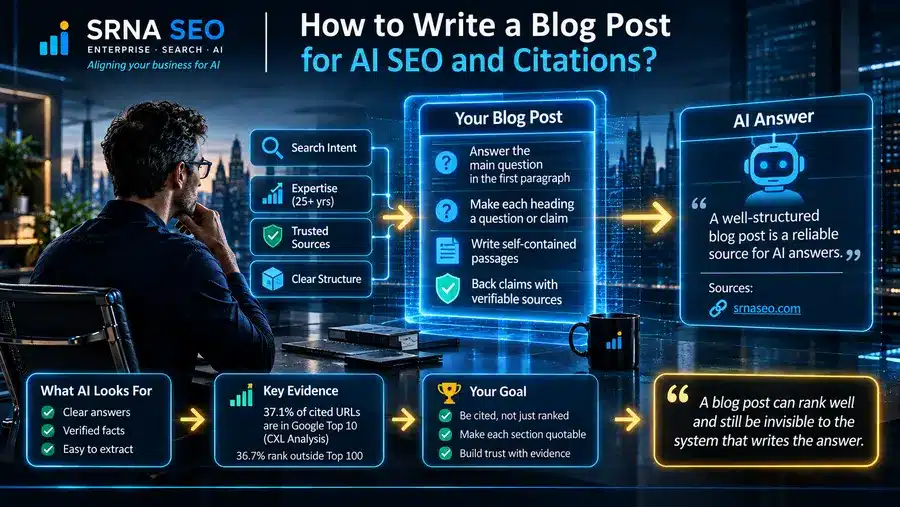
To write a blog post for AI SEO and citations, answer the question in the first paragraph, make every heading a question or a clear claim, write each passage so it still makes sense when copied out alone, and back each claim with something a reader can check. That is the whole method. The rest of this article is the evidence for it and the order I would apply it in. I wrote this post by those same rules, so you can judge whether they work.
Have you ever publish a well-researched blog post, it ranks reasonably, and AI assistants still quote somebody else. If yes, then this article is for you.
I have 25 years in SEO and 7 inside global enterprises, and I will be direct: most blog posts fail AI citation not because the content is weak, but because the point arrives too late.
What writing for AI citations actually means
An AI citation (a link or named reference that an AI answer gives to your page as a source) happens when a retrieval system finds your page, pulls out one passage, and decides that passage is safe to quote. AI SEO, also called GEO or AEO (generative engine or answer engine optimization), is the work of making that passage easy to find, easy to extract and easy to attribute.
So you are not writing for a reader who scrolls. You are writing for a system that takes one block of text and leaves the rest. Every section of the post needs to survive that.
And ranking alone does not settle it. Ahrefs found that only 37.1% of URLs cited in Google AI Overviews also ranked in Google’s top 10 for the same query, according to a CXL analysis. Another 36.7% ranked outside the top 100. I explain that gap in more detail in Why Good SEO Content Still Fails in AI Search.
A blog post can rank well and still be invisible to the system that writes the answer.
What the data says about where citations come from
The best dataset I found is a study by Kevin Indig, published in Search Engine Journal in February 2026, using data from Gauge. It analyzed 18,012 verified ChatGPT citations. 44.2% came from the first 30% of the page, 31.1% from the middle, and 24.7% from the last third. Inside paragraphs, 53% came from the middle sentences.
A smaller analysis by CXL, covering 100 Google AI Overview citations, found 55% of cited passages in the first 30% of the page. Treat that one gently. A hundred citations is a small sample, and the article does not fully explain how they were selected.
Both are correlation, and the Indig study covers ChatGPT only. Still, the direction is hard to ignore: the top of the page does most of the work. Indig describes AI as a busy editor, not a patient student. I agree with the image.
The traits of text that gets cited
The same study compared cited and uncited text. These are the numbers I use:
| Trait | Cited text | Uncited text |
|---|---|---|
| Definitive language (“is defined as”, “refers to”) | 36.2% | 20.2% |
| Contains a question mark | 18% | 8.9% |
| Flesch-Kincaid reading level | 16 | 19.1 |
In addition, 78.4% of the cited text that involved questions came from headings. And heavily cited text reached 20.6% entity density, against roughly 5 to 8% for normal English. Entity density (the share of words that name a specific person, company, product or place) is a pattern in the data, not a target. If you stuff names into a post to hit a number, you get a post that reads like a directory.
How to write the post, step by step
1. Pick one question and let the post answer only that
One post, one buyer question. If you cannot state the question in one sentence, the post is not ready to write. My AI Citation Engineering article covers how I choose and phrase those questions.
2. Put the answer in the first paragraph
Open with the situation your reader is in, then give the answer straight away, in definition style: “X is…”. Do not build up to it. Compare these two openings, both illustrative.
| Weak | Strong |
|---|---|
| “Many companies today are wondering how entities fit into their SEO strategy, and there is a lot to consider.” | “An entity is a clearly identifiable company, person or product that search systems can tell apart from similar ones.” |
The strong one can be lifted out and quoted. The weak one cannot.
In enterprise review cycles, I would watch for one pattern: the direct answer is the first thing a committee softens or moves down. Protect it.
3. Make headings carry the question or the claim
Use H2s that state the question or the conclusion. “How do I fix entity conflicts?” works. “Overview” does not. Keep one H1, then H2 and H3 in a clean order. My Section Hierarchy Developer Blueprint shows how I structure that, and AI Content Structure for Enterprise Visibility covers it at scale.
4. Write passages that survive being copied out
Take any section, paste it into a blank document, and read it. If it says “this system” or “the platform” and you cannot tell which, an AI system cannot either. Name the thing every time. Keep paragraphs to 2 to 4 sentences (AirOps recommends this, as practice, not as a measured result). My AI Retrieval Optimization Framework explains why retrieval works at passage level.
5. Name entities and define them once
On first use of a tool, framework or concept, add a short parenthetical definition, as I did with AI citation above. That prevents ambiguity, and it gives a system a clean definition to extract.
Not sure which of your existing posts an AI system can actually read and quote?
My AI Visibility Inspector (my diagnostic for how AI systems see a website) shows the gaps page by page. If you are an SEO Manager or Head of Digital who has to explain it to a CMO, talk to me.
6. Replace adjectives with evidence
“Leading provider of innovative solutions” cannot be quoted, because nobody can check it. “Near 5x revenue growth and 110M€ turnover at Portugal Homes” can. Where you have no number, write “Not enough available data” and move on. An honest gap is more credible than a soft claim.
7. End with an FAQ whose answers stand alone
The CXL analysis noted that some AI Overview citations came from FAQ blocks lower on the page, where each question and answer was self-contained. It does not prove FAQ sections get preferential treatment. But a self-contained answer is easier to extract, so I write each one to be quoted without the surrounding article.
8. Refresh before you republish
Old posts often hold the best material. In my Bing AI citations case study on refreshing a legacy page, I looked at what changed when an older page was restructured. AirOps reports that 40% of pages that lost AI visibility resurfaced after improving structure and freshness, but it changed both at once, so you cannot say which did the work.
This is not publishing AI-written posts at scale. Models can invent details, and a confident wrong claim is exactly what you do not want quoted under your name. I cover that risk in LLM Hallucination Content Risk.
It is not formatting tricks. AirOps reports that pages with clean heading hierarchy and aligned schema earned 2.8 times higher citation rates, but its article does not describe the sample or method, and it is a vendor figure. Structure helps. Structure on empty content does not.
It is not a tool you subscribe to. A tool can show you whether you are cited, and I compare options in Best Tool to Optimize and Track ChatGPT Citations, but no tool writes the first paragraph for you.
And it is not a guarantee. Google itself says standard SEO fundamentals still apply and AI features need no special requirements, as CXL notes. Nobody controls what an AI system quotes.
Writing for AI citation is mostly writing for a busy editor. If a sharp editor would cut your first three paragraphs, so will the model.
What gain to expect
I will not give you a percentage. There is not enough available data to state one I would defend.
What exists is correlation and vendor claims. On timing, one industry guide suggests roughly 4 to 8 weeks between changes and appearing in AI answers. That is a single source, so treat it as rough. A post that already answers a real buyer question will move faster than one that needs a full rewrite. Also remember that being cited is not the same as being clicked. I look at that gap in Zero-Click Synthesis and AI Answer Attribution.
Measure with a fixed set of 20 to 30 buyer questions, checked monthly in more than one AI engine, with the same method each time.
Want your content program rebuilt in this order, with your own numbers?
My Enterprise Search Advisory starts with a diagnostic and ends with a plan your content, legal and SEO teams can all sign. Book a conversation.
FAQ
Answer the question in the first paragraph, use headings that state a question or a claim, write passages that make sense alone, and support each claim with evidence a reader can check.
At the top. Indig’s study of 18,012 ChatGPT citations found 44.2% came from the first 30% of the page. A smaller CXL analysis of 100 AI Overview citations found 55%.
No. According to a CXL analysis of Ahrefs data, only 37.1% of URLs cited in AI Overviews ranked in Google’s top 10 for the same query.
Definitive, plain language. In the Indig study, 36.2% of cited text used definitive phrasing such as “is defined as”, against 20.2% of uncited text, and cited text read at a lower reading level (16 versus 19.1).
Yes. In the same study, 78.4% of cited text that involved questions came from headings, and 18% of cited text contained a question mark against 8.9% of uncited text.
No. Cited text showed higher entity density, 20.6% versus 5 to 8% in normal English, but that is a pattern, not a target. Name the entities the topic needs and stop there.
It can. CXL found some AI Overview citations came from self-contained FAQ blocks, though it does not prove FAQs get preferential treatment. Write each answer so it can be quoted alone.
Not enough available data for a firm answer. One guide suggests roughly 4 to 8 weeks, but it is a single source.
This article was researched and drafted with the assistance of AI tools and reviewed and edited by author prior to publication.
