

In This Article
You rank well, your content is solid, and ChatGPT still recommends three of your competitors when someone asks your category question.
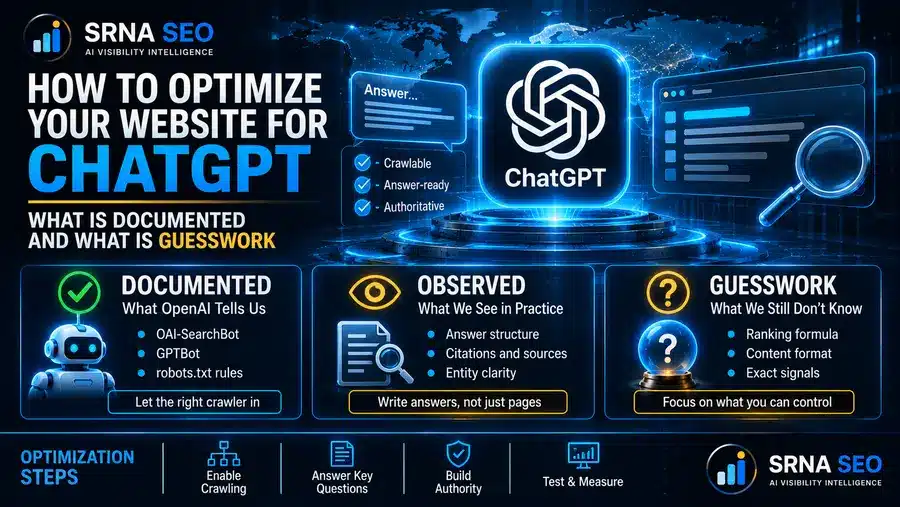
Here is the most important thing to know before you touch a single page. OpenAI does not publish a ranking formula for ChatGPT search, so anything beyond crawler access is either correlation or guesswork. What you can actually control is three things: whether OpenAI’s search crawler can reach you, whether your pages answer specific questions in a form that is easy to retrieve and quote, and whether other sources on the web say you exist. That is what optimizing a website for ChatGPT really means.
What is in This Series
This article is part of cluster How to Measure Your Presence in AI Search Engines, the series hub containing the: How to Optimize Your Website for ChatGPT, How to Measure Your Presence in ChatGPT, How to Optimize Your Website for Perplexity, How to Measure Your Presence in Perplexit, How to Optimize Your Website for Claude, How to Measure Your Presence in Claude.
Also read AI Search Visibility Share of Voice, for turning mentions into a competitive number
What “Optimizing for ChatGPT” Means
Optimizing for ChatGPT is the work of making your site crawlable by OpenAI’s search crawler, easy to retrieve and quote for specific questions, and corroborated by independent third-party sources, so that ChatGPT names or cites you in its answers.
Two terms first. ChatGPT search is the mode where ChatGPT looks up live web sources and shows them as links. GEO (Generative Engine Optimization) is the broader practice of making content retrievable and citable by AI answer engines. ChatGPT is one engine inside that practice, and it behaves differently from Perplexity or Gemini, which is the reason I give it its own article. For the wider engineering view, see The Engineering Definition of GEO.
Step 1: Let the Right Crawler In (This Part Is Documented)
OpenAI’s crawler documentation lists separate bots with separate jobs. This is the only part of the whole topic where I can point to the source itself.
| Bot | What OpenAI says it is for | What it means for you |
|---|---|---|
| OAI-SearchBot | Surfaces websites in ChatGPT’s search features | Block it and you will not appear in ChatGPT search answers, though you can still show up as a plain link |
| GPTBot | Crawls content that may be used to train OpenAI’s foundation models | Disallowing it signals that your content should not be used for training |
| ChatGPT-User | Actions a user starts, such as visiting a page when asked a question | Because the user initiates it, robots.txt rules may not apply |
Two details matter. The settings are independent, so you can allow OAI-SearchBot and disallow GPTBot. And per the same page, search results can take about 24 hours to reflect a robots.txt change.
An example of the split, which you should adapt, not paste:
User-agent: OAI-SearchBot
Allow: /

User-agent: GPTBot
Disallow: /
Search visibility and training permission are two different decisions, and only one of them belongs to the SEO team. Allowing search is a visibility call. Allowing GPTBot is an intellectual property and legal call, and in a big organization it should go through legal, not get decided by whoever edits robots.txt. I covered that side in Everything You Need to Know About AI Intellectual Property.
Also check your firewall and CDN rules. Robots.txt is not the only gate, and one vendor guide (LLM Pulse) recommends confirming nothing blocks the search bot there either. That is a vendor source, so test it on your own setup. For a structured check of crawl and indexation problems, my Indexation and Crawl Diagnostic is the place to start.
Step 2: Write Answers, Not Just Pages
Now we leave documented territory. OpenAI does not publish content format as a citation factor, and the vendor guides say so themselves. What follows is practice, not rule.
- Lead with the answer. Put the direct answer in the first paragraph under each heading, then explain.
- Use question-style headings when they match how buyers actually phrase the question.
- Keep important content in the initial HTML. One guide asserts that many crawlers do not render JavaScript. It gives no source, so treat it as a cheap thing to test, not a fact.
- Define each brand, tool and concept once, early, so an engine cannot confuse you with something else of the same name.
None of this is exotic. It is good writing for a reader in a hurry, which is also what a retrieval system is. I explain the writing side in How to Write a Blog Post for AI SEO and Citations and the structure side in AI Content Structure for Enterprise Visibility.
If you want to see how ChatGPT and other engines currently describe your brand before you change anything, run the AI Visibility Inspector (my diagnostic tool for checking how AI systems see a brand). Fixing pages without a baseline is how people end up claiming credit for noise.
Step 3: Make Your Entity Unambiguous
If an engine cannot tell which “you” a page is about, it will hedge or pick someone else. Same name, different company. Old product name, new product name. A subsidiary that your own site describes three different ways.
So the work is boring and specific: one consistent name and description across your site and profiles, clear author and organization information, and structured data that matches what is visible on the page. I wrote about the failure mode in Entity Ambiguity Resolution and about the framework behind it in the Entity Engineering Framework.
Step 4: Get Mentioned Where You Do Not Control the Page
This is where the data points, and it is the part most “ChatGPT SEO” listicles bury under tactics.
An SE Ranking study, as reported by Search Engine Journal, analyzed 129,000 unique domains and 216,524 pages across 20 niches. These are correlations. The study does not specify the ChatGPT version or timeframe, and SE Ranking sells SEO tools, so read it as a signal and not as proof. Even so, the pattern is hard to ignore:
| Factor | Finding in the study |
|---|---|
| Referring domains | Strongest single predictor. Up to 2,500 referring domains averaged 1.6 to 1.8 citations, over 350,000 averaged 8.4 |
| Domain trust | Below 43 averaged 1.6 citations, 97 to 100 averaged 8.4 |
| Traffic | Under 190,000 monthly visitors averaged 2 to 2.9, over 10 million averaged 8.5 |
| Freshness | Updated within three months averaged 6, outdated pages 3.6 |
| Content length | Under 800 words averaged 3.2, over 2,900 words averaged 5.1 |
| Reddit and Quora presence | Heavy presence on each correlated with 7 citations versus about 1.7 to 1.8 for minimal presence |
| llms.txt | Negligible impact |
| FAQ schema | Associated with fewer citations (3.6 vs 4.2), which the authors suggest reflects the types of pages that use it |
Read that table twice. Most of what correlates with ChatGPT citations is slow authority work, not a page-level trick. Which is unwelcome news if your domain is young or small, because a content tweak will not close a gap measured in tens of thousands of referring domains.
What I would take from it, as an adviser and not as a promise:
- Skip llms.txt as a priority. The study found nothing.
- Do not expect FAQ schema to lift anything. You can still write a real FAQ for readers. Just do not sell it internally as a ChatGPT tactic.
- Update pages that carry time-sensitive facts, and update them for real. A faked “last updated” date helps nobody and will not survive a closer look.
- Do not chase word count. Length correlated, but long and padded is still padded.
- Invest in being named by independent sources (industry publications, review sites, communities where your buyers ask questions). Slow, yes. But it is the lever with the strongest evidence, and a competitor with a deep third-party footprint is hard to out-write.
This also explains why a page can rank well and still lose the AI answer. I explored that gap in Why Good SEO Content Still Fails in AI Search. And classic rankings are not irrelevant: in the same study, pages in positions 1 to 45 averaged 5 citations against 3.1 for pages at 64 to 75.
What Is Documented vs What Is Guesswork
| Tactic | Evidence level | My read |
|---|---|---|
| Allow OAI-SearchBot | Documented by OpenAI | Do first. It is binary |
| Decide GPTBot separately | Documented by OpenAI | A legal call, not an SEO call |
| Answer-first writing, question headings | Vendor practice, no OpenAI statement | Cheap. Do it |
| Key content in initial HTML | Unsourced claim | Cheap. Test it |
| Update time-sensitive pages | Correlation (6 vs 3.6) | Do it, honestly |
| Third-party mentions and referring domains | Strongest correlation | Slow, biggest effect |
| llms.txt | Negligible in study | Skip |
| FAQ schema as a tactic | Associated with fewer citations | Do not expect lift |
This is not a ranking guide, because there is no published ranking to follow. It is not a list of hacks, and anyone offering a guaranteed way into ChatGPT answers is guessing with confidence. It is not a replacement for SEO either (the correlation with Google positions is in the data above). And it is not a one-time project. You change something, then you check whether the answers changed, over repeated runs, not once. For that second half, see How to Measure Your Presence in ChatGPT and my existing piece on tools to optimize and track ChatGPT citations.
Estimated Gain After Implementation
Not enough available data. I know of no study that measured the gain from a defined set of changes, and a number from me would be invented.
What I can say honestly is this. Fixing a crawler block is the only step with a clear before and after, because a blocked search bot means you cannot appear in the search answers at all. Everything else is cumulative and slow, and the evidence points to authority and third-party mentions as the long game. If a consultant gives you a percentage up front, ask for the method behind it.
The Uncomfortable Part
If your competitor has ten times your referring domains, rewriting your pages will not beat them in ChatGPT. It might help at the margin. But the honest plan is a content plan and an authority plan running together, and the authority plan takes quarters, not weeks. Skip that conversation and the budget goes into formatting.
If you want a straight read on where your visibility actually breaks (access, answers, entity or authority), that is the kind of work I do in Enterprise Search Advisory, and you can talk to me here.
FAQ
No ranking formula is published. OpenAI’s documentation covers crawler controls, and everything beyond that is correlation or practice. That is why I split this article into documented and undocumented parts.
OAI-SearchBot, which OpenAI describes as the bot that surfaces websites in ChatGPT’s search features. If you block it, you will not appear in ChatGPT search answers, though you can still appear as a plain link.
GPTBot is separate from search. OpenAI describes it as crawling content that may be used for training, and the settings are independent of OAI-SearchBot. Whether to allow it is an intellectual property and legal decision.
According to OpenAI’s documentation, search results can take about 24 hours to reflect a robots.txt update.
In the SE Ranking study, as reported by Search Engine Journal, llms.txt files showed negligible impact. That is a correlation study, but I would not make it a priority.
The same study associated FAQ schema with fewer citations (3.6 vs 4.2), and the authors suggested that reflects the kinds of pages that use it. Do not expect a lift from it, though a real FAQ is still useful for readers.
Both correlated. Articles over 2,900 words averaged 5.1 citations against 3.2 for those under 800, and pages updated within three months averaged 6 against 3.6. These are correlations, not proof of cause.
No. Not enough available data exists for an honest range. Promise a baseline, a fixed set of changes and a repeated measurement.
Measure repeated runs of a fixed prompt set before and after, and track referral traffic separately. I explain the method in How to Measure Your Presence in ChatGPT.
Where to Go From Here
Start with the AI Visibility Inspector for a first read. When you need ChatGPT tracked over time against competitors, that is what NovaX (my AI Visibility Intelligence Platform) is for. And if you want the access, entity and authority gaps scoped for your market, contact me.
This article was researched and drafted with the assistance of AI tools and reviewed and edited by author prior to publication.
