


Introduction
AI content structure for enterprise visibility is not a copywriting problem. It is an architectural distinction, and most enterprise teams have not yet made it. Over the past several months, I have been systematically analyzing how AI systems interpret enterprise websites. Not how they rank in Google. How they understand the content well enough to extract, cite, and recommend it in AI-generated answers.
What I keep finding surprises most of the senior leaders I work with: strong brands with real authority are consistently invisible to AI systems – not because of poor content, but because of poor structure. Their pages carry substance. They lack interpretability.
To isolate and quantify this, I ran a controlled reconstruction experiment using a real enterprise product page from Ingersoll Rand. The methodology was deliberately disciplined: no new product claims, no expanded information, no brand embellishment. The only variable was architecture – how the existing information was structured and presented.
The results were unambiguous, and they have direct implications for any enterprise team managing product pages, category pages, or solution content at scale.
Why This Matters Now
AI systems such as ChatGPT, Perplexity, and Google AI Overviews do not evaluate content the way traditional search engines do. They interpret, extract, recombine, and recommend – based on how clearly information is structured and defined.
Visibility in AI-driven environments depends on whether intelligent systems understand, trust, and can cite your expertise. What AI models “see” is not what search engines rank, and optimizing for one no longer guarantees inclusion in the other.
This creates a requirement that most enterprise content strategies have not yet addressed: it is no longer enough for content to exist. It must be interpretable.
Structured content improves AI citation rates measurably. Comparison pages with three tables earn roughly 25% more citations from systems like ChatGPT. Validation pages with list sections earn up to 27% more. And around 93% of AI Mode searches now end without a click – meaning the answer is delivered inside the interface, never driving traffic to your page at all.
If your product pages are not structured for AI extraction, they are not just underperforming in traditional search. They are absent from the discovery layer entirely.
The Experiment: Methodology and Controls
This was not a rewrite. It was a reconstruction experiment with a single controlled variable.
I started with a real enterprise product page from Ingersoll Rand – a globally recognized brand with genuine domain authority. I analysed that page using the AI Visibility Inspector to identify structural and interpretive gaps. Then I created a new version of the page in a controlled environment, applying AI visibility principles without introducing any new product information.
The transformation focused exclusively on four structural layers:
Entity Definition Layer: explicit definition of the product entity, with primary topic reinforcement across all sections rather than relying on implicit assumptions.
Structural Layer – a logical H2 hierarchy segmenting the content into clear, navigable blocks: what it is, how it works, features, benefits, applications. This mirrors how AI systems parse and categorize meaning.
Extractability Layer – bullet-point feature breakdowns, structured benefits summaries, a dedicated FAQ section with discrete Q&A pairs, and a Key Takeaways block.
Signal Layer – author attribution, date signals, schema markup, and internal content coherence.
No new product claims entered the page. The transformation focused entirely on how existing information was structured and presented.
Before: The Pattern I See Across Enterprise Websites
The original Ingersoll Rand page followed a pattern I encounter constantly when working with enterprise organizations. The content existed. The product information was present. Some technical signals were in place. But the page lacked what I call interpretive coherence – the structural architecture that allows an AI system to confidently extract meaning.
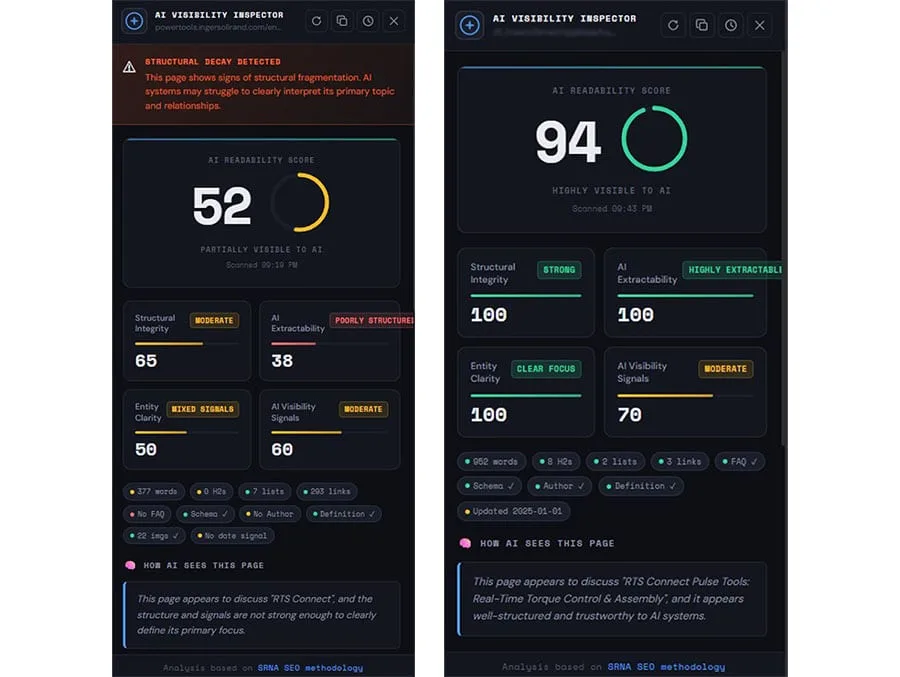
AI Visibility Scores – Before:
| Dimension | Score |
|---|---|
| AI Readability | 52 |
| Structural Integrity | 65 |
| AI Extractability | 38 |
| Entity Clarity | 50 |
| AI Visibility Signals | 60 |
The structural issues behind those scores were identifiable and fixable:
- No H2 hierarchy – content existed in long, undivided blocks
- No summary or conclusion layer
- No FAQ or extractable Q&A structure
- Mixed topical signals within the same content space
- Missing authorship and temporal signals
- No explicit entity definition at the top of the page
When processed by an AI system, the page generated responses like: “This page appears to discuss a product… the primary focus is not clearly defined… key attributes and use cases are not explicitly structured.”
That is not a failure of the AI. It is a reflection of missing interpretive signals. The page was designed for human navigation – browsing, exploration, and visual scanning. It was not designed for structured interpretation, entity definition, or reliable extraction.
This is the gap I see in the vast majority of enterprise content I audit. The structural decay accumulates silently, often invisible to teams measuring performance through traditional traffic and ranking metrics.
This is what invisibility looks like.
After: What Structural Optimization Actually Delivers
The reconstructed page was evaluated using the same scoring framework.
AI Visibility Scores – After:
| Dimension | Before | After | Change |
|---|---|---|---|
| AI Readability | 52 | 94 | +42 |
| Structural Integrity | 65 | 100 | +35 |
| AI Extractability | 38 | 100 | +62 |
| Entity Clarity | 50 | 100 | +50 |
| AI Visibility Signals | 60 | 70 | +10 |
What changed: structure, hierarchy, clarity, signal completeness. What did not change: the product, the core information, the technical substance.
That distinction matters enormously when you bring this to a VP or C-suite conversation. The improvement did not require a content overhaul. It did not require a new editorial strategy or a six-month production cycle. It required architectural intervention in how existing value was presented.
This is consistent with what the data shows at scale. AI systems pull out facts and weave them into answers. To shape those answers and earn citations, content needs to be easy to read, easy to verify, and rich in context. Clear definitions, well-structured FAQs, and properly attributed expertise all help AI systems recognize content as a trustworthy source.
The Two-Layer Model of AI Visibility
The AI Visibility Signals score reached 70, not 100 – and understanding why is as important as understanding the gains.
AI visibility operates across two distinct layers. Most enterprise teams focus on neither of them systematically.
Layer 1: Interpretability (On-Page, Fully Controllable)
This layer includes everything that can be directly controlled within the page:
- Explicit entity definition
- Logical content hierarchy
- Structured sections – H2s, lists, FAQs, summaries
- Schema markup
- Authorship and date signals
These elements determine whether an AI system can understand the content, extract key information, and construct a coherent representation. In this experiment, this layer reached near-maximum scores across all interpretability dimensions. That outcome is replicable. Any enterprise page can be restructured to this standard.
Layer 2: Authority (Off-Page, Ecosystem-Level)
This layer exists outside the page and cannot be replicated in a controlled environment:
- Inbound links from external websites
- Domain-level authority and trust signals
- Search engine crawl and indexation history
- External citations, mentions, and references
These signals influence confidence weighting, selection probability in AI-generated answers, and long-term visibility stability. The gap between 70 and 100 in the AI Visibility Signals score reflects the absence of these ecosystem-level signals in an isolated testing environment.
This makes the result particularly useful for executive conversations. It isolates the maximum achievable impact of content structure alone. And it confirms that structural optimization is the entry point – not the finish line.
The brands most likely to earn durable visibility will be those that stop treating SEO and answer engine optimization as competing models. SEO remains the foundation for being discoverable, crawlable, and authoritative. AEO ensures that same authority can survive the new answer layer, where systems decide which sources deserve to be summarized, cited, and surfaced first.
Without interpretive structure, authority cannot compensate. Without authority signals, structure cannot reach its full potential. Both layers are required.
The Business Cost of Structural Invisibility
I want to be direct about what this means commercially, because the architectural conversation becomes urgent when you attach it to revenue.
The cost of not implementing AI-ready content structure
An enterprise with 500 product or solution pages that score similarly to the original Ingersoll Rand page – around 38 on AI Extractability – is essentially absent from AI-generated answers. In a market where 60% of consumers now start product research with AI assistants, that absence translates directly to pipeline invisibility. Potential buyers receive AI-generated answers that cite competitors. Your pages are indexed. They are simply not interpretable enough to be selected.
In practical terms: if your average deal size is €50,000 and AI-mediated discovery influences 20% of inbound inquiries, structural invisibility is a quantifiable revenue exposure – not an SEO metric.
The gain from implementing it
Structural optimization is not a long-cycle initiative. The transformation applied in this experiment is architectural work that can be executed page by page, prioritized by commercial value. Pages that reach 90+ on AI Extractability become eligible for inclusion in AI-generated responses. They accumulate authority signals faster because they get cited. They convert better because the structure that serves AI extraction also serves human comprehension.
Early movers in this space gain a compounding advantage. Brands that own unique, branded datasets and clearly structured content create sources of truth that AI models cannot synthesize or ignore. The window to establish that position is open now. It will not stay open indefinitely.
I have seen this pattern before – in the early years of mobile optimization, in the first wave of structured data adoption, in the transition to semantic search. Organizations that moved early captured durable positions. Those who waited found the competitive landscape already reshaped.
What Enterprise Teams Should Do Next
This experiment points to a clear sequence of action for organizations managing content at scale.
Start with a structural audit. Before producing any new content, understand what your existing pages score on AI Extractability and Entity Clarity. The AI Search Readiness Audit framework I use with enterprise clients provides a systematic starting point for this assessment.
Prioritize by commercial value. Not every page requires immediate structural transformation. Start with the pages that carry the highest commercial intent – product pages, solution pages, comparison pages, and any content that appears in high-value buyer journeys.
Apply the four-layer transformation model. Entity definition, structural hierarchy, extractability architecture, and signal completeness. These are not independent tasks. They work together to create the interpretive coherence that AI systems require.
Build authority in parallel. Structural optimization makes a page interpretable and eligible. Authority signals determine whether it gets selected. Both tracks need to run simultaneously. This is where authority engineering at the enterprise level becomes a strategic discipline, not a link-building exercise.
Measure the right things. Traditional traffic and ranking metrics will not capture AI visibility performance. You need to track citation rates, AI-generated answer inclusion, and zero-click visibility – how your brand appears in AI responses even when no click occurs.
What AI Visibility Is Not
A point worth making explicitly, because I encounter this confusion regularly in enterprise teams.
AI visibility is not about keyword density. It is not about content volume. It is not about publishing frequency. And it is not a proxy for brand authority.
Ingersoll Rand carries significant brand authority. That authority did not translate into AI interpretability at the page level. They also have a huge base of backlinks and external mentions. That authority also did not translate into AI interpretability at the page level. The original scores reflect this directly – strong domain-level signals, weak page-level structure. Authority is not just about writing more posts. It is building a structured body of content that clearly signals what you do, who you serve, and why you are credible.
The gap is architectural. It is fixable. But it requires treating content structure as infrastructure – with the same rigor and governance that technical SEO receives. I explored this further in my work on entity-based SEO and on weak SEO signals – both of which converge on the same fundamental point: clarity and structure are not aesthetic choices, they are ranking and retrieval factors.
Key Takeaways
- Enterprise websites frequently lack interpretive structure despite carrying strong content and real brand authority.
- AI systems require explicit entity definition, logical hierarchy, and extractable signals to include a page in generated answers.
- Structural changes alone – without adding new information – lifted AI Readability from 52 to 94 and AI Extractability from 38 to 100 in this experiment.
- The gap between content quality and AI visibility is architectural, not informational.
- AI visibility operates on two layers: interpretability (on-page, controllable now) and authority (off-page, built over time). Both are required.
- In a market where the majority of AI Mode searches end without a click, structural invisibility is a measurable revenue exposure.
- Early adopters of AI-ready content architecture gain a compounding visibility advantage that compounds as authority signals accumulate.
Is Your Enterprise Content Structurally Visible to AI?
If this experiment raises a question about your own content portfolio – how your product pages, solution pages, or category pages score on AI Extractability and Entity Clarity – that is worth pursuing systematically, not leaving to assumption.
I work with SEO Managers, Heads of Digital, and C-suite leaders at enterprise organizations to run structured AI visibility diagnostics and build the architectural frameworks that make content consistently interpretable and citable. If that conversation is relevant to your organization.
At this point, the question is not whether structure matters. It’s whether your content is already invisible.
The structural window is open now. The organizations that move first will shape what AI systems cite and recommend for years to come.
Frequently Asked Questions
It means designing the architecture of your web pages – not just the words on them – so that AI systems can parse, extract, and confidently cite the information they contain. In practice, this involves explicit entity definition at the top of the page, a logical H2 hierarchy that segments content into discrete topics, structured elements like bullet lists and FAQ blocks that are extractable as discrete units, and signal completeness through schema markup, authorship attribution, and date signals.
Domain authority and page-level interpretability are separate dimensions. The Ingersoll Rand experiment demonstrates this directly: a recognized global brand with real external authority scored 38 on AI Extractability before structural transformation. Authority signals influence confidence weighting in AI systems, but they cannot compensate for missing interpretive architecture at the page level. AI systems need both layers to function together.
Structural changes take effect as soon as pages are re-crawled and re-indexed. For sites using IndexNow or similar rapid indexing signals, this can happen within hours to days. The more meaningful question is how quickly the changes translate into AI citation inclusion, which depends on the specific AI system’s update cycles and the page’s existing authority signals. Pages with stronger external signals will see faster citation adoption after structural optimization.
Yes, and that is precisely where the commercial impact becomes significant. The four-layer transformation model – entity definition, structural hierarchy, extractability architecture, and signal completeness – can be templated and applied systematically across product families, solution categories, and market verticals. The prioritization should follow commercial value: highest-intent pages first. A structured audit framework identifies where to begin.
The primary cost is pipeline invisibility in AI-mediated discovery. In markets where the majority of early-stage product research now starts with AI assistants, pages that are not interpretable by AI systems are absent from the answers buyers receive. That absence is not visible in traditional traffic metrics – rankings may appear stable while AI citation rates remain at zero. The revenue exposure scales with deal size and the proportion of inbound inquiries influenced by AI-generated discovery.
No. The experiment explicitly tested structural transformation without introducing new information. The same product content, reorganized with proper hierarchy, entity definition, extractable blocks, and signal completeness, produced dramatically higher AI visibility scores. This means the work is architectural rather than editorial – faster to implement, easier to scale, and directly actionable for teams managing large content portfolios without expanding production capacity.
Traditional SEO signals remain important and are not replaced by structural optimization – they form the second layer of AI visibility. The experiment isolates what structural optimization alone can achieve (reaching the upper boundary of interpretability scores) while demonstrating that ecosystem-level authority signals are required for full visibility scoring. Both layers are necessary: structure creates eligibility for AI citation; authority determines selection probability. Neither operates effectively without the other.
