

In This Article
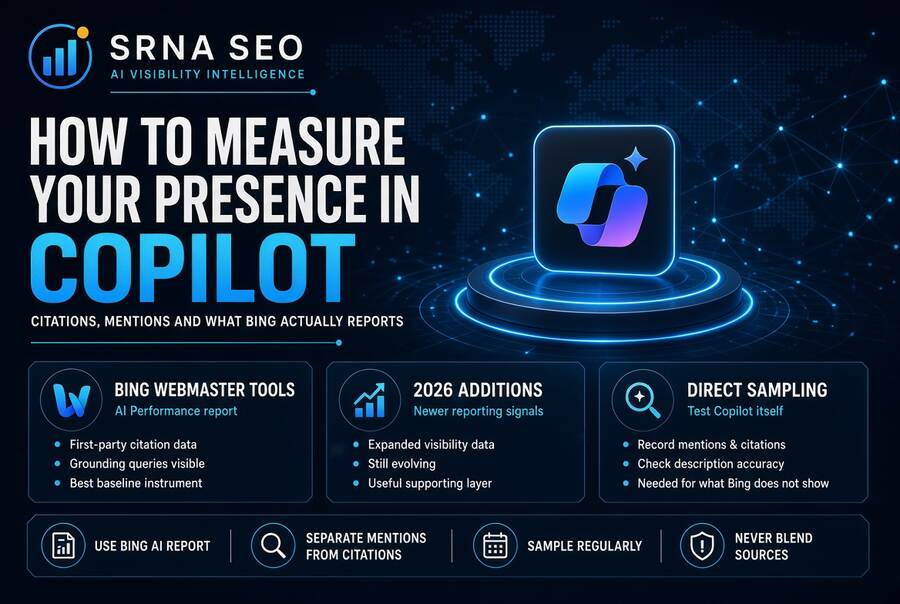
Your Bing Webmaster Tools now shows a citation count for AI answers, and nobody on your team can say what it does and does not mean. Copilot gives site owners a richer first-party report than the other engines I cover in this series: Bing Webmaster Tools reports citations, grounding queries, citation share and topics, but it counts citations only, and Microsoft says it shows neither placement nor ranking. So you read that report for what it is, you sample Copilot yourself for what it leaves out, and you never present either as a window into Microsoft. Measuring your presence in Copilot means using the official report as the backbone, adding repeated sampling for brand mentions and descriptions, and being honest about the gaps.
What is in This Series
This article is part of cluster How to Measure Your Presence in AI Search Engines, the series hub containing the: AI Search Visibility Share of Voice, How to Optimize Your Website for ChatGPT, How to Measure Your Presence in ChatGPT, How to Optimize Your Website for Perplexity, How to Measure Your Presence in Perplexity, How to Optimize Your Website for Claude, How to Measure Your Presence in Claude, How to Optimize Your Website for Gemini, How to Measure Your Presence in Gemini. The optimization half is How to Optimize Your Website for Copilot.
What “Presence in Copilot” Means
Presence in Copilot is how often your pages are cited in Copilot answers, how often your brand is named, and how accurately you are described, each measured separately.
The terms are the same as in the optimization article. Copilot here means Microsoft’s AI experiences that ground answers in web search, mainly Microsoft 365 Copilot and Copilot Chat. Grounding means the model is given retrieved content at the moment it answers. A grounding query is the short search phrase the AI used to retrieve content. A mention is your brand name in the answer text. A citation is a source that names one of your pages.
Microsoft’s web search documentation says Copilot decides when a search would help and sends a generated query of a few words to Bing, not the full prompt. That has a measurement consequence. The queries in your report are not what users typed, and you cannot rebuild their prompts from them.
Which Instrument for Which Question
| Question | First-party source | What it cannot show | What I would do |
|---|---|---|---|
| Are my pages cited in AI answers? | Bing Webmaster Tools, AI Performance | Placement, ranking, importance, and which Copilot | Baseline it, archive exports, read it as a trend |
| What queries triggered retrieval of my pages? | Grounding queries in the same report | It is a sample, not the full set | Use as a content brief, not a census |
| What share of citations do I hold? | Citation Share | Competitor names, traffic, content quality | Read as an observational pattern |
| Does Copilot name my brand and describe it correctly? | None that I found | Everything | Sample prompts and read the answers |
| Did a visit come from Copilot? | Your own analytics | Anything unclicked | Check what actually arrives |
Read the table as a division of labor: Microsoft tells you about citations, and only your own sampling tells you what the answer said about you.
Instrument 1: AI Performance in Bing Webmaster Tools
Microsoft announced AI Performance on 10 February 2026, in public preview, in its launch post. I will stay close to what that post says. The report covers citations across Microsoft Copilot, AI-generated summaries in Bing and “select partner integrations”. Those surfaces are combined, and I did not find a filter in Microsoft’s descriptions that separates them: Not enough available data.
The launch metrics, as Microsoft defines them:
- Total Citations: the number of citations shown as sources in AI-generated answers in the selected time frame. It does not indicate placement within an answer.
- Average Cited Pages: the average number of unique pages from your site shown as sources per day. It does not indicate ranking, authority or a page’s role in an answer.
- Grounding queries: the key phrases the AI used when retrieving content it referenced. Microsoft says the data is “a sample of overall citation activity”.
- Page-level citation activity: citation counts for individual URLs. Microsoft says it reflects how often pages are cited, “not page importance, ranking, or placement”.
- Visibility trends over time: a timeline of citation activity across supported AI experiences.
What the launch post does not say, which matters for how you present it: it does not say whether the report shows clicks or full prompts, it gives no refresh schedule or lag, and it mentions no prerequisites. I would assume your site must be added to Bing Webmaster Tools to see it, because that is where the report lives, but that is my assumption, not Microsoft’s statement.
A citation count tells you that you were used as a source, and Microsoft’s own wording says that is not the same as being important.
Instrument 2: The Additions From 2026
Microsoft added more in a June 2026 post on new AI visibility insights. All four features are in preview and rolling out globally, and the post does not say whether every site has access yet.
- Intents classify grounding queries into categories such as Informational, Commercial, Navigational, Learn and Solve, Research, Creation and Local.
- Topics group related grounding queries into thematic clusters.
- Citation Share is your percentage of all citations shown for a specific grounding query, across every site. Microsoft calls it observational, not a ranking or competitor scoreboard, and says it does not reveal competitor domains, traffic share or content quality scores.
- Compare overlays a previous period on the current one, for example the last 30 days against the 30 before.
The limits, per Microsoft: Intents and Topics rely on an evolving AI and machine-learning classification and may be broad in preview. Citation Share and Compare show patterns, not causes, and Microsoft lists model updates, competing content, freshness, partner refresh cycles and demand shifts as possible drivers.
In October 2026, Microsoft announced a beta called Topics Portfolio. It sorts your grounding queries into larger subject areas and shows three approximate measures per topic: total citations across all sites (demand), how many sites are cited (competition) and how many queries fall under the topic. It also lists “opportunity” queries, where other sites are cited and yours is not, with volumes shown as ranges.
Read it with its own caveats. It appears only when your site has enough data, so smaller sites may see few topics or none. Classifications can be imperfect, some topics are hidden because of low activity, and branded queries can show up as opportunities. Microsoft describes the figures as directional, not exact.
So here is how I would use all of it:
- Archive your own exports every week, so your history does not depend on a preview interface that may change.
- Track it as its own series, never merged with Search Console or standard Bing organic data.
- Look at pages and topics, not only the total.
- Pair every swing with your change log: what you published, updated, blocked or re-submitted. The report cannot tell you why.
- Treat Opportunity queries as a content brief, after removing branded queries.
If your citations fall to nothing on every page at once, check the basics before anything else: crawl access, noindex and your grounding preference. I explained why in the optimization article.
For the wider shift in what visibility means when answers replace clicks, see Zero-Click Visibility and Zero-Click Synthesis and AI Answer Attribution.
Instrument 3: Sampling Copilot Itself
AI Performance counts citations. It does not tell you what Copilot said about your brand, whether the description was right, or which competitors were named. For that, you sample.
Set it up like this:
- Build a non-branded prompt set from buyer questions. Keep branded prompts in a separate list, because they mostly show that your name is known.
- Freeze and version it. Silent edits break the trend line.
- Fix the conditions you can control: the same Copilot experience, the same account type, the same language and country, and write them down. Microsoft’s FAQ says Copilot has several experiences and a Web content setting that users can turn off, so check it is on.
- Run each prompt several times per cycle. My working range is three to five, which is my judgment and not a standard.
- Record for every answer: whether sources were shown, your URL among them, brand named, how you were described, competitors named and which sources they got. Keep the full text.
- Read the answers. A mention that gets your product wrong is a problem, not a win, and I wrote about that risk in LLM Hallucination and Content Risk.
One practical detail from Microsoft’s documentation: in Copilot Chat, the exact search queries sent to Bing appear in the linked citation section of a response, but only in Copilot Chat and only for 24 hours. Per Microsoft, they do not appear in the Copilot panes inside Microsoft 365 apps. If you run your own sampling in Copilot Chat, capture those queries the same day. They are the best view you get of what Copilot actually searched for.
I could not find a public Copilot API that returns citations the way some other engines do, so I will not claim one: Not enough available data. If you need a quick first read without building anything, the AI Visibility Inspector (my diagnostic tool for checking how AI systems see a brand) is the fastest start, and there is a guide to using it here.
Measuring Traffic and Logs
Here I have less than I would like, and I would rather say so. I did not find Microsoft documentation on how visits from Copilot are labeled in your analytics or what referrer they carry: Not enough available data. Look at your own analytics for what actually arrives, write down the exact source and medium values you see, and build a custom channel only after that. Assume undercounting, and remember that analytics sees clicks only, so every answer that names you without a link is invisible there. I explained why this part of the funnel stays dark in The AI Dark Funnel, and how to handle attribution honestly in AI Visibility Is Breaking Revenue Attribution.
Do not use Copilot referral traffic as your presence metric, because it counts only the people who clicked.
Server logs show crawling, not citing. A Bingbot visit tells you Bing fetched a page. It does not tell you the page was used in an AI answer. Use logs to confirm that Bing is reaching your key pages and how quickly it returns after an update or an IndexNow ping. Microsoft’s October 2026 post says IndexNow can prompt a recrawl, with no guarantee, so logs are where you check whether it did.
The Numbers I Would Track
| Number | Source | What it answers | The trap |
|---|---|---|---|
| Total citations and cited pages | AI Performance | Is Bing’s AI surface using my pages? | Combined surfaces. No placement |
| Citation Share by grounding query | AI Performance | Of the citations for this query, what share is mine? | Observational. Not a ranking |
| Topic and opportunity queries | Topics Portfolio | Where are others cited and I am not? | Branded queries show up as opportunities |
| Mention rate | Copilot sampling, non-branded prompts | Does Copilot know me in this category? | Branded prompts inflate it |
| Description accuracy | Copilot sampling | Does it say the right thing about me? | A mention can be wrong |
| Share of voice | Mention counts plus competitors | Who owns the category answer? | Moves with the competitor set |
Share of voice follows from the mention counts, and I explain how to build it in AI Search Visibility Share of Voice. For how fast mentions change, see AI Mention Velocity. For my own write-up on Bing and refreshed older pages, see Bing AI Citations Case Study: Legacy Page Refresh.
Where to Stop Doing It by Hand
Count it plainly. 40 prompts, five runs, is 200 answers per cycle, and someone has to read them and log the sources. That is why I built tooling. For ongoing tracking with repeated runs and competitors, NovaX (my AI Visibility Intelligence Platform) covers Copilot among the five engines in this series. I built it, so judge me accordingly, and compare it with others in Best AI Visibility Tools. If you would rather have a baseline set up and read by someone who has worked inside enterprise teams, see Enterprise Search Advisory or get in touch.
What This Is NOT
This is not a ranking check. Microsoft says its report does not show ranking or placement. It is not a traffic report, since most presence never becomes a visit. It does not prove your changes caused your results, only that two things happened in sequence (see Why SEO Tools Cannot Audit AI Visibility). It is not a one-off audit, because one run on one day is a screenshot. And it is not a complete view. Grounding queries are a sample, and the report is still in preview.
Mistakes I Would Check For First
- Reading citations as importance. Microsoft says the metric does not mean that.
- Treating grounding queries as user prompts. They are short generated queries.
- Treating Citation Share as a competitor ranking. Microsoft says it is not one.
- Counting branded opportunity queries as real gaps.
- Blending AI Performance with Search Console or organic data. Different sources, different definitions.
- Trusting a preview report as a fixed record. Archive your own exports.
- One run per prompt. Variation looks like growth.
- Tracking only Copilot. Strong here says nothing about the other four engines.
Estimated Gain After Implementation
Measurement does not raise your presence. It shows you which pages are cited, which queries and topics you are missing from and which answers describe you badly. Any gain comes from the fixes afterwards, and for those I have no honest cross-company range: Not enough available data. Expect the first reliable read after a baseline and several repeated cycles. Before that, treat any swing, up or down, with suspicion.
The Uncomfortable Part
A citation report from the search engine itself is the best data in this whole series, and it still cannot tell you what the answer said about you. That should make you humble about every dashboard, including mine. The honest report to an executive has three parts: the official citation trend with its definitions attached, a sampled view of Copilot answers with its method attached, and a plain sentence saying that Microsoft shows a sample of grounding queries and no placement.
Where to Go From Here?
Begin with the AI Visibility Inspector for a first read. When you need Copilot tracked over time against named competitors, NovaX does that. And if you want it scoped for your market, contact me.
FAQ
How often your pages are cited in Copilot answers, how often your brand is named, and how accurately you are described, each measured separately.
Yes. AI Performance in Bing Webmaster Tools, announced in public preview on 10 February 2026, covers citations across Microsoft Copilot, AI-generated summaries in Bing and select partner integrations.
Per Microsoft, citation counts do not indicate placement, ranking or importance, and grounding queries are a sample. The launch post does not say whether clicks or full prompts are shown, and gives no refresh schedule: Not enough available data.
Your share of all citations shown for a specific grounding query, across every site. Microsoft calls it observational, not a ranking, and says it does not reveal competitor domains.
The short key phrase the AI used when retrieving content. Microsoft says Copilot sends a generated query of a few words to Bing, not the full prompt.
Not from Microsoft’s report that I could find. Sampling Copilot yourself is the only route, with the method written down.
In Copilot Chat, Microsoft says they appear in the linked citation section of a response for 24 hours. They do not appear in the Copilot panes inside Microsoft 365 apps.
No. Promise a baseline, a locked method, repeated runs and a clear cadence, and report gains with the method attached.
This article was researched and drafted with the assistance of AI tools and reviewed and edited by author prior to publication.
