

In This Article
Someone on your team screenshots ChatGPT recommending your brand, and a week later someone else screenshots it recommending a competitor. Both screenshots are real.
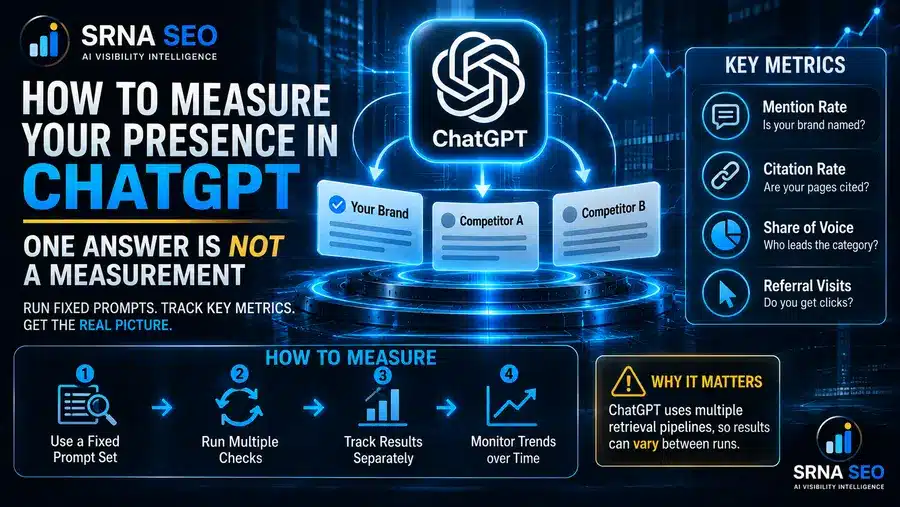
That is the measurement problem in one sentence. A single ChatGPT answer is not a measurement, because the same prompt can return different brands and different sources from one run to the next. Measuring your presence in ChatGPT means running a fixed set of prompts repeatedly, counting mentions and citations separately, and keeping clicks from ChatGPT in a different bucket.
What is in This Series
This article is part of cluster How to Measure Your Presence in AI Search Engines, the series hub containing the: How to Optimize Your Website for ChatGPT, How to Measure Your Presence in ChatGPT, How to Optimize Your Website for Perplexity, How to Measure Your Presence in Perplexit, How to Optimize Your Website for Claude, How to Measure Your Presence in Claude.
Also read AI Search Visibility Share of Voice, for turning mentions into a competitive number
What “Presence in ChatGPT” Means
Presence in ChatGPT is how often your brand is named in ChatGPT’s answers, how often your pages are cited as sources, and how prominently you appear, measured over repeated runs of a fixed prompt set, plus the traffic that ChatGPT links send you.
Three terms I use throughout:
- Mention: your brand name appears in the answer text.
- Citation: your URL appears as a source for the answer.
- Referral: a visit that arrived through a ChatGPT link.
These happen independently. A brand can be recommended without any link, and a page can be cited without the brand being named. (LLM Pulse, a vendor that sells tracking, makes the same point, so weigh the source, but the distinction is simply correct.) Which is why I never merge them into one score.
I know of no first-party ChatGPT report that shows brand-level citations to site owners, unlike the Bing Webmaster Tools report for Copilot. If you find one, tell me. Until then, you have two imperfect instruments: sampling the answers, and reading your analytics.
Why One Check Misleads: The Routing Problem
Here is the finding that matters most for how you sample. According to PinMeTo’s write-up of two researchers’ separate work (a secondary account, so read the originals before quoting numbers externally), ChatGPT’s web search uses at least four backend retrieval pipelines.
In SEO researcher Chris Green’s test, 1,000 prompts were repeated up to ten times for 9,946 completed runs. One pipeline handled 88.1% of primary sources, and the other three handled 9.9%, 1.7% and 0.3%. For 88.4% of prompts the primary source stayed the same across repeats. For the other 11.6% it switched, and when it did, URL overlap fell by about 45% and domain overlap by about 42%.
Do the plain reading. Roughly one prompt in nine can return a noticeably different set of citable pages with no change on your site. If your tool or your intern samples each prompt once, part of the “trend” is routing noise. The same write-up reports that some sources were fetched often but rarely cited, so being retrieved does not mean being cited.
The Four Numbers I Would Track
| Number | How to calculate it | What it answers | The trap |
|---|---|---|---|
| Mention rate | Answers naming your brand ÷ total answers, on non-branded prompts | Does ChatGPT know you in this category? | Branded prompts inflate it badly |
| Citation rate | Answers citing your domain ÷ total answers | Does ChatGPT use your content as a source? | Ignores third-party pages that mention you |
| Share of voice | Your mentions ÷ your mentions plus named competitors’ mentions | Who owns the category answer? | Changes with the competitor set you pick |
| Referral visits | Sessions from ChatGPT in analytics | Does any of it send people to you? | Clicks only. Unlinked mentions are invisible |
LLM Pulse also describes a position-weighted version that credits earlier mentions more (its example weights the first mention fully, the second at half and the third at about a third). That is one vendor’s convention, not a standard, so if you use weights, write them down. For the competitive side of this, see AI Search Visibility Share of Voice.
How to Set Up the Sampling
- Build a non-branded prompt set from buyer questions. Category, comparison and problem-aware prompts. Keep branded prompts in a separate list, because they mostly prove that your name is known.
- Freeze it and version it. LLM Pulse’s advice, which I share: changing prompts breaks the trend line.
- Use clean sessions with the country and language set, and log the date and the full answer text.
- Run each prompt several times. Sources differ on how many. Averi’s guide says at least three runs, while LLM Pulse says at least five for manual checks. Given the routing result above, I would use five for ChatGPT. That is my judgment, not a standard.
- Record which answers carried visible sources, and whether the brand was named, cited, both or neither.
- Read the actual answers. Not only the counts. A mention with wrong facts is a problem, not a win.
The arithmetic is worth seeing. LLM Pulse notes that 30 prompts run weekly give about 30 observations per model, so one answer moves a single model’s rate by about 3.3 points. My own sum for ChatGPT alone: 30 prompts run five times each is 150 answers per cycle, and then one answer moves the rate by about 0.7 points. That is why repeated runs matter. With one run each, a 3-point swing is one answer changing its mind.
Manual works for a first look. It is a poor way to keep a trend, as the same source says. Forty prompts at five runs is 200 answers per cycle, every cycle, and someone has to read them.
Measuring Traffic From ChatGPT
Clicks are the smaller, but the cleaner, half of the picture.
- The UTM parameter. LLM Pulse reports that ChatGPT appends
utm_source=chatgpt.comto links in its answers, and OpenAI’s own publishers and developers FAQ is, per its page title and quoted text in search results, where that statement originates. - A custom channel in GA4. One guide (SEOworks) sets up a channel where Session source partially matches a pattern of AI assistant names (chatgpt, openai, claude, copilot, gemini, perplexity and others). It says data can take 24 to 48 hours to appear as a separate channel.
- The default channel. GA4’s own AI Assistant channel matches on a medium of “ai-assistant” or on Google’s list of AI assistant referrers, according to LLM Pulse. Visits from Google AI Overviews and AI Mode count as Organic Search, not here.
Now the limits, because they are big. Many AI clicks arrive with no referrer. The SEOworks guide attributes this to new-tab opens, in-app browsers, the mobile app and some integrations, and says those visits can land as (not set), so totals are probably understated. Analytics also captures only clicks, so every recommendation without a link is invisible there. I wrote about why this part of the funnel stays dark in The AI Dark Funnel, and about attribution in AI Visibility Is Breaking Revenue Attribution.
Do not use ChatGPT referral traffic as your presence metric, because it measures the people who clicked, not the answers that never sent anyone anywhere.
One More Signal: Your Server Logs
OpenAI’s documentation describes ChatGPT-User as the agent for actions a user starts, such as visiting a page when asked a question. My inference, not a documented use: hits from that agent in your logs may show which pages get fetched live for users. It will not tell you the prompt, and it will not tell you whether you were cited (remember, fetched often does not mean cited). Treat it as a hint to investigate, nothing more.
Where to Start Without Building a Spreadsheet Factory?
If you want a quick first read of how AI systems currently describe your brand, run the AI Visibility Inspector (my diagnostic tool for checking how AI systems see a brand). The guide to using it is here.
For tracking ChatGPT over time with repeated runs and competitors, NovaX (my AI Visibility Intelligence Platform) covers ChatGPT among the five engines in this series. I built it, so judge me accordingly, and compare it with the alternatives in Best AI Visibility Tools and in my piece on tools to optimize and track ChatGPT citations. If you would rather have a baseline set up and read by someone who has worked inside enterprise teams, see Enterprise Search Advisory or get in touch.
This is not a ranking check. ChatGPT has no stable “position one” to track. It is not a traffic report, since most presence never becomes a visit. It does not prove that your content changes caused your results, only that two things happened in sequence (I explained the measurement side of that in Why SEO Tools Cannot Audit AI Visibility). And it is not a one-off audit. A single run on a single day is a screenshot.
Mistakes I Would Check For First
- One run per prompt. Routing alone can move results between runs.
- Branded prompts in the headline number. They inflate mention rate.
- Merging mentions and citations. Different events, different fixes.
- Changing the prompt list quietly. The trend line breaks and nobody notices.
- Reading referral visits as presence. Clicks are a small, partial slice.
- Never reading the answers. Counts hide wrong facts and bad framing.
- Tracking only ChatGPT. Strong here says nothing about the other four engines.
Estimated Gain After Implementation
Measurement does not raise your presence. It shows where you are missing, and which prompts and sources a competitor holds instead. Any gain comes from the fixes you make afterwards, and for those I have no honest cross-company range: Not enough available data. Expect the first reliable read after a baseline and several repeated cycles. Before that, treat any swing, up or down, with suspicion.
The Uncomfortable Part
A dashboard line that moves is not evidence of anything until you know how many runs sit behind each point. Ask your vendor, or your team, that one question. If the answer is “one”, you are looking at routing noise with a title on it.
FAQ
How often your brand is named, how often your pages are cited and how prominently you appear, measured over repeated runs of a fixed prompt set, plus the referral traffic ChatGPT sends. I track mentions and citations separately.
Because the same prompt can return different sources. In one reported test, about 11.6% of prompts switched their primary source between runs, and URL overlap fell by roughly 45% when that happened. That is a secondary account of the research, so check the originals.
Sources differ: at least three in one guide, at least five in another. Given the routing result, I would use five for ChatGPT, but that is my judgment, not a standard.
Keep them in a separate list. Branded prompts mostly show that your name is recognized and inflate the mention rate if mixed in.
Per the sources I used, ChatGPT appends utm_source=chatgpt.com to links, and you can build a custom channel matching AI assistant source names. Totals are probably understated because some clicks arrive with no referrer. Verify the parameter against OpenAI’s documentation.
No. Analytics captures only clicks, so a recommendation with no link does not appear. That is why prompt sampling is the other half of the measurement.
I know of none that shows brand-level citations to site owners. If one exists, I have not found it: Not enough available data.
No. Promise a baseline, a fixed prompt set, repeated runs and a clear cadence. Report gains with the method attached.
This article was researched and drafted with the assistance of AI tools and reviewed and edited by author prior to publication.
