

In This Article
You follow the usual best practices, your blog posts get read by people, and AI answers still quote somebody else.
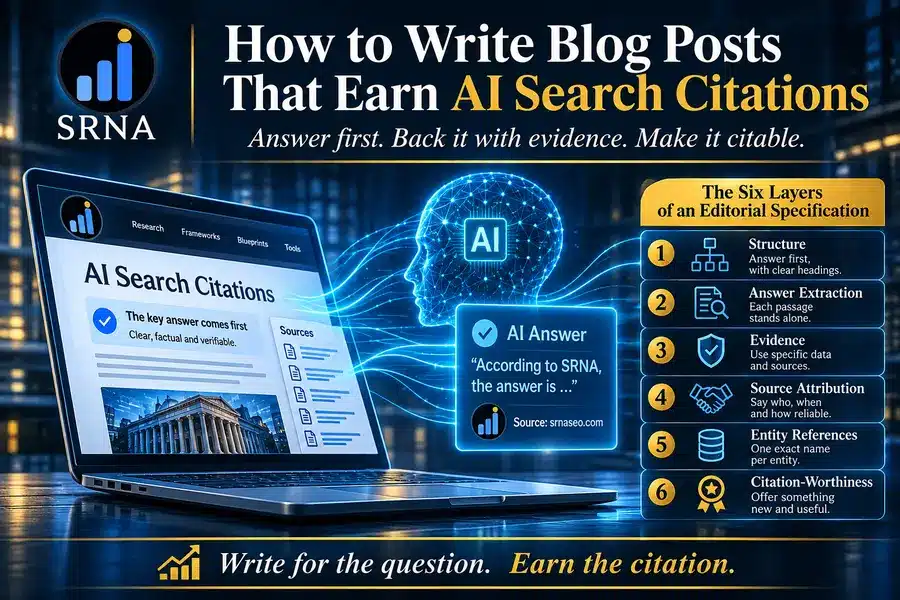
To write a blog post for AI SEO and citations, build it like an engineered document: the answer comes first, each passage carries one claim, every claim has a named source, every entity has one exact name, and every section can be quoted alone. That is what earns AI search visibility and citations. The rest of this article is the specification, with the evidence behind each rule and the limits of that evidence.
I have 25 years in SEO and 7 inside global enterprises, and I will say it plainly: most blog posts are written to be read from top to bottom. AI systems do not read that way. They retrieve one passage, check whether it is safe to quote, and move on.
What writing for AI search visibility and citations means
An AI citation (a link or named reference that an AI answer gives to your page as a source) happens when a system finds your page, lifts one passage, and attributes it to you. Writing for AI search visibility and citations means producing posts where that passage is easy to find, easy to extract, and easy to trust.
It is not a separate discipline from SEO. It sits on top of it. But the unit changes. Classic SEO optimizes the page. This work optimizes the passage.
Microsoft describes how the matching happens in Bing Webmaster Tools. Its AI Performance report shows where your content is cited in AI answers across Copilot, Bing and select partner experiences, grouped by grounding queries (the queries an AI system runs to retrieve content). So a single post can be cited for several different questions. That is why one clear post that covers a topic fully beats four thin posts that each chase one phrasing.
You do not write for a keyword. You write for the question a system is trying to answer, and for the passage that answers it.
The six layers of an editorial specification
I treat this as editorial engineering, so each layer has a rule and a test.
| Layer | Rule | Test before publishing |
|---|---|---|
| 1. Structure | Answer first, headings that state a question or claim | Read only the H2s. Do they tell the story? |
| 2. Answer extraction | Each passage stands alone | Paste one section into a blank file. Does it still make sense? |
| 3. Evidence | Specific numbers, quotations, named sources | Can a stranger check each claim in two minutes? |
| 4. Source attribution | Say who found it, when, and how strong it is | Does each outside claim name its source and its limit? |
| 5. Entity references | One exact name per entity, defined once | Is any entity called two different things? |
| 6. Citation-worthiness | Something new, specific and safe to quote | Would a careful editor quote this sentence? |
1. Structure: the top of the page does most of the work
Kevin Indig’s study, published in Search Engine Journal in February 2026 with Gauge data, analyzed 18,012 verified ChatGPT citations. 44.2% came from the first 30% of the page, 31.1% from the middle and 24.7% from the last third. A smaller CXL analysis of 100 Google AI Overview citations found 55% of cited passages in the first 30%. Both are correlation. The Indig study covers ChatGPT only, and the CXL sample is small, so treat the exact figures loosely. The direction is consistent.
So put the answer in the first paragraph, and make the headings carry meaning. “How do I fix entity conflicts?” tells a system what the section answers. “Overview” tells it nothing. For the heading logic I use at scale, see my Section Hierarchy Developer Blueprint and AI Content Structure for Enterprise Visibility.
2. Answer extraction: write passages that survive being copied out
In the same Indig study, 36.2% of cited text used definitive language (“is defined as”, “refers to”) against 20.2% of uncited text. And 78.4% of cited text that involved questions came from headings. Those are patterns, not formulas, but they match how retrieval works: a clear definition is easy to lift.
My rule is blunt. If a section says “this system” or “the platform” and you cannot tell which one without the paragraph above it, rewrite it. Name the thing every time. It reads a little repetitive to a human and perfectly clear to a machine. Keep paragraphs to 2 to 4 sentences (a practitioner recommendation from AirOps, not a measured result). How retrieval works at passage level is covered in my AI Retrieval Optimization Framework.
3. Evidence: this is where the research is strongest
The best controlled evidence I know is the “GEO: Generative Engine Optimization” paper (Aggarwal and colleagues, KDD 2024). It tested nine content methods on a 10,000-query benchmark. Three methods, Cite Sources, Quotation Addition and Statistics Addition, improved visibility by roughly 30 to 40% on the paper’s position-adjusted word count measure. Keyword stuffing gave little or no improvement, and on Perplexity.ai it performed worse than the baseline.
One result matters for sites like mine, which is about 3 years old with low domain authority. Cite Sources raised visibility by 115.1% for fifth-ranked sources and lowered it by 30.3% for top-ranked ones. Lower-ranked pages gained most from evidence.
Now the limits, because they matter. The authors tested only two engines, one of them a research setup built on gpt-3.5-turbo. The scoring partly relied on a model-based evaluator. And the paper did not measure traditional rankings. So this is lab evidence of direction, not a forecast for your traffic.
Field data points the same way. SE Ranking figures cited by HubSpot, across 216,524 pages, show content quoting experts averaged 4.1 ChatGPT citations against 2.4, and pages with 19 or more data points averaged 5.4 against 2.8. Correlation again.
My own illustration of what evidence looks like: “near 5x revenue growth and 110M€ turnover at Portugal Homes” can be quoted. “A leading provider of innovative solutions” cannot, because nobody can check it. Replace every adjective you cannot prove. Where you have no number, write “Not enough available data” and move on.
4. Source attribution: show the work
Attribution is the layer most posts skip. A system that wants to quote you needs to know that your claim is yours, or whose it is, and how strong it is. So for every outside claim, I name four things: who found it, when, how large the sample was, and the limit. Here is the ledger I keep while drafting. It is my own working method, not an industry standard.
| Claim | Source and year | Type | How I write it |
|---|---|---|---|
| 44.2% of ChatGPT citations come from the first 30% | Indig, Search Engine Journal, 2026 | Third-party study | Name, year, sample, “ChatGPT only” |
| Cite Sources improves visibility | Aggarwal et al., KDD 2024 | Academic, two engines | Name the limit |
| 85% of early-stage brand mentions come from third parties | AirOps research | Vendor | Say “vendor figure” |
| Near 5x revenue growth at Portugal Homes | My own record | First-hand experience | Say it is mine |
| A claim with no source | None | Unverified | “Not enough available data” |
This also protects you. If a model invents a detail and your post repeats it, the error has your name on it. I cover that risk in LLM Hallucination Content Risk.
Not sure which of your existing posts an AI system can read, extract and quote?
My AI Visibility Inspector (my diagnostic for how AI systems see a website) shows the gaps page by page. If you are an SEO Manager or Head of Digital who has to explain it to a CMO, talk to me.
5. Entity references: one name, defined once
Name every company, tool, framework and person exactly, define each on first use in a short parenthetical, and use the same name afterwards. If a post says “the Inspector” in one paragraph and “our visibility tool” in the next, a system has to guess whether that is one thing or two.
The Indig data showed heavily cited text reached 20.6% entity density, against roughly 5 to 8% for normal English. Do not read that as a target. Entity density (the share of words that name a specific person, company, product or place) is a result of writing specifically. Stuffing names into a post to reach a number produces a directory, and the GEO paper’s keyword stuffing result says the same thing about forcing signals. The wider picture of how names connect across the web is in my AI Citation Engineering article and in How to Gain Credibility on Search Engines for Humans and AI.
6. Citation-worthiness: would an editor quote this?
This is my own test, not a published metric. For each key sentence, ask five questions. Is it new, or does it repeat what ten other posts say? Is it specific, with a number, a name or a condition? Can someone check it? Does it say whose view it is? Is it safe to quote with nothing around it?
A sentence that fails two or more of those is filler. Cut it or fix it. I come back to why well-ranked content often fails this test in Why Good SEO Content Still Fails in AI Search.
Best practices for blog posts for AI SEO and citations: the pre-publish checklist
- The post answers one buyer question, stated in one sentence.
- The answer appears in the first paragraph, in definition style.
- Every H2 states a question or a claim.
- Each section works when pasted alone, with no vague referents.
- Each key claim has a number, a name or a condition.
- Each outside claim names its source, year and limit.
- Every entity has one exact name and a first-use definition.
- The FAQ answers use only claims already made in the post.
- Related posts are linked in the text, not in a footer list.
- A named author with a real role stands behind it.
How to measure whether a post earns citations
Do not judge a post by one AI answer on one day. Use Bing Webmaster Tools. Its AI Performance report now includes Citation Share, which is your site’s citations divided by total citations for the same grounding query. Microsoft calls it an observational metric, not a ranking system or a competitive scoreboard, and warns that changes over time can come from model updates, competing content, freshness and partner refresh cycles. So you cannot assign a movement to one edit with confidence.
Pair it with your own baseline: 20 to 30 buyer questions, checked monthly in more than one AI engine, same method each time. I documented one example of this kind of tracking in my Bing AI citations case study on refreshing a legacy page, and I compare tracking options in Best Tool to Optimize and Track ChatGPT Citations. Being cited is also not the same as being clicked, which I look at in Zero-Click Synthesis and AI Answer Attribution.
What this is NOT
This is not publishing AI-written posts at scale. Models invent details, and a confident wrong claim is the worst thing to have quoted under your name.
It is not keyword stuffing or entity stuffing. The GEO paper found keyword stuffing gave little or no improvement.
It is not formatting alone. Clean headings help, but structure on empty content gives a system nothing to cite.
And it is not a guarantee. Microsoft itself says citation activity shifts for many reasons, and gives no prescriptive optimization steps. Anyone promising a citation is selling a story.
A post with no checkable claim has nothing for an AI system to cite. Rewriting the headings will not fix that.
What gain to expect
The GEO paper’s “up to 40%” is a relative visibility gain on a benchmark with two test engines, so please do not read it as a traffic forecast. On timing, one industry guide suggests roughly 4 to 8 weeks between changes and appearing in AI answers. That is a single source, so treat it as rough. A post that already answers a real question will move faster than one that needs a full rewrite.
Want your content program rebuilt to this specification, with your own numbers?
My Enterprise Search Advisory starts with a diagnostic and ends with a plan your content, legal and SEO teams can all sign. Book a conversation.
FAQ
Answer the question in the first paragraph, use headings that state a question or a claim, write passages that make sense alone, name every source, and give every entity one exact name.
Evidence suggests it does. The GEO paper (KDD 2024) found Cite Sources, Quotation Addition and Statistics Addition improved visibility by roughly 30 to 40% on its measure, though it tested only two engines.
No. The same paper found keyword stuffing gave little or no improvement, and on Perplexity.ai it performed worse than the baseline.
At the top. Indig’s study of 18,012 ChatGPT citations found 44.2% came from the first 30% of the page, and a smaller CXL analysis found 55% for AI Overviews.
In the GEO paper, Cite Sources raised visibility by 115.1% for fifth-ranked sources and lowered it by 30.3% for top-ranked ones. It is lab evidence from two engines, so treat it as direction.
Name who found it, the year, the sample size and the limit. Mark your own experience as your own. If you have no source, write “Not enough available data”.
Use the AI Performance report in Bing Webmaster Tools, including Citation Share, and add a fixed set of 20 to 30 buyer questions checked monthly across more than one AI engine. Microsoft notes changes cannot be tied to a single cause.
Not enough available data for a firm answer. One guide suggests roughly 4 to 8 weeks, but it is a single source.
Next step
If you can only do one thing this week, take your three most important posts and run the claim ledger on them: list every claim, its source and its limit. Then rewrite the first paragraph so a stranger could quote it. For a second pair of eyes from someone who has done this inside global enterprises, start with a Search Visibility Diagnostic or contact me directly.
This article was researched and drafted with the assistance of AI tools and reviewed and edited by author prior to publication.
