

In This Article
You ask Claude about your category, your brand is in the answer, and nobody on your team can tell you whether that came from a live search or from memory.
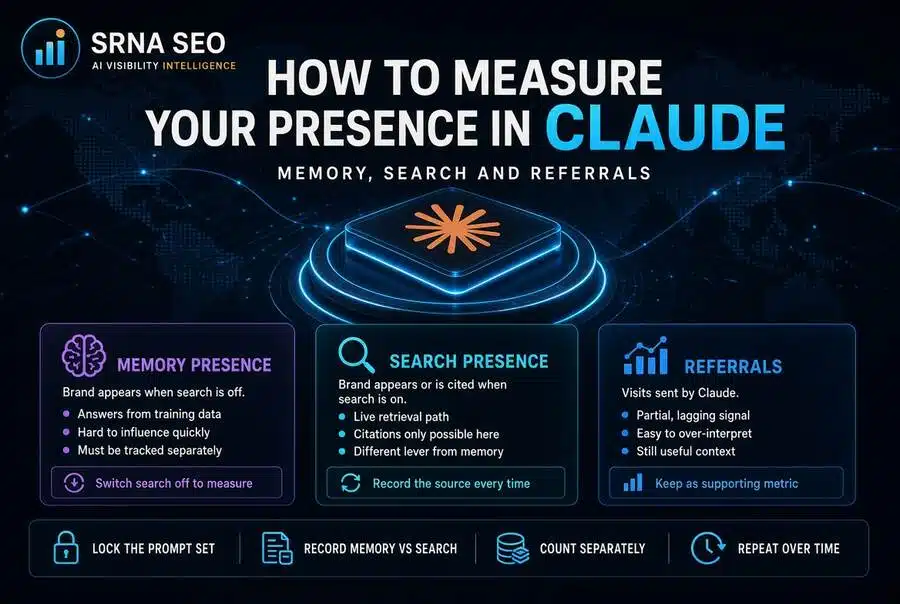
That is the measurement problem unique to Claude. Claude answers from two different sources, its training memory and live web search, so before you count a single mention you have to split every answer by which source produced it. Mix them and you get a visibility number that means nothing, because the fix for a memory problem and the fix for a search problem have almost nothing in common. Measuring your presence in Claude means running a fixed prompt set repeatedly, recording whether each answer used search, and keeping memory presence, search presence and referral traffic as separate numbers. This is the measurement half of a pair.
What is in This Series
This article is part of cluster How to Measure Your Presence in AI Search Engines, the series hub containing the: How to Optimize Your Website for ChatGPT, How to Measure Your Presence in ChatGPT, How to Optimize Your Website for Perplexity, How to Measure Your Presence in Perplexit, How to Optimize Your Website for Claude, How to Measure Your Presence in Claude.
Also read AI Search Visibility Share of Voice, for turning mentions into a competitive number
What “Presence in Claude” Means
Presence in Claude is how often your brand is named in Claude’s answers, how often your pages are cited as sources, and how those answers were produced (from memory or from search), measured over repeated runs of a fixed prompt set, plus any visits Claude sends you.
Four terms I use throughout:
- Mention: your brand name appears in the answer text.
- Citation: one of your pages is named as a source for the answer. Only possible when Claude searched or fetched.
- Memory presence: you are mentioned when web search is switched off.
- Search presence: you are mentioned or cited when web search is switched on.
The last two are my terms, and the gap between them is the most useful number in this article. I know of no first-party report from Anthropic that shows site owners brand-level mentions or citations in Claude: Not enough available data. So, as with the other engines in this series, you have sampling and you have your own logs.
Why the Memory and Search Split Is Documented
Anthropic’s web search tool documentation says Claude decides whether to search based on the prompt, searches for current, changing or out-of-training information, and answers directly for stable knowledge. It also says a developer enables the tool, and administrators can disable it or restrict its domains. That gives you something rare in this field: a switch you control.
So here is the method I would use, derived from that documented behavior:
- Run every prompt with web search off. The result is your memory presence: what Claude says about you from training alone.
- Run the same prompt with web search on. The result is your search presence.
- Compare. If you appear with search on and not with search off, you depend on retrieval, which means your pages and crawl access matter. If you appear in both, memory is working for you. If you appear in neither, you have the hardest problem on the list.
Memory presence tells you what Claude believes about you. Search presence tells you what Claude can find about you. Those are different problems with different owners. The split also tells you where to spend: for a memory gap, the optimization article’s Step 3 applies. For a search gap, Steps 1 and 2 apply.
The method needs API access, because that is where the tool is a switch. In the consumer app, I could not verify from Anthropic’s documentation exactly when search runs or how it shows. So for the app, record what you can see (whether sources appear in the answer) and do not assume. If you do not have an engineer to run the API calls, the AI Visibility Inspector (my diagnostic tool for checking how AI systems see a brand) is the quickest first read, and there is a guide to using it here.
What to Record for Every Answer
The documented response format gives you most of the fields. According to the same documentation, a response with search includes the search queries Claude ran, the result blocks and text blocks with citations, and a usage count of searches. Each citation includes a URL, a title and cited text of up to 150 characters.
| Field | Why it matters |
|---|---|
| Prompt ID and prompt version | Versioned prompts keep the trend line honest |
| Model ID | Different models behave differently. Never mix them in one series |
| Tool version | Newer versions can filter results with code before Claude reads them (dynamic filtering, per the documentation), so that is a different retrieval job |
| Search on or off | The memory and search split |
| Searches used | Tells you how hard Claude looked |
| Brand named (yes or no), and how it was described | Mention, plus accuracy |
| Your URLs cited, other URLs cited | Citation and source gap |
| Competitors named | Share of voice |
Keep the full answer text, not just the flags. A mention that gets your product wrong is a problem, not a win, and I wrote about the content-risk side of that in LLM Hallucination and Content Risk.
The Numbers I Would Track
| Number | How to calculate it | What it answers | The trap |
|---|---|---|---|
| Memory mention rate | Search-off answers naming your brand ÷ total search-off answers, non-branded prompts | Does Claude know you from training? | Branded prompts inflate it badly |
| Search mention rate | Search-on answers naming your brand ÷ total search-on answers | Can Claude find and use you now? | Depends on which tool version and model you ran |
| Citation rate | Search-on answers citing your domain ÷ total search-on answers | Does Claude use your pages as sources? | A mention without a citation is not counted here |
| Search lift | Search mention rate minus memory mention rate | How much do you depend on retrieval? | A single run of each makes this noise |
| Source gap | Third-party URLs cited for competitors but not for you | Where are you missing from the web? | Needs reading, not just counting |
| Referral visits | Sessions from Claude in analytics | Does any of it send people to you? | Clicks only. See below |
Share of voice follows from the mention counts, and I explain how to build it properly in AI Search Visibility Share of Voice. For how fast mentions change, see AI Mention Velocity.
How Many Runs, and What It Costs
Run each prompt several times, for the same reason as every other engine in this series: answers vary, so you report a range. My working range is three to five runs per prompt per cycle, which is my judgment and not a standard.
Now the arithmetic, because with API access it is cheap to do and cheap to get wrong. Anthropic’s documentation prices search at $10 per 1,000 searches, plus standard token costs, and says single-fact queries typically need 1 to 3 searches while comparative research can need 10 or more. Take 40 prompts, five runs each, with search on: 200 answers per cycle. At 3 searches each, that is 600 searches, or about $6 in search fees per cycle, before token costs. At 10 searches each it is about $20. Check Anthropic’s current pricing before you budget, because I am quoting the documentation as I read it.
That tells you something useful. The measurement itself is cheap. The expensive part is the human time to read the answers and sort them. And it tells you why a single run per prompt is false economy: one answer moves a 40-prompt rate by 2.5 points, which is the size of the “growth” most dashboards like to celebrate.
Measuring Traffic From Claude
Referral traffic is the smaller, cleaner half, and I have less to tell you than for the other engines. I did not find Anthropic documentation on how links in Claude answers pass a referrer or tracking parameters: Not enough available data. So do this the evidence-first way:
- Look in your own analytics for sessions whose source contains “claude”, and write down exactly what the source and medium values look like in your data.
- Build a custom channel only after you have seen real values, not before.
- Assume undercounting. Some visits will arrive with no referrer and land as Direct. How many: Not enough available data.
And remember the limit that applies everywhere. Analytics counts clicks only, so every answer that names you without a link is invisible there. Do not use Claude referral traffic as your presence metric, because it counts only the people who clicked. I explained why this part of the funnel stays dark in The AI Dark Funnel, and how to handle attribution honestly in AI Visibility Is Breaking Revenue Attribution.
Your Server Logs Are Better Than Usual Here
Anthropic’s crawler documentation names three bots: ClaudeBot (collects content that may be used for training), Claude-User (accesses sites when a user’s question calls for it) and Claude-SearchBot (browses to improve the relevance of search results). It also publishes the crawler IP list, which lets you verify that a hit is really Anthropic. Anthropic-hosted browsers add a separate Claude-Agent token and their own published IP list, and since anyone can fake a user agent, the IP list is what proves it.
My inference, not a documented use: the three bots map onto the three paths. Hits from ClaudeBot show training collection, Claude-SearchBot hits show indexing for search, and Claude-User hits show pages pulled for a live user question. So a per-page count of those three, tracked monthly, is a leading indicator of where you are being seen. It will not tell you the prompt, and it will not tell you whether you were cited. Treat it as a lead to investigate. If you see no Claude-SearchBot or Claude-User hits at all, go back to the crawler setup in the optimization article, then check your edge rules with my Indexation and Crawl Diagnostic.
Which Claude Are You Measuring?
One more trap, and it is a documented one. In Anthropic’s Claude Desktop documentation for third-party deployments, web search depends on the inference provider or on a backend the organization chooses, such as Brave, Tavily, Exa or its own server. That is an enterprise setup, and it does not describe the consumer app. But it means the Claude your buyers use at work may not search the same way as the one you tested in the API. Record which deployment you measured, and never merge them.
Where to Stop Doing It by Hand
Count it plainly. 40 prompts, five runs, search on and off, is 400 answers per cycle. Someone has to read them, log the sources and keep the versions straight. That is the reason I built tooling. For ongoing tracking with repeated runs and competitors, NovaX (my AI Visibility Intelligence Platform) covers Claude among the five engines in this series. I built it, so judge me accordingly, and compare it with other tools in Best AI Visibility Tools. If you would rather have a baseline set up and read by someone who has worked inside enterprise teams, see Enterprise Search Advisory or get in touch.
What This Is NOT
This is not a ranking check. Claude has no stable “position one” to track, and I cannot tell you which index its search uses. It is not a traffic report, since most presence never becomes a visit. It does not prove your content changes caused your results, only that two things happened in sequence (see Why SEO Tools Cannot Audit AI Visibility). It is not a single audit either. One run on one day is a screenshot. And it cannot see inside Anthropic: the model, the tool version and the deployment all change what you measure.
Mistakes I Would Check For First
- Not knowing whether the answer used search. Then you cannot tell what to fix.
- Counting memory and search together. Different problems, different fixes.
- Mixing models or tool versions in one series. The trend line breaks silently.
- One run per prompt. Variation looks like growth.
- Branded prompts in the headline number. They show that your name is known, not that you are chosen.
- Treating referral visits as presence. Clicks are a small, partial slice.
- Ignoring server logs. They are free and they show which of the three bots actually arrives.
- Tracking only Claude. Strong here says nothing about the other four engines.
Estimated Gain After Implementation
Measurement does not raise your presence. It tells you which of the three paths is failing and which prompts and sources a competitor holds instead of you. Any gain comes from the fixes afterwards, and for those I have no honest cross-company range: Not enough available data. Expect the first reliable read after a baseline and several repeated cycles. Before that, treat any swing, up or down, with suspicion.
The Uncomfortable Part
If you do not know whether Claude’s answer came from memory or from search, you are not measuring visibility, you are collecting screenshots. The split is simple to run through the API and it changes what you do next. Anyone reporting a single “Claude visibility score” without it is mixing two different problems into one confident number. Ask what sits behind it.
Where to Go From Here?
Begin with the AI Visibility Inspector for a first read. When you need Claude tracked over time against named competitors, NovaX does that. And if you want it scoped for your market, contact me.
FAQ
How often your brand is named, how often your pages are cited, and whether the answer came from training memory or live search, measured over repeated runs of a fixed prompt set, plus any referral visits. I track the sources separately.
Anthropic’s documentation says Claude decides per prompt whether to search, and that developers enable the search tool. So run every prompt twice through the API, once with web search off and once on, and compare. In the consumer app, record whether sources appear, and do not assume more.
My term for the difference between your search mention rate and your memory mention rate. A large lift means you depend on retrieval, so crawl access and pages matter. No lift means memory is carrying you or nothing is.
The prompt version, model ID, tool version, whether search was on, how many searches ran, whether you were named and how, which URLs were cited and which competitors appeared. Keep the full answer text.
My working range is three to five per cycle, which is my judgment, not a standard. Report a range, not a point.
Anthropic’s documentation prices search at $10 per 1,000 searches plus tokens, with typical single-fact queries needing 1 to 3 searches. By that arithmetic 200 answers at 3 searches each is about $6 in search fees per cycle. Check current pricing before you budget.
I found no Anthropic documentation on referrer behavior for links in Claude answers: Not enough available data. Look for sessions with “claude” in the source in your own analytics, write down the exact values and expect undercounting.
They show which of Anthropic’s three bots visit your pages: ClaudeBot, Claude-SearchBot and Claude-User. That is an indicator, not a measurement of citations. Verify hits against Anthropic’s published IP list.
No. Promise a baseline, a locked method, repeated runs and a clear cadence, and report gains with the method attached.
This article was researched and drafted with the assistance of AI tools and reviewed and edited by author prior to publication.
