

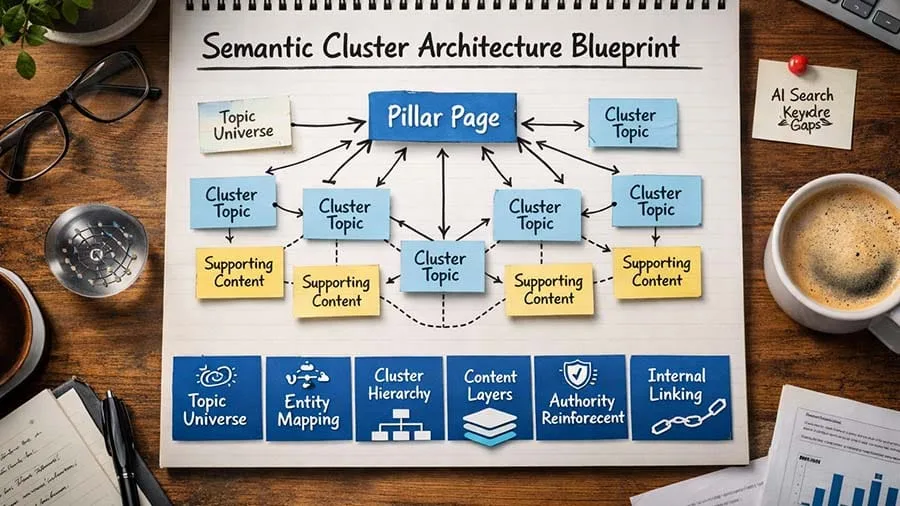
Semantic Cluster Architecture Blueprint Definition
A Semantic Cluster Architecture Blueprint is the structural model that defines how topics, entities, and relationships should be organized across a website to express meaning, hierarchy, and context in a way AI systems can reliably interpret. It provides the architectural rules that govern how pages connect, reinforce each other, and form a coherent semantic ecosystem. This blueprint ensures that your content is not only internally linked, but machine‑interpretable and aligned with how LLMs understand and retrieve information.
How I Design Topical Authority Systems in Enterprise SEO
Semantic cluster architecture is one of the most important structural foundations in modern SEO, yet it is also one of the most misunderstood. When people hear the phrase, they often imagine a simple pillar page with a few supporting articles attached to it. In practice, the reality is far more complex. When I design search visibility strategies for large organizations, I treat semantic cluster architecture as a knowledge system, not just a content structure.
Over the past twenty-five years I have worked across startups, growing companies, and global enterprises. In that time I have seen countless SEO strategies fail for the same reason: they focused on individual pages rather than on the relationships between them. Search engines, however, do not interpret websites as isolated documents anymore. They interpret them as networks of meaning.
That is exactly why concepts like entity relationships, explained in my article on
Entity-Based SEO: How Machines Decide Who Gets Found have become central to modern search understanding.
When I build SEO strategies today, I do not start with keywords. I start with topical architecture.
But architecture alone isn’t enough – without semantic cluster governance, even well-designed structures eventually lose coherence.
Want to evaluate how these principles apply to your organization? Explore the AI Assessment Center and benchmark your readiness across AI strategy, governance, sovereignty, visibility, search, and operational capability.
Search Visibility System Assessment
Most organizations invest in SEO tactics but rarely examine how their underlying systems support long-term search visibility.
This short diagnostic evaluates governance, platform architecture, international structure, and content systems to identify how well your organization supports sustainable search visibility.
Why Semantic Cluster Architecture Matters
Search engines evaluate topic coverage rather than isolated pages. When your content exists within a structured architecture, each article reinforces the others and strengthens the perceived authority of the entire site.
In practice, this directly supports what I describe in internal authority distribution, where the structure of your website determines how ranking signals move across the domain
Without a coherent architecture, even excellent articles struggle to accumulate authority. They remain disconnected assets rather than parts of a strategic system.
When cluster architecture is implemented correctly, several positive outcomes begin to appear. Crawl efficiency improves, keyword cannibalization decreases, and topical authority starts to emerge across the subject area.
When implemented at scale, semantic clusters become part of a broader architectural discipline I refer to as Authority Engineering.
Architecture Components
A complete Semantic Cluster Architecture Blueprint includes five components:
- Core Entity Hub – the central page that defines the primary concept and anchors the cluster.
- Supporting Pillars – deep, structured pages that expand the core entity into sub‑domains.
- Diagnostic Nodes – pages that provide frameworks, models, or evaluative logic.
- Application Nodes – practical, example‑driven pages that show how the concept is used.
- Semantic Pathways – the internal linking and relational structure that expresses hierarchy and meaning.
These components ensure that your cluster is not just a group of pages, but a semantic system.
The Core Structure I Use for Semantic Clusters
When I design semantic cluster architecture, I usually think in three structural layers.
At the top sits the pillar layer, which defines the primary topic. The pillar page introduces the landscape of the subject and connects readers to deeper articles across the cluster. It also serves as the central authority node for the topic.
Below that layer sit cluster pages, which explore individual aspects of the topic in depth. Each article answers a specific question or covers a distinct dimension of the subject. When structured well, cluster pages naturally connect back to the pillar while also linking to related subtopics.
Finally, I add supporting content layers that expand the knowledge space. These articles often answer specific questions, explore practical examples, or explain narrower concepts.
Over time, this layered architecture begins to resemble what I describe in the
semantic cluster blueprint framework.
The blueprint defines the logic, while the architecture determines how that logic becomes visible to search engines.
These architectural principles become even more critical when a website operates across multiple countries and languages. Without a clear structural logic, international versions of the same topic can easily fragment authority and create competing signals. I discuss several of these patterns in international SEO structure mistakes.
A more detailed breakdown of how these clusters are actually structured and implemented can be found in this semantic cluster blueprint.
Step One: Modeling the Topic Universe
Before writing any content, I map the topic universe. This step helps me understand the full knowledge space surrounding a subject.
Instead of beginning with keywords, I identify the main themes, supporting concepts, related technologies, and recurring problems professionals encounter within the field.
This approach is closely related to the diagnostic methodology I describe in
Indexation & Crawl Diagnostic for Enterprise SEO Performance, where understanding the system always comes before attempting optimization.
Mapping the topic universe ensures the cluster will eventually cover the subject comprehensively rather than reacting to isolated keyword opportunities.
Step Two: Mapping Entities
Modern search engines increasingly rely on entity recognition and knowledge graphs to interpret content. Because of that, entity mapping plays a central role in semantic cluster design.
When I plan a cluster, I identify the core entities that define the topic and determine how they relate to each other. For example, in the SEO field those entities may include crawling, indexing, search intent, internal linking, and topical authority.
This entity-first thinking aligns closely with the principles described in my article on entity-based SEO, which explains how search engines interpret relationships between concepts.
When those relationships are reflected consistently across multiple pages, search engines begin to understand the expertise behind the content.
Step Three: Designing the Cluster Hierarchy
Once the topic universe and entity relationships are clear, I design the hierarchical structure of the cluster.
The key rule I follow is simple: one page per intent.
When multiple pages try to answer the same question, they begin competing against each other. This is exactly the situation I describe in my analysis of
International website cannibalization where poorly structured content creates internal competition.
Clear hierarchy eliminates this problem by defining the role of every page within the cluster.
Step Four: Building Supporting Content Layers
Supporting content expands the semantic depth of the cluster. These pages may answer detailed questions, provide examples, or explain specific edge cases within the topic.
Although these pages often target smaller search queries, they contribute significant contextual signals. Over time they help search engines recognize that the site covers the subject from multiple perspectives.
This gradual accumulation of contextual knowledge is closely connected to what I discuss in generic engine optimization, where search visibility increasingly depends on semantic completeness rather than keyword repetition.
Step Five: Authority Reinforcement
The purpose of cluster architecture is not simply organization. Its real purpose is authority reinforcement.
When cluster pages link consistently, use shared terminology, and expand the same topic ecosystem, search engines begin to interpret the site as a credible authority within that domain.
This structural reinforcement is one of the reasons I often emphasize strategic visibility system design, which treats SEO as an integrated system rather than a collection of independent tactics.
Step Six: Internal Linking Architecture
Internal linking is the connective tissue that holds cluster architecture together. Without it, even well-written articles remain isolated signals.
In my implementations, internal links typically operate in three directions. Vertical links connect the pillar with cluster pages, establishing the main hierarchy. Horizontal links connect related cluster articles, reinforcing semantic relationships between subtopics. Contextual links appear naturally within explanations, guiding both readers and search engines toward related concepts.
When implemented carefully, this structure enables what I describe as internal authority distribution, where ranking signals circulate across the entire cluster rather than concentrating on a single page.
Step Seven: Content Expansion Logic
Cluster architecture should evolve over time. Once the foundation exists, expansion becomes a strategic process rather than a random publishing effort.
In practice, I usually expand clusters by identifying three types of gaps: missing queries, missing entities, and missing search intents. Each of these reveals opportunities to strengthen the topical ecosystem.
This iterative expansion also aligns with the principles described in my AI search readiness blueprint, which explains how structured knowledge environments increase the probability of citation in emerging search systems.
What the Architecture Enables
A semantic cluster architecture blueprint gives your site a clear, machine‑readable structure that strengthens entity understanding, improves retrieval accuracy, and increases your likelihood of being surfaced in AI‑generated answers. It ensures that every page reinforces the same conceptual foundation, making your expertise easier for AI systems to interpret, trust, and reuse. With a defined architecture, your content becomes a coherent semantic network rather than isolated articles.
A Final Perspective
Organizations often approach SEO as a process of publishing individual articles and hoping that some of them rank. In reality, sustainable visibility rarely comes from isolated pages.
It comes from structured knowledge systems.
Semantic cluster architecture provides the framework that allows those systems to exist. Once the architecture is in place, content expansion becomes strategic, internal linking becomes purposeful, and every new article strengthens the authority of the entire topic ecosystem.
That is why, in my work with enterprise organizations, cluster architecture is rarely treated as a content tactic. It is treated as the structural backbone of long-term search visibility.
Semantic Cluster Architecture Blueprint FAQ
A semantic cluster architecture blueprint is a structured framework that defines how topics, pages, and entities are organized and connected within a website. It ensures that content works together as a system rather than as isolated pages.
A topic cluster groups content around a general theme. A semantic cluster is built around entities, relationships, and meaning. It focuses on how concepts connect, not just how keywords relate.
Without a blueprint, content grows randomly and creates overlap, gaps, and confusion. A blueprint provides a clear structure that defines what should exist, how it connects, and how authority flows across the system.
A typical architecture includes:
– a central hub representing the main entity or topic
– supporting pages covering specific aspects or relationships
– clear internal linking that reflects how concepts connect
This creates a structured and interpretable system.
It improves clarity for search engines, reduces content overlap, and strengthens topical authority. When structure aligns with meaning, search systems can better interpret and trust the content.
By defining one clear role per page and mapping relationships in advance, the blueprint ensures that pages do not compete for the same intent. Each page has a distinct purpose within the system.
Internal linking acts as the connective layer of the blueprint. It reflects relationships between topics and helps distribute authority across the cluster in a controlled and intentional way.
You can, but the result is usually inconsistent. Without a blueprint, clusters tend to become fragmented, making it harder for search engines to understand how pages relate to each other.
AI systems rely on structured meaning and relationships. A semantic cluster architecture mirrors how these systems interpret information, making content easier to extract, combine, and present in answers.
The goal is to create a coherent system where all content contributes to a clear understanding of a topic, reinforcing authority and improving visibility across search systems.
The biggest mistake is treating clusters as content production tasks instead of system design. Without structure and defined relationships, clusters become disconnected content groups rather than a unified architecture.
