

In This Article
Your CEO asks what Grok says about the company, and there is no dashboard to open. Grok has no first-party report for site owners that I could find, so measuring your presence in it means sampling it yourself, separating answers built from the web from answers built from X, and counting citations with the caveats xAI itself documents. Measuring your presence in Grok is a method problem, not a tooling problem: a frozen prompt set, repeated runs, a record of every source, and a plain statement of what nobody outside xAI can see. This is the measurement half of a pair.
What is in This Series
This article is part of cluster How to Measure Your Presence in AI Search Engines, the series hub containing the: AI Search Visibility Share of Voice, How to Optimize Your Website for ChatGPT, How to Measure Your Presence in ChatGPT, How to Optimize Your Website for Perplexity, How to Measure Your Presence in Perplexity, How to Optimize Your Website for Claude, How to Measure Your Presence in Claude, How to Optimize Your Website for Gemini, How to Measure Your Presence in Gemini, How to Optimize Your Website for Copilot, How to Measure Your Presence in Copilot.
The optimization half is How to Optimize Your Website for Grok.
What “Presence in Grok” Means
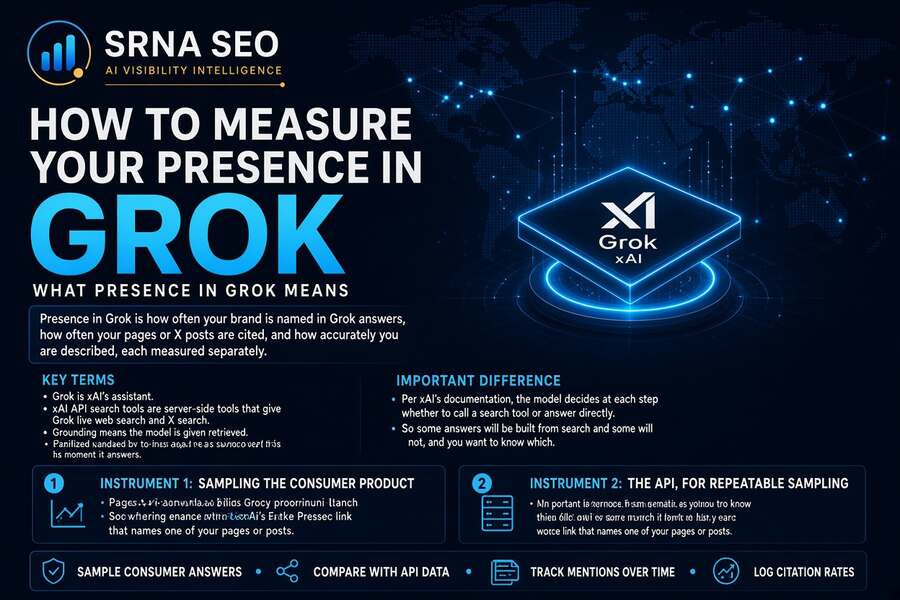
Presence in Grok is how often your brand is named in Grok answers, how often your pages or X posts are cited, and how accurately you are described, each measured separately.
The terms are the same as in the optimization article. Grok is xAI’s assistant. The xAI API search tools are server-side tools that give Grok live web search and X search. Grounding means the model is given retrieved content at the moment it answers. A mention is your brand name in the answer text. A citation is a source link that names one of your pages or posts.
One difference from the other engines matters for measurement. Per xAI’s documentation, the model decides at each step whether to call a search tool or answer directly. So some answers will be built from search and some will not, and you want to know which.
Which Instrument for Which Question
| Question | Source | What it cannot show | What I would do |
|---|---|---|---|
| Does Grok name my brand and describe it correctly? | Sampling the consumer product | Why it said so | Frozen prompts, repeated runs, full text saved |
| Which web pages and X posts does it cite? | API sampling with the search tools | Whether the consumer product behaves the same | Parse the citations. Label as a proxy |
| What did it search for? | API tool call arguments | What the consumer product searched | Build a query log |
| Did a visit come from Grok? | Your own analytics | Anything unclicked | Check what actually arrives |
| Is Grok’s fetcher reaching my pages? | Server logs | Whether you were cited | Look for what arrives. No documented user agent |
Read the table as a warning: every Grok number you will ever show is a sample, and you should say so on the first slide. I found no xAI report that shows site owners their mentions, citations or fetches: Not enough available data.
Instrument 1: Sampling the Consumer Product
For the consumer assistant, you sample by hand or with tooling, and the same discipline applies as for every engine in this series.
- Build a non-branded prompt set from buyer questions. Keep branded prompts in a separate list, because they mostly show that your name is known.
- Freeze and version it. Silent edits break the trend line.
- Fix the conditions you can control: the same product mode, the same account state, the same language and country, and write them down.
- Run each prompt several times per cycle. My working range is three to five, which is my judgment and not a standard.
- Record for every answer: whether sources were shown, your URL or post among them, brand named, how you were described, competitors named and which sources they got. Keep the full text.
- Read the answers. A mention that gets your product wrong is a problem, not a win, and I wrote about that risk in LLM Hallucination and Content Risk.
I could not find an xAI page that says whether or how the consumer product displays sources, so record what you see and do not assume it matches the API: Not enough available data. If you want a quick first read without building anything, the AI Visibility Inspector (my diagnostic tool for checking how AI systems see a brand) is the fastest start, and there is a guide to using it here.
Instrument 2: The API, for Repeatable Sampling
If you have an engineer, xAI’s API gives you something no consumer interface does. With the web search tool, X search tool or both enabled, you get structured data back, and that is where repeatable measurement becomes possible.
Citations, in two forms. Per xAI’s Citations documentation, a citations list on the response holds every URL the agent encountered, built from successful tool calls. Inline citations are links in the answer text numbered from 1, and the Responses API returns them by default, while the xAI Python SDK needs them switched on. The Python SDK also labels each inline citation as a web citation or an X citation, which gives you a built-in split between your site and your posts.
A query log. Per xAI’s advanced usage page, the xAI SDK exposes each server-side call’s name and arguments, and the arguments include search queries. A usage details page says the list of attempted calls includes failed ones, but it does not state outright that the query text is always present, so verify it against a real response before you build on it. Collect the queries across your prompt set and you can see what the model actually searches for in your category. That is a better brief for your content team than most keyword tools.
Now the two honest limits.
- The list is not the answer. xAI says the all-citations list can include sources the agent looked at but did not use in its final answer, and that inline citations are not guaranteed in every answer. So I would count inline citations as your citation rate, and treat the full list as “retrieved”. Report them as two separate numbers.
- The API is a proxy. Nothing I read says the API’s search behaves like consumer Grok. Say that in every report, and do not present API numbers as “what Grok shows”.
The cost, per xAI: X Search is billed per post fetched ($5 per 1,000) and per user profile fetched ($10 per 1,000), on top of token costs, and the counts are not de-duplicated, so a post returned by two searches counts twice. The page I read does not state a web search price, and the tools overview only says tool requests are billed on tokens and tool invocations: Not enough available data. Check current pricing before you budget. You can cap server-side search rounds with max_turns, which keeps a test run from spending more than you planned.
Measuring Traffic and Logs
Here I have less than I would like, and I would rather say so. I did not find xAI documentation on how visits from Grok are labeled in your analytics or what referrer they carry: Not enough available data. Look at your own analytics for what actually arrives, write down the exact source and medium values you see, and build a custom channel only after that. Assume undercounting, and remember that analytics sees clicks only, so every answer that names you without a link is invisible there. I explained why this part of the funnel stays dark in The AI Dark Funnel, and how to handle attribution honestly in AI Visibility Is Breaking Revenue Attribution.
Do not use Grok referral traffic as your presence metric, because it counts only the people who clicked.
Server logs are weak here, for a documented reason. xAI publishes no crawler, user agent string or IP range for its search tools in anything I could read, and its Grok Bot pages do not state them either. Third-party bot directories list strings, and I would treat those as leads to test, not facts. Logs can still tell you something useful: what automated traffic hits your key pages, whether your firewall is challenging it, and whether that changes after you edit a rule. They cannot tell you whether a fetch ended up in an answer.
Do Not Forget the X Side
Because Grok can search X, your presence includes what is said on X about you, and not only what you post. xAI’s X Search documentation says the model can fetch a thread with its replies, search accounts by name or bio, and search posts by keyword or meaning. In your sampling, record whether an answer draws on X citations, and read what those posts say. A brand with strong web pages and a noisy reply thread will see that in Grok. I did not find any xAI report that shows you how often your posts are used: Not enough available data.
The Numbers I Would Track
| Number | Source | What it answers | The trap |
|---|---|---|---|
| Mention rate | Consumer sampling, non-branded prompts | Does Grok know me in this category? | Branded prompts inflate it |
| Inline citation rate | API sampling | Does Grok quote my pages or posts? | An API proxy, not the product |
| Retrieved rate | API citations list | Does Grok look at my pages? | Includes sources not used |
| Web vs X split | API citation types | Where does my presence come from? | Depends on which tools you enabled |
| Query themes | API tool call arguments | What does it actually search for? | Verify the format first |
| Description accuracy | Consumer sampling | Does it say the right thing? | A mention can be wrong |
| Share of voice | Mention counts plus competitors | Who owns the category answer? | Moves with the competitor set |
Share of voice follows from the mention counts, and I explain how to build it in AI Search Visibility Share of Voice. For how fast mentions change, see AI Mention Velocity. For the wider shift in what visibility means when answers replace clicks, see Zero-Click Visibility.
Where to Stop Doing It by Hand
Count it plainly. 40 prompts, five runs, is 200 answers per cycle, and someone has to read them and log the sources. That is why tooling exists. For ongoing tracking with repeated runs and competitors, see NovaX (my AI Visibility Intelligence Platform), and compare it with others in Best AI Visibility Tools. I built it, so judge me accordingly. For Grok specifically, the sampling method above stands on its own, and I would not buy any tool that claims a Grok number it cannot explain. If you would rather have a baseline set up and read by someone who has worked inside enterprise teams, see Enterprise Search Advisory or get in touch.
What This Is NOT
This is not a ranking check. xAI documents no position to track. It is not a traffic report, since most presence never becomes a visit. It does not prove your changes caused your results, only that two things happened in sequence (see Why SEO Tools Cannot Audit AI Visibility). It is not a one-off audit, because one run on one day is a screenshot. And it is not a window into xAI. Every number here is a sample.
Mistakes I Would Check For First
- Counting the full citations list as citations. xAI says it can include sources not used.
- Treating the API as consumer Grok. It is a proxy.
- Ignoring X. The same question can be answered from posts, not pages.
- One run per prompt. Variation looks like growth.
- Branded prompts in the headline number. They show recognition, not choice.
- Trusting a third-party user agent list as if xAI had published it.
- Reading a mention as a recommendation. Check what it says.
- Tracking only Grok. Strong here says nothing about the other engines.
Estimated Gain After Implementation
Measurement does not raise your presence. It shows you which prompts and sources a competitor holds instead of you, and whether the story told about you is accurate. Any gain comes from the fixes afterwards, and for those I have no honest cross-company range: Not enough available data. Expect the first reliable read after a baseline and several repeated cycles. Before that, treat any swing, up or down, with suspicion.
The Uncomfortable Part
With Grok there is no official number to anchor on, so the quality of your method is the only authority you have. That is uncomfortable for a team that wants a dashboard, and it is the right standard for every engine in this series, because even where a first-party report exists it shows citations and not what the answer said. The honest report to an executive has three parts: a sampled view of Grok with its method attached, a split between web and X sources, and a plain sentence saying that xAI publishes no site-owner report.
FAQ
How often your brand is named in Grok answers, how often your pages or X posts are cited, and how accurately you are described, each measured separately.
I found none that shows site owners mentions, citations or fetches: Not enough available data.
Whether sources were shown, whether your URL or post was among them, whether your brand was named and how it was described, which competitors appeared and which sources they got. Keep the full answer text.
Yes, as a proxy. With the search tools enabled, the response carries citations, and the xAI SDK exposes tool call names and arguments. Nothing I read says it matches the consumer product, so label it as a proxy.
Per xAI, the list holds every URL the agent encountered and can include sources not used in the final answer. Inline citations are numbered links in the text, and the model decides when to include them.
Per xAI, X Search costs $5 per 1,000 posts fetched and $10 per 1,000 user profiles fetched, plus tokens. A web search price was not on the page I read. Check current pricing first.
xAI documents no user agent or IP range for its search tools in anything I could read, so I cannot give you a string to look for. Check your own logs for what actually arrives.
No. Promise a baseline, a locked method, repeated runs and a clear cadence, and report gains with the method attached.
Where to Go From Here?
Begin with the AI Visibility Inspector for a first read. When you want ongoing tracking against named competitors, see NovaX. And if you want a Grok baseline scoped for your market, contact me.
This article was researched and drafted with the assistance of AI tools and reviewed and edited by author prior to publication.
