

In This Article
Why Germany, and Why Now
This research is part of the Building A Europe AI Can See series which also includes National AI profiles of Austria, Belgium, Croatia, Cyprus, Czechia, Denmark, Estonia, Finland, France and Germany.
Read also German Flagship Companies.
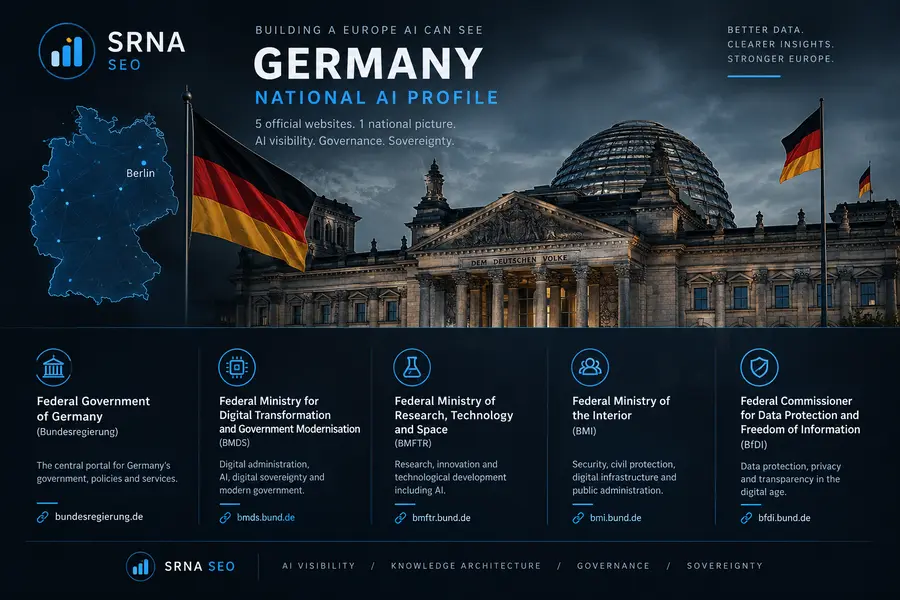
The five audited institutions are the ones that speak for the federal state: the government portal, the ministry responsible for digital transformation, the interior ministry, the labour and social affairs ministry, and the federal data protection authority. These are the pages an AI system is most likely to be asked about. The audits measure whether those pages are readable, verifiable and current to a machine.
The question is sharpest for the ministry whose name is digital transformation. It scored 48 (Grade D), with a freshness score of 0.
The Profile in One View
The five German institutions average 51.8 on the AI Retrieval Index. No institution reaches a B. Two score Grade C (Fair) and three score Grade D (Poor).
| Institution | AI Retrieval Index | Grade | Structure | Depth | Schema |
|---|---|---|---|---|---|
| Federal Ministry of the Interior (BMI) | 61 | C — Fair | C | D | D |
| Federal Ministry of Labour and Social Affairs (BMAS) | 57 | C — Fair | A | C | F |
| Federal Government (Bundesregierung) | 50 | D — Poor | C | B | D |
| Federal Ministry for Digital Transformation (BMDS) | 48 | D — Poor | C | C | D |
| Federal Data Protection Commissioner (BfDI) | 43 | D — Poor | C | B | F |
| Average | 51.8 |
Dimension averages across the five:
| Dimension | Average | Range |
|---|---|---|
| Structural Integrity | 74.0 | 65–100 |
| Data Extractability | 68.4 | 54–85 |
| Entity Clarity | 55.0 | 40–75 |
| Schema & Metadata | 31.0 | 10–50 |
| Freshness & Decay | 21.4 | 0–55 |
The main finding: German federal pages are well structured and extractable, but weak on the signals that let an AI system verify and date what it reads. Structure and extractability average 74.0 and 68.4. Schema and freshness average 31.0 and 21.4.
Other measured indicators:
- Person schema was not detected at any of the five institutions.
- Knowledge-graph anchoring (sameAs links) scored 0/100 at all five.
- Freshness scored 0 at two institutions, the Bundesregierung and BMDS.
- Structural decay alerts were raised at four of five, for multiple H1 tags. Only BMAS has a single H1.
How the Five Engines Read the German Pages
The research scores each page against five engines, each with a defined role: Perplexity (The Researcher), OpenAI / ChatGPT (The Generalist), Claude (The Semanticist), Google Gemini (The Integrator) and Microsoft Copilot (The Knowledge Connector). The audit also gives each engine an estimated citation percentage.
| Engine | Average score | Average citation estimate | Best institution | Weakest institution |
|---|---|---|---|---|
| Claude | 67.2 | ~30.6% | BMAS (75) | BfDI (62) |
| OpenAI / ChatGPT | 66.2 | ~43.4% | BMAS / Bundesregierung (70) | BMDS (62) |
| Microsoft Copilot | 60.6 | ~42.4% | BMI (73) | BfDI (50) |
| Perplexity | 47.0 | ~43.8% | BMI (56) | BfDI (39) |
| Google Gemini | 41.6 | ~18.2% | BMI (60) | BfDI (25) |
Gemini is the weakest engine for Germany. It has the lowest average score (41.6) and the lowest or joint-lowest citation estimate at all five institutions, from ~12% at BMAS to ~25% at the Bundesregierung. Gemini’s issues at four institutions are “No Article or Person JSON-LD – E-E-A-T entirely unverifiable”. At BMI it is partial schema. Image alt-text coverage is also flagged: 15% at BMDS, 13% at BMAS, 11% at BMI and 86% at BfDI.
Claude and ChatGPT score highest on structure, but Claude’s citation estimate is lower. Claude averages 67.2 on score but only ~30.6% on citation. Its estimate peaks at BMAS (~46%), the only institution with a single H1, and is lowest at the Bundesregierung and BfDI (~24–25%). The recurring Claude flags are multiple H1 tags (BMDS 2, BfDI 4, BMI 3, Bundesregierung 2) and absent author/Person schema (all five).
Copilot scores best where schema exists. BMI, the only institution with Article-type JSON-LD, gets Copilot’s highest score (73) and citation estimate (~55%). Copilot flags the same gaps everywhere: no Article or Person schema (BMDS, BfDI, BMAS, Bundesregierung) and multiple H1s.
Perplexity’s citation estimate diverges from its score. Its average score is 47.0, but its citation estimates are the highest at BMDS (~57%) and the Bundesregierung (~58%), both of which scored 42–47. At BfDI it scores 39 and ~27%. The audit does not explain the gap between score and citation estimate, so no reason is claimed here.
ChatGPT’s score is stable across the institutions (62–70), and its citation estimate stays between ~40% and ~49%. The recurring flags are weak entity signals and, at BfDI, the Bundesregierung and BMAS, partial or absent heading hierarchy.
What the Five Audits Reveal
Structure is the strongest dimension, and it is carried by one institution. BMAS scores 100 on Structural Integrity: single H1, H2 sections, logical nesting, balanced heading density and no fragmented intent. The other four score 65–70 and each fails the single-H1 check. Together they carry 11 H1 tags (BMDS 2, BfDI 4, BMI 3, Bundesregierung 2).
Extractability is solid but breaks on tables and images. Scores run from 54 (BMI) to 85 (Bundesregierung), with BfDI at 81. Word density, list structures and internal link density pass nearly everywhere. Table / structured data fails at four of five; only BfDI passes. Image alt-text coverage fails at BMDS, BMI and BMAS, which together have 55 images missing alt text (11, 24 and 20). BfDI has 2 missing.
Entity clarity is middling. Scores run from 40 (BfDI) to 75 (BMI). Primary entity tokenization passes at all five. Article / content schema passes only at BMI. Author / Person schema fails at all five. Organization schema passes only at BMDS (see the note in Scope and Method). Open Graph Title passes at BMI, BMAS and the Bundesregierung, and fails at BMDS and BfDI.
Schema and metadata is the weakest structural dimension. Scores run from 10 (BfDI) to 50 (BMI). Canonical URL and robots checks pass at all five. JSON-LD is present at three institutions, with three different types: GovernmentOrganization (BMDS), WebSite and NewsArticle (BMI) and BreadcrumbList (Bundesregierung). BfDI and BMAS have none. Meta description fails at BfDI, BMI and BMAS. Open Graph tags fail at BMDS and BfDI.
Freshness splits the cluster. BMI (55) and BMAS (45) have some date signal. BfDI scores 7. The Bundesregierung and BMDS score 0 on every check: no JSON-LD dateModified, no machine-readable date, no publish and modified pair. The Bundesregierung is a news-led site, and an AI system cannot read when its pages were written or updated.
Trust and authority signals are near zero. Entity Connectivity is 0 at four institutions, and 50 at BMI. KG Anchoring is 0 at all five. E-E-A-T Density is 0 at BMDS, BMAS and the Bundesregierung, 9 at BMI and 28 at BfDI. Semantic Richness runs from 25 (BMAS) to 45 (BMDS), averaging 36.0. Entity Graph Stability averages 57.4 (range 47–68). The Schema sub-score is 0/20 at four institutions, and 7/20 at BMDS.
Navigation chrome surfaces as queries. Across 126 detected queries, the audits show template labels such as “Main Menu”, “Service-navigation”, “Main-navigation” and “Subnavigation of Service” extracted as queries at BfDI, BMI and the Bundesregierung. Query eligibility estimates range from 37% (BfDI and Bundesregierung) to 65% (BMDS).
Entity detection misreads government pages. “Product / Service” is detected as a commercial entity at 73–81% confidence at all five institutions. At BMI the Federal Ministry of the Interior is classified as both a Person and an Organization.
Institution Profiles
Federal Government (Bundesregierung)
Website audited: https://www.bundesregierung.de/breg-en/
Role: The official website of the Federal Government, covering the chancellor, cabinet decisions, press conferences and government programmes.
Audit result: 50 – Grade D (Poor) · Structure C · Depth B · Schema D
| Structural | Extractability | Entity Clarity | Schema & Metadata | Freshness |
|---|---|---|---|---|
| 65 (C) | 85 (B) | 55 (C) | 35 (D) | 0 (F) |
Strongest findings:
- Extractability of 85 is the highest in the cluster.
- Alt-text coverage, internal link density and scrapeable lists all pass.
- Schema & Metadata passes JSON-LD present, meta description, canonical, Open Graph and robots.
- Perplexity citation estimate of ~58% is the highest of any engine-institution pair in the cluster.
Weaknesses:
- Freshness is 0. There is no machine-readable date of any kind, on a site whose content is cabinet decisions, state visits and press conferences.
- The only JSON-LD is one valid BreadcrumbList. No Organization, Person or Article schema.
- Entity Connectivity, KG Anchoring and E-E-A-T Density are all 0.
- Two H1 tags.
- Gemini scores 38 with a ~25% citation estimate.
- Entity detection reads the site as “Product / Service” (81%) and flags “Conversion Rate” as a topic.
- Query eligibility is low (37–47%). Many queries are navigation labels such as “Main-navigation”, “Service-navigation” and “Area-navigation”.
What it means for AI systems: The portal is easy to read and impossible to date. A system citing a Bundesregierung press conference cannot tell when the page was published or updated, and cannot confirm the publisher from structured data.
BMDS
Website audited: https://bmds.bund.de/en/
Role: The Federal Ministry for Digital Transformation and Government Modernisation. Detected content covers digital government, digital sovereignty, digital infrastructure, digital policy, the 2026 Digital Summit, the government service number 115, state secretaries and Dr. Markus Richter.
Audit result: 48 – Grade D (Poor) · Structure C · Depth C · Schema D
| Structural | Extractability | Entity Clarity | Schema & Metadata | Freshness |
|---|---|---|---|---|
| 70 (C) | 57 (C) | 60 (C) | 40 (D) | 0 (F) |
Strongest findings:
- It is the only institution where Organization schema passes (a valid GovernmentOrganization block, the only JSON-LD on the page).
- Meta description, canonical and robots pass.
- Highest Entity Graph Stability sub-scores: Primary 20/20, Secondary 12/20, Schema 7/20.
- Artificial Intelligence is detected as a primary concept (73% clarity).
- All 22 detected queries are flagged eligible, with the highest query estimate in the cluster: 65% for “What is the Federal Ministry for Digital Transformation and Government Modernisation (BMDS)?”
- Perplexity citation estimate ~57%.
Weaknesses:
- Freshness is 0, the same score as the Bundesregierung. The ministry for digital transformation publishes no machine-readable date.
- Two H1 tags.
- Open Graph tags and Open Graph Title fail.
- 11 images lack alt text (15% coverage).
- Content depth is moderate at 440 words, against a 600+ target.
- No Article or Person schema; Entity Connectivity, KG Anchoring and E-E-A-T Density are 0.
- Gemini ~16%.
What it means for AI systems: BMDS tells AI who it is, through valid GovernmentOrganization markup and a clear primary entity. It does not tell AI when anything was written, who wrote it or what it links to.
BMI
Website audited: https://www.bmi.bund.de/EN/home/home_node.html
Role: The Federal Ministry of the Interior. Detected content covers migration policy (“The new migration policy is working”), a Baltic Sea Security Summit in Flensburg (28 August 2026), a continuation of the Munich Migration Meeting (28 September 2026), cooperation with Ecuador on drug smuggling and organised crime (10 July 2026), and Minister Dobrindt.
Audit result: 61 – Grade C (Fair), the highest in the cluster · Structure C · Depth D · Schema D
| Structural | Extractability | Entity Clarity | Schema & Metadata | Freshness |
|---|---|---|---|---|
| 70 (C) | 54 (D) | 75 (B) | 50 (D) | 55 (C) |
Strongest findings:
- It is the only institution with Article-type markup: valid WebSite and NewsArticle blocks, with the Article carrying 6 of 8 fields (headline, author, datePublished, dateModified, publisher, image).
- Entity Clarity of 75 is the highest in the cluster.
- Entity Connectivity of 50 is the only non-zero score in the cluster.
- Freshness checks pass for JSON-LD dateModified, publish and modified dates, and update frequency signals.
- Copilot scores 73 with a ~55% citation estimate, the highest engine score in the audit set.
- Open Graph tags pass. All 20 queries are flagged eligible (50–60%).
Weaknesses:
- Three H1 tags.
- Meta description is missing.
- 24 images lack alt text (11% coverage), the largest count in the cluster. Table / structured data also fails.
- Content age fails the 12-month check; the audit reads one article as 1.4 years old.
- No Person or Organization schema. KG Anchoring is 0. E-E-A-T Density is 9.
- The Federal Ministry of the Interior is detected as both a Person and an Organization.
What it means for AI systems: BMI shows the working template for the cluster: dated news content with an author and publisher. It still lacks the entity layer that would tie that content to a named, verifiable organization.
BMAS
Website audited: https://www.bmas.de/EN/Home/home.html
Role: The Federal Ministry of Labour and Social Affairs. Detected content covers skilled labour, labour market policy, basic income support for jobseekers, the minimum wage (translated information), migration and integration support, the transformation of the world of work, and FAQs for Ukrainian refugees.
Audit result: 57 – Grade C (Fair) · Structure A · Depth C · Schema F
| Structural | Extractability | Entity Clarity | Schema & Metadata | Freshness |
|---|---|---|---|---|
| 100 (A) | 65 (C) | 45 (D) | 20 (F) | 45 (D) |
Strongest findings:
- Structural Integrity of 100, the only perfect score in the audit set. It is the only institution with a single H1 and passes every structural check.
- Claude scores 75 with a ~46% citation estimate, the best Claude result in the cluster.
- ChatGPT scores 70 (~49%).
- Content age passes the 12-month and 180-day checks.
- 9 of 13 queries are flagged eligible. A Ukrainian-refugee FAQ query is typed FAQ (55%).
Weaknesses:
- No JSON-LD at all. Schema & Metadata is 20 (F); Entity Connectivity, KG Anchoring and E-E-A-T Density are 0.
- Meta description is missing.
- 20 images lack alt text (13% coverage).
- Date signals exist only in text or meta tags, not in JSON-LD, so there is no dateModified and no publish and modified pair.
- Entity Graph Stability is 47 (Fragmented), the lowest in the cluster, with Co-occurrence at 0/15.
- Gemini ~12%, the lowest single citation estimate in the cluster.
- Semantic Richness is 25, the lowest in the cluster.
What it means for AI systems: BMAS is the best-organised page in the set and the least declared. The FAQ-style content has no FAQPage markup, so engines that weight schema get no structured confirmation of it.
BfDI
Website audited: https://www.bfdi.bund.de/EN/Home/home_node.html
Role: The Federal Commissioner for Data Protection and Freedom of Information. Detected content covers the new commissioner Moritz Hennemann taking office, the electronic patient file (medication list data from the end of October 2026), international data transfers, the Data Protection Conference, the Global Privacy Assembly and the federal system of data protection supervision.
Audit result: 43 – Grade D (Poor), the lowest in the cluster · Structure C · Depth B · Schema F
| Structural | Extractability | Entity Clarity | Schema & Metadata | Freshness |
|---|---|---|---|---|
| 65 (C) | 81 (B) | 40 (D) | 10 (F) | 7 (F) |
Strongest findings:
- Extractability of 81 is second only to the Bundesregierung, with every check passing, including tables and alt-text (86% coverage, 2 images missing).
- Entity Graph Stability is 68, the highest in the cluster. Secondary entities score 20/20 and co-occurrence 10/15, the best in the set.
- It has the most expertise and trust signals: Expertise 3 signals, Trustworthiness 4 signals (E-E-A-T Density 28).
- It is the only page with update-frequency signals present without a machine-readable date.
- Detected entities include Data Protection, the Data Protection Conference and the Global Privacy Assembly.
Weaknesses:
- No JSON-LD at all. Schema & Metadata is 10, the lowest in the cluster. Copilot flags no valid schema blocks.
- Four H1 tags, the most in the cluster, and balanced heading density fails.
- Meta description is missing. Open Graph tags and Open Graph Title fail.
- Freshness is 7: only update frequency signals pass.
- Perplexity scores 39 (~27%) and Gemini 25 (~14%), the lowest engine score in the cluster.
- 40 queries, the most of any institution, all between 37% and 46% except one at 51%. They include navigation labels and extraction artefacts such as “Servicemeu”, “Main Menu” and “pixi Videos”.
What it means for AI systems: The institution responsible for data protection and freedom of information has the lowest score of the five. An AI system can read what the BfDI says but receives no machine-readable declaration of who the BfDI is, who wrote a page, or when it changed.
What This Means
Germany’s public knowledge layer is readable but not verifiable. All five institutions can be parsed. None can be confirmed. No Person schema was found, KG anchoring is 0/100 across the board, and four of five show Entity Connectivity of 0. Where an engine asks who stands behind the content, the structured answer is absent from all five. The exception is BMI, which carries author and publisher fields in its NewsArticle block.
Freshness is the national failure. The average is 21.4. Two of the five federal pages, including the government’s own portal, carry no machine-readable date. Pages built on news, cabinet decisions and ministerial statements are the ones where being current matters most to an engine.
The best and worst performers do not map to expectations. The Interior Ministry leads at 61. The data protection authority is last at 43, with no structured data. The ministry for digital transformation scores 48 and has a freshness score of 0. The highest-scoring institution is a C. No German institution in this audit reaches a B.
The fixes are mostly metadata, not content. The pages already pass on word density, lists, internal links, canonical and robots. The gaps are the declared layer: one H1, a meta description, Open Graph tags, alt text, Organization and Person schema, sameAs links, and datePublished and dateModified in JSON-LD. BMI shows that part of this stack already runs inside the federal estate.
Consistency is the gap. Different ministries ship different metadata: GovernmentOrganization at BMDS, WebSite and NewsArticle at BMI, BreadcrumbList at the Bundesregierung, nothing at BMAS and BfDI. No two institutions share a schema pattern. For an engine that cross-references entities, the federal government does not present as a single connected body.
Scope and Method
What was audited. Five German federal institutions, one page each, using the AI Visibility Inspector v1.9.3 (Srna SEO Frameworks, srnaseo.com). All five audits were generated on 9 October 2026 between 3:01 and 3:02 AM. Each audit page was the English-language entry page.
| Institution | URL audited |
|---|---|
| Federal Ministry of the Interior (BMI) | https://www.bmi.bund.de/EN/home/home_node.html |
| Federal Ministry of Labour and Social Affairs (BMAS) | https://www.bmas.de/EN/Home/home.html |
| Federal Government (Bundesregierung) | https://www.bundesregierung.de/breg-en/ |
| Federal Ministry for Digital Transformation (BMDS) | https://bmds.bund.de/en/ |
| Federal Data Protection Commissioner (BfDI) | https://www.bfdi.bund.de/EN/Home/home_node.html |
What the research measures. Each report gives an AI Retrieval Index and grade, Structure, Depth and Schema sub-grades, and five scored dimensions: Structural Integrity, Data Extractability, Entity Clarity, Schema & Metadata, and Freshness & Decay. It adds scores for five engines (Perplexity, OpenAI / ChatGPT, Claude, Google Gemini, Microsoft Copilot) with estimated citation percentages, a Schema Intelligence section (validation, entity connectivity, KG anchoring, E-E-A-T density, semantic richness), query eligibility, and an entity graph stability score.
Boundaries.
- One page per institution. Subpages, PDFs and other domains are not covered.
- Findings describe each page on the audit date.
- Averages are simple means of the five institutional scores.
- The reports produce two freshness blocks per page. Scores matched within each institution, so the figures shown are for the first block.
- Entity and query detection is automated and produces artefacts, such as navigation labels read as queries and “Product / Service” read as a commercial entity.
- Citation figures are the Inspector’s estimates, not observed citations in live engine answers.
- BMDS passes the Organization schema check in the Entity Clarity dimension, while the Schema Field Richness panel shows Organization as not detected. The Inspector does not reconcile the two. The BMDS GovernmentOrganization block is reported here as present, and Organization as not counted by the richness measure.
How Does Your Institution Read to AI?
The five German institutions above were read with the same tool available to any organization. The AI Visibility Inspector produced each report in this profile.
Run your own homepage and compare it with the five profiles above: the H1 count, the schema blocks, the dates, the Person and Organization declarations and the five engine scores. If the pattern matches, the cost is the same.
For a deeper reading, the Knowledge Exposure Audit and the Agent Exposure Audit extend the inspection beyond a single page. For fixes, see relevant frameworks.
Calculate Your Potential Exposure
Reading poorly to AI has a cost. The AI Visibility Cost of Inaction Calculator lets you enter your own figures and see the exposure for your organization.
Inputs
Enter your own data where possible. Hover over labels or open “Methodology” for details on how each field is used.
From GA4, GSC, or your SEO platform. Use a 30–90 day average.
Session → lead / signup / purchase. Use decimal (e.g. 1.2 for 1.2%).
For B2B, use average deal value or LTV. Currency is symbolic here.
Used to show profit‑based cost of inaction. Leave at 100 to ignore.
Share of organic traffic from queries/pages likely to be influenced by AI answers and retrieval systems.
Based on observed traffic loss patterns in AI search and structural decay cases.
Expected organic growth if you do nothing special about AI visibility.
Plausible uplift over the chosen horizon based on case studies.
How these numbers are calculated (methodology)
Let:
- O₀ = monthly organic sessions
- CVRₒ = organic conversion rate (as a decimal)
- ARPC = average revenue per conversion
- GM = gross margin (as a decimal)
- E = AI exposure share (as a decimal)
- D = displacement rate (as a decimal)
- T = time horizon in months
Baseline monthly revenue:
- Revenue: \(R_0 = O_0 imes CVR_o imes ARPC\)
- Profit: \(R_{0,profit} = R_0 imes GM\)
Monthly revenue at risk (for a given D):
- \(R_{risk} = R_0 imes E imes D\)
- Profit version: \(R_{risk,profit} = R_{risk} imes GM\)
The tool computes R_risk for three scenarios:
- Conservative: D = 0.15
- Base: D = 0.30 (or your selected scenario)
- Aggressive: D = 0.50
Cost of Inaction over T months is approximated as:
- \(CoI(T) = R_{risk} imes T\)
- Shown as a range from conservative to aggressive.
The growth inputs (g₀, g₁) are currently used for narrative context and can be incorporated into a more advanced version that models opportunity cost explicitly.
The only URL in the supplied material is the Srna SEO Frameworks homepage, https://www.srnaseo.com, from the report footers. It is used once, in Scope and Method.
