

In This Article
The United Kingdom’s five audited pages average 64.4 on the AI Retrieval Index, the second highest of the seven countries compared in this series so far. Only Sweden scored higher, at 68.8. Norway averaged 58.0, Hungary 55.8, Ireland 51.8, Germany 51.8 and Greece 49.4.
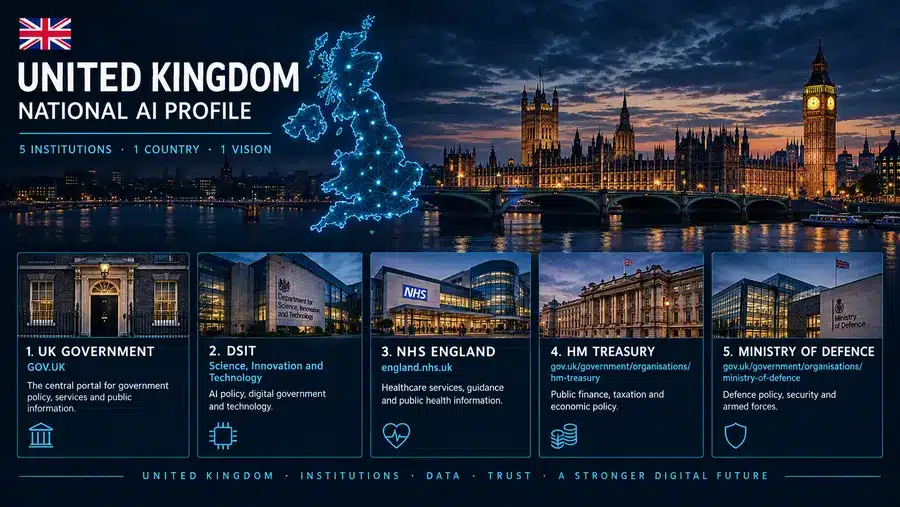
This profile differs from the earlier ones in how the pages are spread. Four of the five audited pages are on GOV.UK, the central publishing platform for UK government: the front page and three departments (Science, Innovation and Technology; Defence; and the Government Digital Service). The fifth is NHS England, which runs its own site at england.nhs.uk. When someone asks an AI assistant how to renew a passport, what the Ministry of Defence announced this week or where the NHS planning framework stands, these are the pages the answer should come from. Because four of the five share one platform, and three of them one department template, the result describes how GOV.UK reads to AI as much as it describes five separate institutions.
The audits measure three things about each page: whether an AI system can read it, whether it can tell who published it, and whether it can judge that the content is current. All five audits were generated on 14 October 2026.
The main finding: the UK average is set by one decision, whether a page carries structured data, and the front door of UK government is the page that does not. The three department pages carry a valid GovernmentOrganization and BreadcrumbList block, and they score 67 to 71. The GOV.UK front page and NHS England carry no JSON-LD and score 54 and 60. The three departments alone average 69.3, above Sweden’s 68.8. The front page is the only page in the set graded D, and its freshness score is 0, the only decay alert in these five audits. Even where structured data exists, it stops at the organisation. Entity connectivity and KG anchoring are 0 on all five pages.
This research is part of the Building A Europe AI Can See series, which also includes National AI profiles of Austria, Belgium, Croatia, Cyprus, Czechia, Denmark, Estonia, Finland, France, Germany, Greece, Hungary, Ireland, Norway, Sweden, United Kingdom.
Read also the Sweden National AI Profile, the closest comparison to this one.
The Profile in One View
| Page | AI Retrieval Index | Grade | Structure | Depth | Schema |
|---|---|---|---|---|---|
| Government Digital Service | 71 | C – Fair | A | B | D |
| Ministry of Defence | 70 | C – Fair | A | B | D |
| Department for Science, Innovation and Technology | 67 | C – Fair | A | B | D |
| NHS England | 60 | C – Fair | A | C | F |
| GOV.UK front page | 54 | D – Poor | A | B | D |
| Average | 64.4 |
The spread between the best and worst page is 17 points, against 6 for Sweden, 19 for Ireland and 27 for Norway. Three pages share the A, B and D sub-grades. NHS England is the only page with a Schema sub-grade of F, and the GOV.UK front page is the only one graded D overall.
| Dimension | UK average | UK range | Sweden average | Norway average | Ireland average | Hungary average | Greece average | Germany average |
|---|---|---|---|---|---|---|---|---|
| Structural Integrity | 96.0 | 95–100 | 100.0 | 92.0 | 86.0 | 98.0 | 58.0 | 74.0 |
| Data Extractability | 73.4 | 67–75 | 83.0 | 71.4 | 73.2 | 76.0 | 73.8 | 68.4 |
| Entity Clarity | 57.0 | 45–65 | 49.0 | 52.0 | 46.0 | 55.0 | 55.0 | 55.0 |
| Schema & Metadata | 41.0 | 20–50 | 38.0 | 31.0 | 26.0 | 23.0 | 32.0 | 31.0 |
| Freshness & Decay | 43.2 | 0–61 | 65.0 | 31.8 | 14.2 | 9.0 | 22.8 | 21.4 |
| AI Retrieval Index | 64.4 | 54–71 | 68.8 | 58.0 | 51.8 | 55.8 | 49.4 | 51.8 |
The UK leads the comparison on two dimensions and sits second on the index. Entity Clarity (57.0) is the highest of the seven, ahead of Hungary, Greece and Germany at 55.0. Schema & Metadata (41.0) is also the highest, 3.0 points above Sweden. The UK is third on structure, behind Sweden and Hungary, fourth on extractability and second on freshness, though 21.8 points behind Sweden’s uniform 65.0. Against Norway, the UK has 11.4 more freshness, 10.0 more schema, 5.0 more entity clarity, 4.0 more structure and 2.0 more extractability, which adds up to 6.4 points on the index.
Other indicators across the five pages:
- Entity graph stability averages 61.0. The GOV.UK front page (41) and NHS England (57) read “fragmented”. The three departments read “moderate” at 70 (Defence, Science, Innovation and Technology) and 67 (Government Digital Service). Sweden averaged 72.2 and Norway 44.0.
- Entity connectivity is 0 of 100 on all five pages. That includes the three pages with a valid structured data block.
- KG anchoring is 0 of 100 on all five pages. None carries a
sameAslink to Wikipedia or Wikidata. - E-E-A-T density is close to zero: 0, 0, 4, 6 and 2 (average 2.4). The front page and Science, Innovation and Technology score 0, NHS England 4, Defence 6 and the Government Digital Service 2.
- Three of five pages carry JSON-LD. Each of the three department pages has two blocks, a GovernmentOrganization and a BreadcrumbList, both valid and field-complete. The front page and NHS England have none.
- Dates are not in JSON-LD on any page. Four pages show dates through page text or meta tags only. The front page shows no date signal at all.
- 41 images across four pages lack alt text. NHS England is the only page with no alt-text finding.
How the Five Engines Read the UK Pages
Per page, as score (estimated citation):
| Page | Perplexity | ChatGPT | Claude | Gemini | Copilot |
|---|---|---|---|---|---|
| Government Digital Service | 67 (~63%) | 78 (~50%) | 81 (~51%) | 63 (~19%) | 74 (~47%) |
| Ministry of Defence | 66 (~63%) | 78 (~50%) | 81 (~51%) | 62 (~19%) | 74 (~47%) |
| Department for Science, Innovation and Technology | 63 (~62%) | 78 (~50%) | 81 (~51%) | 59 (~19%) | 74 (~47%) |
| NHS England | 54 (~30%) | 70 (~49%) | 75 (~46%) | 46 (~22%) | 58 (~34%) |
| GOV.UK front page | 49 (~41%) | 72 (~49%) | 75 (~46%) | 40 (~15%) | 58 (~34%) |
Claude (78.6) and ChatGPT (75.2) read the UK pages best, and Copilot (67.6) passes Perplexity (59.8) on score. The order differs from Sweden, where Perplexity ranked third, and matches Norway’s, where Copilot also ranked ahead of Perplexity. The UK scores higher than Norway on every engine. Against Sweden, it is lower on four engines and higher on Copilot (67.6 against 61.2).
The citation estimates tell a different story from the scores. Perplexity has the highest estimate of the five engines at ~51.8%, despite the second-lowest score, and the UK’s Perplexity, Claude and Copilot estimates are all higher than Sweden’s and Norway’s. Gemini is the weakest reader at 54.0 with an estimate near 19%, below both comparison countries.
Structured data splits the engines in two. The three department pages, which carry JSON-LD, show Perplexity at ~62–63% and Copilot at ~47%. The GOV.UK front page and NHS England, which carry none, show ~41% and ~30% on Perplexity and ~34% on Copilot. Claude scores 81 on the three department pages and 75 on the other two, and ChatGPT 78 against 72 and 70. The audit notes core citation signals on the three department pages. On the front page and NHS England it notes that there is no JSON-LD, so Perplexity cannot anchor citations, and on NHS England it adds that the meta description is missing. Copilot carries the note that no valid JSON-LD blocks were detected on the same two pages.
Gemini finds the same gaps on every page. All five lack Article or Person JSON-LD and carry the missing Person and Organization pairing note. Alt-text coverage is 0% on the front page and on Science, Innovation and Technology, 23% on Defence and 50% on the Government Digital Service. NHS England raises no alt-text finding but is flagged for a missing canonical or meta description. Gemini’s estimate is ~19% on the three department pages whatever their score (59, 62 and 63), and the front page has the lowest in the set at ~15%.
ChatGPT’s findings are identical on all five pages. Each carries the note that entity signals are weak and that key topics should be named and described explicitly, and each is credited for content depth and structure optimised for semantic retrieval. Claude’s findings differ only in degree. All five lack author or Person schema as an expertise signal, and the front page and NHS England add that contextual disambiguation is low.
What the Five Audits Reveal
Structure is strong (96.0, range 95–100). Each page has a single H1, H2 sub-sections and logical nesting. Four pages score 95 because the balanced heading density check fails. NHS England scores 100 with all five checks passing.
Extractability is solid but untidy (73.4, range 67–75). The four GOV.UK pages score 75. All four fail both the table and structured data check and the alt-text check. NHS England scores 67 even though it passes the alt-text check and four of five checks overall. The audit does not explain why it scores lower than pages that pass fewer checks. The alt-text gaps are large where they exist: four images on the front page (0% coverage), 13 on Science, Innovation and Technology (0%), 20 on Defence (23%) and four on the Government Digital Service (50%).
Entity clarity splits in two (57.0, range 45–65). The three department pages score 65 and pass the Organization Schema check. The front page and NHS England score 45 and fail it. All five score full marks for primary entity.
Schema and metadata is mixed (41.0, range 20–50). The three department pages score 50, with the valid GovernmentOrganization and BreadcrumbList blocks, a meta description, a canonical URL, Open Graph tags and no robots block. The front page scores 35 and passes every check except JSON-LD. NHS England scores 20, the only F in the set: it has no JSON-LD and is the only page whose meta description check fails. The audit flags no missing canonical URL on any page.
Freshness is the widest range in the set (43.2, range 0–61). The GOV.UK front page scores 0, with the audit’s only “Structural Decay Detected” alert: no date signals were found, so content age is unverifiable. The other four score 41 (Science, Innovation and Technology), 57 (Defence and NHS England) and 61 (Government Digital Service). On each, dates are detected through text or meta tags, and the audit recommends moving datePublished and dateModified into JSON-LD. None of the three JSON-LD blocks carries a modified date.
The trust layer is nearly empty. Entity connectivity and KG anchoring are 0 everywhere. E-E-A-T density reaches a maximum of 6, on Defence, which records three expertise and two authoritativeness signals. The Government Digital Service records one authoritativeness signal, NHS England one trustworthiness signal, and the front page and Science, Innovation and Technology none. Semantic richness is 60 on three pages, 68 on Defence and 47 on NHS England.
The entity graph is split by the same line. Primary entity (20 of 20) and clarity (15 of 15) are full marks on every page. The three department pages score 14 of 20 on schema and 12 to 15 of 20 on secondary entities, giving 67 to 70. The front page scores 3 of 20 on secondary entities and 0 on schema. NHS England scores 12 and 0, plus 4 of 15 on co-occurrence, the only page above zero. Co-occurrence is 0 on the other four. Query alignment runs from 3 to 6 of 10.
What the detector finds differs by page. On the three department pages, the schema-backed entities are “GOV.UK” at 95% clarity and “Organization / Brand” at 70%. The audit does not list the department itself as a detected entity. “Artificial Intelligence” appears as a primary concept on all three at 73%. On Defence, the detector also finds an “Author / Expert” Person entity at 55% with no schema. The front page produces one detected entity, “Product / Service”, read as a commercial entity at 81%, and no organisation. NHS England produces “Product / Service” at 73% and “My Planned Care” at 48%, read as an emerging concept.
Query eligibility sits at about 55%, with the departments above the front page and NHS England. The audits generated 222 queries across the five pages, against 119 for Sweden. Average eligibility is 56.9% on Science, Innovation and Technology, 56.5% on Defence, 56.2% on the Government Digital Service, 50.5% on the front page and 50.0% on NHS England. The highest-scoring query in the set is the feedback prompt “Is this page useful?”, tagged FAQ, at 70% on all three department pages and 64% on the front page. The lowest score is 45%, on the front page (“Services and information”, “Housing and local services”, “Cost of living support”, “Get the GOV.UK app”) and on NHS England (“Digital transformation”).
Most queries come from the template. 22 queries are identical on all four GOV.UK pages and 35 are identical on the three department pages. They include “cookies on GOV.UK”, “navigation menu”, “search”, “featured”, “subscriptions”, “follow us”, “support links” and the full cookie-banner text. The department-specific queries are mostly headlines.
Automated detection mislabels some of what it finds. A Defence headline on a joint multinational exercise in Iceland is tagged CONVERSION. Headlines on drone data and a space squadron are tagged DIGITAL ANALYTICS or AI. A Science, Innovation and Technology headline on social media curfews is tagged MARKETING, and two others, on Information Commission Board appointments and a skills fund, are tagged TOOL-QUERY. “Conversion Rate” appears as a topic on Science, Innovation and Technology and on NHS England, and “Cost of living support” on the front page is tagged COMMERCIAL. These are artefacts of how the pages are read, and the Boundaries section says how far to trust them.
Page Profiles
GOV.UK front page
The audit reads the page as being about “Welcome to GOV.UK”. It scores 54, grade D – Poor, the lowest in the set.
| Dimension | Score | Grade |
|---|---|---|
| Structural Integrity | 95 | A |
| Data Extractability | 75 | B |
| Entity Clarity | 45 | D |
| Schema & Metadata | 35 | D |
| Freshness & Decay | 0 | F |
Strongest findings. Structure is 95 and extractability 75, in line with the departments. The 46 queries mirror the service categories on the page, from benefits and births, deaths, marriages and care to passports, visas and working, jobs and pensions, which are the topics people come to GOV.UK for. The best query is the feedback prompt at 64%.
Weaknesses. There is no JSON-LD, so every schema finding fails: no Organization, Article or Person block. Freshness is 0 and the page carries the only decay alert in the audits. Four images lack alt text, at 0% coverage. The entity graph (41, “fragmented”) has 3 of 20 on secondary entities and 0 on schema, and the only entity the detector finds is “Product / Service”. The Perplexity estimate is ~41%, Copilot ~34% and Gemini ~15%, the lowest of any page.
What it means for AI systems. The front page is the front door of UK government and the page that tells an engine least about itself. It declares no publisher in structured data and gives no date signal an engine can read. An assistant looking for the source of an answer about UK public services finds a clean page with the right headings, and nothing in structured form to say who owns it or when it was last updated. The department pages show the platform already supports a GovernmentOrganization block.
The three departments
| Page | AI Retrieval Index | Freshness | Images missing alt text (coverage) | Entity graph | E-E-A-T density | Queries (average eligibility) |
|---|---|---|---|---|---|---|
| Government Digital Service | 71 | 61 | 4 (50%) | 67 | 2 | 47 (56.2%) |
| Ministry of Defence | 70 | 57 | 20 (23%) | 70 | 6 | 60 (56.5%) |
| Department for Science, Innovation and Technology | 67 | 41 | 13 (0%) | 70 | 0 | 47 (56.9%) |
All three score 95 on structure, 75 on extractability, 65 on entity clarity and 50 on schema. All three carry a valid GovernmentOrganization and BreadcrumbList block, and none carries a sameAs link, Person or Article schema, or a modified date. Perplexity, ChatGPT, Claude and Copilot score them alike (63 to 67 for Perplexity, then 78, 81 and 74).
Government Digital Service. It scores highest in the set, at 71, with the best freshness of the five pages (61). Its headlines include GOV.UK Pay at 10 (59%, tagged HOW-TO), a simpler and more secure sign-in to government services (55%), digital, data and AI in devolution (51%), a better GOV.UK experience for business (56%) and how deliberately designed teams support transformation (63%, HOW-TO). Four images lack alt text, at 50% coverage. “Artificial Intelligence” is detected at 73%.
Ministry of Defence. It has the most queries (60), the highest semantic richness (68) and the highest E-E-A-T density (6), with three expertise and two authoritativeness signals and an “Author / Expert” entity the detector reads as a Person at 55%, with no schema. It also has the weakest alt-text record of the departments: 20 images lack it, at 23% coverage. Its headlines cover a multinational exercise led by the UK, a sixth attack submarine leaving for sea trials, access for British companies to Ukrainian data for AI drone swarms, a first RAF space squadron, housing reforms for military families and new surveillance drones, at 55% to 60%. A long tail of contact and service pages, among them medals enquiries, Veterans UK, the casualty and compassionate centre, a confidential hotline and vulnerability reporting, scores 56% each.
Department for Science, Innovation and Technology. It scores 67 and has the weakest freshness of the three (41), no E-E-A-T signals and 13 images missing alt text, at 0% coverage. It has the highest average query eligibility in the set (56.9%), and its query on the department itself scores 61%. Its headlines cover social media curfews and addictive features for 16 and 17-year-olds (60%), an £800,000 AI skills fund for Barnsley Tech Town (55%), £3bn of life sciences investment (60%), the 50th government-funded mobile mast in rural Scotland (60%), family leave and flexible working for women researchers (63%, tagged HOW-TO) and new Information Commission Board members (55%). “Artificial Intelligence” is detected at 73%, the same as on the other two departments.
What it means for AI systems. The departments are the best-built pages in the UK set. An engine reading them gets a clean hierarchy, a valid organisation block and breadcrumbs, and recent headlines. What it does not get is a statement of who leads the department, a link to its Wikipedia or Wikidata record, or a date in structured form. Because the three share a template, a change there reaches all of them.
NHS England
The audit reads the page as being about “NHS England”. It scores 60, grade C – Fair, with the only F on the Schema sub-grade.
| Dimension | Score | Grade |
|---|---|---|
| Structural Integrity | 100 | A |
| Data Extractability | 67 | C |
| Entity Clarity | 45 | D |
| Schema & Metadata | 20 | F |
| Freshness & Decay | 57 | C |
Strongest findings. It is the only page that scores 100 on structure and the only one with no alt-text finding. Freshness (57) is above the front page and Science, Innovation and Technology. It has the only non-zero co-occurrence score (4 of 15), the “My Planned Care” entity and one trustworthiness signal, which is why its E-E-A-T density is 4. Weaknesses. It has no JSON-LD and no meta description, and it is the only page missing one. Schema is 20, the lowest in the set. The Perplexity estimate is ~30%, the lowest of any page, and it carries the note that the missing meta description removes the summary anchor for citation. The entity graph is 57 and “fragmented”, with 0 on schema. The detector finds “Conversion Rate” and “Analytics” as topics, which look like artefacts. The 22 queries are the fewest in the set and none scores above 55%, the best being the cookies query. Page headlines include the Medium Term Planning Framework for 2026/27 to 2028/29 (49%, tagged COMMERCIAL), prescription-ready alerts on smartwatches and mobiles (54%) and My Planned Care (52%, tagged COMPARATIVE and AI).
What it means for AI systems. NHS England is the best-structured page in the UK set and the one with the least metadata. The headline sections (elective care, workforce, mental health, integrated care, cancer, urgent and emergency care, primary care, health inequalities, NHS IMPACT and NHS @home) are easy to parse. But with no description, no organisation block and no dates in JSON-LD, an engine has no summary to cite and no structured statement of which body is speaking.
What This Means
The UK profile is two profiles. The three departments score 67 to 71 and would average 69.3 on their own, above every country in the comparison. The front page and NHS England pull the national average down to 64.4. The difference is not in structure, which is 95 to 100 on all five, but in the schema layer, which is present on three pages and absent on two.
Structured data pays off in the engine estimates. The pages with a valid block have the highest Perplexity (~62–63% against ~30–41%) and Copilot (~47% against ~34%) estimates. The front page and NHS England trail by only 6 to 8 points on Claude and ChatGPT (75 and 70–72 against 81 and 78), and by far more on the two engines that lean most on structured data.
The platform can already do what the front page lacks. The same GOV.UK template that carries a GovernmentOrganization block on the department pages carries none on the front page, which scores 54 and is the only page with a decay alert. NHS England needs a meta description and an organisation block of its own.
Where structured data exists, it stops at the organisation. Entity connectivity, KG anchoring and the Person, Article and sameAs layers are empty on all five pages, so engines can read the pages but cannot tie them to a Wikipedia entry, to named ministers or officials, or to a modified date. Moving dates into JSON-LD with a dateModified is a small change, and the audit recommends it on every page.
Scope and Method
What was audited. Five UK public-sector pages, one page each, assessed with the AI Visibility Inspector and Srna Frameworks. All five audits were generated on 14 October 2026.
- gov.uk, the GOV.UK front page
- gov.uk/government/organisations/department-for-science-innovation-and-technology
- gov.uk/government/organisations/ministry-of-defence
- gov.uk/government/organisations/government-digital-service
- england.nhs.uk, the NHS England front page
These five were chosen as the public door of UK government and health: the platform front page, three departments that cover technology, defense and digital government, and the body that leads the NHS in England.
What the research measures. Each report gives an AI Retrieval Index and grade, Structure, Depth and Schema sub-grades, and five scored dimensions: Structural Integrity, Data Extractability, Entity Clarity, Schema & Metadata, and Freshness & Decay. It adds scores for five engines (Perplexity, OpenAI / ChatGPT, Claude, Google Gemini, Microsoft Copilot) with estimated citation percentages, a Schema Intelligence section (validation, entity connectivity, KG anchoring, E-E-A-T density, semantic richness), query eligibility and an entity graph stability score.
Boundaries
- Five pages on two sites, not five institutions. Four pages are on the GOV.UK platform, and the three department pages share one template. They return identical scores on structure, extractability, entity clarity and schema (95, 75, 65, 50) and on the ChatGPT, Claude and Copilot engine scores (78, 81, 74).
- One page per entry. Subpages, PDFs, other departments, other NHS bodies, the NHS website for patients and devolved administrations are not covered.
- Findings describe each page on the audit date. The headlines quoted are those on the pages on 14 October 2026.
- Averages are simple means of the five page scores. Sweden, Norway, Ireland, Hungary, Greece and Germany comparison figures are those published in the Sweden profile and the earlier profiles.
- Each report produces two freshness blocks per page. The scores matched within each page.
- The audit’s scoring is not fully reconciled. Organization schema passes the Entity Clarity check on the three department pages, yet Organization is reported as not detected and entity connectivity is 0. Freshness scores differ (41, 57, 61 and 57 on Science, Innovation and Technology, Defence, the Government Digital Service and NHS England) although the same checks pass and fail on all four. NHS England passes four of five extractability checks and scores 67, while the four GOV.UK pages pass three and score 75. NHS England’s Perplexity score (54) is above the front page’s (49), but its estimate (~30%) is below it (~41%). The Inspector does not explain any of these.
- The Inspector reads pages without running scripts. If any of these pages adds JSON-LD with JavaScript after load, the audits cannot show it.
- Entity and query detection is automated and produces artefacts. Interface text and cookie-banner copy are read as queries, “Product / Service” is read as a commercial entity, headlines are tagged DIGITAL ANALYTICS, AI, CONVERSION, MARKETING or TOOL-QUERY, and “Conversion Rate” is read as a topic. Queries and entity labels are quoted as the audit displays them, and some are truncated by the audit.
- Every report lists a similar set of generic secondary content gaps, such as Large Language Model and Dark Funnel. The list is not interpreted here.
- Citation figures are the Inspector’s estimates, not observed citations in live engine answers.
- Headlines, names and figures in the page profiles are those detected on the audited pages. They are reported as page content and are not independently verified.
Calculate Your Potential Exposure
Reading poorly to AI has a cost. The AI Visibility Cost of Inaction Calculator lets you enter your own figures and see the exposure for your organization.
Inputs
Enter your own data where possible. Hover over labels or open “Methodology” for details on how each field is used.
From GA4, GSC, or your SEO platform. Use a 30–90 day average.
Session → lead / signup / purchase. Use decimal (e.g. 1.2 for 1.2%).
For B2B, use average deal value or LTV. Currency is symbolic here.
Used to show profit‑based cost of inaction. Leave at 100 to ignore.
Share of organic traffic from queries/pages likely to be influenced by AI answers and retrieval systems.
Based on observed traffic loss patterns in AI search and structural decay cases.
Expected organic growth if you do nothing special about AI visibility.
Plausible uplift over the chosen horizon based on case studies.
How these numbers are calculated (methodology)
Let:
- O₀ = monthly organic sessions
- CVRₒ = organic conversion rate (as a decimal)
- ARPC = average revenue per conversion
- GM = gross margin (as a decimal)
- E = AI exposure share (as a decimal)
- D = displacement rate (as a decimal)
- T = time horizon in months
Baseline monthly revenue:
- Revenue: \(R_0 = O_0 imes CVR_o imes ARPC\)
- Profit: \(R_{0,profit} = R_0 imes GM\)
Monthly revenue at risk (for a given D):
- \(R_{risk} = R_0 imes E imes D\)
- Profit version: \(R_{risk,profit} = R_{risk} imes GM\)
The tool computes R_risk for three scenarios:
- Conservative: D = 0.15
- Base: D = 0.30 (or your selected scenario)
- Aggressive: D = 0.50
Cost of Inaction over T months is approximated as:
- \(CoI(T) = R_{risk} imes T\)
- Shown as a range from conservative to aggressive.
The growth inputs (g₀, g₁) are currently used for narrative context and can be incorporated into a more advanced version that models opportunity cost explicitly.
