

In This Article
This research is part of the Building A Europe AI Can See series, which also includes National AI profiles of Austria, Belgium, Croatia, Cyprus, Czechia, Denmark, Estonia, Finland, France, Germany, Greece, Hungary, Ireland.
Read also Ireland Flagship companies research.
Why Ireland, and Why Now
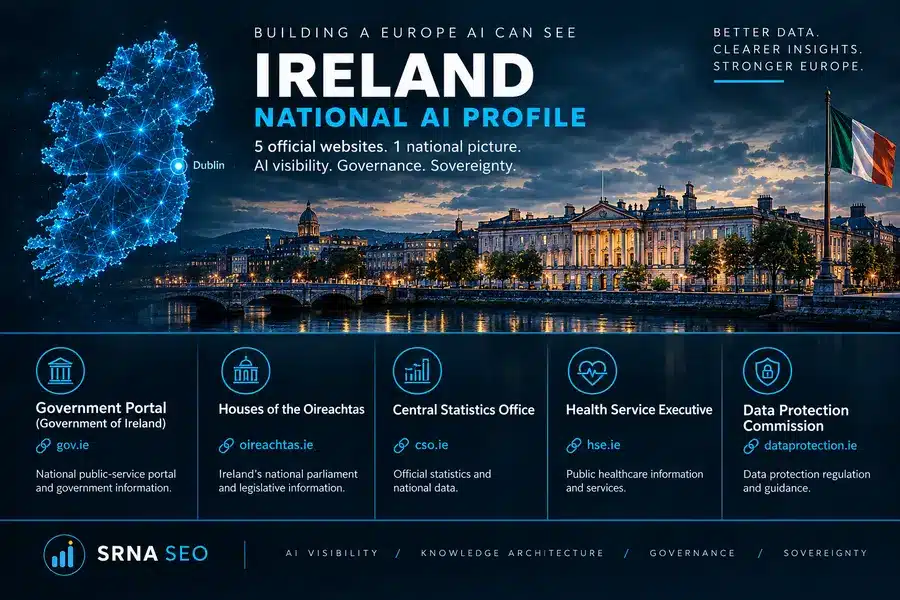
The five audited institutions are the ones that speak for the Irish state to the public: the national portal for government services, the parliament, the data protection regulator, the health service and the statistics office. Each sits on its own domain. These are the pages an AI system is most likely to be asked about when someone wants to know what the government offers, what the Oireachtas is debating, what the regulator has decided, where to find care or what the latest national figure is. The audits measure whether those pages are readable, verifiable and current to a machine.
The pages carry live, time-sensitive public information. The audited queries include Budget 2027 on both the gov.ie and Oireachtas pages, Budget Statements and a Financial Resolution in the Government Business listing, industrial action (work to rule) at the HSE that commenced on 30 September, the Survey on Income & Living Conditions “now under way” at the CSO, and a final decision and a €403 million fine among the Data Protection Commission’s headlines. The gov.ie page also carries a notice about AI search on gov.ie and a request for feedback on it.
The result is split. Three of the five pages have a single H1 and a clean heading hierarchy. The two others do not: the Data Protection Commission has two H1 tags and the CSO has none. Across all five pages there is one JSON-LD block, a WebSite block on gov.ie. Four of the five pages carry no schema at all.
The Profile in One View
The five Irish institutions average 51.8 on the AI Retrieval Index. No institution reaches a B. Three score Grade C (Fair) and two score Grade D (Poor). The spread between best and worst is 19 points.
| Institution | AI Retrieval Index | Grade | Structure | Depth | Schema |
|---|---|---|---|---|---|
| Data Protection Commission | 57 | C — Fair | C | B | D |
| Government of Ireland (gov.ie) | 56 | C — Fair | A | C | D |
| Houses of the Oireachtas | 56 | C — Fair | A | B | F |
| Health Service Executive (HSE) | 52 | D — Poor | A | C | D |
| Central Statistics Office (CSO) | 38 | D — Poor | C | B | F |
| Average | 51.8 |
Dimension averages across the five, with the averages reported in the Hungary, Greece and German National AI Profiles for reference:
| Dimension | Ireland average | Ireland range | Hungary average | Greece average | Germany average |
|---|---|---|---|---|---|
| Structural Integrity | 86.0 | 60–100 | 98.0 | 58.0 | 74.0 |
| Data Extractability | 73.2 | 57–85 | 76.0 | 73.8 | 68.4 |
| Entity Clarity | 46.0 | 40–55 | 55.0 | 55.0 | 55.0 |
| Schema & Metadata | 26.0 | 0–35 | 23.0 | 32.0 | 31.0 |
| Freshness & Decay | 14.2 | 0–53 | 9.0 | 22.8 | 21.4 |
| AI Retrieval Index | 51.8 | 38–57 | 55.8 | 49.4 | 51.8 |
The main finding: Irish public pages are readable where they are built cleanly, and they declare almost nothing. Structure averages 86.0 and extractability 73.2. Schema averages 26.0 and freshness 14.2, and Entity Clarity is 46.0, the lowest of the four countries compared here. Ireland’s overall average of 51.8 equals Germany’s exactly, and it comes from a different mix: 12.0 points more structure than Germany, and 9.0 fewer on Entity Clarity, 5.0 fewer on schema and 7.2 fewer on freshness.
Other measured indicators:
- Three single-H1 pages and two H1 faults. The single-H1 check passes at gov.ie, the Oireachtas and the HSE. It fails at the Data Protection Commission (two H1 tags) and the CSO (no H1 tag). Structural decay alerts were raised at all five institutions: two for H1 structure and three for missing date signals.
- One JSON-LD block in the whole set. gov.ie carries a valid WebSite block. The other four institutions have no JSON-LD. Organization, Person and Article schema were not detected at any of the five.
- Knowledge-graph anchoring (sameAs links) scored 0/100 and Entity Connectivity scored 0 at all five institutions.
- Freshness scored 0 at the HSE and gov.ie, 8 at the Oireachtas and 10 at the CSO. Only the Data Protection Commission scores above 50, at 53.
- The CSO scores 0 on Schema & Metadata. It fails JSON-LD, meta description, canonical URL and Open Graph tags, and passes only the robots check.
How the Five Engines Read the Irish Pages
The research scores each page against five engines, each with a defined role: Perplexity (The Researcher), OpenAI / ChatGPT (The Generalist), Claude (The Semanticist), Google Gemini (The Integrator) and Microsoft Copilot (The Knowledge Connector). The audit also gives each engine an estimated citation percentage.
| Engine | Average score | Average citation estimate | Best institution | Weakest institution |
|---|---|---|---|---|
| Claude | 71.0 | ~37.0% | Oireachtas (80) | CSO (58) |
| OpenAI / ChatGPT | 69.0 | ~45.8% | Oireachtas (78) | CSO (60) |
| Microsoft Copilot | 53.8 | ~32.6% | gov.ie (66) | CSO (44) |
| Perplexity | 47.0 | ~38.4% | DPC (57); gov.ie (~59% cited) | CSO (33) |
| Google Gemini | 37.6 | ~18.2% | DPC (46) | CSO (21); HSE (~15% cited) |
Gemini is the weakest engine for Ireland, as it was for Hungary and Greece. It has the lowest average score (37.6) and the lowest average citation estimate (~18.2%). The audit flags the same two gaps at all five institutions: no Article or Person JSON-LD, which leaves E-E-A-T unverifiable, and a missing Person and Organization pairing. Image alt-text coverage is flagged at three: 25% at the HSE and gov.ie, and 80% at the Data Protection Commission. A missing canonical or meta description is flagged at the CSO and the Oireachtas. Gemini’s citation estimate stays within a narrow band of ~15% to ~21% at every institution, while its score ranges from 21 to 46.
Claude splits on the H1. At the three institutions with a single H1, Claude scores 73 to 80 and its citation estimate is ~45% to ~46%. At the two without one, it scores 65 and 58 and the estimate falls to ~25% and ~23%. The Data Protection Commission is flagged for multiple H1 tags (2) and the CSO for no H1 found. The three clean-H1 pages average 77.3 on score and ~45.7% on citation estimate, and the two others 61.5 and ~24.0%. The audit flags absent author or Person schema at all five institutions.
ChatGPT is the highest-scoring engine after Claude and the most stable. It scores 60 to 78 with citation estimates of ~40% to ~50%. The Oireachtas scores highest (78, ~50%) and the CSO lowest (60, ~40%). Weak entity signals are flagged at every institution. The audit describes content depth at the HSE as moderate (545 words) and recommends 600 or more. At the CSO it flags a partial heading hierarchy.
Copilot scores best where a JSON-LD block exists. gov.ie, the only institution with JSON-LD, scores 66 with a ~46% citation estimate. The four institutions without JSON-LD score 44 to 57 with estimates of ~26% to ~33%. Copilot flags missing Article and Person schema at all five, no valid JSON-LD blocks at the four without any, the two H1 tags at the Data Protection Commission, the missing H1 at the CSO, and the missing canonical URL at the CSO and the Oireachtas.
Perplexity’s citation estimate does not follow its score. The Data Protection Commission scores highest on Perplexity (57, ~43%). gov.ie scores 49 and carries the highest estimate (~59%), and it is the only institution where the audit raises no Perplexity issue (“core citation signals detected”). The other four are flagged for no JSON-LD schema, and the CSO also for a missing meta description and canonical URL. The CSO is lowest on both measures (33, ~17%).
Against Greece and Hungary, Ireland sits between them on Claude, ChatGPT and Perplexity, and below both on Copilot and Gemini. Ireland’s Claude average of 71.0 is 9.8 points above Greece’s 61.2 and 8.4 below Hungary’s 79.4. ChatGPT is 5.2 above Greece and 7.6 below Hungary. Copilot is 2.2 below Greece and 12.2 below Hungary. Perplexity is 0.6 above Greece and 0.8 below Hungary. Gemini is 2.0 below both.
What the Five Audits Reveal
Structure is strong where the H1 is right. Structural Integrity averages 86.0 (range 60–100). gov.ie, the Oireachtas and the HSE score 100 on all five checks. The Data Protection Commission scores 70 and the CSO 60. H2 sub-sections and balanced heading density pass at all five. The Data Protection Commission fails the single-H1, logical nesting and fragmented-intent checks, with two H1 tags. The CSO fails the single-H1 and logical nesting checks, with no H1 tag.
Extractability is solid, and breaks on tables. Scores run from 57 (HSE) to 85 (Oireachtas), averaging 73.2. Word density (300+ words) and list structures pass at all five. Table / structured data fails at all five. Image alt-text coverage fails at the Data Protection Commission (2 images missing alt text), the HSE (3) and gov.ie (3). The Oireachtas has one image missing alt text and still passes the check, and the CSO passes. Internal link density fails at the HSE only, which is the lowest extractability score in the set.
Entity clarity is middling and the lowest of the four countries compared. Scores run from 40 (CSO) to 55 (gov.ie), averaging 46.0. Primary entity tokenization passes at all five. Article / content schema, Author / Person schema and Organization schema fail at all five. Open Graph Title passes at four institutions and fails at the CSO.
Schema and metadata is the second-weakest dimension, and the checks are uneven. Scores run from 0 to 35, averaging 26.0. JSON-LD is present at one institution. The robots check passes at all five. The canonical check fails at the CSO and the Oireachtas. The meta description and Open Graph tag checks fail at the CSO only. gov.ie passes all five checks and scores 35 (Grade D). The Data Protection Commission and the HSE, with no JSON-LD, also score 35. The Oireachtas scores 25 and the CSO 0.
Freshness is the weakest dimension. Scores run from 0 to 53, averaging 14.2. The Data Protection Commission scores 53: a date is detected through text or meta tags, content age passes the 180-day and 12-month checks, and update-frequency signals are present. It fails JSON-LD dateModified, the publish and modified pair and the content-updated check. The CSO scores 10, with the content read as 7.1 years old without a recorded update. The Oireachtas scores 8, with only the update-frequency check passing. The HSE and gov.ie score 0 on every freshness check.
Trust and authority signals are close to zero. Entity Connectivity is 0 and KG Anchoring is 0 at all five institutions. E-E-A-T Density is 5 at the Data Protection Commission and the HSE, 4 at gov.ie, 3 at the CSO and 0 at the Oireachtas. The breakdown shows 2 authoritativeness signals at the Data Protection Commission, and 1 trustworthiness signal each at the HSE, the CSO and gov.ie. No institution shows an expertise or experience signal. Semantic Richness averages 42.8 (range 31–52), with the audit rating the HSE (31) and the Data Protection Commission (37) as thin content.
Entity graph stability varies more than any other measure. Entity Graph Stability averages 59.6 (range 49–76). The Data Protection Commission (76) and the CSO (63) are rated Moderate. gov.ie (53), the HSE (57) and the Oireachtas (49) are rated Fragmented. The Schema sub-score is 0/20 at all five, including gov.ie. The Queries sub-score ranges from 0/10 at the CSO to 9/10 at the Data Protection Commission. The Greek average was 32.2 and the Hungarian 68.0.
Queries are plentiful, and interface text is among them. The audits detect 122 queries across the five pages (18, 27, 28, 27 and 22). 80 are flagged eligible, and eligibility estimates range from 37% to 59%. The CSO has none flagged eligible. Interface text is read as topics: cookie notices and preferences at gov.ie, a “Warning” notification and an outdated-browser message at the HSE, “Search tips”, “Schedules Mailing List” and “Normal View” at the Oireachtas, “header Menu” and “Site Search” at the Data Protection Commission, and “Show Menu” and “Follow us” at the CSO.
Entity detection finds commercial entities on public pages. “Product / Service” is detected as a Commercial Entity at four institutions: 81% at the HSE and gov.ie, 55% at the CSO and the Oireachtas. An Organization brand entity is detected at the Data Protection Commission, the HSE and gov.ie. It is not detected at the CSO or the Oireachtas, where the only entities are interface labels, a commercial entity and, at the Oireachtas, “Artificial Intelligence” (65%). No topic clusters were detected on any page.
Institution Profiles
Government of Ireland (gov.ie)
Website audited: https://www.gov.ie/en/
Role: The national government portal. The Inspector reads the page as being about “Government of Ireland: Welcome to gov.ie”. The detected content covers search for services or information, welfare supports, working supports, becoming a parent, education, your property, additional assistance, departments, auto-enrolment, Budget 2027, the Government Digital Wallet, a notice about AI search on gov.ie with a request for feedback, and cookie notices and preferences.
Audit result: 56 – Grade C (Fair) · Structure A · Depth C · Schema D
| Structural | Extractability | Entity Clarity | Schema & Metadata | Freshness |
|---|---|---|---|---|
| 100 (A) | 69 (C) | 55 (C) | 35 (D) | 0 (F) |
Strongest findings:
- It is the only institution with JSON-LD: one valid WebSite block. It passes all five metadata checks (JSON-LD, meta description, canonical, Open Graph tags and robots).
- Entity Clarity of 55 is the highest in the set.
- Perplexity scores 49 with a ~59% citation estimate, the highest Perplexity estimate in the set, and the audit raises no Perplexity issue.
- Copilot scores 66 (~46%), the highest in the set. Claude scores 79 (~46%) and ChatGPT 74 (~50%).
- gov.ie is detected as an Organization brand entity at 68% confidence. 18 of 22 queries are flagged eligible.
Weaknesses:
- Freshness is 0. There is no dateModified, no machine-readable date and no update signal.
- Passing all five metadata checks earns only 35 (Grade D). The WebSite block carries no Organization, Person or Article schema, and Entity Connectivity and KG Anchoring are 0.
- 3 images lack alt text (25% coverage), and Gemini flags it. Gemini scores 43 with a ~16% citation estimate. The table / structured data check also fails.
- Entity Graph Stability is 53 (Fragmented), with Co-occurrence at 0/15 and the Schema sub-score at 0/20.
- “Product / Service” is detected as a Commercial Entity at 81% confidence. “Author / Expert” is detected as a Person at 55% with no schema.
- Cookie text takes up five of the 22 queries, among them “a notice about cookies”, “manage cookie preferences” and “embedded media cookies”.
What it means for AI systems: This is the page citizens use to reach the state, and it tells an engine that the site exists without saying who runs it. The page promotes AI search of its own and a digital wallet. The markup an outside engine reads carries no organization, no author and no date.
Houses of the Oireachtas
Website audited: https://www.oireachtas.ie/en/
Role: The parliament. The Inspector reads the page as being about “Houses of the Oireachtas website”. The detected content covers the Dáil Éireann and Seanad Éireann schedules, the schedule of meetings, Oireachtas TV, the Parliamentary Budget Office budget briefing and Budget 2027 analysis, the Presidency of the Council of the EU, finding a current TD or Senator, news and press releases, exploring the Dáil Chamber, Bills and Acts, Dáil, Seanad and committee debates, and Government Business (Budget Statements, an Allocation-of-Time motion by the Government Chief Whip and a Financial Resolution).
Audit result: 56 – Grade C (Fair) · Structure A · Depth B · Schema F
| Structural | Extractability | Entity Clarity | Schema & Metadata | Freshness |
|---|---|---|---|---|
| 100 (A) | 85 (B) | 45 (D) | 25 (F) | 8 (F) |
Strongest findings:
- Extractability of 85 is the highest in the set. Structural Integrity is 100.
- Claude scores 80 (~46%) and ChatGPT 78 (~50%), the highest of either engine in the set.
- 24 of 27 queries are flagged eligible, and they come from substantive parliamentary content: schedules, debates, the Budget and Bills.
- Meta description, Open Graph tags and robots pass, and the update-frequency check passes.
Weaknesses:
- No JSON-LD and no canonical URL. Perplexity (51, ~33%) and Copilot (52, ~27%) both flag the missing canonical.
- Freshness is 8. The page text reads “Today, 12 Oct”, and it also reports “No business is currently scheduled”, yet no date is machine-readable.
- E-E-A-T Density is 0 with no signals at all, the only institution with none.
- Entity Graph Stability is 49 (Fragmented), the lowest in the set: Secondary 9/20, Co-occurrence 2/15, Queries 3/10.
- No Organization entity is detected. The only detected entities are “Artificial Intelligence” (65%), “Product / Service” (55%) and “Normal View” (48%).
- Gemini scores 38 with a ~21% citation estimate, and Gemini flags the missing canonical or meta.
- Interface text appears as topics: “Search tips”, “Schedules Mailing List” and “Normal View”.
What it means for AI systems: This is the most time-sensitive page in the set, built on daily schedules, debates and Budget business. An engine reads its structure well and cannot confirm which organization publishes it or when a schedule was written.
Data Protection Commission
Website audited: https://www.dataprotection.ie/en
Role: The data protection regulator. The Inspector reads the page as being about “Homepage | Data Protection Commission”, and a detected sentence describes it as the national independent authority responsible for [the audit truncates the sentence]. The detected content covers a final decision following an inquiry into Children’s Health Ireland (CHI), a fine of €403 million following an inquiry into Google’s processing of location data, an AI Insights Report, information for organisations and for Data Protection Officers, individuals’ data protection rights, news and media, and contact details.
Audit result: 57 – Grade C (Fair), the highest in the set · Structure C · Depth B · Schema D
| Structural | Extractability | Entity Clarity | Schema & Metadata | Freshness |
|---|---|---|---|---|
| 70 (C) | 80 (B) | 45 (D) | 35 (D) | 53 (D) |
Strongest findings:
- It has the highest AI Retrieval Index of the five (57) and the highest freshness score (53): a date is detected through text or meta tags, content age passes both checks and update-frequency signals are present.
- Entity Graph Stability is 76, the highest in the set, with Secondary 20/20, Co-occurrence 12/15 and Queries 9/10. 17 of 18 queries are flagged eligible.
- Perplexity scores 57 and Gemini 46, the highest of either engine in the set. ChatGPT scores 67 (~48%).
- The organization is detected as a brand entity at 73% and 68%, and “Artificial Intelligence” as a primary concept at 73%.
- Meta description, canonical, Open Graph tags and robots pass. E-E-A-T Density is 5, with 2 authoritativeness signals.
Weaknesses:
- Two H1 tags. The single-H1, logical nesting and fragmented-intent checks fail, and a structural decay alert reads “fragmented intent detected”.
- Claude scores 65 with a ~25% citation estimate, and Copilot flags the two H1 tags.
- No JSON-LD at all. Perplexity and Copilot both flag it. The audit asks for the dates to be moved into JSON-LD.
- 2 images lack alt text (80% coverage), and the table / structured data check fails.
- Semantic Richness is 37, rated thin content.
- “Author / Expert” is detected as a Person at 63% with no schema. “Header Menu” and “Site Search” are detected as concepts.
What it means for AI systems: The regulator’s headlines carry its decisions and fines, and the page reads well to engines on entity stability. It sends a mixed signal on its own structure, with two document roots, and it declares nothing in JSON-LD. A date that sits only in text can be read as current without being verified.
Health Service Executive (HSE)
Website audited: https://www.hse.ie/
Role: The public health service. The Inspector reads the page as being about the “HSE website”. The detected content covers health information, advice, supports and services; Health A to Z; living well; schemes and allowances; screening and vaccinations; medical cards; the European Health Insurance Card (EHIC); finding urgent and emergency care; HSE Live; the HSE Health App and HSE Account; a sepsis campaign (“Every second counts”, “Could it be sepsis?”); free HRT; and a notice that industrial action (work to rule) commenced on 30 September.
Audit result: 52 – Grade D (Poor) · Structure A · Depth C · Schema D
| Structural | Extractability | Entity Clarity | Schema & Metadata | Freshness |
|---|---|---|---|---|
| 100 (A) | 57 (C) | 45 (D) | 35 (D) | 0 (F) |
Strongest findings:
- Structural Integrity is 100.
- Claude scores 73 (~45%) and ChatGPT 66 (~41%).
- The queries cover high-value public tasks: medical cards, EHIC, urgent care, screening and sepsis. 21 of 27 are flagged eligible, and an FAQ-type query on symptoms, self-care and treatment reaches 59%, the highest eligibility in the set.
- Meta description, canonical, Open Graph tags and robots pass. The organization is detected as HSE.ie (68%) and “Organization / Brand” (63%).
Weaknesses:
- Freshness is 0, though the page announces industrial action that commenced on 30 September.
- Internal link density fails, the only such failure in the set, and Extractability is 57 (Grade C), the lowest in the set. ChatGPT flags content depth as moderate at 545 words.
- 3 images lack alt text (25% coverage). Gemini scores 40 with a ~15% citation estimate, the lowest Gemini estimate in the set.
- No JSON-LD, and Perplexity (45, ~40%) and Copilot (57, ~31%) flag it.
- Semantic Richness is 31, the lowest in the set, and Entity Graph Stability is 57 (Fragmented), with Co-occurrence at 4/15 and Queries at 3/10.
- “Product / Service” is detected as a Commercial Entity at 81%, and “Free HRT” is tagged Commercial.
- Interface text appears as queries: a “Warning” notification, an outdated-browser message and “support links”.
What it means for AI systems: This is health information where currency matters: urgent care, sepsis, schemes and an industrial action notice. The page gives an engine nothing to tell it when it was written or updated.
Central Statistics Office (CSO)
Website audited: https://www.cso.ie/en/
Role: The national statistics office. The Inspector reads the page as being about “Home”. The detected content covers the latest statistics, the statistics database (“Explore Statistics”), CSO Surveys and notices, the census and Census 1926, the Business in Ireland series, Hubs and Interactive Apps, CSO Visualisations, births, deaths and marriages, crime and justice, social conditions, the information society, the Residential Property Price Index, the Survey on Income & Living Conditions “now under way”, an invitation to take part in household surveys, careers and recruitment, and a “Why you can trust the CSO” section.
Audit result: 38 – Grade D (Poor), the lowest in the set · Structure C · Depth B · Schema F
| Structural | Extractability | Entity Clarity | Schema & Metadata | Freshness |
|---|---|---|---|---|
| 60 (C) | 75 (B) | 40 (D) | 0 (F) | 10 (F) |
Strongest findings:
- Extractability is 75: word density, list structures, internal link density and alt-text coverage all pass.
- Semantic Richness is 52, the highest in the set, and Entity Graph Stability is 63 (Moderate), with Primary 20/20 and Secondary 18/20.
- ChatGPT scores 60 (~40%).
- The page states its own trustworthiness in prose, with sections such as “Why you can trust the CSO” and a statement that its statistics are independently verified, and the audit registers one trustworthiness signal.
- The robots check passes.
Weaknesses:
- No H1 tag. The single-H1 and logical nesting checks fail, and the decay alert reads “No H1 tag found — AI parsers cannot anchor a primary topic.”
- Schema & Metadata is 0. The page fails JSON-LD, meta description, canonical URL and Open Graph tags. Open Graph Title also fails, and Entity Clarity is 40.
- Freshness is 10. The Inspector reads the content as 7.1 years old without a recorded update, and it recommends a refresh.
- Perplexity scores 33 (~17%) and Gemini 21 (~18%), the lowest of both in the set. Claude scores 58 (~23%) and Copilot 44 (~26%).
- None of the 28 queries is flagged eligible (37–46%). Several are bare figures with no label: 4.1%, 5.0%, 0.6%, 5.5%, 10.2% and 5.15 million.
- No Organization entity is detected. “Product / Service” is detected as a Commercial Entity at 55%, and the Residential Property Price Index query is tagged Commercial.
What it means for AI systems: The statistics office is the source of national figures, and its homepage shows those figures to an engine as unlabelled numbers. There is no H1 to say what the page is about, no date and no publisher in markup. The same page says why it can be trusted, and nothing machine-readable says it.
What This Means
Ireland’s public knowledge layer is readable where it is well built, and unanchored everywhere. Three of five pages parse cleanly. None carries Organization, Person or Article schema, KG Anchoring is 0 at all five, and the single JSON-LD block in the set is a WebSite block on gov.ie. Where an engine asks who stands behind the content, the structured answer is absent at every institution.
The H1 divides Ireland’s results. The three institutions with a single H1 average 77.3 on Claude and ~45.7% on its citation estimate. The two without one average 61.5 and ~24.0%. The two H1 faults are the cheapest fixes in the profile: one H1 on each page.
Freshness is the weakest national measure. The average is 14.2, below Greece (22.8) and Germany (21.4), and above Hungary (9.0). Two of five pages score 0, and one more reads as 7.1 years old. These are the pages where currency matters: Budget 2027 business, an industrial action notice, a survey under way, enforcement decisions and health services.
Five domains mean five fixes. Unlike Hungary, where five pages share a platform, the Irish institutions have no common template to correct. Their patterns differ: one WebSite block, no JSON-LD at four, three H1 states, and a CSO that fails four of five metadata checks. The remedies are the same in kind, applied five times.
Ireland matches Germany’s average by a different route. Both finish at 51.8. Ireland has more structure (86.0 against 74.0) and extractability (73.2 against 68.4), and it has less Entity Clarity (46.0 against 55.0), schema (26.0 against 31.0) and freshness (14.2 against 21.4). Against Greece, Ireland leads by 2.4 points, because its structure is 28.0 points higher while it trails on entity, schema and freshness. Hungary leads Ireland by 4.0.
The entity layer is empty, and the audit finds commercial entities where it should find public bodies. “Product / Service” is detected at four of five government pages. The Oireachtas and the CSO are not detected as organizations at all. No institution declares itself as an Organization, a Person or a knowledge-graph entity.
The fixes are metadata, and the pages already pass on word density, lists and robots.
- Consolidate the two H1 tags on the Data Protection Commission page, and add one H1 to the CSO page.
- Add JSON-LD to the Data Protection Commission, the HSE, the CSO and the Oireachtas, and add Organization schema with sameAs links to Wikipedia or Wikidata at all five.
- Add datePublished and dateModified to JSON-LD at all five, including the Data Protection Commission, where dates exist only in text.
- Add a canonical URL to the CSO and the Oireachtas, and a meta description and Open Graph tags to the CSO.
- Add Person schema for named authors and Article schema for news items.
- Add alt text to the nine images missing it at four institutions, fix internal link density at the HSE, and add tables or structured data at all five.
Scope and Method
What was audited. Five Irish public institutions, one page each, using the AI Visibility Inspector and Srna SEO Frameworks. All five audits were generated on 12 October 2026. These five websites were chosen because they are representing the Irish doors to publicity.
What the research measures. Each report gives an AI Retrieval Index and grade, Structure, Depth and Schema sub-grades, and five scored dimensions: Structural Integrity, Data Extractability, Entity Clarity, Schema & Metadata, and Freshness & Decay. It adds scores for five engines (Perplexity, OpenAI / ChatGPT, Claude, Google Gemini, Microsoft Copilot) with estimated citation percentages, a Schema Intelligence section (validation, entity connectivity, KG anchoring, E-E-A-T density, semantic richness), query eligibility and an entity graph stability score.
Boundaries
- One page per institution. Subpages, PDFs and other domains are not covered.
- Findings describe each page on the audit date.
- Averages are simple means of the five institutional scores. Hungarian, Greek and German comparison figures are those published in the Hungary and Greece profiles.
- The reports produce two freshness blocks per page. The scores matched within each institution.
- The audit’s scoring is not fully reconciled. gov.ie passes all five metadata checks and scores 35, the same as the Data Protection Commission and the HSE, which have no JSON-LD. The Oireachtas has one image missing alt text and passes the alt-text check, while the Data Protection Commission, with two, fails it. The Inspector does not explain either result.
- The CSO’s content age (7.1 years) is the Inspector’s reading, and the report does not say which date it read.
- Entity and query detection is automated and produces artefacts. Interface text is read as queries and entities, English phrases are wrapped in a “What is” template, some queries are cut off mid-sentence, and “Product / Service” is read as a commercial entity. Queries and entity labels are quoted as the audit displays them.
- Every report lists the same secondary content gaps (for example Large Language Model, Dark Funnel). The list is generic and is not interpreted here.
- Citation figures are the Inspector’s estimates, not observed citations in live engine answers.
- Headlines, decisions and figures named in the institution profiles are those detected on the audited pages. They are reported as page content and are not independently verified.
How Does Your Institution Read to AI?
The five Irish institutions above were read with the same tool available to any organization. The AI Visibility Inspector produced each report in this profile.
Run your own homepage and compare it with the five profiles above: the H1 count, the schema blocks, the dates, the Person and Organization declarations and the five engine scores. If the pattern matches, the cost is the same. The AI Visibility Cost of Inaction Calculator lets you enter your own figures and see the exposure for your organization.
For a deeper reading, the Knowledge Exposure Audit and the Agent Exposure Audit extend the inspection beyond a single page. For fixes, see the relevant frameworks.
Calculate Your Potential Exposure
Reading poorly to AI has a cost. The AI Visibility Cost of Inaction Calculator lets you enter your own figures and see the exposure for your organization.
Inputs
Enter your own data where possible. Hover over labels or open “Methodology” for details on how each field is used.
From GA4, GSC, or your SEO platform. Use a 30–90 day average.
Session → lead / signup / purchase. Use decimal (e.g. 1.2 for 1.2%).
For B2B, use average deal value or LTV. Currency is symbolic here.
Used to show profit‑based cost of inaction. Leave at 100 to ignore.
Share of organic traffic from queries/pages likely to be influenced by AI answers and retrieval systems.
Based on observed traffic loss patterns in AI search and structural decay cases.
Expected organic growth if you do nothing special about AI visibility.
Plausible uplift over the chosen horizon based on case studies.
How these numbers are calculated (methodology)
Let:
- O₀ = monthly organic sessions
- CVRₒ = organic conversion rate (as a decimal)
- ARPC = average revenue per conversion
- GM = gross margin (as a decimal)
- E = AI exposure share (as a decimal)
- D = displacement rate (as a decimal)
- T = time horizon in months
Baseline monthly revenue:
- Revenue: \(R_0 = O_0 imes CVR_o imes ARPC\)
- Profit: \(R_{0,profit} = R_0 imes GM\)
Monthly revenue at risk (for a given D):
- \(R_{risk} = R_0 imes E imes D\)
- Profit version: \(R_{risk,profit} = R_{risk} imes GM\)
The tool computes R_risk for three scenarios:
- Conservative: D = 0.15
- Base: D = 0.30 (or your selected scenario)
- Aggressive: D = 0.50
Cost of Inaction over T months is approximated as:
- \(CoI(T) = R_{risk} imes T\)
- Shown as a range from conservative to aggressive.
The growth inputs (g₀, g₁) are currently used for narrative context and can be incorporated into a more advanced version that models opportunity cost explicitly.
