

In This Article
You have been told to add “GEO schema” to your site, and nobody can show you which schema that is.
There is no separate GEO schema. SEO schema and GEO schema use the same schema.org vocabulary, and the only difference is the job you give the markup: rich result eligibility for classic search, entity clarity and attribution for AI. Schema markup for AI search is worth doing for that second job. But the evidence says it is infrastructure, not a citation lever, so the work is to get it correct and then stop polishing it.
I have 25 years in SEO and 7 inside global enterprises, and I have watched schema be oversold three times. This is the fourth. The sections below separate what is documented from what is marketing.
What schema markup is, and where “GEO schema” comes from
Schema markup (structured code, usually JSON-LD, that labels what a page is about, who wrote it and who published it) uses the schema.org vocabulary, which Google, Microsoft, Yahoo and Yandex built together. It is one shared vocabulary. Nobody maintains a second one for generative engines.
“GEO schema” is a label vendors attach to ordinary schema.org types when they sell it for AI visibility. The guides I read confirm this. A vendor guide titled “Structured Data for GEO” recommends Article, FAQPage, Organization and Person, which are standard types, and describes no GEO-specific vocabulary. Google’s position is even clearer. Its documentation on optimizing for generative AI features says structured data is not required and there is no special schema.org markup to add, as Search Engine Journal reported in May 2026.
So the term is misleading. It suggests a second technical standard exists. It does not. What exists is one standard and two different jobs.
There is one vocabulary and two jobs. Calling the second job “GEO schema” only makes the first one harder to get right.
SEO schema vs GEO schema: what actually differs
| Question | The classic SEO job | The AI search job |
|---|---|---|
| Which vocabulary? | schema.org | schema.org, the same one |
| What is the goal? | Eligibility for rich results | Clear entities and clear attribution |
| Who reads it? | Google’s index pipeline | Google’s pipeline, Bing’s systems, and AI crawlers with unclear behavior |
| What does “correct” mean? | Passes validation for a feature | Matches the visible page, with stable IDs linking the entities |
| How do you know it worked? | A rich result appears | Not enough available data for a reliable measure |
The last row is the honest one. A rich result is visible. A citation caused by markup is not.
How structured data relates to generative retrieval
The clearest framing I found comes from a guide that splits schema into three places it can act: at Google’s indexing stage, in model training, and at query time. It is one author’s framework, so I use it as a lens, not as an authority.
Index time: where schema does real work
Google extracts JSON-LD and uses it to identify which entity a page describes and to match it against its Knowledge Graph (Google’s database of known entities). Schema helps most with new entities, ambiguous names and precise attributes, according to that guide. It also reports that Ryan Levering, a Google structured data engineer, said at Search Central Live Toronto in April 2026 that this pipeline feeds Google’s generative AI systems, and that schema is used as context served to models when doing fanouts. That comes secondhand, so treat it as reported, not confirmed.
Microsoft has said something similar. Fabrice Canel of Bing reportedly confirmed at SMX Munich that schema markup helps Microsoft’s LLMs understand content, according to Search Engine Land. That account is secondhand too, via a LinkedIn post, and the article notes it is unclear whether Gemini, OpenAI or Perplexity use schema at all.
Training time: indirect and weak
The same guide argues that structured data rarely survives the cleaning of training datasets, and that any benefit arrives indirectly, through entities anchored in sources like Wikidata. I cannot verify the claim about proprietary training corpora, because they are not documented. So I do not build a strategy on it.
Query time: where the evidence is least encouraging
When an assistant fetches a live page to answer a question, it appears to read the visible text. The guide cites an October 2025 searchVIU experiment in which ChatGPT, Claude, Perplexity, Gemini and Google AI Mode all ignored JSON-LD and relied on visible HTML. And an Ahrefs study from May 2026 looked at 1,885 pages that added JSON-LD and found no significant citation uplift over 30 days: +2.2% in ChatGPT, +2.4% in Google AI Mode, and a small, statistically significant drop of 4.6% in AI Overviews.
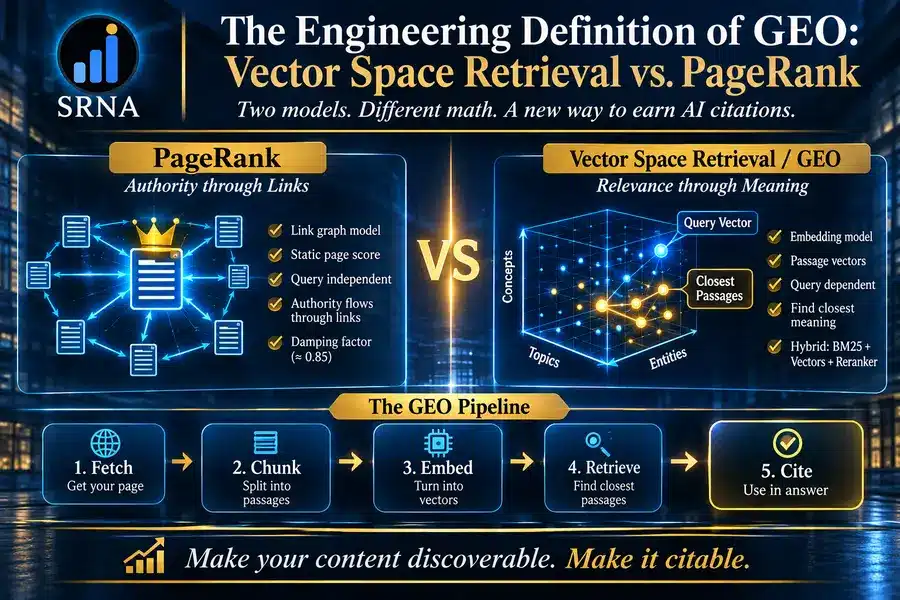
That study measured query-time effects only. It says nothing about index-time or training effects. If you want the retrieval mechanics underneath, I explain them in Engineering Definition of GEO: Vector Space Retrieval vs PageRank.
Which schema markup matters most for AI search visibility
I rank types by how much entity clarity they add, not by any proven citation effect. Nobody has proven one per type. This is my own prioritization, from enterprise work.
| Priority | Type | Why it matters | Rule |
|---|---|---|---|
| 1 | Organization, with sameAs | States who you are and links your official profiles | One description, matching every other source |
| 2 | Person, for authors | Ties a claim to a named expert | Link to a real author page |
| 3 | Article or BlogPosting | States author, publisher and dates | Do not fake dateModified |
| 4 | Product or Service | States what you offer | Only for things that exist on the page |
| 5 | BreadcrumbList and WebSite | Clarifies structure | Keep it simple |
| 6 | FAQPage | Only where the page has real Q&A | Expect no visual rich result |
On FAQPage: the guide reports Google removed the visual FAQ rich result on 7 May 2026, though the markup is still parsed. So add it only when the page has real questions, not for a feature that no longer shows.
Two rules apply to every type. First, markup must match what the visitor sees. Google’s policies require this, and mismatches risk a manual action. Second, give each entity one stable ID. In schema, an @id is a unique identifier that lets separate pieces of markup refer to the same entity. Momentic’s guide advises defining each entity once and never reusing the ID for something else, and warns that standard validators do not flag @id errors. You have to check those yourself.
I judge whether markup is good enough with my Schema Confidence Score. The entity side is scored by the Entity Clarity Index, and how the markup fits into page structure is in my Section Hierarchy Developer Blueprint.
Not sure if your markup says the same thing as your pages and profiles?
My Knowledge Exposure Audit (my structured check of what AI systems can find, and misread, about your organization) tests exactly that. If you are an SEO Manager or Head of Digital who has to explain it to a CMO, talk to me.
This is not a citation lever. Ahrefs found no significant uplift from adding JSON-LD, and I would not tell a CFO otherwise, but personally, I am using schema on my site with reason.
It is not a new vocabulary. If a vendor sells “GEO schema” as something beyond schema.org, ask them which property it is.
It is not a vendor multiplier either. One vendor guide reports pages with Article, FAQPage and Speakable earning AI Overview citations at 2.8 times the rate of Article alone, from 34 client audits. Very similar result I got on my site. Schema usually travels with better content and stronger entities, so correlation is expected.
It is not a replacement for visible content. If a fact is only in your markup, the evidence above suggests many AI systems will not see it. Put it on the page first.
And it is not a one-off job. Redesigns and theme changes can silently remove markup, and my diagnosis framework for SEO traffic drops after a redesign is a reason to recheck it after any rebuild.
Schema does not make you citable. It makes you identifiable, and only visible, checkable content makes you citable.
A 30-day order of work
This is my suggested sequence from experience with enterprise teams. It is not a measured benchmark.
| Week | Focus | Output |
|---|---|---|
| 1 | Inventory | What markup exists, by template, and whether it matches the visible page |
| 2 | Entities | One approved description, stable @id per entity, Organization and Person fixed |
| 3 | Templates | Article and Product or Service markup corrected on the main templates |
| 4 | Consistency | Profiles and directories matched to the markup, baseline of 20 to 30 buyer questions recorded |
If your organization runs several sites or brands, week two takes longest, because someone has to own the description. That is a governance problem first. Wrong or conflicting data tends to surface in answers later, which I write about in When AI Gets It Wrong, Humans Make It Dangerous. Page structure and architecture come next, and my Blueprint for Designing Websites for AI Interpretation and the AI-Ready Website Architecture Blueprint cover them. For the wider public knowledge sources that systems draw on, see National Digital Knowledge Layer.
What gain to expect
The best number I have is the Ahrefs result above, and it says no significant uplift in citations within 30 days from query-time markup alone. That is not the same as no value, because it did not test index-time or training effects. Think of schema as the cost of being clearly identifiable. You pay it to avoid being misread, not to win a ranking.
Measure with a fixed set of 20 to 30 buyer questions, checked monthly in more than one AI engine, same method each time.
Want your markup and entities fixed in order, with your own numbers?
My Enterprise Search Advisory starts with a diagnostic and ends with a plan your IT, legal and SEO teams can all sign. Book a conversation.
FAQ
There is no technical difference. Both use the schema.org vocabulary. The difference is the job: rich result eligibility for classic search, entity clarity and attribution for AI.
No. Google says there is no special schema.org markup to add for generative AI search, and the vendor guide I reviewed used only standard types.
For entity clarity, Organization with sameAs links and Person for authors come first, followed by Article. Not enough available data to say any single type drives citations.
Not reliably. An Ahrefs study of 1,885 pages that added JSON-LD found no significant citation uplift over 30 days, though it tested query-time retrieval only.
Both have reportedly said so, in secondhand accounts. Google’s engineer reportedly described schema as context served to models, and Bing’s Fabrice Canel reportedly confirmed Microsoft’s LLMs use it. Google also says structured data is not required for generative AI search.
Yes, where the page has real questions and answers. The visual FAQ rich result was reportedly removed on 7 May 2026, though the markup is still parsed.
Yes. Google’s policies require it, and a fact that appears only in markup may not be seen by AI systems that read visible text.
Check that it matches the visible page, that each entity has one stable @id, and that your profiles say the same thing. Validators do not catch every @id error, so verify those yourself.
Next step
If you can only do one thing this week, open your home page and one article, compare the Organization and Person markup with what the pages and your LinkedIn profile say, and write down every mismatch. Those mismatches are your first repair list. For a second pair of eyes from someone who has done this inside global enterprises, start with a Search Visibility Diagnostic or contact me directly.
This article was researched and drafted with the assistance of AI tools and reviewed and edited by author prior to publication.
