

In This Article
This research is part of the Building A Europe AI Can See series, which also includes National AI profiles of Austria, Belgium, Croatia, Cyprus, Czechia, Denmark, Estonia, Finland, France, Germany, Greece.
Read also about Greece Flagship companies research.
Why Greece, and Why Now
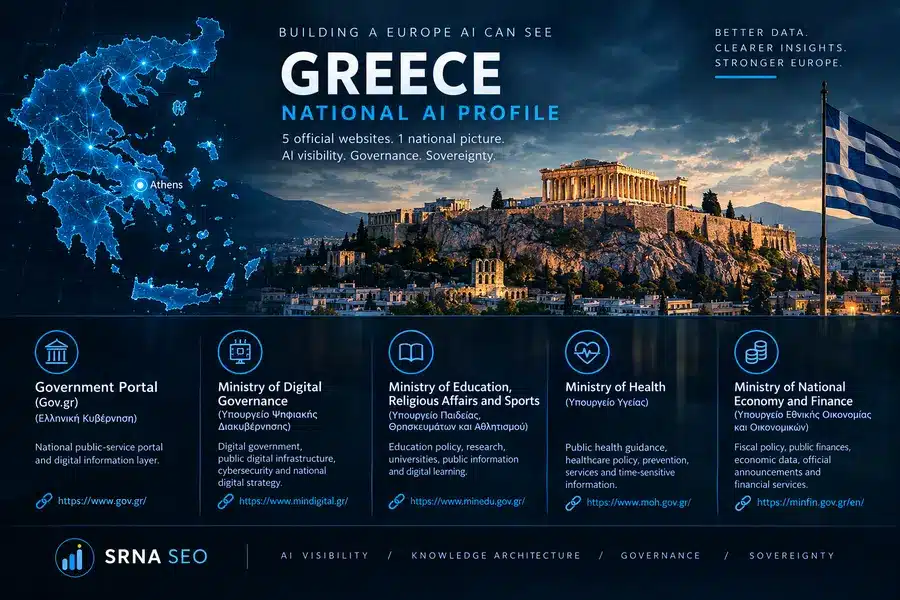
The five audited institutions are the ones that speak for the Greek state: the national portal for public services, the ministry responsible for digital governance, and the ministries of education, health and finance. These are the pages an AI system is most likely to be asked about. The audits measure whether those pages are readable, verifiable and current to a machine.
The question is sharpest for the portal citizens use to reach the state. gov.gr scored 50 (Grade D), with a freshness score of 0 and two H1 tags. The ministry that owns the word digital leads the set at 61, and it is still only a Grade C. It has no H1 tag at all.
The Profile in One View
The five Greek institutions average 49.4 on the AI Retrieval Index. No institution reaches a B. Two score Grade C (Fair) and three score Grade D (Poor).
| Institution | AI Retrieval Index | Grade | Structure | Depth | Schema |
|---|---|---|---|---|---|
| Ministry of Digital Governance | 61 | C — Fair | C | C | D |
| Ministry of National Economy and Finance | 60 | C — Fair | C | B | D |
| Greek Government Portal (gov.gr) | 50 | D — Poor | C | B | D |
| Ministry of Education, Religious Affairs and Sports | 39 | D — Poor | C | B | F |
| Ministry of Health | 37 | D — Poor | D | B | F |
| Average | 49.4 |
Dimension averages across the five, with the German averages from the previous profile for reference:
| Dimension | Greece average | Greece range | Germany average |
|---|---|---|---|
| Structural Integrity | 58.0 | 45–70 | 74.0 |
| Data Extractability | 73.8 | 69–75 | 68.4 |
| Entity Clarity | 55.0 | 40–65 | 55.0 |
| Schema & Metadata | 32.0 | 10–50 | 31.0 |
| Freshness & Decay | 22.8 | 0–63 | 21.4 |
The main finding: Greek public pages are extractable, but not anchored, declared or dated. Extractability averages 73.8 and sits in the narrowest band of any dimension (69–75). Structure averages 58.0, schema 32.0 and freshness 22.8. Against Germany, Greece is level on schema and freshness and 16 points lower on structure.
Other measured indicators:
- No institution has a single H1. Four have no H1 tag and gov.gr has two. Structural decay alerts were raised at all five.
- Person schema and Article schema were not detected at any of the five institutions.
- Knowledge-graph anchoring (sameAs links) scored 0/100 at four institutions. The Ministry of National Economy and Finance scored 30.
- Freshness scored 0 at three institutions: gov.gr, the Ministry of Education, Religious Affairs and Sports, and the Ministry of Health.
- E-E-A-T signals (expertise, experience, authoritativeness, trustworthiness) were detected at none of the five.
How the Five Engines Read the Greek Pages
The research scores each page against five engines, each with a defined role: Perplexity (The Researcher), OpenAI / ChatGPT (The Generalist), Claude (The Semanticist), Google Gemini (The Integrator) and Microsoft Copilot (The Knowledge Connector). The audit also gives each engine an estimated citation percentage.
| Engine | Average score | Average citation estimate | Best institution | Weakest institution |
|---|---|---|---|---|
| OpenAI / ChatGPT | 63.8 | ~41.6% | gov.gr / Finance (68) | Education / Health (59) |
| Claude | 61.2 | ~24.0% | gov.gr (67) | Health (54) |
| Microsoft Copilot | 56.0 | ~40.8% | Digital Governance / Finance (66) | Education (38) |
| Perplexity | 46.4 | ~50.6% | Digital Governance (60) | Health (32) |
| Google Gemini | 39.6 | ~15.4% | Digital Governance (58) | Health (23) |
Gemini is the weakest engine for Greece. It has the lowest average score (39.6) and the lowest citation estimate at four of the five institutions, from ~8% at the Ministry of Education, Religious Affairs and Sports to ~18% at Digital Governance and Finance. At the Ministry of Health, Claude’s ~14% is lower than Gemini’s ~18%. Gemini flags the same two gaps at all five institutions: no Article or Person JSON-LD, which leaves E-E-A-T unverifiable, and a missing Person and Organization pairing. Image alt-text coverage is flagged too: 7% at Digital Governance, 19% at Finance, 37% at Education and 45% at gov.gr.
Gemini’s score follows schema depth. It scores 58 at Digital Governance and 55 at Finance, the two institutions with Organization markup and dated JSON-LD. It scores 38 at gov.gr, 24 at Education and 23 at Health. The average for the first pair is 56.5, for the other three 28.3.
Claude scores well and is cited rarely. Claude averages 61.2 on score but only ~24.0% on citation. Its estimate peaks at ~29% (Digital Governance and Finance) and drops to ~14% at the Ministry of Health, below the lowest Claude figure in the German set (~24%). The recurring Claude flags are the missing H1 (four institutions), two H1 tags (gov.gr) and absent author or Person schema (all five). Health is the only institution where Claude also flags a disordered heading hierarchy.
ChatGPT is the highest-scoring and most stable engine. Scores run from 59 to 68 and citation estimates from ~39% to ~48%, with the top citation figure at gov.gr. Weak entity signals are flagged at all five institutions, and a partial heading hierarchy at every institution except gov.gr.
Copilot scores best where schema exists. It gives 66 (~46%) to both Digital Governance and Finance, and 38 (~25%) to Education, which has no JSON-LD and no canonical link. Copilot flags missing Article and Person schema at all five, and the H1 problem at all five (missing at four, duplicated at gov.gr).
Perplexity’s citation estimate runs ahead of its score. The average score is 46.4, but the average citation estimate is ~50.6%, the highest of the five engines. At gov.gr the score is 45 and the estimate ~58%. At Health the score is 32 and the estimate ~43%. At Education both are low (36 and ~30%). Perplexity raises no issue at gov.gr, Digital Governance or Finance. At Education it flags no JSON-LD and no canonical, and at Health a missing meta description. The audit does not explain the gap between score and citation estimate, so no reason is claimed here.
What the Five Audits Reveal
Structure is anchored nowhere. Structural Integrity averages 58.0 (range 45–70). The single-H1 check fails at all five: Digital Governance, Education, Health and Finance have no H1, and gov.gr has two. Logical nesting (H1→H2→H3) also fails at all five. Education and Health have no H2 sub-sections, and Education passes only the fragmented-intent check. gov.gr scores highest (70) and Health lowest (45).
Extractability is solid, and breaks on tables and images. Scores run from 69 (Digital Governance) to 75 (the other four). Word density, list structures and internal link density pass at all five. Table / structured data fails at all five. Image alt-text coverage fails at four institutions, which together have 163 images missing alt text: gov.gr 11, Digital Governance 26, Education 96 and Finance 30. Education alone holds 59% of them. Health passes the alt-text check.
Entity clarity is middling. Scores run from 40 (Education) to 65 (Digital Governance and Finance). Primary entity tokenization passes at all five. Article / content schema and Author / Person schema fail at all five. Organization schema passes at two (Digital Governance and Finance). Open Graph Title passes at gov.gr, Digital Governance and Finance, and fails at Education and Health.
Schema and metadata is the second-weakest dimension. Scores run from 10 (Health) to 50 (Digital Governance and Finance). The robots check passes everywhere. JSON-LD is present at four institutions: 11 valid blocks in total, in five types. WebSite appears at gov.gr, Digital Governance and Finance. WebPage appears at Digital Governance, Health and Finance. BreadcrumbList and Organization appear at Digital Governance and Finance, and ImageObject at Finance. Education has no JSON-LD and no canonical link. Health has no meta description. Education and Health both lack Open Graph tags. The two institutions that pass all five metadata checks still score only 50.
Freshness splits the set in three. Digital Governance (63) and Finance (51) carry a machine-readable date signal: dateModified in JSON-LD and a publish and modified pair. gov.gr, Education and Health score 0 on every freshness check. Three of five institutions, including the national services portal, give an AI system no way to read when a page was written or changed. At Finance the Inspector reads the content as 1.8 years old and recommends a refresh. At Digital Governance one freshness block fails the 180-day age check, while the other passes the 12-month check.
Trust and authority signals are near zero. Entity Connectivity is 0 at gov.gr, Education and Health, and 20 at Digital Governance and Finance. KG Anchoring is 0 at four institutions and 30 at Finance, whose Organization block has a sameAs field but no knowledge-graph link. E-E-A-T Density is 0 at three institutions and 10 at Digital Governance and Finance. No expertise, experience, authoritativeness or trustworthiness signals were detected at any of the five. Semantic Richness runs from 46 to 60 and averages 55.6. Entity Graph Stability averages 32.2 (range 15–48): Unstable at gov.gr (15), Education (15) and Health (38), Fragmented at Digital Governance (45) and Finance (48). Co-occurrence scores 0/15 and Queries 0/10 at all five.
Navigation chrome and accessibility controls surface as queries. Across 93 detected queries, interface text is extracted as if it were questions: a cookie notice and link labels at gov.gr, contact details and search-box instructions at Digital Governance, run-together menu text at Education, keyboard and screen-reader instructions at Health, and text-size, greyscale and contrast controls at Finance. Query eligibility estimates range from 42% (Education and Health) to 55% (gov.gr). All 13 gov.gr queries are flagged eligible, against 7 of 23 at Finance, 3 of 18 at Digital Governance and none at Education or Health.
Entity detection is thin. Digital Governance and Finance are detected as Organization brand entities at 95% confidence, with schema. Health is detected at 68% with no schema. gov.gr and Education have no primary entity detected. At Finance, “Product / Service” is also detected as a commercial entity (55%). No topic clusters were detected at any institution.
Institution Profiles
Greek Government Portal (gov.gr)
Website audited: https://www.gov.gr/el
Role: The national portal for digital public services. The Inspector reads the page as being about finding the public service you want. Detected content covers finding a service by category or by agency, an eligibility certificate for the home renovation programme, solemn declarations, authorizations and signature authentication, the personal number, a training portal for digital services, support contact and a digital guide.
Audit result: 50 – Grade D (Poor) · Structure C · Depth B · Schema D
| Structural | Extractability | Entity Clarity | Schema & Metadata | Freshness |
|---|---|---|---|---|
| 70 (C) | 75 (B) | 55 (C) | 35 (D) | 0 (F) |
Strongest findings:
- Structural Integrity of 70 is the highest in the set, and Extractability of 75 matches three other institutions.
- Meta description, canonical, Open Graph tags and robots all pass, and one valid JSON-LD block (WebSite) is present.
- ChatGPT scores 68 with a ~48% citation estimate, the highest ChatGPT citation estimate in the set. Claude scores 67, the highest Claude score in the set.
- Perplexity estimates ~58% and raises no issue.
- All 13 detected queries are flagged eligible (50–55%).
Weaknesses:
- Freshness is 0. There is no dateModified, no machine-readable date, no publish and modified pair and no update signal.
- Two H1 tags. Logical nesting and the fragmented-intent check also fail.
- The only JSON-LD is a WebSite block. There is no Organization, Person or Article schema. Entity Connectivity, KG Anchoring and E-E-A-T Density are all 0.
- 11 images lack alt text (45% coverage), and the table / structured data check fails.
- Entity Graph Stability is 15 (Unstable). No primary or secondary entity is detected.
- Gemini scores 38 with a ~15% citation estimate.
- The extracted queries are interface text: link labels, a “current searches” label, a “service categories” label and the cookie notice. All carry the same truncated topic label.
What it means for AI systems: The portal is easy to read and carries real service content, but an engine cannot tell who publishes it, when a page last changed or which entity stands behind it. A system answering a citizen’s question about a certificate or a declaration has no declared date or publisher to check.
Ministry of Digital Governance
Website audited: https://www.mindigital.gr/
Role: The ministry responsible for digital governance. Detected content covers the press office, general secretariats, supervised bodies (including the telecommunications and postal regulator, EETT), the legal framework, an interview with Dimitris Papastergiou on a social media age limit of 15 from 1 January, new adjustment deadlines for the input-output system and the tank registry, and the discussion on digital adulthood.
Audit result: 61 – Grade C (Fair), the highest in the set · Structure C · Depth C · Schema D
| Structural | Extractability | Entity Clarity | Schema & Metadata | Freshness |
|---|---|---|---|---|
| 60 (C) | 69 (C) | 65 (C) | 50 (D) | 63 (C) |
Strongest findings:
- It has the highest AI Retrieval Index of the five (61).
- Four valid JSON-LD blocks are present (BreadcrumbList, Organization, WebPage, WebSite), and all five metadata checks pass. The Organization block carries 3 of 8 fields: name, url and logo.
- Freshness of 63 is the highest in the set. dateModified in JSON-LD, a machine-readable date, a publish and modified pair and a recorded update all pass.
- The ministry is detected as an Organization brand entity at 95% confidence, backed by schema. Primary entity scores 20/20.
- Gemini scores 58 (~18%), the highest Gemini score in the set. Perplexity scores 60 (~61%) and Copilot 66 (~46%).
- Entity Connectivity of 20 is the joint highest in the set, with Finance.
Weaknesses:
- No H1 tag, and logical nesting fails.
- 26 images lack alt text. Coverage is 7%, the lowest in the set. The table / structured data check also fails.
- Entity Graph Stability is 45 (Fragmented): Secondary 3/20, Co-occurrence 0/15, Queries 0/10.
- No Article or Person schema. KG Anchoring is 0, E-E-A-T Density is 10, and the Organization block has no sameAs.
- One freshness block fails the 180-day content-age check.
- Only 3 of 18 queries are flagged eligible (52%); the rest sit at 48%. Many are navigation text: press office, general secretariats, supervised bodies, contact details, useful links and the search-box instruction. A social media news item is tagged as Marketing.
- Claude scores 64 with a ~29% citation estimate.
What it means for AI systems: The ministry tells AI who it is and roughly when pages changed. It does not tell AI who wrote its news or tie its Organization block to any outside identifier.
Ministry of Education, Religious Affairs and Sports
Website audited: https://www.minedu.gov.gr/
Role: The ministry responsible for education, religious affairs and sport. Detected content covers the vision for education, Greece in the European education landscape, universities and curricula, a digital tutoring programme, reform funding, human resources, strategic planning for the education sector, ministry news and interviews, primary education (kindergarten, primary school and intercultural schools), Erasmus+ and eTwinning cooperation with 95+ countries, and personalised support for students.
Audit result: 39 – Grade D (Poor) · Structure C · Depth B · Schema F
| Structural | Extractability | Entity Clarity | Schema & Metadata | Freshness |
|---|---|---|---|---|
| 55 (C) | 75 (B) | 40 (D) | 15 (F) | 0 (F) |
Strongest findings:
- Extractability of 75: word density, list structures and internal link density all pass.
- Meta description and robots pass, and the fragmented-intent check passes.
- ChatGPT scores 59 (~39%) and Claude 56 (~23%) despite the empty markup layer.
- The 19 detected queries come from substantive content: reforms, universities, digital tutoring and Erasmus+.
Weaknesses:
- No JSON-LD at all, no canonical link and no Open Graph tags. Schema & Metadata is 15 (F), and Copilot flags that no valid schema block was detected.
- No H1 and no H2 sub-sections. Logical nesting and balanced heading density fail too. Only the fragmented-intent check passes.
- 96 images lack alt text (37% coverage), the largest count in the set and 59% of all 163 flagged images.
- Freshness is 0.
- Entity Clarity of 40 fails on Article schema, Person schema, Organization schema and Open Graph Title.
- Gemini scores 24 with a ~8% citation estimate, the lowest citation estimate in the set. Copilot scores 38 (~25%) and Perplexity 36 (~30%).
- No primary entity or topic is detected. Entity Graph Stability is 15 (Unstable), and the Schema sub-score is 0/20.
- One extracted query is a menu string run together with line breaks: primary education, kindergarten, primary school and intercultural schools.
- None of the 19 queries is flagged eligible (42–46%).
What it means for AI systems: The content is substantive and the declared layer is empty. Perplexity and Copilot, the two engines the Inspector describes as schema-led, score 36 and 38 here. They have no structured data, no canonical and no date to anchor on.
Ministry of Health
Website audited: https://www.moh.gov.gr/
Role: The ministry responsible for health. Detected content covers primary health care (over 70,000 ΚΟΜΥ visits), the “ΠΡΟΛΑΜΒΑΝΩ” prevention programme, childhood obesity, a memorandum of cooperation with the Sheba Medical Center in Israel, the inauguration of a new cardiology clinic at Vouvaleio General Hospital, drug price bulletins and the reimbursement list, hospital on-call schedules, school canteens, a school action for 2026–2027 and the press office.
Audit result: 37 – Grade D (Poor), the lowest in the set · Structure D · Depth B · Schema F
| Structural | Extractability | Entity Clarity | Schema & Metadata | Freshness |
|---|---|---|---|---|
| 45 (D) | 75 (B) | 50 (D) | 10 (F) | 0 (F) |
Strongest findings:
- Extractability of 75. It is the only institution where the alt-text coverage check passes.
- Canonical and robots pass, and one valid JSON-LD block (WebPage) is present.
- The ministry is detected as an Organization at 68% confidence, and the primary entity scores 20/20.
- Perplexity’s citation estimate (~43%) is well above what its score of 32 would suggest.
- The content is current: it lists a school action for 2026–2027 and updated drug price bulletins.
Weaknesses:
- The lowest AI Retrieval Index of the five (37). There is no H1, no H2 sub-sections and no logical nesting, and Structural Integrity is 45.
- Claude flags a disordered heading hierarchy here and nowhere else, and its ~14% citation estimate is the lowest Claude figure in the set.
- Meta description is missing, and Open Graph tags and Open Graph Title fail.
- Freshness is 0, although the page carries content for the 2026–2027 school year.
- The only JSON-LD is a bare WebPage block. There is no Organization, Person or Article schema. Entity Connectivity, KG Anchoring and E-E-A-T Density are all 0, and the Schema sub-score is 0/20.
- Gemini scores 23 (~18%) and Perplexity 32.
- None of the 20 detected queries is flagged eligible (42–46%). Many are interface text: keyboard-navigation and screen-reader instructions, “topics of interest”, “shortcuts & links” and press release titles.
What it means for AI systems: This is a subject where currency matters, with drug price bulletins and hospital on-call schedules on the page. An engine cannot see when the page was updated or which organization stands behind it. The ministry is detected as an entity, but no schema backs it.
Ministry of National Economy and Finance
Website audited: https://minfin.gov.gr/
Role: The ministry responsible for the economy and public finances. Detected content covers the state budget, laws, e-services, the press office, a ministerial statement on the energy escape clause, a draft tender for reforms in state expenditure control, the monthly general government bulletin for August 2026, public property and shoreline delineation notices, the submission of the 2025 State Budget, and a notice that the website is in a trial operation period.
Audit result: 60 – Grade C (Fair), one point behind the leader · Structure C · Depth B · Schema D
| Structural | Extractability | Entity Clarity | Schema & Metadata | Freshness |
|---|---|---|---|---|
| 60 (C) | 75 (B) | 65 (C) | 50 (D) | 51 (D) |
Strongest findings:
- Five valid JSON-LD blocks, the most in the set: WebPage, ImageObject, BreadcrumbList, WebSite and Organization. The Organization block carries 4 of 8 fields, including sameAs and logo.
- The only institution with a non-zero KG Anchoring score (30/100).
- Machine-readable date signals pass: dateModified in JSON-LD, a publish and modified pair and a recorded update.
- The ministry is detected as an Organization brand entity at 95% confidence, backed by schema.
- ChatGPT scores 68 (~41%), joint highest with gov.gr. Copilot scores 66 (~46%) and Perplexity 59 (~61%).
- 7 of 23 queries are flagged eligible (52%), including the ministerial statement and the August 2026 bulletin.
Weaknesses:
- No H1 tag, and logical nesting fails.
- Stale date signal. The Inspector reads the content as 1.8 years old and recommends a refresh. The content-age and update-frequency checks fail, while the detected queries include an August 2026 bulletin. That suggests the declared date has not kept pace with the content.
- 30 images lack alt text (19% coverage), and the table / structured data check fails.
- No Person or Article schema. Entity Connectivity is 20 and E-E-A-T Density 10. The audit finds no knowledge-graph link in the Organization block.
- “Product / Service” is detected as a commercial entity (55%) with no schema.
- Interface text is extracted as queries: six accessibility controls (text size, greyscale, contrast, light background) and the trial-operation notice. A tender notice for building security services covers 2021–2024.
- Gemini scores 55 with a ~18% citation estimate.
What it means for AI systems: Finance carries the strongest metadata in the Greek set, and it stops short of the entity layer. It declares an organization, a date and a breadcrumb trail. It names no author, links to no knowledge graph, and its own date reads as old next to its newest content.
What This Means
Greece’s public knowledge layer is readable but not anchored or verifiable. All five institutions can be parsed. None has a single H1, none has Person or Article schema, and none shows an E-E-A-T signal. KG Anchoring is 0 at four of five. Where an engine asks who stands behind the content, the structured answer is absent everywhere. The partial exceptions are Digital Governance and Finance, which declare an Organization.
Freshness is the national failure. The average is 22.8. Three of the five pages, including the national services portal and the ministries of education and health, carry no machine-readable date. These are the pages where currency matters most: certificates and declarations, school-year programmes, drug price bulletins.
Greece runs at two speeds. Digital Governance and Finance average 60.5 on the AI Retrieval Index. The other three average 42.0. The difference is a metadata stack: four and five JSON-LD blocks against one, none and one, plus Organization schema and dated markup. Gemini shows it most clearly, averaging 56.5 for the first pair and 28.3 for the rest.
The leader is a C, and the ministry of digital governance has no H1. No Greek institution reaches a B, and the highest score is 61. The Ministry of Health is last at 37, with a freshness score of 0 and a single bare WebPage block.
The fixes are mostly metadata, not content. The pages already pass on word density, list structures, internal links and robots. The gaps are the declared layer: one H1 and a logical heading order at all five, a meta description (Health), a canonical link (Education), Open Graph tags (Education and Health), alt text on 163 images, Organization schema at three institutions, Person and Article schema at all five, sameAs links to Wikipedia or Wikidata, and datePublished and dateModified in JSON-LD. Digital Governance and Finance show that part of this stack already runs inside the Greek state.
Consistency is the gap. The five institutions ship five different JSON-LD patterns: WebSite alone, four types, none, WebPage alone and five types. Only the two leaders overlap, sharing four of their types. For an engine that cross-references entities, the Greek state does not present as one connected body.
Greece and Germany finish close, by different routes. The averages are 49.4 and 51.8. The German set lost structure points to duplicate H1 tags. The Greek set loses them to missing H1 tags, 16 points lower on average. Greek extractability is higher (73.8 against 68.4), and schema and freshness are level.
Scope and Method
What was audited. Five Greek public institutions, one page each, using the AI Visibility Inspector v1.9.3 (Srna SEO Frameworks, srnaseo.com). All five audits were generated on 10 October 2026 between 10:44 and 10:46 PM. Each audited page was the Greek-language entry page.
| Institution | URL audited |
|---|---|
| Greek Government Portal (gov.gr) | https://www.gov.gr/el |
| Ministry of Digital Governance | https://www.mindigital.gr/ |
| Ministry of Education, Religious Affairs and Sports | https://www.minedu.gov.gr/ |
| Ministry of Health | https://www.moh.gov.gr/ |
| Ministry of National Economy and Finance | https://minfin.gov.gr/ |
What the research measures. Each report gives an AI Retrieval Index and grade, Structure, Depth and Schema sub-grades, and five scored dimensions: Structural Integrity, Data Extractability, Entity Clarity, Schema & Metadata, and Freshness & Decay. It adds scores for five engines (Perplexity, OpenAI / ChatGPT, Claude, Google Gemini, Microsoft Copilot) with estimated citation percentages, a Schema Intelligence section (validation, entity connectivity, KG anchoring, E-E-A-T density, semantic richness), query eligibility and an entity graph stability score.
Boundaries.
- One page per institution. Subpages, PDFs and other domains are not covered.
- Findings describe each page on the audit date.
- Averages are simple means of the five institutional scores.
- The reports produce two freshness blocks per page. Scores matched within each institution. For Digital Governance and Finance the listed checks differ between the blocks (a 180-day age check in one, a 12-month age check in the other), and both are reported where they differ.
- Entity and query detection is automated and produces artefacts. Interface text is read as queries, Greek phrases are wrapped in an English “What is” template, topic labels are sometimes truncated, and “Product / Service” is read as a commercial entity at Finance.
- Citation figures are the Inspector’s estimates, not observed citations in live engine answers.
- At Finance, the Organization block lists a sameAs field while the KG Anchoring card reports no knowledge-graph link and still scores 30. The audit also passes the content-updated check while recommending a refresh for content it reads as 1.8 years old. The Inspector does not reconcile either pair, and both are reported as shown.
- People named in the institution profiles appear only because they were detected in the audited pages’ queries.
How Does Your Institution Read to AI?
The five Greek institutions above were read with the same tool available to any organization. The AI Visibility Inspector produced each report in this profile.
Run your own homepage and compare it with the five profiles above: the H1 count, the schema blocks, the dates, the Person and Organization declarations and the five engine scores. If the pattern matches, the cost is the same. The AI Visibility Cost of Inaction Calculator lets you enter your own figures and see the exposure for your organization.
For a deeper reading, the Knowledge Exposure Audit and the Agent Exposure Audit extend the inspection beyond a single page. For fixes, see the relevant frameworks.
Calculate Your Potential Exposure
Reading poorly to AI has a cost. The AI Visibility Cost of Inaction Calculator lets you enter your own figures and see the exposure for your organization.
Inputs
Enter your own data where possible. Hover over labels or open “Methodology” for details on how each field is used.
From GA4, GSC, or your SEO platform. Use a 30–90 day average.
Session → lead / signup / purchase. Use decimal (e.g. 1.2 for 1.2%).
For B2B, use average deal value or LTV. Currency is symbolic here.
Used to show profit‑based cost of inaction. Leave at 100 to ignore.
Share of organic traffic from queries/pages likely to be influenced by AI answers and retrieval systems.
Based on observed traffic loss patterns in AI search and structural decay cases.
Expected organic growth if you do nothing special about AI visibility.
Plausible uplift over the chosen horizon based on case studies.
How these numbers are calculated (methodology)
Let:
- O₀ = monthly organic sessions
- CVRₒ = organic conversion rate (as a decimal)
- ARPC = average revenue per conversion
- GM = gross margin (as a decimal)
- E = AI exposure share (as a decimal)
- D = displacement rate (as a decimal)
- T = time horizon in months
Baseline monthly revenue:
- Revenue: \(R_0 = O_0 imes CVR_o imes ARPC\)
- Profit: \(R_{0,profit} = R_0 imes GM\)
Monthly revenue at risk (for a given D):
- \(R_{risk} = R_0 imes E imes D\)
- Profit version: \(R_{risk,profit} = R_{risk} imes GM\)
The tool computes R_risk for three scenarios:
- Conservative: D = 0.15
- Base: D = 0.30 (or your selected scenario)
- Aggressive: D = 0.50
Cost of Inaction over T months is approximated as:
- \(CoI(T) = R_{risk} imes T\)
- Shown as a range from conservative to aggressive.
The growth inputs (g₀, g₁) are currently used for narrative context and can be incorporated into a more advanced version that models opportunity cost explicitly.
