

In This Article
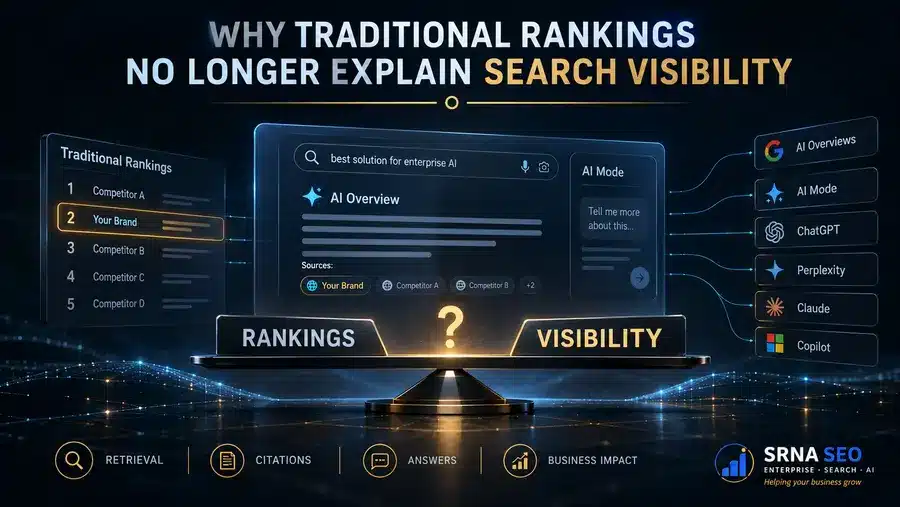
Your rank tracker says you are number two for the keyword that pays the bills, and the pipeline says something else. A ranking position tells you where one link sat in one list, while search visibility is now whether you were retrieved, used and named across answers that no list ever showed, and the two numbers can move in opposite directions. So traditional rankings still describe something real, but they no longer explain search visibility, and every report that treats them as the explanation is answering an older question.
What I Mean by Search Visibility Now
Search visibility is how often, and in what form, your brand and pages show up wherever a buyer gets an answer: classic results, AI summaries inside Google, and AI assistants outside it. A traditional ranking is narrower. It is the position of a link on a results page.
Two terms first. AI Overviews are the AI-generated summaries Google shows at the top of some search results. AI Mode is Google’s conversational search experience. Both can use query fan-out, which Google’s documentation on AI features describes as issuing multiple related searches across subtopics and data sources to build a response.
That one sentence from Google already breaks the old model. Let me show you where.
Four Places Where a Rank Stops Explaining Anything
1. The whole answer gets one position
Here is a rule from Google’s own definitions that most reports ignore. Per Google’s Search Console help on impressions, position and clicks, an AI Overview takes one position, and all links in the AI Overview are assigned that same position. For AI Mode, each follow-up question is treated as a new query and counted separately.
Think about what that does to your position column. Three links inside one summary share a number. A follow-up you never saw is a separate query in your data. The position you export is a bookkeeping rule, not a measurement of how prominent you were. I would not put it on a slide next to a revenue figure without saying so.
2. You can be retrieved for a query nobody typed
Because of fan-out, Google says its AI features can surface a wider and more varied set of supporting links than a classic web search. Microsoft describes the same shape on its side: in its documentation on web search in Microsoft 365 Copilot, Copilot sends a generated query of a few words to Bing, not the full prompt. And in xAI’s tools documentation, the model decides at each step whether to search again or answer.
So the query that retrieves your page may be one your rank tracker has never heard of. You can rank nowhere for the keyword on your list and still be the source. Or rank first for it and be absent from the answer. Both happen, and the tracker cannot see either.
3. A citation is not a placement
Microsoft is blunt about this in its AI Performance launch post. Total Citations does not indicate placement within an answer. Page-level citation activity reflects how often a page is cited, not page importance, ranking or placement. And the grounding queries it shows are a sample of overall citation activity.
xAI adds a second caveat. Its Citations documentation says the model decides when to include inline citations, and that the full citation list can include sources the agent looked at but did not use in its final answer.
So even the engines that give you numbers tell you in writing that the numbers are not a ranking. That is not a technicality. It is the vendor saying what the metric means.
4. Google’s own AI report has no position in it
Google’s Generative AI performance report help page describes impressions from AI Overviews and AI Mode, by page, country, device and date. Multiple results from one site in the same feature count as one impression. The page I read describes no position or ranking metric for these features. Clicks from AI features still land in the standard Performance report under the Web search type, per Google’s AI features page, which is why “total search traffic” quietly includes them.
I will say it plainly. The company that built the system reports your visibility in it as impressions, not as a rank.
What Still Holds
Do not throw the rank tracker away. Google says standard SEO fundamentals still apply, and that there are no additional requirements to appear in AI Overviews or AI Mode, nor other special optimizations necessary. A page has to be indexed and eligible to appear in Search with a snippet. So the work that earns a ranking is also the work that makes you eligible.
That is the part people get wrong in both directions. Rankings are not dead, and they are not an explanation either. A rank is an input to your visibility, and it was never the output. The engine behind the answer is retrieval, and I wrote the engineering version of that argument in The Engineering Definition of GEO: Vector Space Retrieval vs. PageRank. For the plainer comparison, see AI visibility vs SEO visibility.
What a Ranking Answers and What It Does Not
| Question from the boardroom | What a ranking tells you | What actually answers it |
|---|---|---|
| Are we found for this topic? | Where one link sat for one keyword | Sampled answers across a frozen prompt set |
| Are we the source behind the answer? | Nothing | Citation data, with the vendor’s caveats attached |
| Do buyers hear our name? | Nothing | Mention rate, measured separately from citations |
| Is the answer correct about us? | Nothing | Reading the answers |
| Why did traffic move? | One possible cause | Your change log, analytics and the two sources above, together |
| Who owns the category answer? | Rank against rivals on a list | Share of voice across engines |
If you have never run the second row, start with the AI Visibility Inspector (my diagnostic tool for checking how AI systems see a brand). It takes minutes, and it is usually the moment the room stops arguing about position.
What This Is NOT
This is not an argument that SEO is finished. Google’s guidance says the fundamentals still apply, and I agree with it. It is not a claim that every query shows an AI answer either. Google says AI Overviews often do not appear at all, so a lot of your traffic still comes from plain lists. And it is not a license to drop your tracker. It is a reason to stop asking it questions it cannot answer. For the tooling side of that point, see Why SEO Tools Cannot Audit AI Visibility.
What I Would Track Beside Rankings
- Mention rate on non-branded prompts. Run the same frozen prompt set several times per cycle (my working range is three to five, my judgment, not a standard).
- Citation rate, kept apart from mentions. And label the source, because each vendor defines it differently.
- Description accuracy. A wrong mention is a liability.
- Google’s AI impressions, read from the Generative AI report and archived, since the interface can change.
- Share of voice, which turns your mention counts into a competitive number. I explain how in AI Search Visibility Share of Voice.
- Traffic last, and only as the visible tip. The wider KPI problem is in the death of organic clicks as a KPI and Zero-Click Visibility.
For a per-engine method, the hub is How to Measure Your Presence in AI Search Engines. It has a measurement guide for each engine, and each one starts from what that vendor actually documents.
Ready to see how AI sees you?
If you want a straight read on which of your reports are answering the wrong question, that is the kind of work I do in Enterprise Search Advisory, and you can talk to me here.
Adding mention and citation tracking next to rankings does not raise visibility by itself. It changes the decisions you make, because you stop crediting or blaming a rank for results it did not cause. Any gain comes from the fixes that follow, and anyone quoting a percentage for it is guessing.
The Uncomfortable Part
The most dangerous number in your report is the one that is accurate. Your rank is correct. The position is real. It just describes a smaller and smaller share of how buyers meet you, and because it is correct, nobody questions it. I would rather have a messy sampled number I understand than a clean one that answers last decade’s question.
Where to Go From Here
Start with the AI Visibility Inspector for a first read. When you want this tracked over time against named competitors, look at NovaX (my AI Visibility Intelligence Platform). And if you want your current reporting audited for the questions it cannot answer, contact me.
FAQ
Yes, as an input. Google says the SEO fundamentals still apply, and that a page must be indexed and eligible to appear with a snippet to be shown as a link in AI Overviews or AI Mode.
Per Google’s Search Console help, an AI Overview takes one position, and all links in it are assigned that same position. In AI Mode, each follow-up question is treated as a new query and counted separately.
Not in the report help page I read. The Generative AI performance report describes impressions from AI Overviews and AI Mode, and the page describes no position or ranking metric for them.
Yes. The engines that document it say retrieval runs on generated queries and fan-out, and that being cited is a different event from ranking. Google, Microsoft and xAI each describe a version of it.
Not by itself. Microsoft says its citation counts do not indicate placement, ranking or importance, and xAI says the citation list can include sources the agent did not use in its answer.
Measure alongside them, not instead: mentions, citations, description accuracy, Google’s AI impressions and share of voice, each with its method written down.
No. Not enough available data exists for an honest range. Promise a baseline, a fixed method and repeated measurement.
This article was researched and drafted with the assistance of AI tools and reviewed and edited by author prior to publication.
