

In This Article
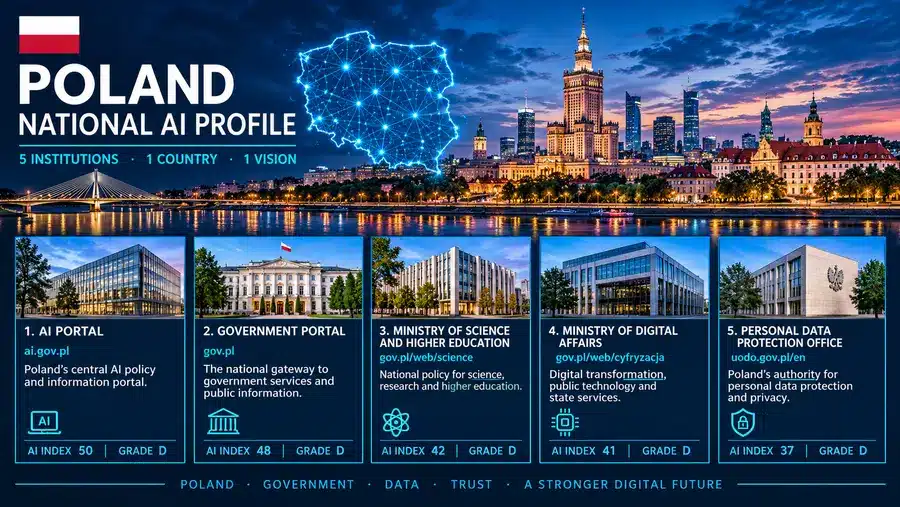
The five audited Polish pages average 43.6 on the AI Retrieval Index (the 0 to 100 score from the AI Visibility Inspector that rates how easily AI engines can parse, attribute and cite a page). That puts Poland tenth of the ten countries compared so far, behind Greece (49.4), Germany and Ireland (both 51.8), Switzerland (52.6), Hungary (55.8), Norway (58.0), the Netherlands (61.2), the United Kingdom (64.4) and Sweden (68.8). The main finding is the floor, not the spread. All five pages grade D, and the gap between the best and the worst is 13 points (50 against 37). Not one page declares any JSON-LD, so there is no Organization, Person or Article block and no machine-readable date anywhere in the set.
This profile covers the Polish government portal gov.pl, the AI portal ai.gov.pl, the Ministry of Digital Affairs and the Ministry of Science and Higher Education on the gov.pl platform, and the English entry point of the Personal Data Protection Office (UODO). Three pages were audited in Polish and two in English.
This research is part of the Building A Europe AI Can See series, which also includes National AI profiles of Austria, Belgium, Croatia, Cyprus, Czechia, Denmark, Estonia, Finland, France, Germany, Greece, Hungary, Ireland, Netherlands, Norway, Poland, Sweden, Switzerland, United Kingdom. Same Frameworks and AI Visibility Inspector were used in all researches.
The Profile in One View
| Page | AI Retrieval Index | Grade | Structure | Depth | Schema |
|---|---|---|---|---|---|
| AI portal (ai.gov.pl) | 50 | D | A | D | D |
| Government portal (www.gov.pl) | 48 | D | A | C | F |
| Ministry of Science and Higher Education (gov.pl/web/science) | 42 | D | C | B | F |
| Ministry of Digital Affairs (gov.pl/web/cyfryzacja) | 41 | D | C | C | F |
| Personal Data Protection Office (uodo.gov.pl/en) | 37 | D | C | C | F |
| Average | 43.6 |
All five pages grade D. The 13-point gap between the best and the worst page sits between the Netherlands (24 points) and Switzerland (5 points). The best result belongs to ai.gov.pl, and the reason is small: it is the only one of the five with a meta description and a canonical URL. The worst belongs to the English entry point of the data protection authority, which the Inspector reads as “Home Page”. The Dutch authority was read as “Home” in the Netherlands audit.
No JSON-LD, no dates, no declared publisher. The pages say what they are about and nothing about who stands behind them, or when.
How Poland compares with the seven countries for which dimension scores are published:
| Dimension | Poland (range) | Netherlands | UK | Sweden | Norway | Ireland | Germany | Switzerland |
|---|---|---|---|---|---|---|---|---|
| Structural Integrity | 79.0 (55 to 100) | 100.0 | 96.0 | 100.0 | 92.0 | 86.0 | 74.0 | 99.0 |
| Data Extractability | 65.6 (50 to 75) | 68.2 | 73.4 | 83.0 | 71.4 | 73.2 | 68.4 | 77.0 |
| Entity Clarity | 45.0 (45) | 52.0 | 57.0 | 49.0 | 52.0 | 46.0 | 55.0 | 44.0 |
| Schema & Metadata | 15.0 (10 to 35) | 31.0 | 41.0 | 38.0 | 31.0 | 26.0 | 31.0 | 23.0 |
| Freshness & Decay | 0.0 (0) | 43.0 | 43.2 | 65.0 | 31.8 | 14.2 | 21.4 | 0.0 |
| AI Retrieval Index | 43.6 (37 to 50) | 61.2 | 64.4 | 68.8 | 58.0 | 51.8 | 51.8 | 52.6 |
Poland has the lowest extractability (65.6) and the lowest Schema & Metadata score (15.0) in this table, and the lowest index of all ten countries. Freshness is 0.0, the same as Switzerland. Structure (79.0) is not the lowest: it sits above Germany (74.0), and Entity Clarity (45.0) sits just above Switzerland (44.0). The structure average also hides a split. ai.gov.pl and gov.pl score 100, the other three score 55 to 70.
How the Five Engines Read the Polish Pages
The Inspector scores every engine lower on the Polish pages than on the Dutch ones, by 9 to 20 points.
| Page | Perplexity | ChatGPT | Claude | Gemini | Copilot |
|---|---|---|---|---|---|
| Personal Data Protection Office | 32 (~17%) | 57 (~39%) | 55 (~23%) | 24 (~18%) | 38 (~25%) |
| Ministry of Digital Affairs | 35 (~18%) | 63 (~47%) | 63 (~24%) | 26 (~14%) | 44 (~26%) |
| Ministry of Science and Higher Education | 36 (~18%) | 65 (~48%) | 64 (~25%) | 26 (~14%) | 44 (~26%) |
| Government portal (gov.pl) | 39 (~19%) | 70 (~49%) | 75 (~46%) | 30 (~9%) | 52 (~27%) |
| AI portal (ai.gov.pl) | 43 (~39%) | 64 (~32%) | 71 (~45%) | 40 (~15%) | 50 (~28%) |
| Average | 37.0 (~22.2%) | 63.8 (~43.0%) | 65.6 (~32.6%) | 29.2 (~14.0%) | 45.6 (~26.4%) |
Claude (65.6) and ChatGPT (63.8) score highest, in the same order as in the Netherlands (77.6 and 73.0). Gemini is lowest at 29.2, as it was there (49.0). What changed is the size of the drop. Against the Dutch set, ChatGPT falls 9.2 points and Claude 12.0, while Copilot falls 15.8, Perplexity 18.4 and Gemini 19.8. The Inspector’s engine descriptions put structured data at the centre for Perplexity, Gemini and Copilot, and the Polish set has no JSON-LD at all, where three of five Dutch pages had none. My reading is that the engines which lean on structured data fall furthest. That is an interpretation of the audit output, not a tested cause.
The Inspector scores Claude and ChatGPT highest on the Polish pages too, but both fall. Gemini barely clears 14% estimated citation share.
Two observations from the table. Both rest on five pages, so treat them as leads.
One page stands out on Perplexity. ai.gov.pl, the only page with a meta description and a canonical URL, has an estimated Perplexity citation share of about 39%. The four pages without them sit at 17 to 19%. ai.gov.pl still has no JSON-LD, and the Inspector lists “no JSON-LD” as its only Perplexity issue, where the other four also get “missing meta description” and “no canonical URL”. One page proves nothing. But those are the two cheapest fixes in the report, and I would test them first.
Heading structure separates the Claude estimates. The two pages with a single H1 (gov.pl and ai.gov.pl) have estimated Claude citation shares of about 46% and 45%. The three pages with multiple H1 tags (Digital Affairs 2, Science 2, UODO 4) sit at about 24%, 25% and 23%. The Claude card flags “multiple H1 tags” on exactly those three.
Two smaller notes. ai.gov.pl has the lowest ChatGPT estimate (~32%, against 39 to 49% elsewhere), and the ChatGPT and Copilot cards both flag its 295 words, five under the Inspector’s 300 minimum. gov.pl has the lowest single estimate in the set, about 9% on Gemini, and the Gemini card cites its 25% alt text coverage.
What the Five Audits Reveal
Structure is split, not solved. gov.pl and ai.gov.pl score 100, with a single H1, H2 sub-sections and logical nesting. The Ministry of Digital Affairs and the Ministry of Science and Higher Education score 70 with two H1 tags each. The data protection authority scores 55 with four H1 tags, no H2 sub-sections and no logical nesting, and only balanced heading density passes. The average is 79.0, against a perfect 100.0 in the Netherlands.
Extractability is low and flat. Scores run 50 to 75 (average 65.6). All five pass list structures and internal link density, and all five fail the table / structured data check. The Inspector flags missing alt text on 83 images: 51 on gov.pl, 19 at the Ministry of Digital Affairs, 7 on ai.gov.pl, 5 at the Ministry of Science and Higher Education and 1 at the data protection authority. Alt text coverage is reported as 25% on gov.pl, 50% on ai.gov.pl, 62% at Digital Affairs and 81% at Science (the data protection authority passes the check). ai.gov.pl is also the only page under the 300-word minimum, at 295 words, which is why its Depth grade is D.
Entity clarity is the same on all five. Every page scores 45. Primary entity tokenization and the Open Graph title pass, and Article, Person and Organization schema fail everywhere. In the Netherlands the score ran from 40 to 65 because two pages had some schema. Here nothing varies, because there is no schema to vary.
Schema is absent, and metadata is the only difference. The Schema Intelligence section reports no JSON-LD blocks on any of the five pages. Schema & Metadata scores 10 on four pages and 35 on ai.gov.pl, which alone passes the meta description and canonical URL checks. Open Graph tags pass and robots meta does not block on all five. Nothing keeps these pages from being read. They just declare nothing.
Freshness is zero on all five. No page has a machine-readable date of any kind, and every freshness check fails. The Netherlands ran from 0 to 93, and Switzerland is the only other country in the comparison table at 0.0. These are pages with news feeds, announcements and numbered newsletter editions, and an engine cannot see which item is new.
The trust layer is empty. Entity connectivity is 0 on all five and knowledge graph anchoring is 0 on all five (the Dutch set had one page at 100). E-E-A-T density averages 6.0: the data protection authority scores 26, the Ministry of Science and Higher Education 4, the other three 0. Semantic richness averages 50.0, against 39.8 in the Netherlands. My reading: the Polish pages carry more topical content than the Dutch set, and say less about who published it.
Query eligibility sits at about 48% across 90 generated queries (about 53% across 136 in the Netherlands). gov.pl is highest (50.9%) and ai.gov.pl lowest (41.7%). The data protection authority produced only 5 queries. Many queries are interface text read as questions, and the same cookie banner questions (“dbamy o Twoją prywatność”, “szczegóły plików cookie”) appear on all three gov.pl pages.
Three of the five pages share one platform, and one profile. gov.pl, the Ministry of Digital Affairs and the Ministry of Science and Higher Education all fail the same checks: no JSON-LD, no meta description, no canonical URL, no date. They share the same cookie banner queries and footer entities (detected as “Rada Ministr”, “Kancelaria Premiera” and “Serwis Rzeczypospolitej Polskiej” on gov.pl and the Digital Affairs page, and “Prime Minister” on the Science page). That suggests the cause sits in the platform template and not in each ministry’s editorial work. It is my inference from the reports, not something I confirmed in the platform’s code. If it is right, one change in the template would reach every page built on it. It also means the sample is smaller than five independent pages.
Page Profiles
Personal Data Protection Office (uodo.gov.pl/en)
Score 37, grade D, the lowest in the set. AI models parse it as being about “Home Page”, close to the label the Inspector gave the Dutch Data Protection Authority (“Home”). Four H1 tags, no H2 sub-sections and no logical nesting hold Structure at 55. There is no JSON-LD, no meta description, no canonical URL and no date, and 1 image lacks alt text. Only 5 queries were generated (44.4% average), mostly widgets and labels (“What is nEWS AND EVENTS?”, “What is predecessors?”, “What is eDPB Plenary meetings?”). The Inspector reads the brand as UODO, the Polish abbreviation (68% clarity), while the English name “Personal Data Protection Office” is only an emerging concept at 48%. The page has the highest E-E-A-T density in the set (26, from three authoritativeness and three trustworthiness signals) and still zero entity connectivity. What it means for AI systems: the page carries the text signals of an authority and none of the declarations, and it reads as a home page with four competing roots.
Ministry of Digital Affairs (gov.pl/web/cyfryzacja)
Score 41, grade D. Parsed as “Ministerstwo Cyfryzacji”, which is correct. Two H1 tags are the audit’s critical flag (Structure 70). 19 images lack alt text (62% coverage). No JSON-LD, meta description, canonical URL or date. The ministry appears three times in the entity list: “Ministerstwo Cyfryzacji” (brand, 68%), “Ministerstwa Cyfryzacji” (the genitive form, named entity, 64%) and “Ministerstwo Cyfryzacji” again as an emerging concept (48%). Polish inflection splits one organization into variants. Other detected entities include Krajowy Plan Odbudowy (National Recovery Plan), Jednolity Rynek Cyfrowy (Digital Single Market) and Krajowy Punkt Kontaktowy (National Contact Point). Of 23 queries (50.2% average), most are section labels (“przejdź do sekcji Usługi i informacje”) or contact details such as the citizen helpline and opening hours. What it means for AI systems: the ministry is read correctly by name and then split into three entities, with no Organization block to say they are one. My opinion, not a finding: the ministry named for digital affairs publishes a page that declares nothing to machines.
Ministry of Science and Higher Education (gov.pl/web/science)
Score 42, grade D. Parsed as “Ministry of Science and Higher Education”. It has the best Depth grade of the set (B, extractability 75, with 5 images lacking alt text at 81% coverage) and the highest semantic richness (60), but two H1 tags, no JSON-LD, no meta description, no canonical URL and no date. E-E-A-T density is 4 (one expertise and two authoritativeness signals). The entity list names “Minister Dariusz Wieczorek” and “Deputy Minister Andrzej Szeptycki” (64% each), plus “United States” (56%), two generic placeholders (“Author / Expert” and “Product / Service”, 55%) and “Scienceand Higher Education” with a missing space. Of 22 queries (50.6% average), most are navigation and contact items, including the citizen helpline and opening hours. What it means for AI systems: it is the most readable of the three gov.pl pages, and the one where missing dates show most clearly. The only minister in its entity list is, according to public sources, a former one (see above).
Government portal (www.gov.pl)
Score 48, grade D. Parsed as “Portal Gov.pl”. Structure is 100, but Depth is C: 51 images lack alt text (25% coverage), which is 61% of the 83 images flagged across the whole set. No JSON-LD, meta description, canonical URL or date. It has the highest Claude (75) and ChatGPT (70) scores of the set, and the lowest single citation estimate, about 9% on Gemini. The entity list holds “Gov.pl” (68%) and footer items as emerging concepts at 48% (“Rada Ministr”, “Kancelaria Premiera”, “Serwis Rzeczypospolitej Polskiej”, “Dla Obywatela”, “Dla Przedsi”, “Dla Urz”). Its 20 queries have the highest average eligibility (50.9%) and mix real citizen services (“załatwiaj sprawy urzędowe”, “podpisz dokument elektronicznie”, “logowanie do panelu mObywatel”, ID card, passport and driving licence) with cookie and footer text, a COVID-19 vaccination entry and a Ukrainian-language entry (“сайт для громадян України”). What it means for AI systems: the front door of the national portal has the cleanest structure and the richest service content in the Polish set, and declares no publisher, no date and no alt text on 51 images. An engine cannot place the COVID-19 entry in time.
AI portal (ai.gov.pl)
Score 50, grade D, the top page. Parsed as “Portal sztucznej inteligencji” (artificial intelligence portal). Structure is 100, but Depth is D: 295 words and 7 images without alt text (50% coverage). It is the only page with a meta description and canonical URL, which lifts Schema & Metadata to 35, and it has the highest Perplexity (43) and Gemini (40) scores of the set. It still has no JSON-LD and no date. Entity graph stability is 54, rated “Fragmented”, the only page below “Moderate”. Detected entities: “Artificial Intelligence” (81%), “AI HUB Poland” (68%), “Szkolenia Artyku” and “Unii Europejskiej” (48%). Its 20 queries have the lowest average eligibility (41.7%), and none is flagged eligible. Most are calls to action (“Wykorzystaj AI w pracy”, “AI dla Ciebie”, “Poznaj drogę do wdrożenia AI Act”) or headlines such as “Dziewiętnasta edycja newslettera MC – AI w administracji”. What it means for AI systems: the page about AI is the best read of the five and still cannot say who stands behind it or when it was updated. A numbered newsletter edition with no date shows the problem: an engine cannot tell whether the nineteenth is the latest.
| Page | AI Retrieval Index | Images missing alt text (coverage) | Entity graph stability | E-E-A-T density | Semantic richness | Queries (avg eligibility) |
|---|---|---|---|---|---|---|
| AI portal (ai.gov.pl) | 50 | 7 (50%) | 54 | 0 | 40 | 20 (41.7%) |
| Government portal (gov.pl) | 48 | 51 (25%) | 67 | 0 | 52 | 20 (50.9%) |
| Ministry of Science and Higher Education | 42 | 5 (81%) | 70 | 4 | 60 | 22 (50.6%) |
| Ministry of Digital Affairs | 41 | 19 (62%) | 70 | 0 | 52 | 23 (50.2%) |
| Personal Data Protection Office | 37 | 1 (check passed) | 61 | 26 | 46 | 5 (44.4%) |
What This Means
The Polish set is one profile with one exception. Four pages have no JSON-LD, no meta description, no canonical URL and no date. The exception is ai.gov.pl, which has the last two metadata signals and the best score (50). That is a different result from the Netherlands, where the set split into two groups, and from Switzerland, where all five pages behaved alike at a higher level.
The fixes are small and mostly template-level. Based on the Inspector’s own recommendations, the common list is:
- An Organization block with sameAs links (Wikipedia or Wikidata) on all five pages
- Article blocks with
datePublishedanddateModifiedfor news items and pages - Person blocks where ministers, officials or authors are named
- A meta description and a canonical URL on gov.pl, the Ministry of Digital Affairs, the Ministry of Science and Higher Education and the data protection authority
- One H1 on the three pages that have two, two and four
- Alt text for the 83 flagged images, 51 of them on gov.pl
- More than 300 words on ai.gov.pl
My own addition, not an Inspector recommendation: check whether the cookie banner text is rendered in the page body, since it shows up as queries on three pages.
Honest numbers on the gain: not enough available data to state a verified uplift. What the dataset does show is that the gap between Poland (43.6) and the Netherlands (61.2) sits in the schema, entity and freshness layers, and that three of the five pages share one platform. If the shared gaps come from the platform template (my inference), one change would reach every page built on it.
If you want this done on your own pages, book a call and tell me which pages you want in scope.
Scope and Method
Five pages were audited with the AI Visibility Inspector (version 1.9.3) and Srna Frameworks on 3 November 2026:
- https://www.gov.pl/ (government portal, Polish)
- https://ai.gov.pl/ (AI portal, Polish)
- https://www.gov.pl/web/cyfryzacja (Ministry of Digital Affairs, Polish)
- https://uodo.gov.pl/en (Personal Data Protection Office, English)
- https://www.gov.pl/web/science (Ministry of Science and Higher Education, English)
Each audit reports an AI Retrieval Index and grade, Structure, Depth and Schema sub-grades, five scored dimensions, five engine scores with estimated citation shares, a Schema Intelligence section, query eligibility, and entity graph stability.
Boundaries
What this research is NOT: it is not a ranking of Polish institutions, and it does not measure how good their content is. It measures how machine-readable five pages were on one day.
- Five pages is five pages. Each is one entry per body, three in Polish and two in English. Other pages, other language versions and PDFs were not audited, and the Polish pages cannot be compared like for like with the English ones.
- The pages are not independent. Three of the five sit on the gov.pl platform and share template elements such as the cookie banner and footer.
- Findings reflect 3 November 2026. Headlines and news items change daily.
- Averages are simple means of five pages. Comparison figures come from earlier country profiles as published in the Netherlands profile, and Poland’s rank depends on them. The dimension comparison covers seven countries.
- The Inspector does not run scripts and reports JSON-LD only. “No JSON-LD” does not prove that no structured data of any kind exists on these sites. Markup added by JavaScript, or written as microdata or RDFa, would not appear.
- Date detection counts machine-readable signals only. A date written in the visible text does not count.
- Entity detection appears to cut Polish names at diacritics. “Rada Ministr”, “Dla Przedsi”, “Dla Urz” and “Szkolenia Artyku” all end where a Polish letter (ó, ę, ł) would follow. That is my reading of the pattern, and I did not test the Inspector’s code.
- Polish inflection splits one entity into variants. The Ministry of Digital Affairs appears as “Ministerstwo Cyfryzacji” and “Ministerstwa Cyfryzacji”.
- Automated query detection produces artefacts. It puts an English “What is …?” template on Polish text, lowercases the first letter of uppercase labels (“aDRES”, “kONTAKT”, “nEWS AND EVENTS”), and reads cookie banner text, footer labels and contact details as queries. “stopka … comparison” is a footer label, not a comparison.
- Each report lists a Freshness & Decay card twice, with different checks and the same score of 0, and repeats the date recommendation. I treated them as one dimension.
- Named entities are reported as detected. I checked “Minister Dariusz Wieczorek” against public sources (cited above) but could not open the live page to see where the name appears. “Deputy Minister Andrzej Szeptycki” was not verified.
- Citation figures are the Inspector’s estimates, not observed engine citations.
- The generic content gap list (Large Language Model, Dark Funnel, Buyer Journey and similar) was not interpreted.
Calculate Your Potential Exposure
Reading poorly to AI has a cost. If you want to put a number on it for your own site, use the AI Visibility Cost of Inaction Calculator and enter your own sessions, conversion rate and revenue per conversion. The output is a strategic estimate, not a forecast.
Frequently Asked Questions
The five audited Polish pages average 43.6 on the AI Retrieval Index, tenth of the ten countries compared so far, behind Greece (49.4) and the Netherlands (61.2).
The AI portal ai.gov.pl scored highest (50, grade D) and the Personal Data Protection Office lowest (37, grade D). The gap is 13 points.
Schema and dates. No page has JSON-LD, no page has a machine-readable date, and entity connectivity and knowledge graph anchoring are 0 on all five.
Claude (65.6 average) and ChatGPT (63.8). Gemini scores lowest at 29.2, with an estimated citation share of about 14%.
No. Citation figures are the Inspector’s estimates, not observed citations. ai.gov.pl, the only page with a meta description and a canonical URL, has the highest Perplexity estimate (about 39%, against 17 to 19% on the other four), but that is one page.
JSON-LD with an Organization block and sameAs links, dates in JSON-LD, a meta description and a canonical URL on four pages, a single H1 on three pages, and alt text for the 83 flagged images.
This article was researched and drafted with the assistance of AI tools and reviewed and edited by author prior to publication.
