

In This Article
Finland hosts Europe’s LUMI AI Factory and is preparing an AI-powered public sector – but the five ministry homepages that should make that direction visible to AI systems say almost nothing about it, and give machines no way to anchor or date what they do say.
An AI Visibility Inspector audit of five Finnish government homepages across five domains finds a national average of 46.4/100, Grade D. Scores run from 53 on the Government and the Ministry of Economic Affairs and Employment down to 41 on the Ministry of Transport and Communications. Estonia’s five pages sat within one point of each other on perfect structure. Finland splits: two pages have clean heading structure and three do not. What all five share is the layer above the structure: no JSON-LD, no freshness signals and no canonical URL.
In This Article
- National average: 46.4, Grade D. All five audited pages are Grade D, ranging from 41 to 53. That is below Estonia’s 48.6 and Belgium’s 49.8 in this series.
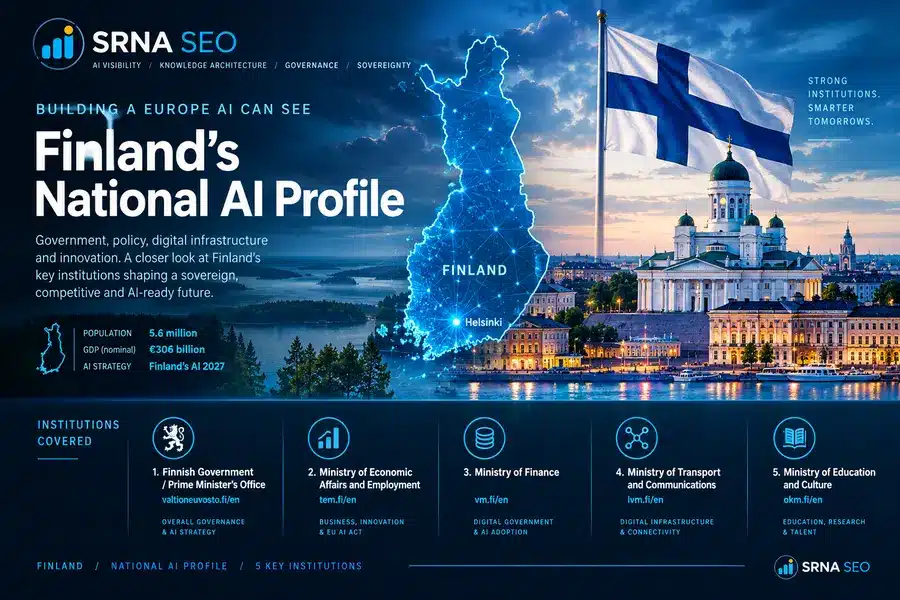
- Five institutions, five domains. The audits cover the Finnish Government (valtioneuvosto.fi/en), the Ministry of Economic Affairs and Employment (tem.fi/en), the Ministry of Finance (vm.fi/en), the Ministry of Transport and Communications (lvm.fi/en) and the Ministry of Education and Culture (okm.fi/en). Each was audited once.
- Structure is not Finland’s safe ground. Only two pages pass the single-H1 test. vm.fi and okm.fi have no H1 at all, and lvm.fi has two.
- Metadata and dates are absent everywhere. All five pages have no JSON-LD, 0/100 on freshness signals and no canonical URL. 52 images across the five pages have no alt text.
- The pages describe navigation, not AI policy. 46 of the 135 candidate queries the Inspector generates are language-switcher or cross-government menu text. None mention AI. The best-scoring query on the Government homepage is about F-35 fighters.
- The missed opportunity is national. Finland’s AI story lives in policy and infrastructure. The homepages that should carry it expose none of it as structured data.
The profile in one view
The table below shows the five audited institutions (rows) and the five dimension scores that determine the overall index. Scores are from the AI Visibility Inspector (v1.9.3), audited on 7 October 2026.
| Institution (URL) | Structural integrity | Data extractability | Entity clarity | Schema and metadata | Freshness signals | Overall index |
|---|---|---|---|---|---|---|
| valtioneuvosto.fi/en | 100 | 75 | 45 | 25 | 0 | 53 (D) |
| tem.fi/en | 95 | 80 | 45 | 25 | 0 | 53 (D) |
| vm.fi/en | 60 | 75 | 45 | 25 | 0 | 43 (D) |
| lvm.fi/en | 70 | 70 | 45 | 10 | 0 | 41 (D) |
| okm.fi/en | 55 | 75 | 45 | 25 | 0 | 42 (D) |
| Five-page average | 76.0 | 75.0 | 45.0 | 22.0 | 0.0 | 46.4 (D) |
Shading convention (for your CMS): 75 and above strong, 50 to 74 moderate, 20 to 49 weak, below 20 absent.
Estonia’s gaps were discipline: one H1 per page, one date per document, one entity per institution. Finland has the same gaps and, on three pages, one more: the H1 itself. Structure was the one dimension Estonia could count on. In Finland it is a 55-point spread, from 100 on the Government homepage to 55 on the Ministry of Education and Culture.
The shared absence is the same as everywhere else in the series: zero JSON-LD, almost no trust signals and no machine-readable identity for the institutions that run national AI policy.
How the five engines read the Finnish pages
The Inspector reports compatibility scores for five engines: Perplexity, OpenAI/ChatGPT, Claude, Google Gemini and Microsoft Copilot. The table below shows the five institutions (rows) and the five engine scores (columns).
| Institution (URL) | Perplexity | ChatGPT | Claude | Gemini | Copilot |
|---|---|---|---|---|---|
| valtioneuvosto.fi/en | 47 | 74 | 77 | 36 | 52 |
| tem.fi/en | 47 | 74 | 76 | 36 | 52 |
| vm.fi/en | 40 | 62 | 59 | 30 | 44 |
| lvm.fi/en | 35 | 63 | 63 | 26 | 44 |
| okm.fi/en | 39 | 60 | 57 | 30 | 44 |
| Average | 41.6 | 66.6 | 66.4 | 31.6 | 47.2 |
Engines that reward readable prose and hierarchy (Claude, ChatGPT) are good on Finland’s two best-structured pages and drop sharply on the other three. Claude runs from 77 on valtioneuvosto.fi to 57 on okm.fi, and the Inspector’s heuristic citation estimate for Claude is about 46% on the two pages with a single H1 against 23–24% on the three without. That is the clearest cost of a missing or duplicated H1 anywhere in this audit.
Engines that lean on structured data, freshness and authorship (Gemini, Perplexity) are weak on all five. Gemini averages 31.6 and bottoms out at 26 on lvm.fi. Perplexity averages 41.6, with 35 on lvm.fi, the only page flagged for a missing meta description.
Against Estonia, every Finnish page scores higher on Perplexity (35–47 against a flat 27) and on Gemini (26–36 against 14–19), and lower on Copilot (44–52 against 58). The Finnish pages carry slightly more page-level metadata (schema and metadata is 25/100 on four of five, against 10/100 in Estonia), which is the likely source of the edge. The Inspector does not itemise that score.
Where Finland needs to improve
Ranked by how many pages are affected and how much one fix would unlock.
1. Structured identity (all five)
No Organization, Person or Article schema exists on any of the five audited pages. Entity connectivity and knowledge-graph anchoring score 0/100 on all five. E-E-A-T density runs from 0 to 7 out of 100.
The Inspector can read the names. It detects the Finnish Government, the Prime Minister, Foreign Affairs, Economic Affairs and Social Affairs as emerging concepts on every page, because the same government-wide menu appears on each homepage. Entity graph stability is moderate on all five (65–68/100, against 15–53 in Estonia). But the schema component of that score is 0/20 on every page. The names are recognised and nothing connects them: not which ministry leads which policy, not which agency implements it, not who is responsible.
2. Structure is no longer the safe part (three of five)
vm.fi and okm.fi have no H1, flagged as a critical issue. lvm.fi has two H1 tags, which the Inspector reads as fragmented intent. Structural integrity on these three is 60, 55 and 70. Estonia’s five pages all scored 100.
The consequences are measurable in the engine scores: Claude drops to 57–63, and Copilot flags the missing H1 because Bing uses the primary heading as its topic anchor. This is the cheapest fix in the report. It is a template change, not a content project. On okm.fi the Inspector already parses the page topic as the ministry’s name, so the H1 is effectively written.
3. Dates that exist for humans and not for machines (all five)
All five pages score 0/100 on freshness signals. The Inspector reports no JSON-LD dateModified, no machine-readable publication or modification date and the audit flags “No date signals found – content age is unverifiable” on every page.
These are not archive pages. vm.fi publishes the proposal for the 2027 Budget and the Autumn 2026 Economic Survey. lvm.fi announces that legislation on European Digital Identity Wallets enters into force in October. okm.fi carries the PISA 2025 results. tem.fi carries a proposal on residence permits for startup entrepreneurs. Engines that weigh recency cannot tell any of it is recent, and a plain-text date is not enough: Perplexity, Gemini and other retrieval-driven systems look for datePublished and dateModified in JSON-LD.
4. Head hygiene: canonical, meta description and alt text (all five)
No canonical link was found on any of the five pages, which the audits flag on every page. Finnish government sites serve multiple language versions, so duplicate-variant risk is real and retrieval weight can be split across URLs. lvm.fi also has a missing or too-short meta description, which the Inspector links to its Perplexity score of 35.
Separately, 52 images lack alt text: 16 on okm.fi (45% coverage), 13 on vm.fi (35%), 12 on valtioneuvosto.fi (37%), 6 on lvm.fi (70%) and 5 on tem.fi (76%). Gemini scores visual context separately and is the weakest engine on every page.
5. The homepages describe navigation, not AI policy (all five)
The Inspector generated 135 candidate queries across the five pages. At least 46 of them (34%) are boilerplate: four language-switcher strings on four pages (English, Swedish, Northern Sámi and Inari Sámi) and the same six cross-government ministry names on all five. The language strings are a sign the sites do right by Finland’s language communities. Without markup, the Inspector reads them as questions.
Not one of the 135 queries mentions AI. “Artificial Intelligence” is detected as a concept only on tem.fi and vm.fi, at 55% clarity and with no schema. On the Government, Transport and Communications, and Education and Culture homepages it is listed as a content gap. The best-scoring query on the Government homepage (59%) is about the Minister of Defence and Finland’s F-35 fighters.
6. A government in active AI expansion is the cheapest moment to fix this
Finland’s AI agenda is moving on several fronts this year. National implementation of the EU AI Act, led by the Ministry of Economic Affairs and Employment with Traficom as central contact point, began with a first set of measures on 1 January 2026. On 31 August 2026 the EuroHPC Joint Undertaking signed the contract for the LUMI-AI supercomputer in Kajaani. The LUMI AI Factory consortium Finland leads includes Czechia, Denmark and Estonia, each already profiled in this series, plus Norway and Poland. The Government has backed a Nokia-led bid to host an EU AI gigafactory. And the Ministry of Finance is preparing a plan to move the public sector onto a shared AI platform by 2031, with its report expected by the end of 2026 or in the first quarter of 2027.
Ministry names, mandates, programme dates and reporting lines are all fresh facts this year. They are also the ones engines will be asked about when users query “Finland AI strategy”, “LUMI AI Factory” or “Finland AI Act”. Identity markup is cheap to add to a build in progress and expensive to retrofit.
The missed opportunity: what Finland could be saying
Finland does not have an AI-policy visibility problem in the usual sense. The policy is real, public and well documented. The missed opportunity is that none of it is attached to the pages machines read first. Each ministry already owns a piece of the national AI story. Each homepage already carries content that sits next to it. What is missing is the layer that says: this institution, this role, this date.
| Finland’s AI position | Owner | What the audited homepage exposes | What would make it citable |
|---|---|---|---|
| National AI coordination and AI Act implementation | Ministry of Economic Affairs and Employment (tem.fi) | Finnish-language organization token, AI as an unanchored concept, top queries on residence permits, hydrogen and energy efficiency | GovernmentOrganization with fi/sv/en names and parentOrganization, plus dated NewsArticle on AI programmes |
| AI Act central contact point (Traficom) and digital identity | Ministry of Transport and Communications (lvm.fi) | Two H1s, no meta description, AI listed as a content gap, undated wallet legislation news | Single H1, meta description, Organization linked to Traficom, dated press-release markup |
| Public-sector AI transformation to 2031, AI productivity in the 2026–2029 fiscal plan | Ministry of Finance (vm.fi) | No H1, top content is the 2027 Budget and Autumn 2026 Economic Survey with no dates | H1, Article markup with datePublished and dateModified on budget and survey pages |
| LUMI AI Factory, gigafactory bid, government-level AI coordination | Finnish Government (valtioneuvosto.fi) | Best structure in the set, but the best query is about F-35 fighters | GovernmentOrganization, Person for the Prime Minister, dated NewsArticle for AI announcements |
| AI in education, skills, research and copyright | Ministry of Education and Culture (okm.fi) | No H1, 16 images without alt text, AI as a content gap, top queries on PISA 2025 | H1, Organization record, dated Article for PISA and OECD results |
Finland also carries an identity problem its Nordic neighbours mostly do not: every institution has at least Finnish, Swedish and English names, and three of the five audits anchor the page on the Finnish-language name (Työ- ja elinkeinoministeriö, Valtiovarainministeriö, Opetus- ja kulttuuriministeriö) even though the audited page is the English one. alternateName and sameAs are built for exactly this. They tell a machine that three strings are one ministry.
Institution profiles
valtioneuvosto.fi/en – Grade D – 53/100
The Finnish Government homepage, with the strongest structure in the set and no machine-readable identity
Strengths: Perfect structural integrity (100) and solid data extractability (75), tied for the highest overall score in the set. The page carries government news, the ministries and the institutional repository, with Prime Minister Petteri Orpo’s Government named in the content. Claude scores it 77, the highest engine score in the audit.
What AI sees: “Startpage” as the page topic, a single H1 and logical nesting, and “Finnish Government” as the primary entity (68% clarity), with “Prime Minister”, “Foreign Affairs”, “Economic Affairs” and “Social Affairs” as emerging concepts without schema. Entity graph stability is 65/100 (moderate) but the schema component is 0/20. Twelve images lack alt text (37% coverage), no canonical is set and no JSON-LD is detected. Of 22 candidate queries, the best (59%) is about the F-35 fighters, four are language-switcher strings, and “Artificial Intelligence” is listed as a content gap.
Missed opportunity: This is the page where the Prime Minister’s AI roundtable of June 2025, the LUMI AI Factory and the AI gigafactory ambition should be machine-readable. A GovernmentOrganization record with Finnish, Swedish and English names, Person markup for the Prime Minister, and NewsArticle markup with datePublished and dateModified on announcements would turn a page that currently answers a question about fighter jets into one that can answer a question about national AI direction.
tem.fi/en – Grade D – 53/100
The Ministry of Economic Affairs and Employment homepage, with the most extractable content and the clearest AI mandate
Strengths: Near-perfect structure (95) and the best data extractability in the set (80). The page publishes news on hydrogen and energy security, residence permits for startup entrepreneurs, energy efficiency agreements, EU structural-change aid for Äänekoski and Päijät-Häme and priority procedures for electricity grid connections. Its best candidate query reaches 57%. Claude scores it 76.
What AI sees: “Frontpage” as the page topic and “Työ- ja elinkeinoministeriö” as the primary entity (68% clarity): the Finnish name on the English page. “Artificial Intelligence” is detected as a technology concept (55% clarity), alongside an “Author / Expert” token with no Person schema behind it. Entity graph stability is 65/100. Five images lack alt text (76% coverage), no canonical is set and no JSON-LD is detected. None of its 28 candidate queries concerns AI.
Missed opportunity: TEM has coordinated Finland’s AI programmes since the national Artificial Intelligence Programme of 2017 and leads national implementation of the AI Act. The homepage does not carry that role. A GovernmentOrganization record with parentOrganization pointing to the Finnish Government, fi/sv/en alternateName values, and Article markup with dates on AI-programme and AI Act pages would let engines cite tem.fi as the authority it is by mandate. The role is already in law and policy documents. The markup is not.
vm.fi/en – Grade D – 43/100
The Ministry of Finance homepage, with the most time-sensitive content in the set and no dates
Strengths: Solid data extractability (75), entity graph stability of 68/100 (the joint highest) and the richest policy content: the proposal for the 2027 Budget, the Autumn 2026 Economic Survey, the sixth payment request under the Recovery and Resilience Plan and EU tax legislation. A “Product / Service” entity aligns with queries at 81% clarity, the highest single entity score in the audit. Best candidate query: 46%.
What AI sees: “Frontpage” as the page topic and no H1, flagged critical, with structural integrity at 60. The primary entity is “Valtiovarainministeriö”, the Finnish name. “Artificial Intelligence” is detected as a technology concept with no schema. Thirteen images lack alt text (35% coverage), no canonical is set and no JSON-LD is detected. Claude scores it 59 (about 24% estimated citation) and Copilot flags the missing H1.
Missed opportunity: The Ministry of Finance is preparing the analysis behind the public-sector AI transformation plan and counted AI-driven productivity savings and EUR 250 million for LUMI-AI in the 2026–2029 fiscal plan. None of that is structured on the homepage. An H1, Article or NewsArticle markup with dates on budget and survey pages, and an Organization record would matter more here than anywhere else in the set. A budget proposal and an economic survey are exactly the content people ask AI about “this year”, and an undated page cannot answer.
lvm.fi/en – Grade D – 41/100
The Ministry of Transport and Communications homepage, with the lowest score in the set
Strengths: Structural integrity (70) and data extractability (70), and the highest E-E-A-T density of the five (7/100, with three expertise signals). The page carries press releases on the ministry’s budget proposal, EU transport funding, European Digital Identity Wallets and a study on the discoverability of media services, and links to Finland’s Cyber Security Strategy 2024–2035. Best candidate queries: 55% and 54%.
What AI sees: “Home” as the page topic and two H1 tags, flagged critical for fragmented intent. The primary entity is “Ministry of Transport and Communications” (68% clarity). There is no meta description, no canonical and no JSON-LD, so schema and metadata scores 10/100, the lowest in the set. Six images lack alt text (70% coverage). Semantic richness is 52/100, against 68 on the other pages. Perplexity scores it 35 (about 18% estimated citation) and Gemini 26, the lowest engine score in the audit. “Artificial Intelligence” is a content gap.
Missed opportunity: Traficom, an agency in the ministry’s administrative branch, is Finland’s central contact point for the AI Act, and the ministry has experimented with generative AI based on Finnish language models in legislative preparation. Neither is visible. Three fixes cost almost nothing: one H1, a meta description and a canonical. After that, an Organization record linked to Traficom and dated press-release markup. The Digital Identity Wallet legislation entering into force in October is precisely the kind of dated fact an engine needs to be able to confirm.
okm.fi/en – Grade D – 42/100
The Ministry of Education and Culture homepage, with no H1 and the most images without alt text
Strengths: The widest content surface in the set, with 32 candidate queries across publications, events, futures work in comprehensive schools, the vision for higher education and research, the PISA survey, Study in Finland and media literacy. It is also the only page whose topic the Inspector parses as a real name (“The Ministry of Education and Culture, Finland”) rather than a generic label. Data extractability is 75 and the best candidate query reaches 46% (PISA 2025).
What AI sees: No H1, flagged critical, with structural integrity at 55, the lowest in the set. The primary entity is “Opetus- ja kulttuuriministeriö”, the Finnish name. Sixteen images lack alt text (45% coverage), the most of any page. No canonical is set and no JSON-LD is detected. Claude scores it 57 (about 23% estimated citation) and Gemini 30. “Artificial Intelligence” is a content gap, and none of the 32 queries concerns AI.
Missed opportunity: AI reaches the ministry’s remit through education, skills, research and copyright. The homepage links futures work in schools and a vision for higher education, but with no H1, schema or dates, none of it can be tied to the national AI story. The fastest wins: an H1 (the topic is already correctly named), alt text, an Organization record, and dated Article markup for PISA 2025 and Education at a Glance.
Scope and method
Each page was audited once on 7 October 2026 with the AI Visibility Inspector (v1.9.3) and the Srna SEO Frameworks. This is a snapshot of five page audits across five domains, not a full-site audit. All five are English-language homepages for the Finnish Government and four ministries involved in Finland’s AI policy, regulation, public-sector use and skills. The audited paths are /en/frontpage (valtioneuvosto.fi, tem.fi, vm.fi, okm.fi) and /en/home (lvm.fi).
The identical entity clarity score of 45 on all five is a feature of the scoring model rather than of the sites, since the Inspector reports no JSON-LD anywhere. This profile treats schema as absent and reads that credit as coming from page-level metadata and entity tokenization. The entity graph stability scores (65–68) should be read the same way: the Inspector can tokenize the names, but nothing anchors them.
Query categories and engine citation percentages are the tool’s estimates and are heuristic. The count of navigation and language-switcher queries (46 of 135) is a manual classification of the Inspector’s candidate queries. Facts about the Finnish government and AI policy come from public sources checked on 7 October 2026. The Inspector measures what a page exposes, not what an institution does.
The national average of 46.4 is the arithmetic mean of the five overall index scores: 53, 53, 43, 41 and 42.
This research series also includes National AI profiles of Austria, Belgium, Croatia, Cyprus, Czechia, Denmark, Estonia and Finland.
Read also Finland Flagship Companies.
Calculate your potential exposure below
Inputs
Enter your own data where possible. Hover over labels or open “Methodology” for details on how each field is used.
From GA4, GSC, or your SEO platform. Use a 30–90 day average.
Session → lead / signup / purchase. Use decimal (e.g. 1.2 for 1.2%).
For B2B, use average deal value or LTV. Currency is symbolic here.
Used to show profit‑based cost of inaction. Leave at 100 to ignore.
Share of organic traffic from queries/pages likely to be influenced by AI answers and retrieval systems.
Based on observed traffic loss patterns in AI search and structural decay cases.
Expected organic growth if you do nothing special about AI visibility.
Plausible uplift over the chosen horizon based on case studies.
How these numbers are calculated (methodology)
Let:
- O₀ = monthly organic sessions
- CVRₒ = organic conversion rate (as a decimal)
- ARPC = average revenue per conversion
- GM = gross margin (as a decimal)
- E = AI exposure share (as a decimal)
- D = displacement rate (as a decimal)
- T = time horizon in months
Baseline monthly revenue:
- Revenue: \(R_0 = O_0 imes CVR_o imes ARPC\)
- Profit: \(R_{0,profit} = R_0 imes GM\)
Monthly revenue at risk (for a given D):
- \(R_{risk} = R_0 imes E imes D\)
- Profit version: \(R_{risk,profit} = R_{risk} imes GM\)
The tool computes R_risk for three scenarios:
- Conservative: D = 0.15
- Base: D = 0.30 (or your selected scenario)
- Aggressive: D = 0.50
Cost of Inaction over T months is approximated as:
- \(CoI(T) = R_{risk} imes T\)
- Shown as a range from conservative to aggressive.
The growth inputs (g₀, g₁) are currently used for narrative context and can be incorporated into a more advanced version that models opportunity cost explicitly.
