

In This Article
Your CMO asks whether GEO replaces SEO, and every answer you find was written by someone selling one or the other. GEO vs SEO is not a replacement question: SEO decides whether you can be found and eligible, generative engine optimization (GEO) is the work of being retrieved, used and named inside generated answers, and the real difference sits in what you write for and what you measure, not in a secret second toolkit. I will mark my own judgments as I go, so you can tell them apart from what the vendors document.
What Each Term Means?
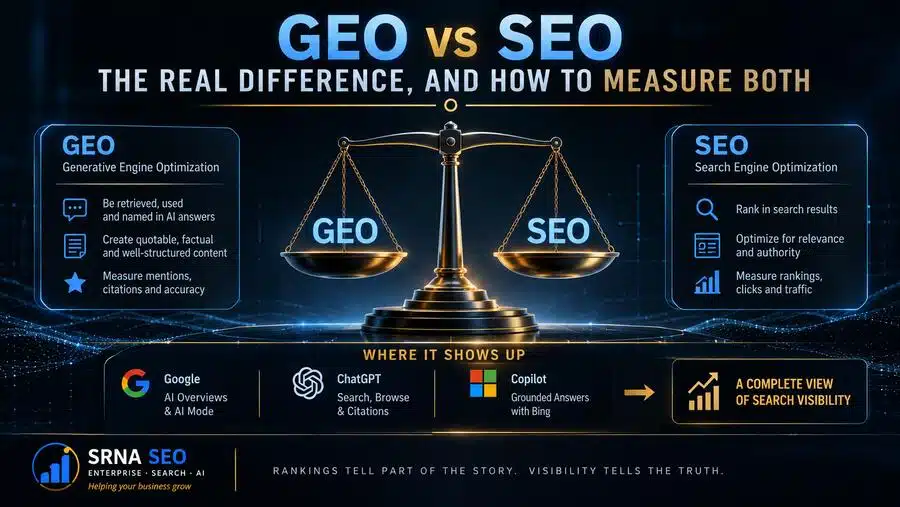
SEO (search engine optimization) is the work of making pages crawlable, indexable, relevant and trusted so they rank in a list of results. GEO (generative engine optimization) is the work of making your content get retrieved, cited and described correctly when an AI system builds an answer instead of a list.
The term has an academic origin. The paper GEO: Generative Engine Optimization, published at KDD 2024, frames GEO as a black-box approach that changes the presentation, style and content of a website to raise its visibility in generative engine responses. That is a narrower thing than what vendors now sell under the same three letters.
And yes, the acronym soup is part of the problem. GEO, AEO, LLMO, AI SEO. I wrote about that in The SEO Acronym Inflation Problem. I use GEO here because it is the term people search for, but I do not think the label matters. What the work does matters.
What the GEO Research Actually Found?
Most articles on GEO vs SEO quote one number from that paper and stop. Let me give you the context, because it changes how you should use it.
The authors tested nine methods on a benchmark of about 10,000 queries. Visibility was measured mainly with Position-Adjusted Word Count, which is the share of an answer’s words attributed to a source, discounted by citation position. The unoptimized baseline scored 19.3. The percentages below are my own arithmetic from the paper’s Table 1.
| Method tested | Score | Change vs baseline (my calculation) |
|---|---|---|
| Quotation Addition | 27.2 | about +41% |
| Statistics Addition | 25.2 | about +31% |
| Cite Sources | 24.6 | about +27% |
| Easy-to-Understand | 22.0 | about +14% |
| Keyword Stuffing | 17.7 | about -8% |
Three things stand out.
- Content that gives the model something to quote helped most. Quotations, statistics and cited sources beat style tweaks.
- Keyword stuffing, the oldest SEO trick, scored below the baseline. That is the one finding I would put on a slide for an SEO team.
- The limits are stated by the authors. The main experiments used a simplified engine built on a GPT-3.5 model, plus Perplexity.ai as a real-world check. They did not measure the effect on traditional search rankings. And effectiveness varied by domain.
A lab result that keyword stuffing loses and evidence-rich writing wins is a strong hint, not a guarantee, and it says nothing about how ChatGPT, Gemini or Copilot behave today. I would use it to set priorities and never to promise a percentage. The abstract’s “up to 40%” is the ceiling of a benchmark, not a forecast for your site.
Where GEO and SEO Are the Same?
Here the primary sources are clearer than the blog posts.
Google. Its documentation on AI features and your website says a page must be indexed and eligible to appear in Search with a snippet. It also says there are no additional requirements to appear in AI Overviews or AI Mode, nor other special optimizations necessary. And it says that standard SEO fundamentals still apply.
OpenAI. Its crawler documentation separates three agents. OAI-SearchBot surfaces sites in ChatGPT’s search features, and OpenAI recommends allowing it. GPTBot is for content that may be used to train its models, and disallowing it does not govern search visibility. ChatGPT-User handles actions a user asks for. The settings work independently, so you can appear in search and still opt out of training.
Microsoft. Bing is the search service behind web grounding in Microsoft 365 Copilot, per Microsoft’s web search documentation. In its October 2026 post on training and grounding preferences, Microsoft says its new settings govern use, not crawl access, so a robots.txt rule that blocks Bingbot still blocks crawling.
So the shared layer is plain. If a crawler cannot reach a page, or the page is not indexed, no amount of GEO work helps. For that link, see the relationship between indexation and AI visibility, and my Indexation and Crawl Diagnostic is where I would start. For how old signals carry over, see How Traditional SEO Signals Transform into AI Signals.
Where GEO and SEO Really Differ?
| Dimension | SEO | GEO |
|---|---|---|
| What you compete for | A position in a list | A place inside a generated answer |
| The query | What the user typed | Often a generated query, or several (fan-out) |
| Success signal | Rank, impressions, clicks | Mentions, citations, accuracy of description |
| What the metric means | Position is reasonably defined | Vendors say citation counts are not placement |
| Variability | Stable day to day | Answers vary between runs |
| Best content shape | Relevant, linkable, well structured | Quotable, specific, easy to check |
| Where value shows up | Visits | Influence, often with no click |
Each row has a primary source behind it.
- Fan-out and generated queries. Google says its AI features can issue multiple related searches across subtopics and data sources. Microsoft says Copilot sends a generated query of a few words to Bing, not the full prompt.
- Metrics. Microsoft says its AI Performance citation counts do not indicate placement or ranking. Google’s Search Console treats an AI Overview as one position, and all links inside it get that same position. I broke that down in Why Traditional Rankings No Longer Explain Search Visibility.
- Variability. The GEO paper itself sampled five answers per query in its main setup, a sign that one run is not a result. My working range for your own testing is three to five runs per prompt (my judgment, not a standard).
What To Do Next?
The biggest difference is not tactical, it is that SEO has a number everyone agrees on and GEO does not. That is why most arguments about GEO vs SEO are really arguments about measurement.
If you want to see where you stand on the GEO side before you debate any of it, run the AI Visibility Inspector (my diagnostic tool for checking how AI systems see a brand). And if you want the gap between your SEO reporting and your AI presence scoped properly, that is what Enterprise Search Advisory is for, and you can talk to me here.
What GEO Is NOT?
GEO is not a replacement for SEO, because the access layer is shared and Google says the fundamentals still apply. It is not a list of tricks with promised percentages, since the one academic study I cite tested a simplified engine and says methods may need to change. It is not a guarantee of citations, and Microsoft’s own sitemap guidance says that no tool can guarantee when or how content will appear in AI-generated results. And it is not a reason to rewrite your whole site this quarter. For the engineering-level argument on how retrieval differs from link-based ranking, see The Engineering Definition of GEO: Vector Space Retrieval vs. PageRank.
The Order I Would Do It In
- Fix access. Indexation, crawlability, noindex mistakes, bot rules in your firewall.
- Set your bot policy on purpose. Allow OAI-SearchBot if you want to be in ChatGPT search. Decide separately about training. And set your Microsoft grounding preference deliberately. Microsoft says that restricting grounding “significantly reduces brand visibility” in AI experiences including Copilot.
- Write for extraction. Specific claims, real figures, cited sources and a clear definition near the top. The research points that way. So does How to Write a Blog Post for AI SEO and Citations.
- Measure a baseline before you change anything. Otherwise you will credit your edits for noise.
- Then go engine by engine. Each engine documents different things. The hub How to Measure Your Presence in AI Search Engines has an optimization and a measurement guide for each, for example How to Optimize Your Website for ChatGPT and How to Optimize Your Website for Copilot.
Common Mistakes When Choosing a GEO Platform
Many people searching for GEO platforms are really asking how not to get fooled. These are the mistakes I would check first. They are my judgment, from how I would audit any measurement tool, not a survey of the market.
- Buying a dashboard before a method. If you cannot write down your prompt set, your run count and your definitions, the tool will define them for you.
- A score you cannot explain. If a vendor’s “visibility score” cannot be broken down into mentions, citations and accuracy, you cannot defend it to a CFO.
- One run per prompt. Answers vary. A single run looks like a trend until the next one.
- Mixing mentions and citations. They are different events, and the engines themselves define citations differently.
- Ignoring accuracy. A mention that gets your product wrong is a problem, and no volume metric will tell you.
- No history and no export. You will want to compare against today’s baseline in six months. Preview reports change.
- Assuming every platform covers every engine the same way. Ask which engines, how often and under what conditions.
I explained the tooling limits in Why SEO Tools Cannot Audit AI Visibility, and my comparison of options is in Best AI Visibility Tools. If you are still choosing, Which AI Visibility Solution Is Right for You is the place to start. I built NovaX (my AI Visibility Intelligence Platform), so weigh my view accordingly and ask me the same hard questions.
Tracking Improvement After an Audit
An audit gives you recommendations. What most teams do not have is a way to tell whether the recommendations worked. Here is the minimum.
- Freeze a baseline. The same non-branded prompt set, run several times, with the conditions written down.
- Keep a change log. What you changed, which pages, which date, which bot or preference setting.
- Re-run on a fixed cadence. Monthly is a reasonable start for most teams (my judgment). Faster than the engines or reports move just produces noise.
- Compare mentions, citations and accuracy separately, and keep each engine’s numbers apart.
- Archive first-party exports where the vendor offers them, such as Google’s Generative AI report and Bing’s AI Performance report.
- Report with the method attached. Executives forgive a limit, but they do not forgive a surprise.
For the share of voice number that turns mentions into a competitive view, see AI Search Visibility Share of Voice. And for how to put this in front of leadership, AI Visibility and Executive Reporting.
If You Are a Smaller Business in the US
I found no primary data that treats US small businesses differently from anyone else in this space: Not enough available data. So I would not buy a package on the promise that it is “for small business”. The same order applies. Fix access, set your bot policy, write specific pages, take a baseline. You can do all of that before any platform. And when you do need a tool, Which AI Visibility Tool Is Best for SME covers the comparison.
Estimated Gain After Implementation
Not enough available data, and I will not invent a range. The paper’s figures come from a benchmark and a simplified engine, so they are not forecasts for your site. Fixing access is the one case with a clear before and after, because if a crawler could not reach you, removing the block changes eligibility directly. Everything else is cumulative, and anyone quoting a percentage for it is guessing.
The Uncomfortable Part
Most of what is sold as GEO today is SEO with a new invoice, and the part that is really new is measurement. That is my opinion, and I hold it loosely, but it matches what the sources say. Google says no special optimization is needed. OpenAI’s search bot is a crawler you allow in robots.txt. The best-tested content tactics in the research are things a good editor already does. What changed is that you can no longer see your results in one rank column. So the teams that win will be the ones with the discipline to measure, not the ones with the cleverest acronym.
FAQ
SEO makes pages crawlable, indexable and relevant so they rank in a list. GEO makes content get retrieved, cited and described correctly inside generated answers. The access layer is shared, and the competition, the queries and the metrics differ.
No. Google says a page must be indexed and eligible to appear with a snippet to show up in AI Overviews or AI Mode, and that the SEO fundamentals still apply.
Per Google’s documentation, there are no additional requirements to appear in AI Overviews or AI Mode, nor other special optimizations necessary.
Per OpenAI’s documentation, no. GPTBot relates to training, and OAI-SearchBot controls whether your site appears in ChatGPT search. The settings work independently.
In the KDD 2024 paper, adding quotations, statistics and cited sources scored best, and keyword stuffing scored below the baseline. The main experiments used a simplified engine and Perplexity.ai, and the authors did not measure effects on traditional rankings.
No. The paper’s gains are benchmark results, and Microsoft states that no tool can guarantee when or how content appears in AI-generated results.
Keep your SEO reporting, and add mentions, citations and description accuracy from repeated sampling, kept separate per engine, with first-party reports archived where they exist.
A score you cannot break down, a single run per prompt, mixing mentions and citations, no history or export, and unclear engine coverage.
I found no primary data that says so: Not enough available data. The same order applies: fix access, set bot policy, write specific pages, take a baseline.
This article was researched and drafted with the assistance of AI tools and reviewed and edited by author prior to publication.
