

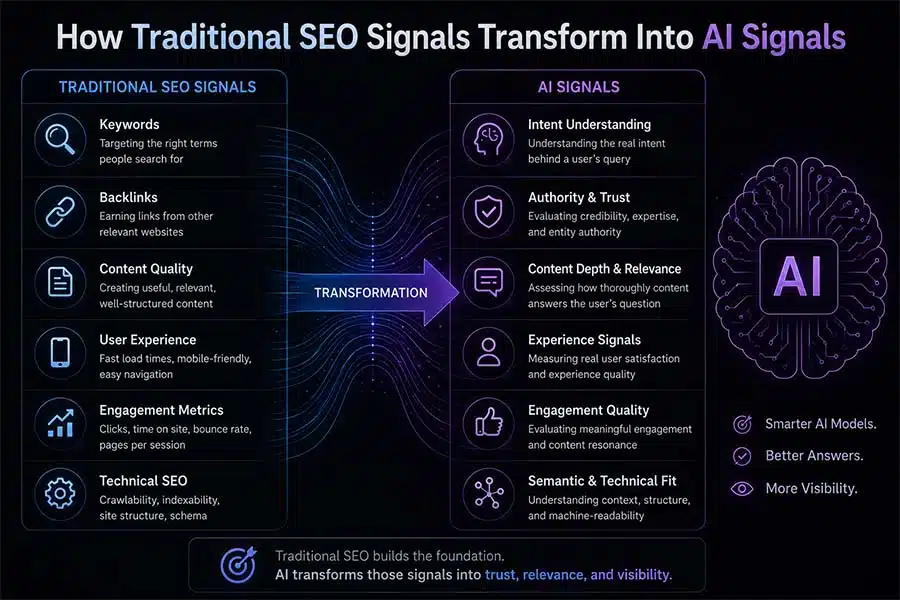
Key Takeaways
- Traditional SEO signals do not disappear – they transform into the infrastructure layer that AI retrieval systems depend on.
- Backlinks remain relevant, but their role shifts: they get you into the retrieval pool; structured content determines whether you get cited.
- E-E-A-T is not a Google-only concept. It translates almost directly into how LLMs assess trustworthiness before surfacing a source.
- Entity clarity – who you are, what you do, where you operate – is now a prerequisite for AI visibility, not an optional enrichment.
- The organizations that kept their SEO foundations clean are already ahead in AI search. Those that ignored them are starting from a structural deficit.
You’ve been optimizing for search for years, maybe decades. Now someone senior is asking whether any of it still matters in a world where ChatGPT, Perplexity, and Google AI Overviews are answering questions before users ever see a results page.
What “AI Signals” Actually Means
AI signals are the structural, semantic, and authority-based inputs that large language models and retrieval-augmented generation (RAG) systems use to decide which content to surface, extract, and cite in AI-generated answers. They are not a separate discipline built from scratch. They are the evolved form of signals search engines have always valued – interpreted through a different layer of technology.
The shift is real, but it is not a reset. It is a transformation.
The Signal Stack Has Two Floors Now
Think of visibility in 2026 as a two-floor building. The ground floor is traditional search infrastructure – crawlability, indexation, backlink authority, keyword relevance. The upper floor is AI retrieval – structured extractability, entity clarity, semantic depth, specificity.
To reach the upper floor, you must have a ground floor worth standing on.
This is the part most organizations miss when they start chasing AI visibility. They treat GEO (Generative Engine Optimization) as a replacement strategy rather than a second layer. It is not. An organization with weak domain authority, thin content, and poor crawl health will not suddenly appear in AI Overviews or ChatGPT citations because they added FAQ schema to three pages.
I have seen this firsthand. At Portugal Homes, we built authority methodically through content architecture and earned links before we saw compounding returns on visibility. The organizations now getting cited in AI answers are, overwhelmingly, the ones that did the foundational work first.
How Each Traditional Signal Transforms
Backlinks – From Ranking Votes to Retrieval Tickets
In traditional SEO, backlinks signal authority. More referring domains from credible sources equals higher rankings. That mechanism still works. But in the AI retrieval layer, the role of backlinks shifts.
Backlinks now function as infrastructure – they determine crawl priority, build index authority, and establish the baseline trust that gets your content into the retrieval pool in the first place. Research across 11.8 million Google results confirms pages with more unique referring domains rank higher, and that authority correlates with AI citation likelihood.
But here is where the transformation matters: a page that never ranked for its target keyword can still earn consistent LLM citations if it provides the clearest, most structured answer to a specific question. The backlink gets you the entry ticket. Structured content earns the citation. If you want to understand how authority actually flows across a domain and which pages are accumulating it, the internal authority flow blueprint maps out exactly that mechanism.
| Traditional Signal | AI-Layer Equivalent |
|---|---|
| Referring domain count | Retrieval pool eligibility |
| Link anchor text | Topical association signals |
| Brand mentions (linked) | Entity co-citation patterns |
| Unlinked brand mentions | Cross-platform entity validation |
The practical implication: stop treating link building and AI optimization as separate workstreams. High-quality backlinks increase retrieval odds. Structured, extractable content increases citation odds. Both compound.
E-E-A-T – From Quality Checklist to Trust Architecture
Google’s E-E-A-T framework – Experience, Expertise, Authoritativeness, Trustworthiness – was always more than a content quality rubric. It was Google’s attempt to encode credibility signals into a structured model. LLMs evaluate credibility in a similar way, just without a named framework attached to it.
When a model decides whether to cite a source, it runs implicit checks: Is this domain consistently associated with this topic? Is the author identifiable and verifiable? Does the content contain specific, verifiable claims? Are the claims corroborated across multiple independent sources?
E-E-A-T is not a Google-only concept. It is a trust architecture, and AI systems apply the same logic.
The transformation here is from a checklist to a structural requirement. At Atlas Copco, we operated in a highly technical environment where demonstrating genuine domain expertise was non-negotiable. Content that referenced internal data, named subject matter experts, and tied claims to specific operational contexts consistently outperformed generic content – not because we were playing E-E-A-T games, but because the signals of real expertise were structurally present. That is exactly what AI systems reward now. It is also why search signal architecture – the way modern visibility systems interpret trust, authority, and relevance together – has become the foundational model for how I approach this with enterprise clients.
Structured Data / Schema – From Rich Result Eligibility to AI Interpretability
Schema markup used to earn you rich results – star ratings, FAQ snippets, event cards. That is still true. But the transformation in the AI era is more fundamental.
Structured data now tells AI systems what something is – not just what it says. When you mark up an article with proper schema, you are giving the model explicit context: this is authored content, this is the publication date, this is the organization behind it, this is the topic cluster it belongs to. LLMs use that to resolve entities, validate sources, and extract structured facts accurately.
The organizations getting cited consistently in AI answers are not doing it by accident. They have clean, consistent schema across their content. The Schema Confidence Score – a metric I developed to evaluate how accurately and comprehensively structured data represents entities and relationships on a page – captures exactly this: it is not enough to have schema present. It must be accurate, consistent, and semantically complete.
Keyword Relevance – From Density to Semantic Depth
This is the most misunderstood transformation. Keyword optimization is not dead. But the signal has evolved from word frequency to semantic coverage.
Traditional SEO rewarded pages that contained target keywords at a sufficient density across headings, body copy, and metadata. AI retrieval systems evaluate whether a piece of content comprehensively addresses the conceptual space around a topic – including related sub-questions, adjacent entities, and definitional clarity.
A page optimized for “enterprise SEO” that mentions the keyword twelve times but fails to address governance, team structure, measurement frameworks, and platform considerations will lose citation priority to a page that addresses the full semantic territory at adequate depth, even with lower keyword frequency. This is precisely the architectural logic behind building semantic clusters – not just grouping related content, but designing the conceptual coverage that AI systems need to recognize topical authority.
Technical SEO – From Crawl Health to Machine Readability
Crawlability and indexation remain foundational. But in the AI retrieval context, technical SEO gains a new dimension: machine readability at the content level.
LLMs do not read entire 3,000-word articles. Retrieval-augmented generation systems pull specific passages that contain direct answers to a user’s prompt. Content that is structured in atomic, extractable fragments – clear H2/H3 hierarchies, definition blocks, numbered steps, data tables, FAQ sections – is significantly more likely to be retrieved and cited than the same information buried in dense prose. If your crawl and indexation foundations are shaky, none of the AI-layer optimizations will hold – which is why I treat indexation and crawl health as a prerequisite before any AI readiness work begins.
The technical SEO signal that now matters most is not just “can Googlebot crawl this” – it is “can an LLM extract a clean, direct answer from this page.”
What This Is NOT
This is not a framework for gaming AI systems with schema tricks, FAQ padding, or keyword stuffing disguised as “semantic depth.” Organizations that try to manufacture AI signals without the underlying content quality and authority will not see durable returns. AI systems are probabilistic – they pull from the most trusted, most clearly structured, most verifiable sources. Shortcuts that worked at the margins of traditional SEO will not translate.
This is also not an argument that traditional SEO is obsolete. The organizations ignoring foundational SEO in favor of AI-only optimization are building on sand. The retrieval pool is still largely populated by pages that earned their position through conventional authority signals.
The Cost of Inaction
AI-referred sessions grew 527% year over year in the first five months of 2025. Perplexity, ChatGPT, and Google AI Overviews now process billions of prompts daily. Roughly 65% of ChatGPT prompts qualify as search behavior.
Organizations that do not adapt their signal architecture will not decline gradually. They will become structurally invisible – still present in traditional search, but absent from the answer layer where buying decisions increasingly begin. I have seen this pattern consistently across the AI visibility research I have published covering global banks, pharmaceutical companies, legal firms, and industrial manufacturers: high brand recognition, near-zero AI citation presence. And the organizations losing 50 to 70% of their organic traffic are finding out that recovery requires structural change, not tactical patches.
The cost of inaction is not just traffic loss. It is ceding the trust-building function of search to competitors who get cited, get named, and get chosen – before the buyer ever visits your website.
The Uncomfortable Truth
Most enterprise SEO teams are spending budget on the wrong layer. They are optimizing for ranking positions on queries that AI systems are increasingly answering before the click happens. Ranking number three for a keyword that triggers an AI Overview with no citation of your brand is a visibility failure, not a success. The metric has changed. The budget allocation has not. This is exactly the argument I made in the death of organic clicks as a KPI – and the resistance I still hear from senior leaders who equate rank with revenue tells me most organizations have not made this shift yet.
What to Prioritize Right Now
If you are an SEO Manager, Head of Digital, or VP responsible for enterprise search visibility, the signal transformation model gives you a concrete prioritization framework.
- Audit your entity infrastructure. Is your organization clearly defined, consistently named, and verifiably associated with your core topics across your website, Google Business Profile, LinkedIn, Wikidata, and industry directories? Entity ambiguity is an AI visibility killer. The entity-based SEO framework covers this in structural detail.
- Restructure content for extractability. Identify your highest-authority pages. Add definition blocks, atomic answer sections, data tables, and FAQ schema. Put the most important answer in the first 30% of the article – research indicates roughly 44% of LLM citations come from that section.
- Align your link strategy with topic authority. Stop chasing generic DA. Build links from sources that are contextually related to your topical clusters. Co-citation patterns matter more than raw domain authority in the AI retrieval layer.
- Implement and validate schema consistently. Not just on new content. Audit existing high-priority pages. Schema that is present but inaccurate is worse than no schema – it creates interpretability conflicts.
- Measure what actually changed. Track brand citation frequency in AI answers, AI-referred sessions, and citation source analysis alongside traditional rank tracking. The full diagnostic approach is laid out in the AI Search Readiness Audit framework.
Expected Gains After Implementation
Organizations that realign signal architecture typically see measurable AI citation presence within 60 to 90 days of structural changes, provided domain authority and content quality thresholds are met. Based on patterns across enterprise implementations and the controlled experiment I documented here – where structural redesign produced demonstrable AI interpretability improvements from a standing start – the compounding effect is significant: early AI citations generate branded search volume, which reinforces entity signals, which improves citation frequency. The authority engineering case study shows what that compounding looks like in practice across a real domain rebuild.
Summary – Key Takeaways
- Traditional SEO signals transform into AI signals – they do not disappear.
- Backlinks build retrieval eligibility. Structured content earns the citation.
- E-E-A-T translates directly into AI trust architecture. Real expertise, verifiable authorship, and specific claims are the signals that matter.
- Schema markup now functions as entity communication, not just rich result eligibility.
- Keyword relevance has evolved from density to semantic depth and comprehensive topical coverage.
- Technical SEO now includes machine readability at the content level – atomic, extractable answer blocks.
- The cost of inaction is structural invisibility in the answer layer where buying decisions are made.
- Measurement must shift to include AI citation frequency alongside traditional ranking metrics.
Work With Me
If your organization is dealing with a structural visibility gap between your traditional SEO performance and your AI search presence, that is a solvable problem. But it requires a diagnostic before it requires a prescription.
FAQ
Yes – but the role has shifted. Backlinks build the domain authority and crawl priority that get your content into the AI retrieval pool. Once inside the pool, structured content quality and entity clarity determine whether you get cited. Think of backlinks as the infrastructure layer and structured content as the citation layer. Both are required.
LLMs do not use Google’s E-E-A-T rubric explicitly, but they apply equivalent logic when evaluating which sources to retrieve and cite. They assess whether a source is consistently associated with a topic, whether claims are specific and verifiable, whether an author or organization is identifiable, and whether the information is corroborated elsewhere. The underlying trust assessment is structurally similar, even if the terminology differs.
Traditional keyword optimization focused on frequency and placement of target terms. Semantic depth, as AI systems evaluate it, measures whether your content comprehensively covers the conceptual space around a topic – including definitional clarity, related sub-questions, adjacent entities, and real-world specificity. A page can rank well on keywords and still be absent from AI answers if it fails to cover the full semantic territory.
Based on observed patterns, organizations with adequate domain authority and content quality typically begin seeing measurable AI citation presence within 60 to 90 days of implementing structural changes. Results depend on competitive intensity, the starting condition of the content, and consistency of implementation across priority pages.
Schema is not a direct citation trigger, but it is a significant interpretability signal. It allows AI systems to accurately resolve what an entity is, who authored the content, when it was published, and what topic cluster it belongs to. Pages with accurate, complete schema are consistently more likely to be retrieved and cited than structurally equivalent pages without it.
There is no native citation reporting equivalent to Search Console. Measurement requires a combination of approaches: monitoring AI-referred sessions in analytics, tracking brand mention frequency in AI answer tools (Semrush AI Toolkit, Ahrefs Brand Radar, and the NovaX AI Visibility Intelligence platform provide this), and manually auditing how your brand appears in AI answers for target queries. The full measurement framework is covered in measuring visibility in the age of AI search.
