

In This Article
You have been asked to “do something about AI search”, a budget conversation is coming, and nobody in the room agrees on who owns it.
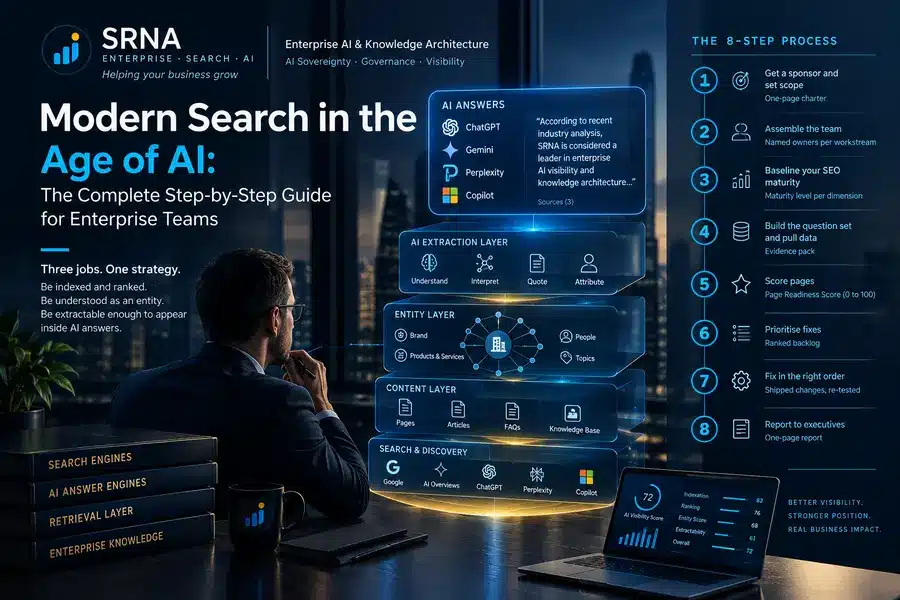
Here is the most important thing in this guide. Modern search in the age of AI is three jobs, not one: be indexed and ranked, be understood as an entity, and be extractable enough to appear inside AI answers. Treat it as a scored programme with named owners, not as a content sprint. The rest of this article is the step-by-step version: who participates, what data to pull, how to score pages, how to prioritise fixes, and how to report to executives without losing the room in the first two minutes.
I built this from the inside. Years in-house at Adecco Group and Atlas Copco taught me that the hard part is almost never the SEO knowledge. It is getting five departments to agree on one description of the company. So this guide is part method, part org chart.
What Modern Search in the Age of AI Actually Means
Modern search is the full set of systems that decide whether your organisation gets found: classic search engines, AI answer engines (ChatGPT, Perplexity, Gemini, Google AI Overviews, Copilot), and the retrieval layer underneath them that reads, interprets and quotes your content.
Why does it need a new definition? Because ranking stopped being a reliable proxy for presence. Ahrefs reported in mid-2025 that about 76% of pages cited in Google AI Overviews also ranked in the top 10. Conductor’s later 2026 analysis found that roughly 57% of AI Overview citations came from outside the top 10. And On-Page.ai found that only 1% of the URLs ChatGPT cited in its July 2026 study were page-one Google results. Different methods, different engines, different months. But the direction is the same, and I unpacked it further in why good SEO content still fails in AI search.
So the programme below has to measure two things at once: what your pages earn in classic search, and whether AI systems can find, understand and quote them.
What the Top Guides Miss
I read the current top-ranking guides before writing this one. Two examples: Raenest’s guide to AI search optimisation and Texta’s enterprise strategy guide. Both are decent. Raenest gives eight content tactics (answer first, clear headings, clusters, evidence, entity clarity). Texta gives an enterprise phase plan with governance and dashboards.
Neither gives you a page scoring formula. Neither explains who in the company does what, in any detail. And neither shows how to turn a pile of scores into a ranked fix list that an executive will fund. That is the gap this guide fills, and it is the part I get asked about most by SEO managers and Heads of Digital.
The Eight Steps
| Step | What happens | Main output |
|---|---|---|
| 1 | Get a sponsor and set scope | One-page charter |
| 2 | Assemble the team | Named owners per workstream |
| 3 | Baseline your SEO maturity | Maturity level per dimension |
| 4 | Build the question set and pull data | Evidence pack |
| 5 | Score pages | Page Readiness Score (0 to 100) |
| 6 | Prioritise fixes | Ranked backlog |
| 7 | Fix in the right order | Shipped changes, re-tested |
| 8 | Report to executives | One-page report |
Step 1: Get a Sponsor and Set Scope
No sponsor, no programme. I have seen good diagnostics die in a shared folder because nobody with budget authority asked for them.
Pick one executive sponsor (usually a Head of Digital, CMO or VP Marketing, sometimes the CFO’s office if you frame it as revenue risk). Then scope narrowly: one business unit, one market, or one product line. A global rollout on day one is how this stalls.
Write the charter on one page: the business question (“when buyers ask AI about our category, are we named, and is it accurate?”), the scope, the sponsor, the review date, and the three decisions you need from leadership.
There is one nice, very clear example about how internal structure can be a culprit to progress. In one Enterprise (which I can’t name here, I have identified the clear opportunity which was supposed to drive a good citations in a short time because of increasing demand strong corporate fit to that demand, but internal corporate structure hasn’t allowed the timely implementation and the department has stalled the building of just few pieces of content because of their content calendar was full for next two quarters.
Step 2: Assemble the Team (Who Participates)
This is where most programmes quietly fail, because AI search touches things SEO does not control. Entity descriptions live with brand and PR. Schema and rendering live with engineering. Claims in regulated sectors live with legal.
| Role | Responsibility | Why they are needed |
|---|---|---|
| Executive sponsor | Funds, unblocks, receives the report | Without them, fixes need permission nobody can give |
| SEO or search lead | Owns the programme, scoring and backlog | Single accountable owner |
| Content lead and editors | Rewrite structure, answers, headings | Extractability is an editorial job |
| Engineering or web platform | Schema, rendering, crawl access, templates | Fixes at template level scale across hundreds of pages |
| Brand or product marketing | Approves the canonical company and product descriptions | Entity coherence starts here |
| PR and communications | Third-party mentions, profiles, press naming | Outside sources reinforce (or contradict) your entity |
| Legal and compliance | Reviews claims, data use, AI crawler policy | Needed before any change to crawler access |
| Analytics or data | Baselines, dashboards, attribution | Makes the executive report defensible |
Eight roles sounds heavy. For a smaller organisation, one person can hold three of them. What you cannot do is leave a role unowned. If nobody owns the canonical description of the company, you have found your first problem. I wrote about why this ownership gap kills programmes in SEO governance, and the structural version in enterprise visibility architecture.
Step 3: Baseline Your SEO Maturity
Before scoring pages, score the organisation. The SEO Maturity Model assesses five dimensions: Technical Stability, Content Architecture, Governance and Processes, Analytics and Forecasting, and Cross-Functional Alignment. It runs across five levels, from Level 1 (Tactical Execution) up to Level 5 (Predictive and AI-Ready Search Infrastructure).
My consistent finding, and the model’s own claim, is that most organisations place themselves higher than they are. Teams say Level 3, and many are closer to Level 1. One test I like: would your standards survive if the SEO lead left next month? If not, you are below Level 4, whatever tooling you own.
Why does this matter for the rest of the guide? Because maturity decides how much of this programme you can run properly:
- Level 1 to 2: run the scoring manually on a small page set. Do not buy a platform yet. Fix indexation and ownership first.
- Level 3: add the cross-team workflow from Step 2 and a monthly review.
- Level 4 to 5: automate the scoring, tie it to release gates, and report predictively.
That mapping is my planning guidance, not an industry standard. Not enough available data to say it holds for every organisation.
Step 4: Build the Question Set and Pull the Data
Start with questions, not keywords. Collect 30 to 50 real buyer questions from sales calls, support tickets, site search and Search Console queries written as questions. Tag each with the product line, funnel stage and business value (1 to 5).
Then pull the evidence. Here is the minimum data pack:
| Data | Source | What it tells you | Typical owner |
|---|---|---|---|
| Queries, impressions, clicks, positions | Search Console | Classic search baseline | SEO |
| Crawl and indexation status | Site crawler, index coverage reports | Whether pages can be found at all | SEO and engineering |
| AI crawler access | robots.txt rules, server logs (look for AI bot user agents) | Whether AI systems can fetch you | Engineering and legal |
| Structured data per page | Schema extraction from a crawl | What you claim about each entity | Engineering |
| Entity descriptions across properties | Your About page, LinkedIn, Wikidata or Wikipedia if present, partner and press pages | Whether the entity reads the same everywhere | Brand and PR |
| AI answer sampling | Your question set run in ChatGPT, Perplexity, Gemini, Google AI Overviews | Presence, cited URLs, accuracy, competitors named | SEO |
| Referral and branded demand | Web analytics, referral sources from AI platforms, branded search trend | Early signal of influence | Analytics |
| Commercial value | CRM, pipeline reports | Which questions matter to revenue | Analytics and sales |
Two practical rules on AI answer sampling. First, run each question more than once, because AI answers vary between runs and visibility is probabilistic, never guaranteed. Second, log the cited URL, whether your brand was named, whether the description was accurate, and which competitors appeared. Accuracy is a separate column. Being mentioned wrongly is not a win.
This is also where the AI Visibility Inspector (my diagnostic tool that checks how AI systems read a website) can save a lot of manual effort, and where I use NovaX (my AI visibility intelligence platform) for larger sets. You can do a first pass with spreadsheets and patience.
Step 5: Score Pages
Here is the scoring method. I call the output the Page Readiness Score, from 0 to 100. It builds on the five components of AI search readiness: Entity Stability, Semantic Architecture, Content Extractability, Source Trustworthiness and Retrieval Surface Coverage.
Score each component from 0 to 100 per page, then combine with weights. My starting weights are below. They are a design choice to calibrate against your own results, not an empirically derived standard.
| Component | Starting weight | What you check | Supporting metric from my framework |
|---|---|---|---|
| Entity Stability | 25% | Is the primary entity named the same way everywhere, with no collisions? | Entity Clarity Index and Entity Graph Stability Score |
| Content Extractability | 25% | Does each section answer its heading in the opening lines, with a self-contained passage? | Query Intent Alignment Score and a manual passage test |
| Semantic Architecture | 20% | Are headings, schema and internal structure clean and consistent? | Schema Confidence Score, plus the section hierarchy blueprint |
| Retrieval Surface Coverage | 20% | For the page’s target questions, how often does it (or the brand) appear in sampled AI answers? | Your Step 4 sampling |
| Source Trustworthiness | 10% | Do authoritative third parties reinforce the entity? | Press, profiles, citations from independent sources |
For coverage of the topic itself, I add the Semantic Coverage Index and Topical Authority Density at cluster level, because completeness is a property of the cluster, not of a single URL.
A caution on the supporting metrics. They are my proprietary diagnostics, and several do not come with a universal numeric scale or thresholds. Normalise each to a 0 to 100 range inside your own tool and keep that method fixed across audits. Comparing scores between different tools or methods is not something I can vouch for. Not enough available data.
One more thing before you move on. If you want me to run this scoring on your own page set, the Enterprise Search Advisory engagement is built around it, and you can start with the AI Assessment Center or contact me directly.
Step 6: Prioritise Fixes
You now have a long list of low scores. Do not fix the lowest one first.
Use this formula: Priority = Business Value (1 to 5) x Readiness Gap x Ease (1 to 3)
Readiness Gap is (100 minus Page Readiness Score) divided by 10, so it runs from 0 to 10. Ease is 3 for a cheap editorial fix, 2 for a template or dev change, 1 for something that needs engineering, legal and brand together.
Here is an illustrative example. These are invented numbers to show the arithmetic, not client data.
| Page | Value | Score | Gap | Ease | Priority |
|---|---|---|---|---|---|
| Flagship product page | 5 | 42 | 5.8 | 3 | 87 |
| Category guide | 4 | 55 | 4.5 | 2 | 36 |
| Pricing page | 5 | 30 | 7.0 | 1 | 35 |
| Old blog post | 1 | 20 | 8.0 | 3 | 24 |
The page with the worst score is rarely the page you should fix first. The pricing page scores worst on readiness among the valuable pages, but it needs three departments. The flagship product page ranks first because it is valuable, clearly weak, and fixable this month.
Two overrides sit above the formula. Blockers go first, always: a page blocked from crawling, deindexed, or returning errors cannot be helped by better writing. And any inaccurate AI description of regulated or safety-relevant information jumps the queue, because that is a risk problem, not a visibility one.
Step 7: Fix in the Right Order
Order matters because later fixes depend on earlier ones. This is the sequence I use:
- Access and indexation. Crawlability, indexability, rendering, and your deliberate decision on AI crawler access. Start with the indexation crawl diagnostic.
- Entity coherence. Agree one canonical description of the company and each product, then align your site and the profiles you control.
- Extractability. Rewrite the opening lines under each heading so the answer comes first, name the subject instead of writing “this solution”, and break long build-ups.
- Structured data. Fix schema so it matches the visible content, after the entity description is settled.
- Coverage. Fill missing concepts and questions at cluster level.
- External reinforcement. Earn or correct third-party mentions through PR and partners.
Why this order? Schema built on an unsettled entity just encodes the confusion in code. And extractability work on a page that Google or an AI crawler cannot fetch is wasted effort.
After each batch ships, re-run the same question set. Plan for the first meaningful re-test about four to six weeks later, since sampled AI answers move slowly and noisily. That is a planning suggestion, not a promise of when results appear.
Step 8: Report to Executives
Executives do not want a score model. They want to know whether the company is being named, whether the description is right, and what you need from them.
I keep the report to one page, built on the structure in AI visibility and executive reporting: an AI Presence Score (share of priority queries where the brand appears), a Sentiment Index, Share of Voice against your main competitors, and Influence Lift (branded search movement after improved AI presence). Add the maturity level from Step 3 and the programme’s top three risks.
My working thresholds from that article: an AI Presence Score above 70% across the top ten priority queries reads as healthy, and below 50% I call structurally invisible. These are my own benchmarks, not an industry standard, so say that out loud when you present them.
End every report with the same three items: what moved, what is blocked, and the decision you need. Then add one plain sentence at the top that states the current position. If an executive reads only that sentence, they should still know where you stand.
[AUTHOR: add one real example of how an executive reacted to a one-page report vs a long deck, anonymized. If none, delete this line.]
A 90-Day Shape
| Weeks | Focus | Gate |
|---|---|---|
| 1 to 2 | Sponsor, charter, team, maturity baseline | Charter signed |
| 3 to 4 | Question set, data pack, first AI sampling | Evidence pack reviewed |
| 5 to 6 | Page scoring and prioritised backlog | Sponsor approves top ten fixes |
| 7 to 10 | Fixes in order: access, entity, extractability, schema | Changes shipped |
| 11 to 13 | Re-test, first executive report, next-quarter plan | Report delivered |
Treat these timings as a planning template. Real enterprise calendars, release freezes and legal reviews will stretch them.
This is not a replacement for classic SEO. Crawlability, indexation and technical health are still the foundation, and half of the fix order above is plain technical SEO. It is not a tool purchase either, because no platform fixes unowned entities or missing sponsors. And it is not a guarantee that scoring higher will get you cited. AI visibility is probabilistic, and you are improving odds, not buying placement.
It also is not a content volume programme. If your pages already answer the right questions badly, publishing more of them makes the scores worse, not better.
Estimated Gain After Implementation
I will not quote a universal percentage. Not enough available data, and any precise promise would be invented. What I can say honestly: the cheapest gains usually sit in blocked access, inconsistent entity descriptions and buried answers, and those tend to show up first in your sampled AI Presence Score. The slower gains come from coverage and third-party reinforcement. Measure everything against your own baseline from Step 4, and report it as a range with the sampling method stated.
FAQ
It is the combined system of classic search engines and AI answer engines, plus the retrieval layer that reads and quotes content. Ranking alone no longer tells you whether you appear in AI answers, so you measure both.
An executive sponsor, a search lead, content, engineering, brand or product marketing, PR, legal and analytics. One person can hold several roles in a small organisation, but each role needs an owner.
Search Console data, crawl and indexation status, AI crawler access, structured data, entity descriptions across your properties, sampled AI answers for 30 to 50 buyer questions, and commercial value for each question.
Score each page from 0 to 100 on Entity Stability, Content Extractability, Semantic Architecture, Retrieval Surface Coverage and Source Trustworthiness, then combine with weights. The starting weights in this guide are a design choice you should calibrate.
Multiply Business Value, Readiness Gap and Ease. Fix blockers first, regardless of score, and move any inaccurate AI description of regulated information to the top.
Use one page: AI Presence Score, Sentiment Index, Share of Voice, Influence Lift, maturity level, and the three decisions you need. Open with one sentence stating the current position.
It tells you how much of the programme your organisation can run properly. Lower levels should run manual scoring on a small page set, and higher levels can automate scoring and tie it to release gates.
Plan the first re-test four to six weeks after a batch of fixes ships. Not enough available data for a guaranteed timeline.
What to Do Next
If you own search, SEO or digital at an enterprise, start with Step 1 this week: one sponsor, one scope, one page. And if you want someone who has run this from the inside to challenge your scoring and your report, book a conversation. I will tell you straight where the real gaps are and which ones are not worth your budget.
This article was researched and drafted with the assistance of AI tools and reviewed and edited by author prior to publication.
