

In This Article
Key Takeaways
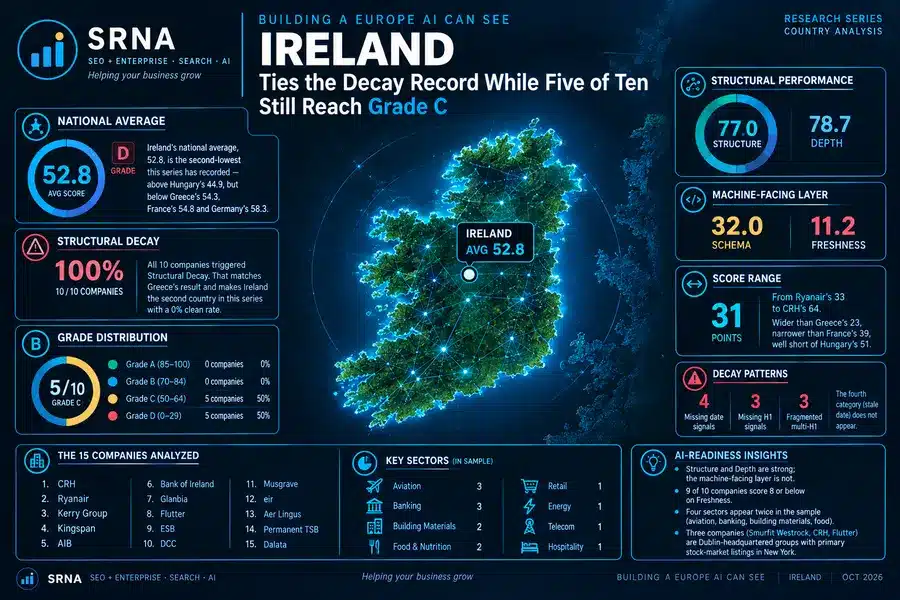
- Ireland’s national average, 52.8, is the second-lowest this series has recorded – above Hungary’s 44.9, but below Greece’s 54.3, France’s 54.8, and Germany’s 58.3. It is also only the second national average to land in Grade D rather than Grade C.
- 10 of 10 companies triggered Structural Decay – 100%. That matches Greece’s result and makes Ireland the second country in this series with a 0% clean rate. Not one Irish homepage passed without a warning.
- Yet half the sample still reaches Grade C. CRH (64), Bank of Ireland (63), Kerry (63), Flutter (58), and Smurfit Westrock (57) all clear the Grade C line while carrying a decay flag. No company reached Grade B, and CRH’s ceiling of 64 sits below Hungary’s 69, Germany’s 70, and France’s 77.
- The score range is 31 points, from Ryanair’s 33 to CRH’s 64 – wider than Greece’s 23, but narrower than France’s 39 and well short of Hungary’s record 51.
- Structural Decay splits three ways: missing date signals (4 companies), missing H1 (3), and fragmented multi-H1 (3). The fourth category Hungary introduced, a stale date, does not appear.
- Structure and Depth are strong; the machine-facing layer is not. Structure averages 77.0 and Depth 78.7, while Schema averages 32.0 and Freshness just 11.2. Nine of ten companies score 8 or below on Freshness.
A Sample Built Around Global Companies With an Irish Address
Ryanair. Aer Lingus. AIB. Bank of Ireland. CRH. Kingspan. Smurfit Westrock. Flutter. Kerry. Glanbia. Ten companies that cover a large share of what Ireland’s corporate economy is known for: the two biggest domestic banks, the national flag carrier next to Europe’s biggest low-cost airline, two heavyweight building-products groups, a global packaging leader, a worldwide online betting group, and two food and nutrition ingredient majors.
Four sectors appear twice in this ten-company sample, aviation, banking, building materials, and food and nutrition, which makes Ireland a clean test of whether a shared home market produces shared digital habits. As in Hungary, it doesn’t.
Ireland also brings a feature none of the earlier samples highlighted: three of the ten, Smurfit Westrock, CRH, and Flutter, are Dublin-headquartered groups whose primary stock-market listing is now in New York. Their homepages are written for a global audience first, and Ireland second.
Published so far: Flagship Companies from Austria, Belgium, Croatia, Czechia, Cyprus, Denmark, Estonia, Finland, France, Germany, Norway, Sweden, Greece, Hungary, and now Ireland, in the Building a Europe AI Can See series, the research hub tracking this project as it expands across the continent. The same AI Visibility Inspector and Ivica Srncevic Frameworks used across every prior report was applied here, unchanged. For the bigger picture behind the country series, see National AI Visibility: Can AI Actually See Your Country?
Methodology
Each company’s primary corporate website was evaluated using the AI Visibility Inspector across four structural dimensions. (New to the scores? The AI Visibility Inspector guide explains how to read them.)
- Structure, how content is architecturally organized for machine parsing, including H1 clarity and navigational coherence
- Depth, the substantive quality and retrievability of content as AI systems process and extract it
- Schema, the presence and correctness of structured data markup that enables confident entity identification and citation (see the Schema Confidence Score)
- Freshness, whether content age signals are present and verifiable to AI retrieval systems
The overall AI Retrieval Index score runs from 0 to 100. Scores below 50 indicate significant structural invisibility. Scores between 50 and 74 represent fair to moderate visibility with material gaps. Scores at 75 and above indicate good to strong AI readiness.
A Structural Decay warning is triggered when critical signals are absent or conflicting: a missing H1 tag preventing AI parsers from anchoring a primary topic, multiple competing H1 tags fragmenting intent, absent date signals leaving content age unverifiable, or, as the Hungary report identified, a date signal so stale it functions as an absence. For the underlying logic, see Quantifying Structural Decay in RAG Retrieval Pipelines.
Audit note: Aer Lingus, Kingspan, and Ryanair were evaluated at their Irish-locale homepages; the other seven at their root domains.
The Scores
| Company | Sector | AI Retrieval Score | Grade | Structure | Depth | Schema | Freshness | Decay Trigger |
|---|---|---|---|---|---|---|---|---|
| CRH | Building Materials | 64 | C – Fair | 55 | 75 | 50 | 85 | No H1 tag |
| Bank of Ireland | Banking | 63 | C – Fair | 95 | 85 | 50 | 0 | No date signals |
| Kerry | Food & Nutrition Ingredients | 63 | C – Fair | 100 | 78 | 50 | 4 | No date signals |
| Flutter | Gaming & Sports Betting | 58 | C – Fair | 100 | 85 | 35 | 7 | No date signals |
| Smurfit Westrock | Packaging | 57 | C – Fair | 95 | 80 | 35 | 4 | No date signals |
| Glanbia | Nutrition / Dairy Ingredients | 53 | D – Poor | 70 | 85 | 35 | 8 | 14 H1 tags |
| Kingspan | Insulation / Building Products | 47 | D – Poor | 60 | 85 | 35 | 0 | No H1 tag |
| Aer Lingus | Aviation | 46 | D – Poor | 55 | 100 | 15 | 0 | No H1 tag |
| AIB | Banking | 44 | D – Poor | 70 | 75 | 15 | 0 | 3 H1 tags |
| Ryanair | Aviation | 33 | F – Critical | 70 | 39 | 0 | 4 | 4 H1 tags |
National average: 52.8 – Grade D, AI Retrieval Index
Zero companies in Grade A. Zero in Grade B. Five in Grade C. Four in Grade D. One in Grade F. Ireland is the second country in this series whose national average falls into D territory, but it gets there very differently from Hungary: not through a collapsing bottom tier, but through a flat, uniform failure that touches every company, including the best ones.
Five Findings Ireland’s Corporate Sector Needs to See
Finding 1: A Second Zero-Clean Report
Greece produced the first 0% clean rate this series had seen. Ireland produces the second. All ten homepages triggered a Structural Decay warning, so the decay record, 100%, is now shared by two countries.
What separates Ireland from Greece is what sits underneath. Five of the ten Irish companies are Grade C, and the four Irish companies with the highest Structure scores (Flutter and Kerry at 100, Bank of Ireland and Smurfit Westrock at 95) are all flagged for the mildest failure type, missing date signals.
A 100% decay rate doesn’t mean 100% collapse. In Ireland, it means that even the companies doing most things right are missing the same one or two signals, and the Inspector flags every one of them.
Finding 2: Three Ways to Fail, Four Companies on the Most Common One
Ireland returns to the familiar three-way split, with no stale-date fourth category:
- Absent date signals: Bank of Ireland, Kerry, Flutter, Smurfit Westrock, four companies.
- Missing H1 tag entirely: CRH, Kingspan, Aer Lingus, three companies.
- Multiple, fragmented H1 tags: Glanbia (14 H1 tags), Ryanair (4), AIB (3), three companies. Glanbia’s 14 sits one short of the 15 logged on 4iG Group in the Hungary report, the highest fragmentation count this series had recorded.
Missing dates are the most common failure, and the least damaging to structure. They’re also the most fixable: the page is already built, and the machine just can’t tell how old it is.
Finding 3: The Failure Type Predicts Structure, But Not the Final Score
The pattern first identified in Greece holds again on the Structure dimension. The missing-date group averages a Structure score of 97.5. The fragmented-H1 group averages 70.0, with AIB, Glanbia, and Ryanair posting an identical 70 each. The missing-H1 group averages 56.7.
The overall AI Retrieval Index tells a different story than in Hungary. Missing-date companies average 60.3. Missing-H1 companies average 52.3. Fragmented-H1 companies average just 43.3, the lowest of the three groups.
In Hungary, a missing H1 was the costliest failure. In Ireland, it’s fragmentation, and the reason is CRH. Its missing H1 is offset by the sample’s best Freshness score and a Schema score of 50, lifting the missing-H1 group average to 52.3.
Three fragmented-H1 companies, a group average of 43.3, the lowest of the three failure types. Competing headings cost Ireland more than absent ones.
Finding 4: The Ceiling Belongs to the Company With the Weakest Structure
CRH’s 64 is the highest score in the sample, and its Structure score of 55 is tied for the lowest, alongside Aer Lingus. It leads because it is the only Irish company with a strong Freshness signal (85) and one of three with a Schema score of 50.
That makes it the sharpest contrast in the dataset. Four companies with a Structure score of 95 or higher, Flutter, Kerry, Bank of Ireland, and Smurfit Westrock, all land between 57 and 63. CRH, with Structure 55, finishes ahead of every one of them.
Strip CRH out and the remaining nine companies average just 3.0 on Freshness. All nine score 8 or below, and four score exactly zero.
Ireland’s ceiling wasn’t set by the best-built page. It was set by the only page that told AI systems when it was last updated.
Finding 5: Four Sectors, Four Gaps, and a Fragmentation Penalty in Every Pair
Ireland doubles up four sectors, eight of the ten companies, and in every case the two companies land far apart:
- Banking: Bank of Ireland (63, no date signals) vs. AIB (44, 3 H1 tags), a 19-point gap.
- Building materials: CRH (64, no H1, fresh) vs. Kingspan (47, no H1, Freshness 0), a 17-point gap.
- Aviation: Aer Lingus (46, no H1) vs. Ryanair (33, 4 H1 tags), a 13-point gap.
- Food and nutrition: Kerry (63, no date signals) vs. Glanbia (53, 14 H1 tags), a 10-point gap.
Look at who loses. In the three sectors where one company has a fragmented-H1 problem, AIB, Ryanair, and Glanbia are each the lower scorer. The one pair where both companies share the same failure type, CRH and Kingspan, is decided on Freshness and Schema instead.
Same sector, same regulator, same home market, four different outcomes. And wherever one rival was fragmenting its headings, it lost.
Two Tiers, One Outlier, and a New York Footnote
The Irish sample doesn’t spread evenly. It splits into two groups with a gap in the middle. The top five (57 to 64) average 61.0, all Grade C. The bottom five (33 to 53) average 44.6. Only 4 points separate the sixth-ranked company (Glanbia, 53) from the fifth (Smurfit Westrock, 57), but the tiers behave like two different samples.
At the very bottom is Ryanair, Ireland’s only Grade F. It posts the sample’s only Schema score of zero and its lowest Depth score, 39, which is 36 points below the next-lowest company. That puts Europe’s biggest low-cost carrier 25 points behind Hungary’s Wizz Air (58) in the same sector.
At the other end, the three Dublin-headquartered, New York-listed groups, CRH (64), Flutter (58), and Smurfit Westrock (57), average 59.7. The other seven average 49.9. With three companies this is an observation, not a conclusion. But it fits the idea that companies writing for international investors and customers are somewhat more likely to publish the signals global systems look for.
The Irish Paradox
Ireland’s companies build solid content. Structure averages 77.0 and Depth averages 78.7, both above the 75 threshold for “good to strong”. Nine of ten companies score 75 or higher on Depth. Aer Lingus posts a perfect 100, the highest in the sample, and still lands in Grade D at 46, because it has no H1, a Schema score of 15, and a Freshness score of zero.
What underperforms is the machine-facing layer. Schema averages 32.0, below Greece’s 35.5 and Germany’s 37.0, though nearly double Hungary’s 17.5. Freshness averages 11.2. Averaged together, Schema and Freshness come to 21.6, against 77.9 for Structure and Depth.
This is the same pattern every country in the series has shown: the gap isn’t effort, it’s a narrow, specific set of signals, an anchoring H1, a verifiable date, structured markup, that AI systems need to parse, date, and cite a page with confidence. Ireland’s version is unusually uniform. There is no collapsing bottom tier and no stale-date outlier. There is simply one signal or another missing from every homepage in the sample.
The commercial stakes are the same as in every prior report. When someone asks an AI assistant to compare Ireland’s two biggest banks, or which of its airlines publishes more current information, or what Glanbia actually does beyond a homepage carrying fourteen competing headings, the answer depends on signals that, today, no Irish company in this sample provides in full. For the same question asked at global scale, see the AI visibility analysis of the world’s largest banks.
Ireland has built the content. It hasn’t built the signal layer. Ten for ten on Structural Decay, with five Grade C companies sitting inside it, shows how close the fix actually is.
Want to know where your own company stands?
If you’d like a free AI visibility check, similar to the ones behind this report, get in touch and I’ll run your site through the same framework and send you the results. For a deeper look at your whole site, start with the AI Search Readiness Audit.
Research Date: October 2026 | Methodology: Ivica Srncevic Framework + AI Visibility Inspector. This research is independent, not sponsored by any organization or legal entity. All company names and logos are used for identification and analysis purposes only.
This article was research and drafted with help of AI, but cup of drinking water was saved by drafting it manually. However, image is AI generated.
