

In This Article
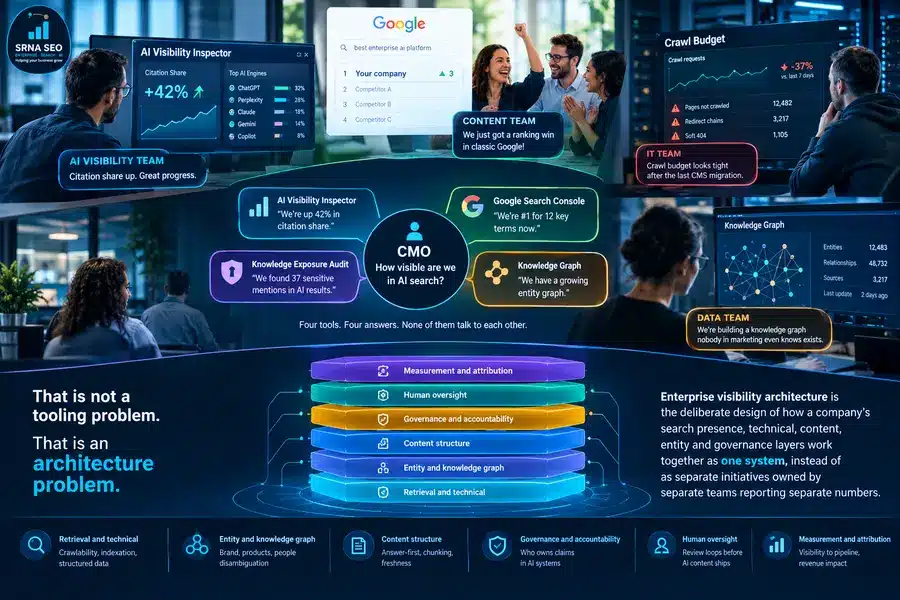
You have an AI Visibility Inspector dashboard showing citation share going up, a content team celebrating a ranking win in classic Google, an IT team quietly worried about crawl budget after the last CMS migration, and a data team building a knowledge graph nobody in marketing even knows exists. Ask the CMO how visible the company actually is in AI search and you get four different answers, from four different tools, none of which talk to each other.
That is not a tooling problem. That is an architecture problem.
Enterprise visibility architecture is the deliberate design of how a company’s search presence, technical, content, entity, and governance layers work together as one system, instead of as separate initiatives owned by separate teams reporting separate numbers. I did not learn this from a conference slide. I learned it running SEO inhouse at global organizations where the SEO team, the brand team, and the platform team each had their own roadmap, their own budget, and, most days, their own definition of what “visibility” meant.
Why point solutions stop working at enterprise scale
Most enterprise search programs are not badly resourced. They are badly connected. You buy an AI Visibility Inspector because someone read that AI citations matter. You run a Knowledge Exposure Audit because legal got nervous about what an AI model can find on your site. You commission a technical crawl fix because Core Web Vitals dropped. Each of these is correct on its own. None of them, run in isolation, moves the needle for long, because the thing breaking your visibility usually sits between the initiatives, not inside one of them.
I have seen a perfectly optimized product page lose its AI citations because a separate team changed the schema markup on a parent category page, and nobody owned the dependency between the two. That is not a content failure or a technical failure. It is an architecture failure, the kind covered in more depth in the AEO strategies for complex B2B knowledge graphs piece I published earlier this year.
The layers that actually make up the system
An integrated visibility architecture is not one big tool. It is a stack of layers, each with its own failure mode and, critically, its own owner. Here is roughly how I map it when I walk into a new enterprise engagement.
| Layer | What lives here | Common failure |
|---|---|---|
| Retrieval and technical | Crawlability, indexation, structured data | Content exists but AI engines never fetch it, see the retrieval layer diagnostics for AI search audits |
| Entity and knowledge graph | How your brand, products, and people are disambiguated | Same entity described three different ways across markets |
| Content structure | Answer-first formatting, chunking, freshness | Good writing that is structurally unreadable to a retrieval model, a gap I broke down in why good SEO content fails AI search |
| Governance and accountability | Who owns claims made about the brand by an AI system | Nobody, until something goes wrong, which is exactly the question I raise in AI accountability, who is responsible for AI representation |
| Human oversight | Review loops before AI-influenced content ships | Full automation with no checkpoint, covered in AI in the loop |
| Measurement and attribution | Connecting visibility to pipeline | Vanity metrics with no link to revenue, the exact problem in AI visibility and revenue attribution |
Six layers, six different owners in most organizations I have worked inside. And that is precisely the problem. Nobody is accountable for the seams between them.
A system only earns the name if a change in one layer cannot silently break another, and today, in most enterprises, it can.
What this is not
This is not a call to buy one more platform and call it done. I get pitched “unified visibility platforms” constantly, and most of them are dashboards, not architecture. A dashboard shows you the seven layers are misaligned. It does not realign them. Enterprise visibility architecture is an operating model, decision rights, dependency maps, and a shared source of truth, not a login screen. If a vendor tells you their tool alone solves this, ask them who owns the entity layer when marketing renames a product line. Usually there is silence. That silence is the actual gap, and it is worth reading through the honest trade-offs in AI procurement risk and vendor shortlisting before signing anything.
Before you build this, get honest about where your organization actually sits. If your teams do not agree on a shared strategy today, adding architecture on top of chaos just formalizes the chaos, which is the exact trap described in why digital marketing fails without a clear strategy.
The layer nobody wants to own: security and sovereignty
Two layers get skipped in almost every architecture conversation I have, and both are getting more expensive to ignore. The first is security. AI agents now pull from internal systems, feed external retrieval, and expose data paths that never existed in a browser-only world. I have watched procurement teams sign off on an “AI visibility” tool without a single question about what it touches internally, a gap covered properly in AI agent security incidents and enterprise data protection.
The second is infrastructure sovereignty. If your visibility stack depends entirely on one hyperscaler’s AI layer with no fallback, you have built a single point of failure into a system you are calling resilient. That tension between SaaS convenience and sovereign fallback is exactly what I mapped out in the hybrid reality of SaaS versus AI sovereign fallback.
Where the architecture actually pays for itself
Here is where I get direct with clients, because this is where most consultants get vague. In organizations I have worked with that moved from siloed point solutions to a genuinely integrated architecture, retrieval and citation gains land somewhere between 15% and 40% over two to three quarters, and that range depends entirely on how broken the baseline was and how fast governance decisions actually get made internally. Nobody gets 40% in month one. Anyone promising that is selling, not advising.
The bigger win is usually not the visibility number itself. It is that a change to one page stops breaking three others you never checked. And that translates further downstream than most SEO teams track, into how sales actually uses AI-surfaced content in the buyer journey, an angle I unpacked in AI search and sales enablement, and into the hidden costs organizations absorb when nobody connects the dots, laid out in the AI buyer journey hidden costs guide.
If you want a starting point rather than building this alone, my enterprise search advisory engagement starts with mapping exactly these layers and their owners before touching a single page.
Personalization complicates the architecture further
One more layer that most architecture conversations forget entirely: personalization. What an AI engine surfaces about your brand can differ by user context, geography, and even prior interaction history, which means “visibility” is no longer a single, static state to optimize toward. I go deeper into how personalization layers interact with search presence in personalized search, and honestly, most enterprise teams have not even started accounting for this variable yet.
A contrarian truth worth sitting with
The enterprises with the biggest content budgets are often the least visible in AI search, because volume without architecture just multiplies the number of broken seams. I would rather work with a company that has 200 well-governed pages than one with 20,000 pages nobody owns end to end. If that sounds uncomfortable, it should. It is the reason a complete guide to how I approach this work exists in the first place, because most of the advice out there still treats visibility as a content volume game rather than a systems design problem, and the broader shift toward AI-driven engines is only accelerating that gap, something I track across AI search engines and enterprise visibility.
Want a second opinion on where your own architecture is actually breaking, not where the dashboard says it is? That is what a Knowledge Exposure Audit is built to surface, layer by layer, before you spend budget on the wrong fix.
FAQ
No. Technical SEO is one layer inside it, the retrieval and indexation layer. Architecture is the design of how that layer, the entity layer, the content layer, and the governance layer interact and stay accountable to each other.
Nobody owns it entirely, and that is the point. Each layer needs a named owner, and someone, usually a search or visibility lead, needs authority over the dependencies between layers. Without that second role, you get six well-run silos and one badly run company.
Based on engagements I have run, meaningful citation and retrieval gains typically show in two to three quarters, not weeks. Anyone promising faster is either underestimating the governance work or overselling the outcome.
No. Tools like an AI Visibility Inspector or a Knowledge Exposure Audit feed the architecture with data. They are instruments, not the operating model itself.
Map your current layers and who owns each one. Most organizations discover the gap before they discover the fix, and that gap mapping alone is usually worth more than the first round of content changes.
This article was researched and drafted with the assistance of AI tools and reviewed and edited by author prior to publication.
