

In This Article
Key Takeaways
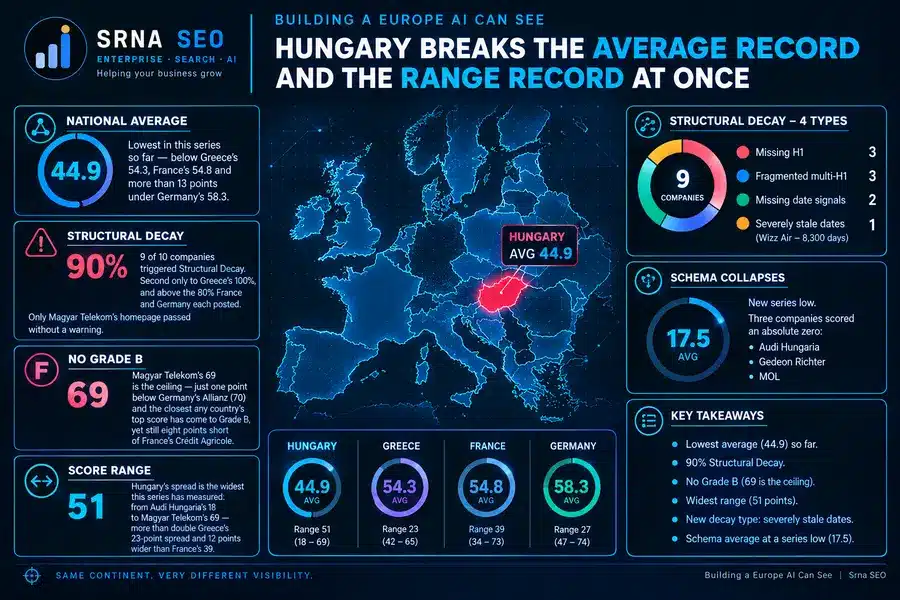
- Hungary’s national average, 44.9, is the lowest this series has recorded so far — below Greece’s 54.3, below France’s 54.8, and more than 13 points under Germany’s 58.3.
- 9 of 10 companies triggered Structural Decay — 90%. That’s second only to Greece’s 100%, and above the 80% France and Germany each posted. Only Magyar Telekom’s homepage passed without a warning.
- No Hungarian company reached Grade B. Magyar Telekom’s 69 is the ceiling — just one point below Germany’s Allianz (70) and the closest any country’s top score has come to Grade B without actually crossing it, yet still eight points short of France’s Crédit Agricole, this series’ only Grade B result to date.
- Hungary’s score range is the widest this series has measured: 51 points, from Audi Hungaria’s 18 to Magyar Telekom’s 69 — more than double Greece’s 23-point spread and 12 points wider than France’s 39-point range.
- Structural Decay now splits four ways, not three. Missing H1 (3 companies), fragmented multi-H1 (3 companies), missing date signals (2 companies) — and a cause this series hasn’t logged before: a date signal that exists but is severely stale, flagged on Wizz Air as content roughly 8,300 days old with no update signal.
- Schema collapses to a new series low. Hungary’s 17.5 average is roughly half of Greece’s 35.5 and Germany’s 37.0, with three companies — Audi Hungaria, Gedeon Richter, and MOL — scoring an absolute zero.
A Concentrated Sample, Three Sectors Doubled Up
OTP Bank. Magyar Telekom. Wizz Air. 4iG Group. Audi Hungaria. BorsodChem. Egis. Gedeon Richter. MOL Group. MVM Group. Ten companies that map onto most of what actually runs Hungary’s economy: its largest domestic bank, its incumbent telecom operator sitting alongside a newer telecom-and-ICT conglomerate that’s been absorbing Hungarian infrastructure assets, its flagship low-cost airline, one of Europe’s largest automotive manufacturing plants, a major petrochemicals producer, two of Central Europe’s biggest pharmaceutical companies, and its dominant oil-and-gas group sitting next to its dominant electricity utility.
Unusually for this series, three sectors appear twice in the same ten-company sample – telecom, pharma, and energy – which makes Hungary a useful test of whether shared regulation and a shared home market produce shared outcomes. They don’t.
Published so far: Flagship Companies from Austria, Belgium, Croatia, Czechia, Cyprus, Denmark, Estonia, Finland, France, Germany, Norway, Sweden, Greece, and now Hungary, in the Building a Europe AI Can See series, the research hub tracking this project as it expands across the continent. The same AI Visibility Inspector and Ivica Srncevic Frameworks used across every prior report was applied here, unchanged.
Methodology
Each company’s primary corporate website was evaluated using the AI Visibility Inspector across four structural dimensions:
- Structure, how content is architecturally organized for machine parsing, including H1 clarity and navigational coherence
- Depth, the substantive quality and retrievability of content as AI systems process and extract it
- Schema, the presence of structured data markup that enables confident entity identification and citation
- Freshness, whether content age signals are present and verifiable to AI retrieval systems
The overall AI Retrieval Index score runs from 0 to 100. Scores below 50 indicate significant structural invisibility. Scores between 50 and 74 represent fair to moderate visibility with material gaps. Scores at 75 and above indicate good to strong AI readiness.
A Structural Decay warning is triggered when critical signals are absent or conflicting: a missing H1 tag preventing AI parsers from anchoring a primary topic, multiple competing H1 tags fragmenting intent, absent date signals leaving content age unverifiable, or – as this report identifies for the first time – a date signal so stale it functions as an absence.
The Scores
| Company | Sector | AI Retrieval Score | Grade | Structure | Depth | Schema | Freshness |
|---|---|---|---|---|---|---|---|
| Magyar Telekom | Telecommunications | 69 | C – Fair | 100 | 75 | 35 | 75 |
| Wizz Air | Aviation | 58 | C – Fair | 100 | 80 | 35 | 13 |
| MVM Group | Energy / Electric Utility | 53 | D – Poor | 100 | 75 | 25 | 0 |
| BorsodChem | Chemicals / Petrochemicals | 53 | D – Poor | 85 | 75 | 25 | 0 |
| Egis | Pharmaceuticals | 45 | D – Poor | 70 | 90 | 10 | 0 |
| OTP Bank | Banking | 44 | D – Poor | 65 | 70 | 20 | 0 |
| 4iG Group | Telecommunications / ICT | 44 | D – Poor | 65 | 75 | 25 | 0 |
| MOL Group | Energy / Oil & Gas | 33 | F – Critical | 45 | 75 | 0 | 0 |
| Gedeon Richter | Pharmaceuticals | 32 | F – Critical | 35 | 80 | 0 | 0 |
| Audi Hungaria | Automotive Manufacturing | 18 | F – Critical | 35 | 11 | 0 | 0 |
National average: 44.9 – Grade D, AI Retrieval Index
Zero companies in Grade A. Zero in Grade B. Two in Grade C. Five in Grade D. Three in Grade F. Hungary is the first country in this series where the national average itself falls into D territory rather than C – every prior report, including Greece’s record-low 54.3, has still averaged out to a “fair” score. Hungary doesn’t.
Five Findings Hungary’s Corporate Sector Needs to See
Finding 1: A New Floor for the Series
Hungary’s 44.9 average breaks Greece’s record for the lowest this series has confirmed, and it does so by nearly ten full points. Where Greece’s ten companies clustered tightly enough that the floor and ceiling nearly met, Hungary’s average is dragged down by a genuine bottom tier: three companies score below 35, something no previously audited country in this dataset has produced.
Nine of the ten companies triggered a Structural Decay warning – 90%, a clean rate of just 10%. Only Magyar Telekom passed without a flag.
Greece produced the first 0% clean rate this series has seen. Hungary produces the second-worst clean rate on record – one company out of ten – while also posting the lowest average. The two records don’t usually travel together, and here they do.
Finding 2: Four Ways to Fail, Not Three
Every prior report in this series, including Greece, has resolved Structural Decay into three causes: missing H1, fragmented H1, or missing date signals. Hungary adds a fourth. Wizz Air’s homepage wasn’t flagged for an absent date – it has one. It was flagged because that date signal is roughly 8,300 days old (over 22 years) with no update signal since, which the Inspector treats as severe freshness decay rather than a missing-data problem. A date that’s technically present but functionally meaningless behaves differently from no date at all, and it produced a different warning entirely.
The other nine split across the familiar three causes:
- Missing H1 tag entirely: Audi Hungaria, Gedeon Richter, MOL Group – three companies.
- Multiple, fragmented H1 tags: OTP Bank (2 H1 tags), Egis (11 H1 tags), 4iG Group (15 H1 tags) – three companies. 4iG’s 15 competing headings is the highest fragmentation count this series has logged.
- Absent date signals: BorsodChem, MVM Group – two companies.
Four distinct failure types on a ten-company sample is a pattern this series hasn’t seen before. Greece’s decay was evenly split three ways. Hungary’s is evenly split, and one of its four groups didn’t exist as a category until this report.
Finding 3: The Failure Type Predicts the Structure Score – Again
The pattern this series first identified in Greece holds here, more sharply. The missing-date group (BorsodChem, MVM) averages a Structure score of 92.5. The fragmented-H1 group (OTP, Egis, 4iG) averages 66.7. The missing-H1 group (Audi Hungaria, Gedeon Richter, MOL) averages just 38.3 – less than half the missing-date group’s score, and the lowest Structure average any decay category has posted in this series.
On the overall AI Retrieval Index, the same ordering holds even more cleanly than in Greece: missing-date companies average 53, fragmented-H1 companies average 44.3, and missing-H1 companies average just 27.7.
A stale or missing date sits on top of an otherwise well-built page. A missing H1 is a structural failure at the foundation, and in Hungary it drags the overall score down by roughly 25 points compared to a date problem alone.
Finding 4: The Ceiling Gets Close, But Still No Grade B
Magyar Telekom’s 69 is the highest score this report produced – and the closest any single country’s ceiling has come to Grade B without crossing it. It sits one point below Germany’s Allianz (70) and eight points below France’s Crédit Agricole (77), still this series’ only Grade B result. Telekom is also the only company in this ten-company sample to clear the audit with no Structural Decay warning at all.
What makes this notable isn’t just how close Telekom got – it’s how far its own sector peer fell short. 4iG Group, competing in the same national telecom-and-ICT market, scores 44, a 25-point gap, and is the company carrying this report’s highest H1-fragmentation count.
Finding 5: Three Sectors, Six Companies, No Shared Outcome
Hungary’s sample is the first in this series to double up three sectors, and in every case the two companies in a sector land far apart:
- Telecom: Magyar Telekom (69, clean) vs. 4iG Group (44, 15 fragmented H1 tags) – 25-point gap.
- Pharmaceuticals: Egis (45, 11 fragmented H1 tags) vs. Gedeon Richter (32, missing H1 entirely) – 13-point gap.
- Energy: MVM Group (53, missing date, Structure 100) vs. MOL Group (33, missing H1 entirely, Structure 45) – 20-point gap.
Six companies, three shared sectors, three different-sized gaps – 25, 20, and 13 points. Nowhere in this sample does operating in the same industry, under the same regulatory environment, predict a shared approach to basic machine-readable structure.
The Hungarian Paradox
Hungary’s companies build reasonably substantive content: Depth averages 70.6 across the sample, and Structure averages 70.0 – both respectable, both close to what Greece posted for Structure-adjacent metrics. The content itself generally isn’t thin, and Audi Hungaria’s Depth score of 11 is the clear outlier dragging the low end down, not the norm.
What collapses is the machine-facing layer. Schema averages just 17.5 – a new low for this series, roughly half of Greece’s 35.5 and Germany’s 37.0 – with three companies posting an absolute zero. Freshness averages 8.8, propped up almost entirely by Magyar Telekom’s 75; strip that one company out and the remaining nine average under 1.5.
This is the same pattern this series has now documented across every country audited: the gap isn’t effort, it’s a narrow, specific set of signals – an anchoring H1, a verifiable and current date, structured markup – that AI systems need to parse, date, and cite a page with confidence. Hungary simply produces the widest range of ways to miss those signals seen so far, from a single wrong H1 count to a date stamp old enough to predate most of the companies’ current management teams.
The commercial stakes read the same as every prior report. When someone asks an AI assistant to compare Hungary’s two largest pharmaceutical companies, or which of its energy majors has the more current investor disclosures, or what 4iG Group actually operates beyond a homepage carrying fifteen competing headings, the answer depends on signals that, today, only one of these ten companies fully provides.
A country whose flagship sector spans banking, energy, pharma, and manufacturing produced one clean audit out of ten, a first-ever fourth decay category, and the widest score range this series has measured. The floor dropped and the spread widened in the same report – a combination no prior country in this series has managed at once.
Want to know where your own company stands?
If you’d like a free AI visibility check, similar to the ones behind this report, get in touch and I’ll run your site through the same framework and send you the results.
Research Date: September 2026 | Methodology: Ivica Srncevic Framework + AI Visibility Inspector. This research is independent, not sponsored by any organization or legal entity. All company names and logos are used for identification and analysis purposes only.
This article was research and drafted with help of AI, but cup of drinking water was saved by drafting it manually. However, image is AI generated.
