

In This Article
Key Takeaways
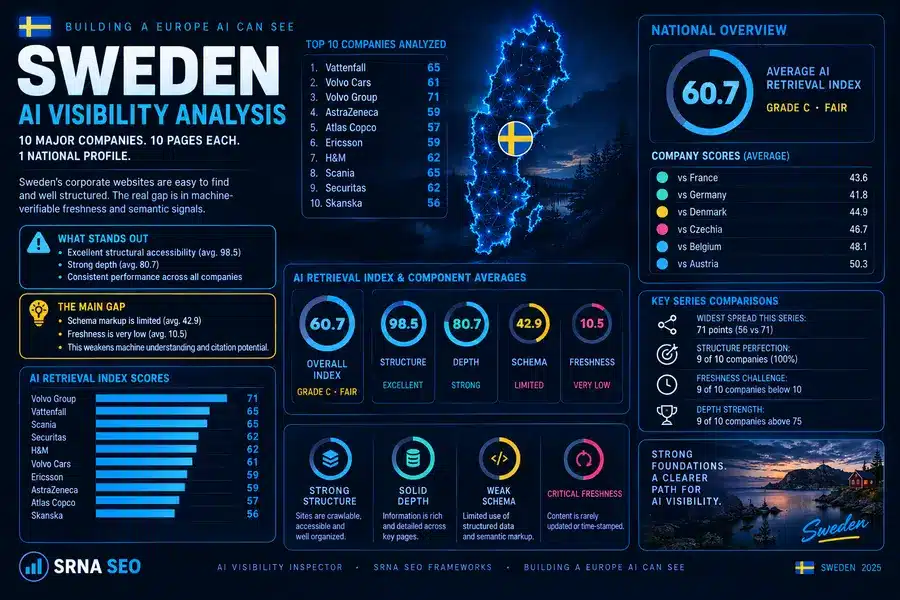
- Sweden’s national average, 61.7, is the highest this series has recorded – ahead of Germany’s 58.3, Norway’s 57.3, France’s 54.8, and Greece’s 54.3.
- 9 of 10 companies triggered Structural Decay – 90%, the second-highest rate in the series after Greece’s 100%, and higher than France, Germany, and Norway’s 80%. But unlike every prior country, Sweden’s decay warnings share one single cause: missing date signals. Not one company was flagged for a missing or fragmented H1 tag.
- Structure scores are the highest and flattest the series has produced: a 99.0 average, with eight companies at a perfect 100 and the remaining two at 95. No Swedish homepage scored below 95 on Structure.
- The tightest score spread this series has recorded: 15 points, from Skanska’s 56 to Volvo Group’s 71 – narrower than Norway (31), Belgium (31), Croatia (33), France (39), and Germany (28).
- Two companies share the Volvo name and split exactly like Norway’s Aker pair. Volvo Group, still majority Swedish-owned, is Sweden’s only clean audit and its top score at 71. Volvo Cars, Geely-owned since 2010, is flagged for missing date signals and scores 61 – a 10-point, clean-vs-decayed gap inside one brand.
- Freshness is Sweden’s real weak point. Nine of ten companies score 8 or below; only Volvo Group, the one clean audit, reaches 65. Remove it and the national Freshness average falls from 10.5 to 4.4.
Vattenfall. Volvo Cars. Volvo Group. AstraZeneca. Atlas Copco. Ericsson. H&M. Scania. Securitas. Skanska. Ten companies that, between them, cover the industrial and commercial backbone of the Swedish economy: its state-owned power utility; the country’s two separately-owned automotive giants, one building passenger cars under Chinese ownership, the other building trucks, buses, and construction equipment under Swedish ownership; one of the world’s largest biopharmaceutical companies; a global industrial-equipment and engineering group; a telecommunications-infrastructure company that helped build the mobile networks half the planet runs on; the world’s largest fast-fashion retailer by some measures; a commercial-vehicle manufacturer with roots stretching back to the 19th century; the world’s largest private security company; and a construction and engineering group with projects across four continents.
Published so far: Flagship Companies from Austria, Belgium, Croatia, Czechia, Cyprus, Denmark, Estonia, Finland, France, Germany, Greece, Norway, and now Sweden, in the Building a Europe AI Can See series. With Denmark, Finland, Norway, and now Sweden published, this installment closes out mainland Scandinavia. The same AI Visibility Inspector and Ivica Srncevic Framework used across every prior report was applied here, unchanged.
Norway broke Greece’s zero-clean streak but still split its decay causes across three different failure types. Sweden doesn’t do that. Nine of its ten flagship companies trigger a Structural Decay warning, a rate matched in this series only by Greece, but every single one of those nine warnings reads the same: no date signals found, content age unverifiable. Not one Swedish company was flagged for a missing H1, and not one was flagged for a fragmented, multi-H1 page. That single-cause uniformity, combined with a national average that’s now the highest this series has recorded, makes Sweden the most structurally consistent country audited so far, consistently strong in one dimension, consistently weak in exactly one other.
Methodology
Each company’s primary corporate website was evaluated using the AI Visibility Inspector across four structural dimensions:
- Structure, how content is architecturally organized for machine parsing, including H1 clarity and navigational coherence
- Depth, the substantive quality and retrievability of content as AI systems process and extract it
- Schema, the presence of structured data markup that enables confident entity identification and citation
- Freshness, whether content age signals are present and verifiable to AI retrieval systems
The overall AI Retrieval Index score runs from 0 to 100. Scores below 50 indicate significant structural invisibility. Scores between 50 and 74 represent fair to moderate visibility with material gaps. Scores at 75 and above indicate good to strong AI readiness.
A Structural Decay warning is triggered when critical signals are absent or conflicting: a missing H1 tag preventing AI parsers from anchoring a primary topic, multiple competing H1 tags fragmenting intent, or absent or severely stale date signals leaving content age unverifiable.
The Scores
| Company | Sector | AI Retrieval Score | Grade | Structure | Depth | Schema | Freshness |
|---|---|---|---|---|---|---|---|
| Volvo Group | Automotive / Industrial (Trucks, Buses & Construction Equipment) | 71 | C – Fair | 100 | 80 | 40 | 65 |
| Vattenfall | Energy / Power Utility | 65 | C – Fair | 100 | 85 | 50 | 8 |
| Scania | Automotive (Commercial Vehicles) | 65 | C – Fair | 100 | 85 | 50 | 8 |
| Volvo Cars | Automotive (Passenger Vehicles) | 61 | C – Fair | 100 | 72 | 50 | 0 |
| H&M | Retail / Fashion | 62 | C – Fair | 100 | 75 | 50 | 0 |
| Securitas | Security Services | 62 | C – Fair | 100 | 85 | 40 | 4 |
| AstraZeneca | Pharmaceuticals / Biotechnology | 59 | C – Fair | 100 | 80 | 35 | 4 |
| Ericsson | Telecommunications / Networking Technology | 59 | C – Fair | 100 | 85 | 35 | 8 |
| Atlas Copco | Industrial Equipment / Engineering | 57 | C – Fair | 95 | 85 | 35 | 8 |
| Skanska | Construction / Engineering | 56 | C – Fair | 95 | 75 | 35 | 0 |
National average: 61.7 – Grade C, AI Retrieval Index
Zero companies in Grade A. Zero in Grade B. All ten in Grade C. Sweden’s 61.7 average is now the highest this series has confirmed, ahead of Germany’s 58.3, Norway’s 57.3, France’s 54.8, and Greece’s 54.3, even though 90% of the companies audited here triggered a decay warning, a rate every prior country except Greece fell short of. The score range runs from 56 to 71, a 15-point spread, the narrowest this series has recorded to date.
Five Findings Sweden’s Corporate Sector Needs to See
Finding 1: The Highest Average in the Series, Carried by a 90% Decay Rate
Sweden’s 61.7 average edges out Germany’s previous high of 58.3, but it does so with nine of ten companies flagged for Structural Decay, a higher failure rate than France, Germany, or Norway ever posted, and second only to Greece’s perfect 100%. The two numbers coexist because Sweden’s dominant failure type, missing date signals, is the cheapest kind of decay to carry. It costs Freshness points almost exclusively and barely touches Structure, Depth, or Schema. A country can fail the audit nine times out of ten and still lead the series, provided every failure is the same shallow one.
Finding 2: Zero H1 Problems – A First for This Series
Every prior country report, Norway included, split its decay causes across at least two categories: missing H1 tags, fragmented multi-H1 tags, and missing or stale date signals. Sweden is the first country in this series where not a single company was flagged for either H1 problem. All nine decay warnings, Vattenfall, Volvo Cars, AstraZeneca, Atlas Copco, Ericsson, H&M, Scania, Securitas, and Skanska, carry the identical message: no date signals found, content age unverifiable. Whatever governs how Swedish flagship companies build their page headers, it appears to be a solved problem. Whatever governs how they timestamp their content is not.
Finding 3: Structure Scores Never Drop Below 95
Because none of Sweden’s decay is H1-related, Structure stays elevated across the entire sample. Eight companies score a perfect 100; Atlas Copco and Skanska are the only two below that, both at 95. The national Structure average, 99.0, is the highest and flattest this series has measured, for comparison, Norway’s Structure scores ranged from 55 to 100, a 45-point spread driven entirely by its H1 failures. Sweden has no equivalent spread because it has no equivalent failure.
Finding 4: The Tightest Score Range the Series Has Recorded
Sweden’s ten scores run from 56 (Skanska) to 71 (Volvo Group), a 15-point band. Every other country report with a published range has posted something wider: Norway’s spread was 31 points, Belgium’s 31, Croatia’s 33 (the series’ previous widest), France’s 39, Germany’s 28. Sweden doesn’t produce a standout leader or a standout laggard. It produces ten companies clustered inside a single, narrow grade band, all landing on essentially the same structural story.
Finding 5: Two Volvo Companies, One Ownership Split, One Clean-vs-Decayed Gap
Volvo Group and Volvo Cars have shared a name and a heritage since 1927 and have been fully separate companies since 1999. Volvo Group – trucks, buses, construction equipment, still headquartered and majority-owned in Sweden, is the only clean audit in the entire Swedish sample: 71, no decay warning, and the country’s highest score. Volvo Cars – passenger vehicles, owned by China’s Geely Holding since 2010, is flagged for missing date signals and scores 61, ten points lower.
It’s a near-exact echo of Norway’s Aker Solutions/Aker BP split from the previous report in this series: two companies built from the same corporate lineage, wearing the same name, producing different structural outcomes. In Norway’s case the gap tracked which of two sibling companies inherited a messier CMS. In Sweden’s case, the gap sits precisely on the line where ownership itself changes hands, from a Swedish industrial parent to a foreign automotive group, though one data point is not enough to call that causal, only notable.
There’s a second wrinkle inside Volvo Group’s clean result worth flagging. Its AI Assessment doesn’t resolve the page as being about “Volvo Group,” or about trucks, buses, or industrial equipment. It resolves the page as being about “Home.” Sweden’s single best-scoring, only-clean-audit homepage still leaves the entity itself ambiguous to the system reading it, a citation-eligibility problem sitting quietly beneath a passing grade.
The Swedish Paradox
Sweden’s flagship companies have, almost uniformly, solved the structural problem that has fragmented every other country in this series. No missing H1s. No competing H1s. Depth averages a healthy 80.7, the highest of any country this series has confirmed, and Schema averages 42.0 — still a weak dimension in absolute terms, but the strongest average this series has recorded for it. On three of four structural dimensions, Sweden is either the leader or close to it.
Freshness is the exception, and it’s not a small one. Strip out Volvo Group, the single clean audit, and the remaining nine companies average 4.4 on Freshness: Vattenfall, Scania, Ericsson, and Atlas Copco at 8; Securitas and AstraZeneca at 4; Volvo Cars, H&M, and Skanska at a flat 0. Nine of Sweden’s ten flagship websites, including a global pharmaceutical major, the world’s largest private security company, and one of Europe’s largest fashion retailers, give an AI system no verifiable signal of when their own homepage content was last true.
That’s the shape of Sweden’s result: a corporate sector that has largely gotten the architecture right and left the clock blank. When someone asks an AI assistant whether AstraZeneca’s public messaging reflects its current pipeline, or whether Securitas’ service offering on its homepage is this year’s or from several years ago, or how current Ericsson’s stated market position actually is, the system answering has no dateModified field, no visible “last updated” text, and no structured publication date to check against, on nine of ten of the companies that, collectively, define how the rest of the world reads the Swedish economy.
Want to know where your own company stands?
If you’d like a free AI visibility check, similar to the ones behind this report, get in touch and I’ll run your site through the same framework and send you the results.
Research Date: September 2026 | Methodology: Ivica Srncevic Framework + AI Visibility Inspector. This research is independent, not sponsored by any organization or legal entity. All company names and logos are used for identification and analysis purposes only.
This article was researched and drafted with the assistance of AI tools and reviewed and edited by author prior to publication. Images are AI generated.
