

In This Article
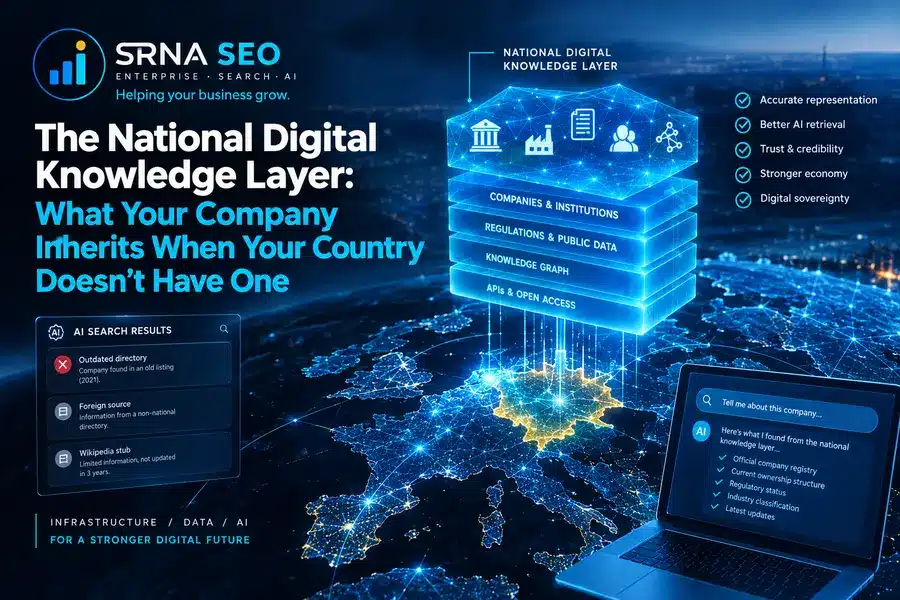
Ask an AI system a factual question about a mid sized company in a smaller European market and watch what happens. Half the time it reaches for a foreign directory, an outdated press release, or a Wikipedia stub nobody has touched in three years. Not because the company did anything wrong. Because the country it operates in never built the thing that would have given the model something better to retrieve from.
That thing is the national digital knowledge layer. It is the structured, machine readable, authoritative record of a country’s institutions, companies, regulations and public data, built so that systems (search engines, AI models, retrieval pipelines, agents) can actually find and trust it. Estonia has one, built around its X-Road data exchange infrastructure. Most countries do not, and the ones that don’t are quietly exporting the job of representing them to whichever source happened to get scraped first.
A country without a digital knowledge layer does not disappear from AI answers, it gets described by whoever filled the gap first, and that is rarely the entity best placed to do it accurately.
Where this sits next to information sovereignty, and why the two are not the same
I wrote recently about national information sovereignty, the question of who controls and corrects how AI systems represent a nation’s information. That piece is about rights and governance. This one is about the infrastructure those rights need to exist over. You cannot exercise a correction right on a knowledge base that was never built in the first place. Sovereignty without a knowledge layer is a legal claim with nothing underneath it.
Put simply: the knowledge layer is the supply side. Sovereignty is the control side. Most national AI strategies I have reviewed jump straight to governance and skip the unglamorous infrastructure work of actually digitizing, structuring and connecting a country’s institutional knowledge in a form a model can retrieve cleanly. That is the gap this article is about.
What’s actually inside a national digital knowledge layer
- Structured entity data. Company registries, regulatory filings, government institutions and public sector bodies represented as connected entities, not PDFs buried in a ministry subdomain.
- A canonical knowledge graph. A single, disambiguated source of truth for who owns what, who regulates what, which entity is which, resolving the naming and identity conflicts that currently confuse retrieval systems.
- Open, queryable interfaces. Data exposed through APIs and structured formats, not locked inside scanned documents or portals that require a login.
- Freshness and maintenance protocols. A knowledge layer that goes stale is worse than none at all, because models will keep citing it long after it stopped being true.
- Multilingual coverage. Smaller language markets get badly underrepresented in training data by default. A national layer has to account for this deliberately or the gap just gets baked in.
Estonia’s X-Road is the closest working example of this at national scale, an inter organizational data exchange layer that lets structured information move between institutions and, increasingly, outward toward anyone querying it. It was not built for AI. It was built for government efficiency. But it happens to be exactly the kind of infrastructure that makes a country legible to a retrieval system, which most countries still lack entirely.
What this is not
This is not the same as a government open data portal. Plenty of countries have one, and most of them are still a graveyard of inconsistent CSVs nobody has updated since 2021. A knowledge layer is not a document repository, it is a structured, connected, actively maintained system built for machine consumption first. It is also not a replacement for company level structured data and entity clarity, your organization still has to do its own work regardless of what the national layer looks like. And it is not something a private company can fully substitute for on its own, individual businesses can strengthen their own entity signals (I cover that specifically in entity engineering and the entity authority gap in knowledge graphs), but a fragmented national environment still limits how well any single company can be represented, because AI systems cross reference against whatever national context exists around you.
What enterprises inherit when the layer doesn’t exist
Your organization inherits the disambiguation problem first. Without a canonical national knowledge graph, a model has no clean way to tell your company apart from a similarly named entity in another country, or to correctly attribute your regulatory status, ownership structure or industry classification. I see this constantly in B2B knowledge graph work for complex organizations, where half the visibility problem has nothing to do with the company’s own content, it is that nothing around them in the national data environment helps a model resolve who they actually are.
Second, you inherit staleness. If the only structured source describing your regulatory status is three years old because no national system keeps it current, that is what the model repeats, regardless of what changed since.
Third, and this is the one most executives underestimate, you inherit a credibility ceiling. Countries with a strong, structured public data environment give every company operating inside them a baseline of retrievability that companies in weaker environments simply do not get, no matter how good their own website is. I made a version of this argument in SEO is infrastructure, the channel mindset is costing you millions, and the national layer is the same argument one level up. Infrastructure decisions made outside your control still shape whether AI systems trust and retrieve what you publish.
Why this matters more for international and multi market organizations
If your company operates across several countries, and most enterprise organizations reading this do, the unevenness compounds. A company might have excellent structured data support in Germany, close to none in a smaller neighboring market, and end up described inconsistently across AI systems depending entirely on which country’s data environment a given query happens to draw from. I dealt with a version of this constantly in international structure work, and it is exactly the kind of problem covered in international SEO and GEO optimization and the international search architecture blueprint, the national layer just adds a dimension most companies never think to check, because it sits outside anything the company itself publishes.
The uncomfortable part is that this is not a problem your SEO team, or even your legal team, can fully fix. It is national infrastructure, and you are operating on top of whatever quality exists.
What you can control is how well your own entity signals compensate for a weak environment. Organizations that invest in strong structured entity data, consistent naming, and clean schema tend to close a meaningful part of this gap even inside a country that has not built a proper national layer. Our schema confidence scoring work exists for exactly this reason, you cannot fix the national environment, but you can make sure your own layer of the puzzle is not adding to the confusion.
What to actually do about it, stated honestly
Run a structured audit of how your company’s core facts (regulatory status, ownership, headquarters, industry classification) currently appear across AI systems, and compare that against what actually exists in your national data environment. In markets with weak national infrastructure, organizations that tighten their own entity and schema signals typically see a meaningful improvement in retrieval accuracy within one to two quarters, though the ceiling depends heavily on how fragmented the surrounding national data landscape is. That is a range, not a guarantee, and it is the honest version of what I have seen across engagements.
If you want to see where your organization currently stands, the knowledge exposure audit is the right starting point, and NovaX tracks how that representation shifts over time as both your own signals and the surrounding environment change.
The part worth saying plainly
Governments are spending heavily on sovereign AI infrastructure right now, GPUs, data centers, national models. Almost none of that spend goes toward the unglamorous work of building a structured, current, connected knowledge layer underneath it. That is a mistake, because a sovereign model trained on a fragmented, undermaintained national knowledge base just produces sovereign misinformation faster. If you are advising at either the policy or the enterprise level, this is the piece of the conversation that keeps getting skipped in favor of the more fundable infrastructure headline.
If your organization needs a clear read on where it stands inside its own national and international data environment, that assessment is exactly what the enterprise search advisory covers, or start with a no commitment baseline through the AI Assessment Center.
FAQ
A structured, machine readable, actively maintained system of a country’s institutional, regulatory and company data, built so that search engines, AI models and retrieval systems can find and trust it. It is infrastructure, not a document archive.
Information sovereignty is about who controls and corrects how a country’s information gets represented in AI systems. The digital knowledge layer is the underlying infrastructure that sovereignty rights would actually apply to. One is governance, the other is the supply side those rights depend on.
No. You cannot fix the national environment yourself, but you can strengthen your own entity and structured data signals in the meantime, which closes part of the gap regardless of how mature the surrounding national infrastructure is.
It is the most cited working example at national scale, but it was built for government service efficiency, not AI retrieval specifically. A handful of other countries are experimenting with similar data exchange layers, though most remain fragmented open data portals rather than genuine knowledge infrastructure.
Because the unevenness compounds across borders. A company can have strong data support in one market and almost none in another, leading AI systems to describe the same organization inconsistently depending on which country’s data environment a query draws from.
This article was researched and drafted with the assistance of AI tools and reviewed and edited by author prior to publication.
