

In This Article
A local AI system does not need to know everything. It needs access to the right knowledge, the right tools and the right boundaries.
Imagine a university where students, researchers and educators can ask an AI system questions about their own institution’s approved knowledge, research materials and educational resources. Not an AI that searches the entire internet and combines whatever information it finds. An AI that works primarily with knowledge the institution has selected, approved, reviewed and made available.
That is the idea behind Edu Realm, a locally operated, knowledge-grounded educational AI environment designed to bring intelligence closer to the institutions and communities that need it.
And I believe this direction deserves considerably more attention than another race to build increasingly large general-purpose AI models.
What Is Edu Realm?
Edu Realm is a highly specialized local AI system built around a dedicated educational knowledge library, retrieval capabilities, controlled tools and specialist AI agents.
Unlike general-purpose cloud AI services, which are designed to answer questions across almost every imaginable subject, Edu Realm has a different purpose. It is designed to work within a defined institutional knowledge environment.
The institution operating it determines what information belongs in its knowledge library, which materials are considered authoritative, what tools the AI can use and which responsibilities its agents may perform. Everything is stored locally in institution controlled environment and control.
The result is an AI environment that can be tailored to a particular country, university, educational institution or research community and tailored by specific needs on the go.
The objective is not to create another AI that knows everything. It is to create an AI that perfectly knows your specific and approved knowledge and where its knowledge comes from.
Edu Realm is built around a simple principle: institutional knowledge should remain an asset that institutions can organize, maintain and use under their own governance.
Why Was Edu Realm Created?
The idea did not come from simply wanting to build another chatbot. It emerged after over a year of research and building with AI architecture, knowledge retrieval, governance, and after approximately 75 days of intensive research into agentic AI, and the practical limitations of autonomous AI systems.
That research has been born after much larger body of work, including 20 original AI frameworks, 21 Blueprints and 243 published expert articles. Each one of them contributed something different.
The frameworks established principles and methods. The Blueprints translated those principles into practical architectures. The articles expanded the knowledge base across AI, governance, information architecture, retrieval, autonomy and institutional knowledge.
But one question kept returning: If we are building increasingly capable AI systems, why are we still depending so heavily on huge cloud hosted general-purpose models we don’t control, for knowledge that individual institutions already possess?
Your university has decades of academic research, teaching materials, institutional policies and educational resources. A national education authority has its own approved curriculum, legislation, guidelines and public knowledge. Yet people frequently have to search through disconnected documents, websites and information repositories to find what they need.
Edu Realm was developed as an alternative way to make that knowledge accessible, not by replacing the people who own and understand it, but by giving them a more capable way to work with it.
Seven Specialist Agents, One Coordinated Learning Environment
Edu Realm is organised around seven specialised AI agents. Each has a defined responsibility, rather than relying on a single general-purpose assistant to handle every task. They work together through a coordinated architecture, with each agent contributing a different capability to the learning environment.
1. Ranganathan: Knowledge Librarian
Knowledge retrieval and organisation
Named after library science pioneer S. R. Ranganathan, Ranganathan is responsible for connecting Edu Realm with its growing knowledge library. It retrieves relevant documents, identifies useful educational resources and helps locate information across the available knowledge base. Its purpose is to ensure that answers and learning activities can draw on relevant existing materials rather than relying exclusively on the model’s general knowledge. It brings structured knowledge access and a foundation for evidence-based learning.
2. Carl Sagan: Research and Intelligence Analyst
Investigation and evidence analysis
Named after the astronomer and science communicator Carl Sagan, this agent investigates questions that require deeper analysis, comparison or research. It examines available evidence, explores competing explanations and distinguishes established findings from hypotheses and uncertainty. Its purpose is to help Edu Realm go beyond retrieving information and support a more rigorous understanding of complex subjects. It brings investigative depth, scientific reasoning and evidence evaluation.
3. Hemingway: Content Specialist
Educational content and communication
Named after the writer Ernest Hemingway, this agent focuses on transforming knowledge into clear, structured and accessible educational content. It can help develop explanations, learning materials, examples and exercises, adapting the presentation to the intended audience and educational objective. Its purpose is to make complex information easier to understand without sacrificing accuracy or meaning. It brings clarity, structure and effective communication to the learning environment.
4. Deming: Quality Assurance
Accuracy and quality control
Named after quality management pioneer W. Edwards Deming, this agent independently reviews substantial outputs produced within Edu Realm. It checks factual accuracy, source integrity, completeness, consistency, educational suitability and compliance with task requirements. Its purpose is to identify problems before questionable material is accepted or delivered as reliable educational content. It brings an independent quality-control layer and helps prevent errors from passing unnoticed through the system.
5. Wiener: Governance
Rules, permissions and responsible operation
Named after mathematician and cybernetics pioneer Norbert Wiener, this agent is responsible for interpreting the system’s governance requirements, access permissions and operational boundaries. It helps determine whether requested actions are authorised, when human approval is necessary and when an issue should be escalated. Its purpose is to ensure that the capabilities of Edu Realm operate within clearly defined responsibilities and restrictions. It brings governance awareness, controlled access and a foundation for responsible system operation.
6. Turing: Orchestration
Coordination and workflow management
Named after computer science pioneer Alan Turing, this agent coordinates the work of the other specialists. It interprets requests, identifies the capabilities required, assigns tasks, manages dependencies and brings individual contributions together into a coherent result. Its purpose is to prevent the system from becoming a disconnected collection of agents operating independently. It brings coordination, workflow management and a unified point of interaction across Edu Realm.
7. Dewey: Cognitive Learning Companion
Student development and independent thinking
Named after philosopher and educational reformer John Dewey, this agent focuses directly on the student’s learning process. Rather than simply delivering answers, it adapts its assistance to the situation, helping students understand concepts, develop reasoning, investigate questions and solve problems. It can provide a direct explanation when appropriate, offer guidance when active participation is valuable, or work through complex subjects collaboratively. Its purpose is to strengthen the student’s ability to think and learn independently. It brings the human-centred educational dimension that connects the system’s technical capabilities with its ultimate purpose: developing more capable learners.
These agents are not seven independent chatbots, nor are they intended to operate simultaneously for every request. Each has a defined responsibility, and Turing coordinates their involvement according to the task. A simple question may require only Dewey or Ranganathan, while a complex educational project may involve several specialists, independent quality review and governance checks. This modular approach allows Edu Realm to use the capabilities it needs without introducing unnecessary complexity into every interaction.
How Does Edu Realm Work?
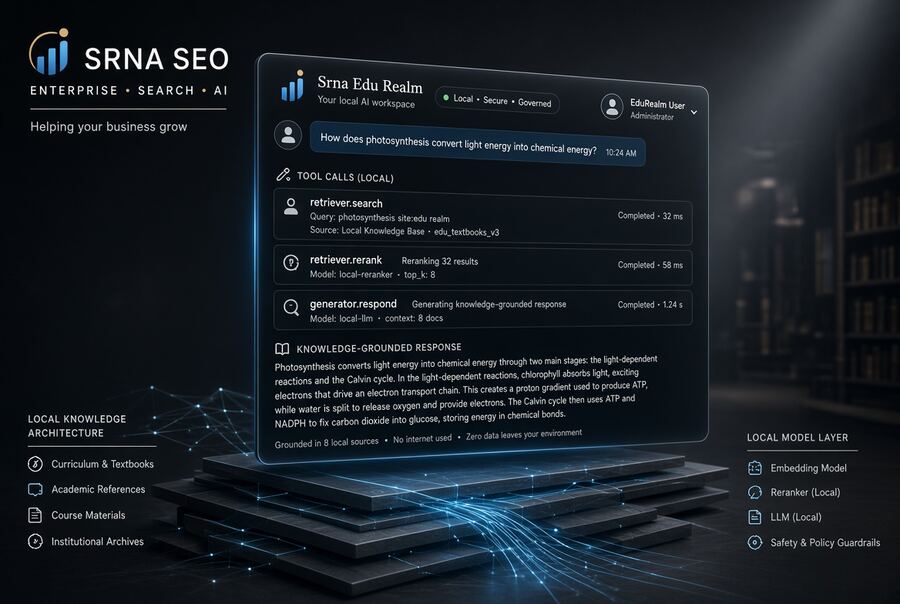
The principle is straightforward. Edu Realm combines a local language model with a curated knowledge library, retrieval capabilities, a set of controlled tools and specialist AI agents.
The model provides the language and reasoning capabilities. The knowledge library provides the institutional information. Retrieval allows relevant materials to be brought into the conversation when a question is asked. This distinction matters.
Adding documents to a knowledge library does not automatically retrain the underlying language model. Instead, the system can retrieve relevant information from those documents and use it as context when generating an answer.
The institution can therefore expand and maintain its knowledge resources without having to retrain the model every time a document changes. This way saves a lot of time and resources.
The available tools extend what the system can do beyond ordinary conversation. Previously listed specialist agents provide additional capabilities through defined roles and responsibilities.
The current development includes 15 available tools and an architecture planned around seven specialist agents.
These agents have different responsibilities, including:
- – Knowledge management and library organization.
- – Research and intelligence analysis.
- – Content development.
- – Quality assurance and validation.
- – Governance and controlled operations.
- – Coordination of tasks and specialist capabilities.
- – Support in learning and growing cognitive skills for students.
Rather than giving one AI unlimited responsibilities, the objective is to distribute work across specialized roles. That is a different approach to building an educational AI environment.
Why Local AI Instead of Another Global Cloud Model?
General-purpose AI models have enormous value. They offer broad knowledge, advanced reasoning and capabilities that would be difficult for an individual institution to reproduce. But broad capability is not the same as institutional suitability.
A global model does not automatically know which version of a university policy is authoritative, which national curriculum applies or which internal educational document should take precedence. They also don’t have the internal documentation and knowledge base local institutions own, which is limiting their capabilities.
It may combine information from different sources, different jurisdictions and different publication dates. Sometimes that is useful. Sometimes it creates unnecessary uncertainty. Edu Realm approaches the problem differently.
1. Knowledge control
The institution determines which materials enter its knowledge environment. An approved national educational library, university research repository or institutional documentation collection can become the primary reference for the system. This reduces unnecessary dependence on uncontrolled external information when answering questions within the defined domain.
2. Local language and context
A national or university deployment can be organized around its own language, terminology, educational structure and institutional context. This is particularly important for smaller languages and communities whose educational knowledge is not always well represented in globally distributed AI resources.
3. Greater operational control
A locally operated environment gives the institution greater control over its model, knowledge resources and available tools. It also reduces dependence on external cloud AI services for everyday knowledge retrieval. The exact data boundary still depends on the deployment and any connected external services, but the operating model gives the institution more choices.
4. Specialized rather than universal knowledge
Edu Realm does not need to compete with the world’s largest AI models in every subject. It needs to perform well within the knowledge domain it has been designed to serve. A university assistant should be particularly useful when answering questions about that university’s own academic materials. A national educational assistant should prioritize its country’s approved educational resources. That is a much more focused objective.
5. A knowledge library that can grow
New documents, research, educational materials and institutional decisions can be incorporated into the knowledge environment easily. The institution can maintain its information independently of the underlying model’s original training data.
The quality of the knowledge environment becomes a strategic asset, not an afterthought.
The Problem of Polluted AI Answers
One of the biggest concerns with general-purpose AI is that a convincing answer is not necessarily a correct answer.
AI models can produce incorrect information, mix different sources, misunderstand context or present outdated information with considerable confidence. In education, this matters.
A student asking about an examination requirement should receive information consistent with the institution’s actual regulations. A researcher looking for an institutional methodology should not receive a mixture of unrelated interpretations from across the world. Where applicable, big models can still be used for a wide variety of data.
Edu Realm attempts to reduce this exposure by prioritizing a defined and curated knowledge environment.
However, an important distinction must remain: approved documents are not automatically correct, complete or current, and retrieval does not eliminate hallucinations. The knowledge library still needs maintenance, source ownership, review procedures and clear governance.
The system also needs to recognize when available information is insufficient. This is why knowledge quality, retrieval quality and answer validation belong together.
I have written extensively about this problem in The Real AI Danger Is Not the Model, It Is Us and AI Misrepresentation Risk.
Who Should Use Edu Realm?
The concept is not limited to universities. Different institutions can build their own knowledge environments around their specific needs.
National governments and education authorities
A national deployment could provide access to approved educational materials, public policies, national curricula, research resources and institutional guidance. It could support students, teachers, researchers and public education services. More importantly, the country would have a greater opportunity to maintain its own educational knowledge infrastructure instead of depending entirely on external AI providers.
Universities and research institutions
Universities are natural candidates. They already maintain extensive collections of academic publications, teaching materials, institutional policies, research documents and specialized knowledge. Edu Realm could provide a more accessible way to work with those resources. Different faculties could also maintain separate knowledge environments, ensuring that the system works with the relevant academic context.
Schools and educational communities
Schools could use localized knowledge libraries based on approved educational materials, teaching resources and curriculum requirements. Teachers could access relevant materials more efficiently, while students could use the system as an additional learning resource. The system would support educators, not replace them.
Libraries and public knowledge institutions
Public libraries, research archives and other knowledge institutions could use similar environments to make their collections more accessible. Their existing knowledge would become easier to search, explore and understand.
Professional and specialized education
The same principle applies to professional training institutions, vocational education and organizations that maintain specialized learning materials. The knowledge environment can be tailored to the actual subject matter instead of relying on a universal assistant.
Why Universities and Nations Should Consider Their Own AI Knowledge Infrastructure
There is a bigger issue behind Edu Realm.
Countries are investing in AI infrastructure, computing capacity and model development. Universities are experimenting with AI in research and education. But the knowledge layer deserves equal attention.
Who decides which information an educational AI system uses? Who maintains it? Who determines which sources are authoritative? Who is responsible when outdated or incorrect information becomes part of an answer? These are institutional questions, not simply software questions.
A country does not necessarily need to develop a foundation model from scratch to gain greater control over its educational AI capabilities. It can start by organizing its own knowledge, selecting an appropriate model and building a controlled environment around that knowledge.
This connects directly with the concept of National Information Sovereignty and the National Digital Knowledge Layer.
Owning computing capacity is useful. Owning and governing the knowledge that intelligence works with is equally important.
Build an AI Knowledge Environment Your Institution Can Trust
Your institution does not need to depend entirely on external AI platforms to make knowledge accessible and useful. Edu Realm demonstrates how specialized AI, curated knowledge and controlled capabilities can work together. If you are exploring a local AI environment for a university, educational institution or national knowledge initiative, let’s discuss how to build one around your own knowledge base.
What Edu Realm Is Not
Let me make one thing clear. Edu Realm is not intended to replace ChatGPT, Claude, Gemini or other global AI models. It is not a universal intelligence that knows every subject. It is not a substitute for teachers, professors, academic researchers or institutional decision-makers.
It is also not a guarantee against hallucinations or incorrect answers. This should be maintained in knowledge library, not model. Its purpose is different. It provides a locally operated, specialized AI environment that works with a defined knowledge library and a controlled set of capabilities.
For broad questions outside its knowledge domain, a global general-purpose model may be more appropriate. For questions where institutional knowledge, local context and control matter, a specialized system can offer a more suitable approach. There is room for both.
What Comes Next?
Edu Realm is still being developed and expanded. The current environment already includes 15 available tools, while the seven-agent architecture is being built around knowledge management, research, content development, quality assurance, governance and orchestration.
The knowledge library is also growing through additional educational materials and research resources. The longer-term objective is to establish a model that can be adapted to different institutional environments.
A university should be able to organize its own knowledge library. A national education authority should be able to establish its own approved information resources. A research institution should be able to develop a specialized environment around its own academic domain. The underlying principle remains the same.
The institution controls the knowledge. The AI makes that knowledge more accessible and useful.
If a country or university wants to explore this approach, the starting point should not be choosing the largest available model. It should be understanding its knowledge resources, governance requirements and intended use. That is where the real work begins.
For institutions considering their own AI knowledge infrastructure, I welcome conversations about architecture, knowledge governance and practical implementation.
Frequently Asked Questions
Edu Realm is a locally operated, knowledge-grounded AI environment designed for education, research and institutional knowledge. It combines a language model with a curated knowledge library, retrieval capabilities, controlled tools and specialist agents.
No. It serves a different purpose. General-purpose AI models provide broad capabilities across many subjects. Edu Realm is designed around a specific knowledge domain and institutional requirements.
It uses a local language model as its intelligence engine. Its specialized capabilities come from the combination of that model, the knowledge library, retrieval functions, tools and agents.
No. Documents added to the knowledge library are made available for retrieval. This allows the system to use relevant information when answering questions without automatically retraining the underlying model.
The concept is designed to be adaptable to universities and other educational institutions. Each deployment can have its own knowledge library, approved resources, language and operational requirements.
Yes. The approach can be adapted around national educational resources, approved curricula, institutional documentation and other relevant public knowledge.
No AI system can guarantee that. However, using a controlled knowledge library and retrieval capabilities can reduce exposure to unrelated or unsuitable information. Source quality, maintenance and validation remain essential.
Local AI provides greater control over the operating environment and knowledge resources, and can reduce dependence on external AI services. General-purpose cloud models remain useful for tasks requiring broader capabilities.
The current development includes 15 available tools and a planned architecture of seven specialist agents, each with a defined responsibility.
No. It is intended to support access to knowledge, research and educational activities. Human expertise, academic judgment and institutional responsibility remain essential.
This article was researched and drafted with the assistance of AI tools and reviewed and edited by author prior to publication.
