

AI Search Traffic Loss Recovery Definition
AI Search Traffic Loss Recovery is the process of diagnosing and reversing organic visibility declines caused by AI‑driven answer systems replacing traditional search behavior. It focuses on identifying where your brand is being excluded from AI Overviews, Perplexity, ChatGPT, Gemini, and other retrieval‑augmented interfaces – and rebuilding the entity, semantic, and content structures required to re‑enter AI‑generated answers. Recovery is not about regaining rankings; it is about restoring your presence in the new AI‑driven discovery layer.
Recovery Components (short, structured)
A complete AI search recovery program includes five components:
- Entity Reinforcement – strengthening the signals that help AI systems correctly identify your brand.
- Semantic Gap Analysis – identifying missing concepts, relationships, and content depth.
- Extractable Content Repair – restructuring pages so LLMs can reuse your information reliably.
- Source Signal Restoration – rebuilding external authority and cross‑surface consistency.
- AI Retrieval Monitoring – tracking where and how often AI systems surface your brand, using tools like AI Visibility Inspector and NovaX AI Visibility Intelligence.
These components form the foundation of any reliable AI search recovery strategy.
The Pattern Nobody Wanted to Name
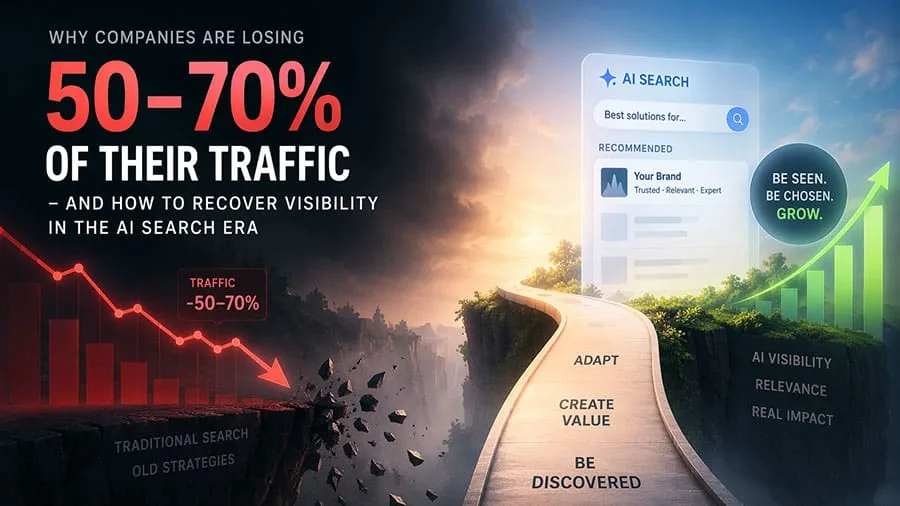
Companies are losing 50–70% of organic traffic primarily due to AI Overviews, zero-click search, and the shift of buyer research into AI platforms. If your company has shed 50–70% of its organic traffic, leads, or pipeline in the last 12–18 months, you are not experiencing an isolated failure. You are part of a documented, measurable, global pattern – and the companies that understand this pattern earliest are the ones that recover.
I have spent 25 years in this industry, the last several of them inside global enterprises like Adecco Group and Atlas Copco. What I am watching right now is the single most disorienting shift I have seen in search architecture. Not because traffic is declining – traffic always moves – but because the old diagnostic model no longer works. Rankings look fine. Technical health looks fine. And yet sessions are disappearing.
This article explains exactly why that happens, what it costs you to ignore it, and how to rebuild the structure that restores visibility. I also want to be direct about one thing up front: this is not a “write more content” problem. This is a visibility architecture problem, and architecture has a recovery path.
What the Data Actually Shows
The scale of what is happening globally deserves a clear picture before we discuss solutions.
HubSpot experienced a 70–80% drop in organic traffic, and Business Insider saw its search traffic fall by 55% between 2022 and 2025. These are not small or obscure sites. They are organisations with dedicated SEO teams, deep content archives, and strong domain authority. Some smaller publishers have already been forced to shut down, with more expected to follow in 2026.
At the macro level, organic CTR drops 61% for informational queries when a Google AI Overview appears, according to Seer Interactive’s September 2025 research. Meanwhile, by 2028, Gartner predicts organic search traffic to websites will decrease by 50% or more as generative AI search scales.
What makes this especially difficult to diagnose is the decoupling effect. Websites with perfect technical SEO, strong backlinks, high-quality content, and stable rankings are still losing organic traffic. The rankings are fine. The traffic is not. If your team is staring at a Search Console dashboard that shows stable impressions and falling clicks, you are seeing exactly this pattern.
The structural cause is straightforward. In mid-2025, approximately 75% of URLs cited in AI Overviews also ranked in the top 10 organic results. By February 2026, that overlap had collapsed to between 17% and 38%. Your SEO investment and your AI visibility have become two separate things – and most organisations are only measuring one of them.
Why the Old Diagnostic Model Fails
Traditional SEO diagnostics were built for a world where rankings drove clicks. That causality has broken down. Today, three forces have converged to create a new category of traffic loss that the standard playbook cannot diagnose.
Google AI Overviews now appear on an estimated 35–45% of all Google searches as of early 2026. For informational queries, that number exceeds 60%. Every AI Overview is a potential click that never reaches any website.
At the same time, standalone AI search platforms – ChatGPT Search, Perplexity, Claude, and others – now handle an estimated 12–18% of queries that previously went through Google. Those users are not appearing in your analytics at all. Their sessions never start.
And then there is the buyer journey shift. According to Bain & Company, 85% of B2B buyers already have a “Day One List” of preferred vendors before they ever speak to a sales representative. That list is now being formed in AI conversations, not in Google searches. If your brand does not appear in those AI-generated answers, you lose the deal before the sales conversation even begins.
The Real Problem: Structural Decay in Enterprise Visibility
Here is what I consistently find when I begin working with enterprise organisations that have experienced severe traffic loss: the decline rarely started with AI. AI accelerated it, exposed it, and made it impossible to ignore – but the structural decay had been accumulating for years.
The signals were present long before anyone noticed:
- Outdated site architecture that had not scaled with content growth
- Content decay across older pages that ranked but no longer earned trust
- Fragmented governance with no ownership model for ongoing maintenance
- No entity clarity – search engines and AI systems could not confidently understand what the organisation actually does
- Technical debt that had been deferred across multiple roadmap cycles
- Internal reporting that focused on stable rankings rather than engagement or pipeline contribution
For years, these problems stayed hidden because traffic was “stable enough.” Then AI-driven search arrived, and everything that was structurally weak collapsed at once. The companies that are struggling most right now are not the ones with the worst content – they are the ones that were comfortable for too long.
I wrote about this structural pattern in detail in my article on structural decay in enterprise SEO. If your leadership team is still treating this as a content volume problem, that article is a useful place to start the conversation.
Structural decay is rarely caused by a single failure – it is typically the absence of enforced governance across content, technical, and architectural layers.
What Happens If You Do Not Address This
I want to be concrete about the cost of inaction, because I find that most enterprise teams respond faster to quantified risk than to general warnings.
Invisible pipeline loss. The most dangerous category of loss is the one that never appears in your dashboard. When a procurement director opens Perplexity and asks, “Which enterprise SEO consultancy has the deepest experience in international visibility architecture,” and your brand does not appear – that conversation happened without you. No bounce. No zero-second session. No signal in Google Analytics. The lead simply went to a competitor who had structured their visibility correctly.
Compounding structural disadvantage. AI search traffic is growing 165 times faster than organic search traffic. Every month you delay rebuilding the architecture is another month your competitors who are investing in this space accumulate citation equity, entity recognition, and AI retrieval signals that compound over time. You cannot close a 12-month gap in four weeks.
Revenue exposure that scales with your informational content footprint. In 2026, 65% of all informational queries will be resolved entirely within AI interfaces. If a significant portion of your pipeline originates from informational top-of-funnel content – and in B2B, it almost always does – your exposure is proportionally severe.
The financial framing I use with enterprise clients: for every month you delay a structured visibility recovery, you are not just missing traffic. You are allowing a competitor to accumulate the citation and authority signals that will make them the default answer when your buyers ask AI systems for recommendations. Recovering from that position takes considerably longer than building it correctly from the start.
The Recovery Architecture: What Actually Works
Recovery is possible. I have seen it happen consistently, and the pattern is reliable. But recovery does not come from tactical fixes in isolation. It comes from rebuilding visibility as a system.
Here is the architecture that drives consistent recovery.
1. Diagnostic Precision First
Before changing anything, understand exactly where the loss is concentrated. Plot your traffic decline against the major AI expansion milestones: May 2024 when Google AI Overviews launched broadly, August 2024 when they expanded internationally, February 2025 when they reached 100+ countries, and June 2025 when Google AI Mode launched. If your declines correlate tightly with those dates, you have an AI-driven structural problem, not a traditional ranking problem.
Then audit your entity footprint. Do search engines and AI systems understand clearly and consistently what your organisation is, what it does, and who it serves? Entity confusion is one of the most common and most underdiagnosed causes of AI visibility loss at the enterprise level. I cover the diagnostic methodology for this in detail in my article on entity-based SEO.
2. AI-Ready Content Architecture
44.2% of all LLM citations come from the first 30% of the text – the introduction. This changes how you need to structure every important page. Front-loading definitive, citable statements is not a stylistic choice. It is a retrieval signal.
Instead of writing “There are several approaches to content distribution,” write “Content distribution strategies fall into three categories: owned channels, earned media, and paid amplification.” The second version gives AI models a clear framework they can cite and attribute to you.
This is the difference between content that gets paraphrased into oblivion and content that gets cited by name. For enterprise organisations, every important service page, thought leadership piece, and case study needs this structural rethink. I covered the technical blueprint for this in my article on AI search readiness.
3. Semantic Cluster Governance
Topical authority in AI-driven search does not come from individual pages. It comes from coherent, well-governed content ecosystems. Answer engines reward well-structured topical ecosystems because they help disambiguate concepts. If your service pages, strategy pages, and proof content support one another, the site becomes easier to interpret and trust.
This requires governance – not just architecture. Someone must own the freshness, internal linking, and factual consistency of each cluster. Content that goes stale loses citation priority rapidly. I built a detailed governance model for this in my semantic cluster governance article.
4. Technical Integrity for AI Crawlers
34% of SaaS companies are actively blocking AI crawlers including GPTBot, inadvertently ensuring their brand is excluded from AI recommendations. Unblocking these crawlers is one of the fastest wins available.
Beyond crawler access, structured data matters significantly. Pages with structured data appear 60% more often in AI-generated answers – the single highest-impact technical lever available right now. Author schema, FAQ schema, and organisation schema are not optional decorations. They are the machine-readable signals that allow AI systems to confidently attribute content to your brand.
5. Measurement Recalibration
Organic traffic is still important, but it is no longer sufficient as the only scorecard. You also need to track citation frequency, brand mentions in AI outputs, visibility across answer-triggering queries, and downstream conversion quality from fewer but more qualified visits.
Teams that continue measuring success purely in session volume will consistently underestimate their actual AI visibility – in both directions. Some organisations are receiving qualified inbound from AI citations that never appear as organic traffic in GA4. AI-referred traffic converts 4.4 times better than standard organic search because visitors arrive already informed and further along in their buying decision.
Ready to understand exactly where your visibility architecture is breaking down?
I offer a structured Search Visibility Diagnostic for enterprise organisations that combines technical audit, entity mapping, AI retrieval analysis, and a prioritised recovery roadmap. If your team is facing a 50%+ traffic decline and leadership is demanding answers, this is the right starting point.
What Recovery Looks Like in Practice
Organisations that execute a structured visibility recovery – addressing entity clarity, content architecture, technical signals, and governance together – typically see:
Within 60–90 days: Measurable improvement in AI citation frequency for target queries. Early recovery in informational traffic as restructured content begins earning retrieval preference.
Within 6 months: Meaningful recovery in qualified organic sessions. Improvement in brand presence in AI-generated answers across ChatGPT, Perplexity, and Google AI Overviews. Reduced dependence on any single search surface.
Within 12 months: Compound authority accumulation as entity signals strengthen across the web. Traffic levels that often exceed pre-decline peaks, because the recovered architecture outperforms the legacy structure it replaced.
The keyword is “structured.” Organisations that take a tactical approach – updating meta descriptions, adding FAQ sections, adjusting keyword density – see marginal and temporary improvement. Organisations that rebuild the architecture see durable, compounding recovery.
In practice, this gap becomes measurable only when you look at citation probability and AI visibility scores – something I break down in detail through NovaX.
What Recovery Enables
AI search recovery restores your brand’s presence in the discovery layer where users now consume answers instead of clicking links. It gives organizations a clear path to regain visibility, rebuild trust signals, and re‑establish their entity as a reliable source for AI systems. With a recovery program in place, teams can stabilize performance, reduce volatility, and create a durable foundation for long‑term visibility in AI‑driven environments.
Key Takeaways
- Organic traffic loss at the 50–70% level is a documented global pattern, not a company-specific failure. HubSpot, Business Insider, and dozens of major publishers have experienced comparable declines.
- The core cause is a visibility architecture problem – not a content quality or keyword strategy problem. AI-driven search has separated SEO ranking from AI retrieval, and most organisations are only managing one of them.
- The old diagnostic model fails because rankings can remain stable while traffic collapses. The cause is AI Overviews, zero-click search, and the migration of buyer research intent into AI platforms that do not send referral traffic.
- The cost of inaction compounds monthly. Every month you delay is another month competitors accumulate AI citation equity that is difficult to displace once established.
- Recovery requires rebuilding visibility as a system: diagnostic precision, AI-ready content architecture, semantic cluster governance, technical integrity for AI crawlers, and recalibrated measurement.
- Companies that execute structured recovery consistently outperform their pre-decline traffic levels, because the rebuilt architecture is more durable than the legacy structure it replaces.
The decline is not the end. It is the beginning of a more honest picture of your visibility – and clarity is always the first step toward recovery.
If your organisation is ready to move from diagnosis to action, the Search Visibility Diagnostic is where we start. Or explore my Strategic Search Visibility Advisory to understand how ongoing advisory engagement is structured.
Frequently Asked Questions
The loss reflects a structural shift in search architecture, not a failure of individual SEO practice. Google AI Overviews now appear on 35–45% of all searches, resolving user intent directly on the results page without generating a click. Simultaneously, AI platforms like ChatGPT and Perplexity handle an estimated 12–18% of queries that previously went through Google. Companies that were structurally weak – with outdated site architecture, fragmented content governance, and no entity clarity – were hit hardest when this shift accelerated.
This is the defining diagnostic challenge of 2026. Rankings in traditional organic results and visibility in AI-generated answers are now two separate systems. You can rank #1 for a query, while an AI Overview above your result absorbs 61% of the clicks that would otherwise reach you. Impressions may even increase while sessions fall, because users see your content referenced in AI summaries without clicking through to your site.
Not necessarily. The portion lost to zero-click behaviour on purely informational queries is unlikely to fully return. However, structured recovery – rebuilding entity clarity, AI-ready content architecture, and technical signals for AI crawlers – consistently delivers measurable recovery. In many cases, recovered organisations outperform their pre-decline traffic levels because the rebuilt architecture earns both traditional organic rankings and AI citations.
An SEO problem is tactical: a technical error, a keyword gap, a thin page. A visibility architecture problem is structural: search engines and AI systems do not reliably understand who your organisation is, what it does, what topical territory it owns, or which of your pages should be trusted for which queries. Architecture problems cannot be fixed with individual page updates. They require a diagnostic-first approach that maps entity clarity, structural integrity, content governance, and technical signals together.
Early citation improvements in AI platforms often appear within 60–90 days of structural changes. Meaningful organic session recovery typically follows within 6 months. Full compound authority accumulation – where the rebuilt architecture outperforms the legacy structure – generally requires 9–12 months of consistent execution. The timeline accelerates significantly when diagnostic precision identifies the highest-priority structural failures early, rather than applying uniform fixes across the entire site.
Frame it as a structural environment change, not a team failure. The search environment that powered the organisation’s visibility strategy for the last decade has been fundamentally restructured by AI. The companies that recover fastest are the ones that acknowledge this structural reality, invest in rebuilding visibility architecture to match the new environment, and shift measurement frameworks from session volume to citation frequency, AI retrieval presence, and qualified pipeline contribution. The board question is not “why did we lose traffic?” – it is “do we have a structured recovery plan?”
Yes – and significantly. Traditional SEO is the foundation that enables AI retrieval. Sites that cannot be reliably crawled, indexed, and understood by search engines are also less likely to be surfaced by AI systems that depend on search infrastructure for source selection. SEO remains the operating system underneath discoverability. The recovery architecture builds AI visibility on top of strong SEO foundations, not instead of them.
