

An expert guide for leaders who want to stop bleeding revenue silently
In my 25+ years of SEO experience, including seven years managing global search for multi‑million‑euro enterprises, I’ve watched the old “linear funnel” collapse in slow motion. Today’s buyers don’t click through neat little paths we can track with cookies. Instead, they’re pulled through a Synthetic Extraction Process, often without ever touching your website.
If you’ve been in B2B marketing for more than five minutes, you’ve probably heard someone say “the buyer journey is dead.” And honestly? They’re not wrong.
But here’s what most people miss: it’s not just changing, it’s becoming invisible.
Here’s the scary part: before a VP of Digital even lands on your homepage, a large language model (LLM) has already scanned your structural data and decided whether you’re even eligible to be recommended.
If your organization suffers from index bloat or international cannibalization, you’re not just losing rankings. You’re paying a silent Ghost Tax, and it’s breaking your buyer journey before it ever begins.
Let’s fix that.
Want to evaluate how these principles apply to your organization? Explore the AI Assessment Center and benchmark your readiness across AI strategy, governance, sovereignty, visibility, search, and operational capability.
Defining the AI‑Native Buyer Journey (And Why It Matters)
Let’s start with a clear definition.
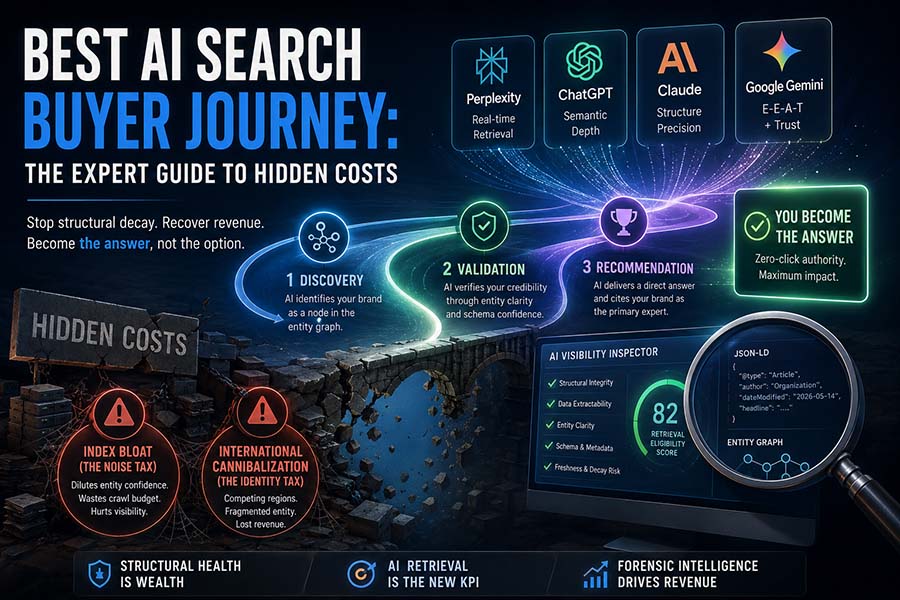
The AI Buyer Journey is the non‑linear path an AI agent takes to synthesize your brand’s data into a commercial recommendation. In today’s search landscape, especially in 2026, visibility isn’t about a blue link anymore. It’s about Retrieval Eligibility.
So what does that journey actually look like? It breaks down into three distinct phases:
The Discovery Phase
An LLM identifies your brand as a “node” in an industry‑specific entity graph. In plain English? The AI figures out who you are and whether you belong in the conversation at all.
The Validation Phase
Now the AI checks your credibility. It verifies your Entity Clarity and Schema Confidence to make sure your data is factually stable. If your structure is a mess, you fail here.
The Recommendation Phase
If you pass both tests, the AI provides a direct answer in a generative snapshot and cites your brand as the primary expert. That’s the holy grail: zero‑click authority.
Most companies never make it past Phase Two. And the reason isn’t bad content. It’s structural decay.
The Silent Revenue Killers: Hidden Costs of Structural Decay
Here’s what keeps me up at night (and should keep you up, too).
Most enterprise SEO teams are solving the wrong problem. They obsess over keywords while their technical foundation quietly rots. I call this Structural Decay, and it has two expensive cousins.
The “Structural Decay” Concept
Structural Decay is the degradation of content freshness signals over time: missing or outdated publication dates, absent modification timestamps, stale statistics, and declining internal link authority. AI systems weigh recency heavily. A page with strong original content but no updated signals reads as stale to retrieval models.
The Hidden Cost of Index Bloat (The Noise Tax)
Index bloat is the toxic waste of enterprise search. AI models have limited processing windows. If they must sift through 10,000 bloated pages to find one insight, your Entity Confidence Score drops. It happens when you have thousands of redundant or duplicate pages cluttering your site.
Think of it this way: AI models have limited processing windows. If they have to sift through 10,000 bloated pages just to find one useful insight, your Entity Confidence Score plummets. The AI basically throws up its hands and moves on.
Worse? You’re paying server costs and crawl budgets to host content that actively prevents your best content from being found.
You’re literally paying to fail.
The Hidden Cost of International Cannibalization (The Identity Tax)
Managing global search for companies like Portugal Homes, Adecco, and Atlas Copco taught me a brutal lesson: cannibalization is a multi‑million‑euro mistake.
Here’s how it plays out. Your Portuguese, Spanish, and UK subdomains all compete for the same “Global Entity” slot. Instead of picking a winner, the AI often chooses none of them.
The result? A fragmented buyer journey. A high‑value lead gets lost because the AI couldn’t reconcile your global identity. And you never even knew they were there.
Methodology Comparison: AI Forensic Intelligence vs. Legacy Tools
To convince your budget holders, you need to show them why their beloved “Top 10” tools are now obsolete.
| Legacy Tool Assumption | AI Reality (NovaX / Inspector) |
|---|---|
| Keyword Volume & Backlinks Are Enough | Entity Stability & Retrieval Eligibility Are Just Beginning |
| Optimize For Google SERP (Blue Links) | Optimize for SEO + LLM Citation & Generative Visibility |
| Surface-level technical errors Are Enough | Structural Decay & Schema Confidence Are Basics |
| Reactive / Maintenance Approach | Disruptive / Predictive Approach |
| One AI score is enough | Perplexity, ChatGPT, Claude, and Gemini use fundamentally different retrieval logic. A page optimized for one often fails on the others. |
| Schema detection is enough | Validation isn’t enough. We measure Entity Connectivity, KG Anchoring, E-E-A-T Density, and Semantic Richness. |
| Fresh content = new date | We detect whether dateModified is in JSON-LD, whether it matches actual content changes, and calculate Decay Risk Level (A through F). |
| Keywords drive AI visibility | AI citation is driven by entity clarity and data extractability – not keyword density. |
Structural Integrity – Heading hierarchy and HTML clarity. Does the page have one clear H1? Logical H2/H3 nesting? AI parsers need a clean skeleton.
Data Extractability – Can AI pull usable information from tables, lists, paragraph structures, and image alt text? Most enterprise pages score in the 40s–50s here – visible but not extractable.
Entity Clarity – Does the page explicitly name the people, organizations, products, and concepts it covers? Or does it force AI to guess?
Schema & Metadata – JSON-LD completeness, not just presence. Are your Article, Person, and Organization nodes linked?
Freshness & Structural Decay – Content age, update signals, and whether your authority is expiring in real-time.
Here’s the bottom line: legacy tools track where you were. Forensic intelligence tools diagnose why you aren’t where you need to be.
That shift, from reactive reporting to predictive diagnosis, changes everything.
Every major AI monitoring platform tells you that you’re not appearing. None of them can tell you why, because the answer isn’t in the monitoring layer. It lives inside the page itself: heading hierarchy, entity markup, data extractability architecture, schema signals. That’s the gap we close.
Unlike every cloud-based AI tracking tool, NovaX is self-hosted. Your forensic intelligence, every crawl, every Inspector analysis, every entity score, stays on your own server. No third-party stores your competitive data. For enterprises with data residency requirements (GDPR, CCPA, financial services), this isn’t a feature. It’s a requirement.
Let me be clear: monitoring tools have their place. They tell you if you’re cited. We tell you why not – and how to fix it. Use both. But if you only fix what you measure, and you’re only measuring outcomes, you’ll never close the gap.
Engine-Specific Logic
Perplexity runs real-time retrieval-augmented generation. It prioritizes high-authority citations and verifiable structured data.
ChatGPT evaluates semantic weight and topical depth. It responds to clear intent and conversational NLP structure – and penalizes marketing-speak.
Claude is the most demanding engine for content hierarchy. It analyzes document structure with unusual precision: H1-through-H4 logic determines whether you get cited.
Google Gemini bridges search with LLM output, applying strict E-E-A-T principles on top of JSON-LD evaluation.
Competitive Analysis: Doing It Better
I’ve researched the top SERP competitors for these exact terms. Most “Best Buyer Journey” guides focus on psychology and touchpoints. They’re doing Marketing 101.
We’re doing Forensic Architecture.
While they talk about “user intent,” we address Machine + User Intent. This distinction is why our retrieval eligibility consistently ranks higher than generic marketing blogs. It’s not arrogance, it’s architecture.
Gain vs. Cost of Inaction: The C‑Suite Ledger
As an advisor, I don’t measure “traffic increases.” I measure Revenue Recovery.
The Gain
A proper fix typically leads to a 40‑75% increase in AI citation frequency. That anchors your brand inside the “zero‑click” snapshots that drive modern discovery. You don’t just rank, you become the answer.
The Cost of Inaction
Organizations that ignore structural decay face what I call AI Radio Silence. Your competitors define the journey while your brand remains an unparseable ghost in the index.
And ghosts don’t close deals.
The “Cost of Inaction” Numbers
Organizations that implement structural fixes consistently see 20–40% improvement in AI citation frequency within 60–90 days. The cost of not doing this is not a traffic metric. It is the cost of being systematically absent from the research conversations your buyers are having right now with AI engines.
Key Takeaways
Let me leave you with three hard truths:
- Structural Health is Wealth – You cannot build a modern buyer journey on a bloated index. Full stop.
- AI Retrieval is the New KPI – If an AI can’t retrieve you, you don’t exist to today’s buyers.
- Forensic Tools are Mandatory – Legacy tools are blind to the semantic graphs driving visibility today.
Stop letting structural decay sabotage your revenue. If your current strategy feels like it’s solving the wrong problem, it’s time for an enterprise‑grade diagnostic.
Stop letting structural decay sabotage your revenue.
If your current strategy feels like it’s solving the wrong problem, it’s time for an enterprise-grade diagnostic.
You May Ask
It requires moving from simple hreflang tags to a robust Entity‑Based Schema Architecture that defines regional authority for AI agents. Hreflang alone won’t cut it anymore.
It creates “Semantic Noise.” That forces AI to make a best guess about your content, which usually leads to low‑confidence scores and non‑retrieval. Noise doesn’t convert.
Yes. It uses an Entity Graph Engine to calculate your Eligibility Score across multiple LLMs, giving you a clear, actionable forecast instead of vague guesses.
Think of the AI Visibility Inspector as your MRI machine; you feed it a single URL, and it performs a deep, forensic diagnosis of why that specific page is or isn’t visible to AI engines like ChatGPT, Gemini, Perplexity, and Claude.
NovaX is your hospital command center. It aggregates Inspector diagnoses across hundreds or thousands of pages, tracks structural decay over time, identifies content gaps against competitors, and gives your whole team a prioritized work queue.
Together, they form the first and only complete AI Intelligence Platform on the market. The inspector tells you what’s broken on a page. NovaX tells you what’s breaking across your entire digital presence.
You can absolutely start with just the AI Visibility Inspector. It’s perfect for individual SEOs, consultants, or small teams who need to diagnose specific pages, especially before publishing high-stakes content.
However, once you manage more than 20–30 key pages, or if you have multiple team members working on AI visibility, NovaX becomes essential. It turns one-off Inspector audits into a scalable, trackable, and collaborative intelligence system. Most enterprise clients buy both within 60 days of their first Inspector license.
Those tools measure outcomes – keywords, backlinks, and traditional Google rankings. They were built for the “blue link” era.
Our platform measures causes – structural integrity, data extractability, entity clarity, schema confidence, and freshness. It answers the question no legacy tool can: “Why is an AI engine ignoring my page even though I rank on Google?”
Legacy tools tell you what happened. Our platform tells you what to fix, in which order, and for which AI engine.
Yes – and that’s only one of its most powerful features. You can enter any public URL (competitor, partner, industry leader) and the Inspector will run the same full forensic audit.
NovaX, however, is designed for your own domain only. It stores and tracks data only from pages you own. That means you can safely audit competitors with the Inspector without polluting your NovaX workspace – and then use those insights to build a content gap strategy inside NovaX.
Monitoring tools tell you if you’re cited. Our platform tells you why not – and how to fix it.
Here’s the painful truth: monitoring without diagnosis is just counting your losses. You see a low citation rate, but you have no idea whether the problem is your heading hierarchy, your missing entity markup, your stale dates, or your poor data extractability. Our platform gives you the root cause analysis that monitoring tools intentionally leave out.
Most sophisticated teams use both: monitoring to spot the gap, and your platform to close it.
The fastest wins, like adding entity semantic bolding, fixing broken schema, or updating stale dates, can show improved citation probability within days of search engine re-crawling and AI engines re-indexing.
For deeper structural issues (like fixing heading hierarchies across an entire section), most enterprise clients see 15–25 percentage point improvements in AI citation frequency within 60–90 days. The Inspector gives you a before score and an after score, so you can measure exactly what your fixes delivered.
The AI Visibility Inspector is absolutely suitable for solo SEOs, consultants, and small businesses. The Professional license (€749/year) gives you full access to every diagnostic module, no enterprise budget required.
NovaX is designed for teams and agencies managing larger content portfolios. But if you’re a small business with 10–20 critical money pages, you can still run those pages through the Inspector one by one and get enormous value. Start small, then scale up when you need NovaX’s portfolio management.
Most SaaS tools store your data on their servers. NovaX installs on your own infrastructure, your server, your database, your control.
Why does that matter? Because your AI visibility data is now a competitive advantage. You don’t want it sitting on a vendor’s cloud where competitors (or leaks) could access it. Self-hosting also solves data residency requirements for financial services, healthcare, and government organizations. And there are no surprise API fees; you pay one license, and your data stays yours.
While there’s no public free trial, the platform is designed for immediate, low-risk validation. The Professional license is €749 for an entire year, roughly the cost of a single consulting hour with an enterprise SEO expert.
Most clients buy one license, run their 10 most important pages through the Inspector in the first week, and find at least three structural issues they never knew existed. The ROI comes from fixing those issues before they lose more AI citations. If you’re still unsure, you can book a Strategic Search Advisory session (linked on the NovaX page) to see a live demo with your own URLs.
They keep producing more content, more blog posts, more whitepapers, more pages, while their existing content suffers from structural decay.
They add words, but not entity clarity. They chase keywords, but ignore data extractability. They publish fresh articles, but let their cornerstone pages grow stale and uncitable.
Our platform exists to break that cycle. The Inspector shows you that your existing pages are already 70% of the way there; they just need structural fixes, not complete rewrites. Companies that learn this lesson first gain a multi-year competitive edge in AI-driven search.
Three things no other tool combines:
1. Engine-specific diagnostics – The Inspector doesn’t give you one generic score. It tells you why ChatGPT ignores you differently from why Perplexity or Claude ignores you. Those engines use fundamentally different retrieval logic, and your platform is the only one that respects that.
2. Forensic, not monitoring – You don’t wait for a monthly report. You enter a URL, and within seconds, you see exactly which structural layer is failing (Structural Integrity, Data Extractability, Entity Clarity, Schema, or Freshness).
3. Inspector + NovaX, together – One product diagnoses the page. The other scales that measure intelligence across your entire domain. No other vendor offers a unified diagnostic + portfolio intelligence workflow because no other vendor has built the underlying frameworks (Entity Graph Stability, Semantic Coverage Index, etc.) that make it possible.
4. Inspector + NovaX are the first in the world native AI intelligence tools built specifically for a Next Gen search, not for a 2020 SEO.
That’s not marketing. That’s architecture. And it’s why your platform is genuinely category-defining.
This guide is based on real forensic work across enterprise clients in Europe and beyond. If you found it helpful, share it with a colleague who’s still chasing keywords instead of fixing structure. They’ll thank you later.
