

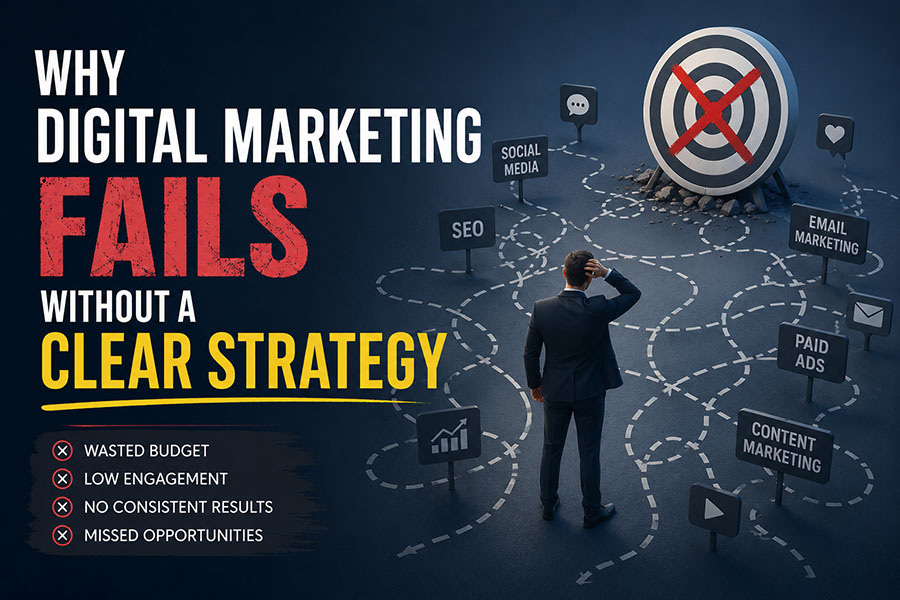
Digital Marketing Fails Definition
A digital marketing strategy is the structured system that connects your business objectives to every channel, campaign, and content decision your team executes. Without it, each tactic operates in isolation, producing activity without direction and spending without return.
I have sat in rooms where enterprise marketing teams celebrated record-high traffic while organic-sourced revenue had been declining for six months. I have watched global organizations pour budget into SEO, paid media, and content – simultaneously, without alignment – and then blame the channels when results failed to materialize. After 25 years in this industry, including senior roles at organizations like Adecco Group and Atlas Copco, I can tell you this clearly: digital marketing strategy failure is not a channel problem. It is a structural one.
Digital marketing strategy failure happens when teams execute without a unified plan, when tactics replace direction, and activity replaces outcomes. Understanding why it happens and how to fix it is the most important decision your organization can make this year.
The Illusion of Doing Enough
Most enterprise teams are not failing because of lack of effort. They are failing because effort is distributed across disconnected initiatives that share no common direction.
I see this pattern repeatedly. SEO wants organic visibility. Paid media wants conversion volume. Content wants engagement metrics. Social wants follower growth. Each team optimizes for its own signal. None of them optimizes for the business. The result is what I call coordinated chaos, professional execution of strategically misaligned work.
Research consistently shows that marketers estimate wasting between 26% and 60% of their budgets on ineffective channels when no structured strategy governs their activity. At enterprise scale, that figure represents millions. More importantly, it represents opportunity cost, the compound growth that aligned programs would have generated instead.
What a Strategy Actually Is (And Is Not)
A strategy is not a content calendar. It is not a keyword list. It is not a quarterly campaign plan.
A digital marketing strategy is a system that defines: who you are targeting and why, what business outcome each initiative must move, how channels interact and reinforce each other, what success looks like in measurable terms, and how you reallocate resources when conditions change.
Without that system, your team is running campaigns. Running campaigns is not the same as executing a strategy. The difference is compound growth versus flat performance. The difference is predictability versus reactive firefighting.
I built predictable growth systems inside global organizations before I ever sold consulting services. The discipline that drives it is always the same: strategy first, execution second, measurement throughout.
The Four Structural Failures Behind Digital Marketing Strategy Failure
1. Objectives That Do Not Connect to Revenue
Most enterprise teams set marketing goals that are disconnected from business outcomes. “Increase brand awareness.” “Grow organic traffic.” “Improve engagement rate.” These are not strategies. They are activity descriptions.
When objectives do not connect to revenue, specifically to pipeline, to customer acquisition cost, to retention, your team has no way to prioritize. Every initiative looks equally valid. Budget gets spread thin. Nothing performs at the level it would with full resource commitment and clear direction.
The fix requires every marketing initiative to answer one question before approval: which revenue outcome does this move, and by how much?
Estimated gain from fixing this: Organizations that align marketing objectives to revenue outcomes typically see 20–35% improvement in marketing ROI within two to three quarters, simply from reallocation of existing budget, not additional spend.
Cost of not fixing it: Continued misallocation, declining executive confidence in the marketing function, and eventual budget cuts that make recovery even harder.
2. Channel Execution Without Integration
Channels do not exist in isolation. SEO informs paid media keyword strategy. Content builds topical authority that lifts organic rankings. Email nurtures the intent that paid acquisition creates. When these channels operate without integration, each one underperforms relative to its potential.
I have seen organizations running SEO and paid media campaigns targeting the same keywords in competition with each other, bidding against their own organic results, inflating cost-per-click while cannibalizing organic click-through rates. This is a digital marketing strategy failure in its most expensive form.
The solution is a channel architecture, a documented system showing how each channel contributes to the overall funnel, where handoffs occur, and which metrics belong to which stage. This is not complex to build. It is simply discipline that most teams skip in their rush to execute.
For organizations navigating this, I cover the foundational layer in detail in my piece on SEO foundation for AI retrieval, the same principles that govern channel integration in a modern visibility strategy.
3. Measurement Built Around Vanity, Not Value
Digital marketing generates enormous amounts of data. Most teams measure the wrong things.
Impressions, followers, session counts, and bounce rates: these metrics describe behaviour. They do not describe business impact. When your executive team asks whether marketing is working, they are not asking about impressions. They are asking about revenue attribution, pipeline contribution, and customer acquisition efficiency.
The gap between what teams measure and what leadership cares about is one of the most consistent sources of friction I see in enterprise organizations. It also creates a dangerous dynamic: teams optimize for metrics they can control, rather than outcomes that matter.
Building measurement that connects marketing activity to business outcomes requires intentional design. You need attribution models, conversion tracking, and agreement, upfront, on what “working” looks like. I address how to think about this measurement challenge in the context of AI search in measuring visibility in the age of AI search.
4. Strategy as a One-Time Document
The most common structural mistake I encounter is treating strategy as something you produce once, a document that lives in a shared drive and gets referenced at kick-off and then ignored.
An effective strategy is a living system. Markets shift. Search behavior changes. New channels emerge. Competitors adapt. The organizations that consistently outperform are the ones that have built review cycles into their strategy, quarterly resets that assess performance against objectives, and reallocate resources based on evidence, not assumptions.
In 2026, this is more important than ever. The rise of AI-driven search has fundamentally altered how content is discovered, how authority is assessed, and how intent is served. Organizations still executing 2022-era strategies in a 2026 search environment are experiencing the gap between those two realities in their traffic data right now. I break down what that gap looks like and how to close it in How to recover traffic loss from AI search.
The Real Cost of Running Without Strategy
I want to be specific here because I have watched organizations absorb these costs without connecting them to the root cause.
When a digital marketing strategy failure persists across one to two years in an enterprise organization, the compounding effects are significant. Paid spend efficiency declines as channels operate without coordination. SEO authority stagnates because content is not structured around topical depth or semantic relevance. Organic traffic drops as AI-driven search surfaces better-organized competitors instead. Executive confidence in the marketing function erodes. Headcount gets cut. The team that remains inherits a harder problem with fewer resources.
The cost is not just the wasted budget. The cost is the compounding growth you did not build, the customers you did not acquire, the positions you did not hold, the authority you did not accumulate, because activity replaced direction for too long.
The organizations that recognize and address this pattern early recover faster and build more defensible positions than those that wait for the crisis to force the conversation.
What Strategic Alignment Actually Produces
I grew revenue at Portugal Homes from a position of moderate digital visibility to nearly 5x growth, reaching €110M in turnover. That did not happen because we ran more campaigns. It happened because we built a system where every channel, every piece of content, and every investment decision pointed at the same objective, measured the same outcomes, and adjusted based on the same data.
When strategy aligns with execution, the results compound. SEO produces traffic that paid media does not have to buy. Content builds authority that reduces the cost of ranking. Organic discovery creates a pipeline that sales can close without cold outreach. Each piece reinforces the next.
That compounding effect is what digital marketing is capable of producing. Most organizations never experience it because they skip the structural work that makes it possible.
If you want to understand how to build the visibility infrastructure that supports this kind of strategic alignment, my AI Search Readiness Blueprint outlines the framework I use with enterprise clients today.
Key Takeaways
- Digital marketing strategy failure is a structural problem, not a channel problem. Effort without direction produces activity, not outcomes.
- The four structural failures behind most digital marketing strategy failure are misaligned objectives, disconnected channel execution, vanity-driven measurement, and treating strategy as a static document.
- Organizations that align marketing objectives to revenue outcomes typically recover 20–35% of wasted marketing ROI within two to three quarters – without additional budget.
- The cost of not building a strategy is not just wasted spend. It is the compound growth that misaligned execution never produces.
- In 2026, AI-driven search has raised the stakes. Organizations running without strategic alignment are losing ground to competitors who have built integrated visibility systems.
- Strategy is not a document. It is a living system – reviewed, tested, and adjusted on evidence.
Work With Me
If you are leading SEO, digital, or growth at an enterprise organization and your team is executing hard, but the outcomes are not matching the investment, the issue is almost certainly structural – not tactical.
I work with enterprise teams as an independent advisor to diagnose the gap between strategy and execution, build the frameworks that align channels to business outcomes, and establish the governance that makes those outcomes sustainable.
Frequently Asked Questions
Digital marketing strategy failure is the structural condition in which marketing initiatives are executed without a unified system connecting them to business objectives. It produces high activity levels alongside poor or unpredictable business outcomes, and is the most common root cause of wasted marketing budget in enterprise organizations.
Not always. Many organizations have planning documents that function as marketing plans rather than strategies; they describe what will be done but not why, for whom, or how it connects to revenue. The failure often lives in the gap between documentation and operational alignment.
The recovery timeline depends on how long misalignment has persisted and which channels have been most affected. In my experience, organizations that address structural issues decisively, realigning objectives, integrating channels, and rebuilding measurement, can see meaningful improvement in marketing efficiency within two to three quarters. Organic search recovery typically takes longer, particularly if authority has decayed.
A written document is less important than genuine alignment. Teams that operate with a shared, internalized understanding of objectives, audience, and channel roles can execute effectively. However, in enterprise organizations with multiple stakeholders and distributed teams, documentation is the only scalable way to maintain alignment across functions and over time.
Start with objectives. Ask every team member and stakeholder to write down what success looks like for digital marketing this year, in measurable, revenue-connected terms. The degree of disagreement in those answers will tell you exactly how misaligned your strategy foundation is, and where to begin rebuilding it.
AI-driven search surfaces content and brands that demonstrate clear topical authority, structured information, and consistent entity signals, advantages that only compound over time with coordinated, strategic execution. Organizations running without strategic alignment are increasingly invisible in AI-generated responses, not just lower in traditional rankings. The cost of strategy failure in 2026 is substantially higher than it was three years ago.
The organizations that recover are the ones that diagnose the structural root cause rather than intensifying tactical effort. They stop adding channels and start integrating existing ones. They replace vanity metrics with revenue-connected measurement. And they treat strategy as a living system, not a document produced once and then ignored.
