

Key Takeaways
- AI visibility is not a switch you flip. It is a maturity progression, and most enterprise organizations are stuck at Level 1 or 2 without knowing it.
- Strong traditional SEO performance does not predict AI citation presence. The two systems are structurally different enough that you can rank on page one and still be invisible to every major LLM.
- Each maturity level has a specific structural gap – and patching the wrong layer wastes budget and time.
- Moving from Level 1 to Level 3 is an architectural problem, not a content problem. Leadership needs to understand this before they approve the roadmap.
- The organizations reaching Level 4 and 5 are treating AI visibility as an operational system, not a campaign.
Your organic rankings look fine. Your traffic is holding. But ChatGPT recommends three competitors when a buyer asks about your category, and your brand is not in the answer.
What AI Visibility Maturity Means
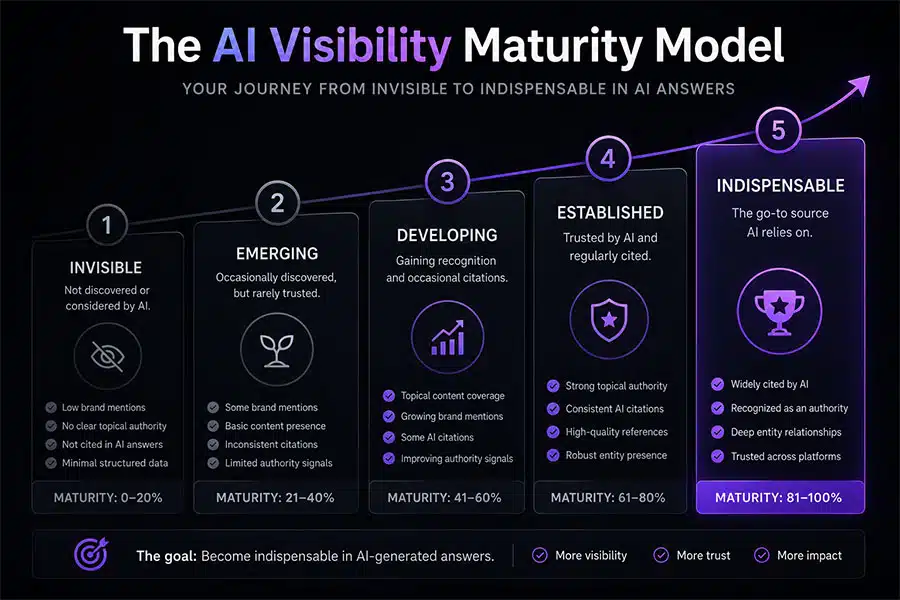
The AI Visibility Maturity Model is a diagnostic framework that maps where an organization sits across five levels of structural readiness for AI-driven search – from complete absence in AI-generated answers to systematic, durable citation presence across ChatGPT, Perplexity, Google AI Overviews, and emerging LLM-powered discovery surfaces.
It is not a measure of how much content you have published. It is a measure of how well your organization’s content, entity infrastructure, and authority signals are interpreted, trusted, and retrieved by AI systems.
The distinction matters because most teams conflate output with readiness. Publishing more content does not advance maturity. Restructuring how existing authority is expressed and made extractable does.
Why a Maturity Model and Not a Checklist
Checklists tell you what to do. A maturity model tells you where you are – and what the structural bottleneck is at your specific level. Those are very different answers.
I have walked into enterprise engagements where teams had implemented schema markup, published FAQs, and were tracking AI-referred sessions. On paper, they looked like Level 3 organizations. But their entity infrastructure was fragmented, their topical clusters had no semantic coherence, and their domain authority was flowing to the wrong pages. The checklist was green. The citations were not coming.
A maturity model surfaces the structural gap, not just the missing tactic.
This is the same diagnostic logic I apply in the SEO Maturity Model – which maps organizational search capability from tactical execution through to governance. The AI Visibility Maturity Model builds a parallel layer on top of that: it assumes your SEO foundations are in place (or diagnoses that they are not) and then evaluates your readiness for the retrieval layer specifically.
The Five Levels of AI Visibility Maturity
Level 1 – Structurally Invisible
At Level 1, the organization has made no deliberate effort to optimize for AI retrieval. Content is written for human readers and traditional search algorithms. There is no entity clarity, no structured data strategy, and no awareness of how LLMs retrieve and cite content.
This is not a small organizations problem. The AI visibility research I have published across global banks, pharmaceutical companies, automobile manufacturers, and industrial manufacturers consistently shows the same pattern: organizations with billion-dollar brand values and decades of domain authority sitting at Level 1 in AI visibility. High recognition. Near-zero citation presence.
Signs you are at Level 1:
- Your brand does not appear when you prompt ChatGPT or Perplexity with category-level questions.
- You have no structured process for monitoring AI-generated answers about your industry.
- Your content team has not been briefed on AI retrieval requirements.
- Schema markup is absent or confined to basic article types.
The structural gap at Level 1 is foundational: the organization has not yet accepted that AI search is a separate retrieval layer with its own requirements. Until that is accepted at the leadership level, tactical fixes will not hold.
Level 2 – Awareness Without Architecture
Level 2 organizations know the problem exists. Someone in the team has flagged AI Overviews, a VP has asked about ChatGPT mentions, and there may even be an ongoing conversation about GEO or AEO. But the response has been tactical – a few FAQ sections added to existing pages, some schema applied to new content, and a monthly manual check of how the brand appears in AI answers.
This is the most dangerous level to sit at, because it creates the illusion of action without structural progress.
The gap at Level 2 is architectural. The tactics being deployed – FAQ schema, better headings, shorter paragraphs – are necessary but not sufficient. Without the underlying entity infrastructure, semantic cluster coherence, and consistent authority signals, the tactics produce inconsistent and unpredictable results. A page gets cited once and then disappears from the AI answer the next week. The team cannot explain why, because they are optimizing surface features without understanding the retrieval system.
Signs you are at Level 2:
- You have implemented GEO tactics on some pages but see no consistent citation pattern.
- Your AI-referred sessions are a rounding error in analytics.
- Different teams are running disconnected AI optimization experiments.
- You are measuring AI visibility with ad-hoc manual checks, not a structured prompt library.
Level 3 – Structural Foundation in Place
Level 3 is where consistent AI citation begins to become possible. The organization has addressed the prerequisite layer: entity infrastructure is clean and consistent, core content is structured for extractability, schema is implemented accurately across priority pages, and there is a defined prompt library for measuring citation presence.
This is the level where the AI Search Readiness Audit typically moves from diagnosis to roadmap. The structural problems are identified and being addressed systematically, not reactively.
At Level 3, the organization understands the two-gate model: the first gate is retrieval pool eligibility, driven by domain authority and crawl health; the second gate is citation selection, driven by content structure, entity clarity, and specificity. Most Level 2 organizations only address the second gate. Level 3 means both gates are being managed deliberately.
Signs you are at Level 3:
- You appear consistently in AI answers for at least some category and comparison queries.
- You have a defined prompt library and track AI Share of Voice on a regular cadence.
- Entity information is consistent across your website, Google Business Profile, LinkedIn, and key industry directories.
- Schema is accurate and semantically complete on priority pages, not just technically present.
- Your content clusters have genuine topical depth and coverage, not just keyword targeting.
The structural work that gets you here centers on search signal architecture – the coordinated system through which trust, authority, and relevance signals reach AI retrieval layers in a form they can interpret and act on.
Level 4 – Systematic AI Visibility Operations
Level 4 organizations have moved from project to system. AI visibility is not a campaign running alongside the SEO program. It is an operational layer with defined ownership, measurement cadence, content governance, and cross-team integration.
At this level, content decisions are made with AI retrievability in mind from the brief stage, not retrofitted after publication. The internal authority distribution across the domain is actively managed – equity flows to pages that need it, and structural debt is identified and resolved before it creates retrieval gaps. The internal authority distribution model is not a periodic audit exercise. It is a live operational input.
Level 4 also means measurement has matured. The organization tracks AI Share of Voice, mention position, sentiment accuracy, and citation frequency across a consistent prompt set on at least a monthly cadence – ideally weekly for high-stakes categories. Teams can identify why citation presence increased or decreased after a structural change, not just that it did.
Signs you are at Level 4:
- AI visibility KPIs are reported alongside traditional SEO metrics at the leadership level.
- Content briefs include AI retrievability requirements as a standard input.
- Internal linking and authority flow are managed as part of ongoing operations, not periodic cleanup.
- You have a documented governance model for how schema, entity data, and cluster architecture are maintained.
- You can attribute AI citation changes to specific structural interventions.
Level 5 – AI Visibility as Competitive Infrastructure
Level 5 is where AI visibility becomes a strategic asset rather than an optimization outcome. The organization does not just appear in AI answers. It shapes them. Proprietary research, named frameworks, original data, and defined methodologies give LLMs reason to cite the brand specifically – not as one of several interchangeable sources, but as the authoritative origin of a concept or finding.
At this level, the distinction between brand and entity has collapsed in a useful way: the organization is so clearly and consistently associated with its core topics, across so many corroborating sources, that AI systems reach for it by default when synthesizing answers in that category.
This is the compounding effect of AI visibility at scale. Early citations generate branded search volume. Branded search reinforces entity signals. Stronger entity signals improve citation frequency. The loop is self-reinforcing once it starts – but it only starts if the structural foundation is solid enough to sustain it.
Level 5 also means zero-click visibility is not a threat but a channel. The organization’s brand, definitions, and frameworks are being distributed inside AI-generated answers to audiences it would never have reached through traditional search.
Signs you are at Level 5:
- Your frameworks, methodologies, or proprietary research are cited by name in AI answers.
- Competitors reference your organization as a source in their own content.
- AI-referred sessions contribute meaningfully to branded search and pipeline, not just traffic.
- You have a content and PR strategy specifically designed to generate the third-party corroboration that sustains AI citation at scale.
- AI visibility is discussed at the C-suite level as a strategic capability, not a marketing tactic.
What This Is NOT
This model is not a content audit checklist. Publishing more blog posts does not advance your maturity level. Neither does adding FAQ schema to twenty pages if the entity infrastructure underneath is fragmented.
This is also not an AI hype framework. Every level maps to specific structural requirements – crawl integrity, entity clarity, schema accuracy, semantic cluster coherence, authority distribution. These are architectural decisions, not content decisions. Organizations that treat AI visibility as a content problem will cycle through Levels 1 and 2 indefinitely.
And this is not an argument that traditional SEO is secondary. The retrieval pool that AI systems draw from is still largely populated by pages that earned authority through conventional signals. Weak SEO foundations cap your AI visibility ceiling regardless of how well you optimize the retrieval layer.
The Cost of Staying at Level 1 or 2
AI-referred sessions grew 527% year over year through the first five months of 2025. The organizations already at Level 3 and above are compounding that advantage every month. The organizations at Level 1 are not just missing citations – they are watching competitors establish the entity associations and topical authority signals that become progressively harder to displace.
Retrieval systems are not neutral. They develop preferences based on which sources consistently provide the clearest, most verifiable, most structurally sound answers. An organization that establishes that reputation early in a category builds a citation moat that late-movers must work significantly harder to breach.
The organizations losing 50 to 70% of their organic traffic to AI search disruption are not losing because the algorithm changed against them. They are losing because they never built the structural layer that the new retrieval systems require. Recovery from that position is possible – but it takes longer than prevention, and it costs more.
The Uncomfortable Truth
Most enterprise organizations overestimate their maturity level by at least one stage. The team believes they are at Level 3 because they have schema, a GEO initiative, and someone tracking AI mentions. Leadership believes they are at Level 2 because the team has not escalated the issue properly.
Neither assessment is usually correct. The actual position is determined by what AI systems do when a buyer asks a relevant question – not by what the internal roadmap says. Checking your real position takes thirty minutes and a structured prompt set. Most organizations have not done it.
If you want to understand how this structural gap appears in practice across industries, the AI Visibility Analysis series documents it across global pharmaceutical, legal, automotive, banking, insurance, and industrial sectors. The pattern is consistent and the gaps are larger than most leadership teams expect.
How to Move Between Levels
| From | To | Primary intervention |
|---|---|---|
| Level 1 | Level 2 | Leadership alignment – accept AI search as a separate retrieval layer requiring dedicated strategy |
| Level 2 | Level 3 | Structural foundation – entity infrastructure, schema accuracy, semantic cluster architecture, crawl integrity |
| Level 3 | Level 4 | Operational systems – governance, measurement cadence, content brief integration, authority flow management |
| Level 4 | Level 5 | Strategic positioning – proprietary research, named frameworks, digital PR, third-party corroboration at scale |
The most common mistake is trying to jump from Level 1 to Level 3 by deploying tactics. It does not work. The structural prerequisites at each level are sequential. Skipping the entity infrastructure work and going straight to content restructuring produces the Level 2 trap: action without architecture.
Where to Start
If you are not certain which level your organization sits at, the Search and AI Visibility Diagnostic is the fastest way to get an honest answer. It evaluates the structural signals that determine retrieval eligibility and citation likelihood – not just the surface-level indicators that make organizations feel more advanced than they are.
If you already know you are at Level 1 or 2 and need a structured roadmap, the AI Search Readiness Audit maps the architectural gaps and sequences the interventions in order of structural dependency.
Summary – Key Takeaways
- The AI Visibility Maturity Model has five levels: Structurally Invisible, Awareness Without Architecture, Structural Foundation in Place, Systematic Operations, and AI Visibility as Competitive Infrastructure.
- Most enterprise organizations are at Level 1 or 2, including many with strong traditional SEO performance and high brand recognition.
- Each level has a specific structural gap. Applying Level 3 tactics to a Level 1 foundation produces Level 2 results at best.
- Moving between levels requires sequential interventions: leadership alignment first, then structural foundation, then operational systems, then strategic positioning.
- Organizations at Level 4 and 5 are compounding AI visibility advantages that become harder for late-movers to close.
- The real-world position of any organization is determined by what AI systems say when a buyer asks a relevant question – not by what the internal roadmap claims.
Work With Me
If your organization needs an honest assessment of where it sits and a sequenced plan to advance, that conversation starts here. If you want to begin with a structured self-assessment, the AI Search Readiness Audit framework gives you the diagnostic architecture to do it properly.
FAQ
The AI Visibility Maturity Model is a five-level diagnostic framework for assessing how well an organization’s content, entity infrastructure, and authority signals are structured for retrieval and citation by AI-driven search systems including ChatGPT, Perplexity, Google AI Overviews, and similar platforms. It distinguishes between organizations that are structurally invisible to AI systems, those deploying tactics without architectural foundations, those with structural readiness in place, those running AI visibility as an operational system, and those using AI citation presence as a strategic competitive asset.
A traditional SEO maturity model evaluates how deeply search logic is embedded into an organization’s structure – governance, cross-team integration, measurement sophistication, and strategic alignment. The AI Visibility Maturity Model evaluates a separate but related layer: whether the organization’s content, entity signals, and authority architecture are prepared for retrieval by AI systems specifically. An organization can be at Level 4 or 5 on a traditional SEO maturity model and still be at Level 1 on AI visibility, because the retrieval mechanisms are structurally different.
Yes – and this is one of the most important distinctions the model makes. Google’s ranking algorithm and LLM retrieval systems evaluate content through different mechanisms. A page can rank in position one for a target keyword and still never appear in AI-generated answers for equivalent questions. The two systems reward overlapping but not identical signals. Traditional SEO performance is a prerequisite for AI visibility but does not guarantee it.
Based on observed patterns across enterprise implementations, organizations with adequate domain authority that execute the structural interventions in sequence typically see consistent Level 3 signals – measurable AI citation presence across a defined prompt set – within 60 to 90 days of beginning the foundational work. The timeline depends on how fragmented the entity infrastructure is, how much crawl and indexation remediation is needed, and how consistently the structural changes are applied across priority content.
Leadership alignment. At Level 1, the primary gap is not technical – it is organizational. Until decision-makers accept that AI search is a structurally distinct retrieval layer with its own requirements, tactical interventions will not be resourced or sustained at the level needed to produce consistent results. The first move is demonstrating the gap with real prompt data: show leadership what AI systems say about the organization versus what they say about competitors when a buyer asks a relevant category question. That conversation changes the resource conversation.
The most reliable method is a structured prompt test. Build a set of 30 to 50 prompts that reflect how buyers in your category actually ask questions – category queries, comparison queries, problem-type queries, use-case queries. Run them across ChatGPT, Perplexity, and Google AI Overviews. Measure your brand’s citation frequency, mention position, and accuracy. Cross-reference with your entity infrastructure, schema completeness, and semantic cluster architecture. If you want a structured framework for that assessment, the AI Search Readiness Audit provides the diagnostic architecture to do it systematically rather than ad hoc.
