

In This Article
The Most Shocking Dataset in This Series
Four industries analyzed. Forty companies examined. One finding more striking than any that came before it.
This installment follows analyses of the legal industry, global pharmaceutical, SaaS CRM, global banking, industrial tools manufacturing, life and health insurance, automobile industry, commercial vehicle sector, hospitality and tourism, global light vehicle manufacturers, chemicals and petrochemicals, media and entertainment, e-commerce and cloud computing, global payment networks and payment platforms, and most recently non-commercial real estate services.
In each case, the pattern was consistent: organizations with significant digital budgets and recognizable brand equity underperforming in machine interpretability.
The automobile industry breaks every assumption about what that finding means.
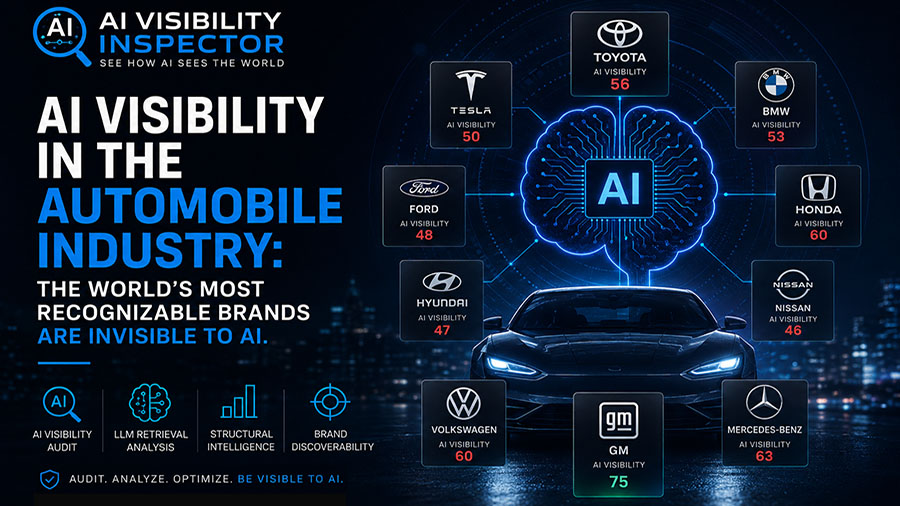
Toyota. BMW. Mercedes-Benz. Ford. Volkswagen. Tesla. Honda. Hyundai. Nissan. General Motors. These are not niche players or regional operators. These are the ten largest and most recognized automotive brands on earth, companies that collectively sell tens of millions of vehicles annually, employ hundreds of thousands of people globally, and invest billions of dollars in brand communications annually.
Every person reading this article can identify these companies by their logo alone.
AI systems cannot reliably cite most of them.
Why the Automobile Industry Is the Most Consequential Case Yet
Before examining the findings, the strategic context demands attention.
The automotive purchase journey is, by measurable distance, the highest-consideration consumer decision most people make in their lives. Buyers research for months. They compare brands, models, safety ratings, fuel economy, technology packages, financing options, and residual values. They ask questions across dozens of sessions before stepping into a dealership.
That research journey is increasingly happening inside AI systems. When a consumer asks ChatGPT or Perplexity to compare an electric SUV from BMW against one from Hyundai, to explain the reliability differences between Toyota and Nissan, or to recommend a luxury sedan with the best safety ratings, they are not receiving a list of links. They are receiving a synthesized answer. The brands that appear prominently in that answer are the ones AI systems can confidently interpret, extract from, and represent.
The brands that do not appear, regardless of their real-world standing, model range, or century of heritage, are absent from the moment of consideration that now precedes the dealership visit.
For automotive brands, the stakes are not abstract. A car purchase averages between €25,000 and €100,000+ in Europe. If AI systems cannot confidently retrieve and represent a brand’s positioning, products, and differentiated value, that brand is invisible at the exact moment a potential buyer is forming their shortlist.
This is the environment in which the following ten companies were evaluated using the AI Visibility Inspector.
Methodology
Each company’s global corporate website was evaluated across four structural dimensions using the AI Visibility Inspector and the Ivica Srncevic Framework:
- Structure – how content is architecturally organized and logically sequenced for machine parsing
- Depth – the substantive quality and retrievability of content as AI systems process it
- Schema – the presence of structured data markup that enables confident entity identification
- Freshness – whether content age signals are present and verifiable to AI retrieval systems
The overall AI Retrieval Index score runs from 0 to 100. Scores below 50 indicate significant structural invisibility. Scores between 50 and 74 represent fair to moderate visibility with material gaps. Scores at 75 and above indicate good to strong AI readiness.
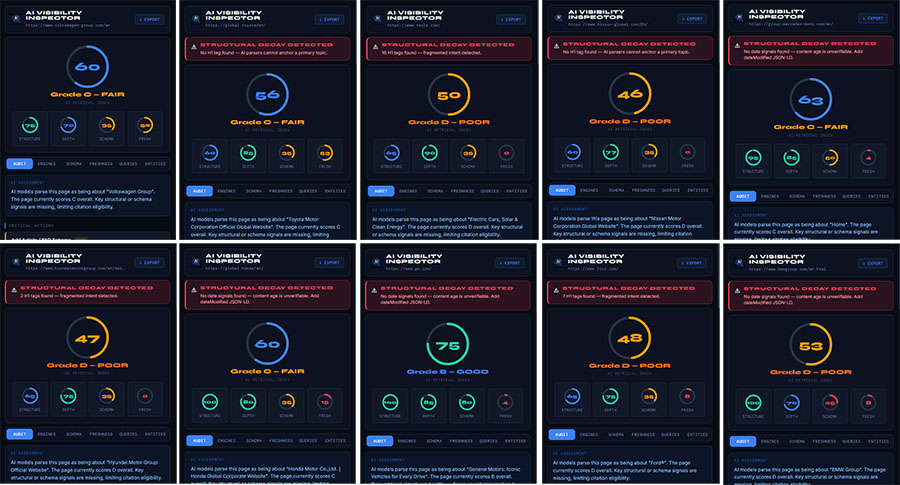
A Structural Decay warning was triggered when critical signals were absent, either missing date verification, multiple competing H1 tags fragmenting intent, or no H1 tag at all, preventing AI parsers from anchoring a primary topic. Every single company in this dataset triggered this warning, except Volkswagen.
The Scores: A Leaderboard Built on Near-Universal Failure
| Brand | AI Retrieval Score | Grade | Structure | Depth | Schema | Freshness |
|---|---|---|---|---|---|---|
| General Motors | 75 | B – Good | 100 | 85 | 80 | 4 |
| Mercedes-Benz | 63 | C – Fair | 95 | 85 | 50 | 4 |
| Volkswagen | 60 | C – Fair | 75 | 70 | 35 | 52 |
| Honda | 60 | C – Fair | 100 | 80 | 35 | 15 |
| Toyota | 56 | C – Fair | 60 | 85 | 35 | 53 |
| Tesla | 50 | D – Poor | 65 | 90 | 35 | 0 |
| BMW | 53 | D – Poor | 100 | 70 | 25 | 8 |
| Ford | 48 | D – Poor | 65 | 75 | 35 | 8 |
| Hyundai | 47 | D – Poor | 65 | 75 | 35 | 0 |
| Nissan | 46 | D – Poor | 60 | 77 | 35 | 0 |
Sector average: 55.8 – Grade C, AI Retrieval Index
One company in Grade B. Four companies in Grade C. Five companies in Grade D. Zero companies in Grade A. This is the automobile industry’s AI visibility profile in 2026.
Five Findings That Automotive Digital Leaders Cannot Ignore
Finding 1: The Sector Average Is Lower Than Every Previous Industry Analyzed
The automobile industry’s average AI Retrieval Index score of 55.8 is the lowest recorded across all five industries in this research series.
For reference:
- SaaS CRM sector average: approximately 73.8
- Industrial manufacturing average: low-to-mid 60s
- Banking and insurance: similarly mid-range
The automotive sector falls below all of them. This is not a marginal difference. It represents a structural gap between the industry’s digital investment, which is enormous, and its machine interpretability, which is categorically poor.
The implication is direct: across all the industries examined in this series, automotive is the sector where AI systems have the least reliable and consistent ability to retrieve, extract, and represent brand information. That gap is most consequential here, precisely because the purchase decision these brands depend on is increasingly researched through AI-mediated channels.
Finding 2: General Motors Is the Sole Exception, and It Reveals Exactly What the Others Are Missing
General Motors achieved the only Grade B score in the dataset at 75, and it is the only company that avoided what is otherwise universal underperformance. Its structural scores are instructive: Structure 100, Depth 85, Schema 80.
That Schema score of 80 is the most significant data point in this table. Every other company in the dataset scored 35 or below on Schema. GM’s Schema score is more than double the next highest, Mercedes-Benz at 50. Four companies, Tesla, Hyundai, Nissan, and BMW, scored 35 or below, with Tesla, Hyundai, and Nissan recording zero on Freshness.
Schema markup is not a design decision or a brand strategy. It is a technical implementation that tells AI systems, in machine-readable language, what an entity is, who it is, and what structured facts can be confidently attributed to it. GM’s relative strength here is not accidental; it is the output of a technical decision that the rest of the industry has not made.
GM still triggered a Structural Decay warning for absent date signals. Even the sector leader has visible gaps. But the distance between 75 and the next best score of 63 illustrates how consequential a single well-implemented technical dimension can be.
Finding 3: The World’s Most Recognizable Brands Are Invisible to AI at the Entity Level
Mercedes-Benz’s AI assessment returned: “Home.” That is the entity AI systems parsed from one of the world’s most prestigious automotive brands, an organization with 140 years of engineering history, a presence in virtually every country on earth, and instant human recognition across every demographic and culture.
AI systems do not process prestige. They process structural signals.
The same dynamic appears across the dataset:
- Toyota was read as “Toyota Motor Corporation Official Website”, a generic bureaucratic label that provides no product context, no differentiation, and no retrievable positioning.
- Nissan was interpreted as “Nissan Motor Corporation Global Website”, nearly identical, structurally indistinguishable from Toyota, despite being a different company with a different product range, heritage, and positioning.
- Tesla surfaced as “Electric Cars, Solar & Clean Energy”, the closest to product-relevant content in the dataset, but still lacking the structured entity signals that would enable confident citation.
- Ford appeared as “Ford®”, a trademark symbol. Not a company description. Not a product category. A trademark.
These summaries are not editorial. They are what AI systems extract when they attempt to identify what a page is about. The gap between what these brands want to communicate and what AI systems can actually retrieve is, in most cases, total.
This is the most structurally revealing finding in this research series. Every previous industry showed brands with weak AI visibility. This industry shows brands with near-complete AI identity failure at the entity level.
Finding 4: Freshness Signals Are Absent Across Most of the Industry
Seven of the ten brands scored in single digits on Freshness. Three: Tesla, Hyundai, and Nissan – scored zero.
Freshness is not about publishing new content. It is about communicating to AI systems that the content is current and verifiable. The mechanism is dateModified JSON-LD – a structured data tag that tells machine retrieval systems when a page was last updated. Without it, AI systems cannot verify whether the content they are reading represents an organization’s current state or reflects information that may be years out of date.
For automotive brands, this has specific consequences. Car manufacturers update model ranges, pricing, safety ratings, technology packages, and regional availability continuously. If AI systems cannot verify that corporate content is current, they downweight it in favour of sources, news articles, review sites, and comparison platforms that do contain verifiable date signals.
This is the mechanism by which third-party content comes to represent automotive brands better than the brands represent themselves. It is not an SEO failure. It is a structural signal failure that the industry has not addressed.
Volkswagen is the notable exception at 52 on Freshness, the only company that implemented date signals at a level AI systems can use with any confidence. The result is visible in their overall score, which at 60 places them in the Fair band despite weak Schema performance.
Finding 5: Schema Is the Universal Failure Mode – and It Has a Direct Competitive Cost
Across ten automotive brands representing some of the highest-value consumer products on earth, the average Schema score is 36.5.
Schema markup, specifically the Organization, AutoDealer, Product, and related vocabulary types, is the primary mechanism by which AI systems identify what a company does, what it sells, and what facts can be confidently attributed to it. In AI-mediated research, Schema is not supplementary. It is foundational. Without it, AI systems are parsing page text and inferring entity relationships rather than reading structured declarations.
The cost of that inference is precision. An AI system that has to infer what the BMW Group does from unstructured page text will produce a less confident, less specific, and less citation-worthy representation than one that can read a structured declaration of brand identity, product categories, and organizational relationships.
For automotive brands, this is particularly consequential in the competitive context. When a consumer asks an AI system to recommend a luxury SUV, the answer is drawn from whatever the system can retrieve with confidence. A brand with Schema-declared product categories, entity relationships, and structured feature comparisons has a structural advantage over a brand that relies on inferential parsing, regardless of the real-world quality of its vehicles.
The Schema gap in this dataset is not a niche technical oversight. It is a category-wide failure to communicate with the systems that increasingly mediate high-value purchase decisions.
What AI Actually Sees When It Reads These Pages
The AI Visibility Inspector provides an entity interpretation summary for each scanned site, a direct readout of how AI systems represent each brand. These summaries are the most revealing output in the dataset:
General Motors was interpreted as “General Motors: Iconic Vehicles for Every Drive”, the most complete and product-relevant entity representation in the dataset. It provides category context (“vehicles”), breadth signalling (“every drive”), and a brand statement that AI systems can use in comparative responses.
Tesla was read as “Electric Cars, Solar & Clean Energy”, accurate, but generic. An AI asked to compare electric vehicles from Tesla and BMW would have product-category context for Tesla but would struggle to extract differentiated positioning, model-specific information, or structured feature comparisons.
Volkswagen surfaced as “Volkswagen Group”, an entity identified, but with no product context, no differentiation, and no structured signals that allow citation beyond a name mention.
BMW was interpreted through the lens of its Structural Decay warning: “No date signals found – content age is unverifiable.” For a brand that leads the luxury automotive segment, the most salient AI-readable fact is that it cannot confirm its own content is current.
Ford triggered a Structural Decay warning for 7 competing H1 tags. The AI Visibility Inspector flagged this as “fragmented intent detected” – meaning AI systems encounter multiple competing primary topics on the same page and cannot anchor a coherent entity representation.
Tesla triggered the most striking warning in the dataset: 16 H1 tags found – the highest H1 fragmentation count in any company analyzed across all five industries in this research series. Sixteen competing structural anchors on a single page. For a company positioning itself as the most technologically advanced automotive brand in the world, this is a structural contradiction of the first order.
Hyundai had 2 competing H1 tags. Nissan had none: “No H1 tag found, AI parsers cannot anchor a primary topic” is as complete a structural failure as the metric can express.
The Paradox at the Center of This Dataset
There is a pattern in this data that deserves specific attention: the brands with the strongest human recognition are not the brands with the strongest AI visibility.
Toyota is the most trusted automotive brand in multiple global markets. It scored 56. BMW is the aspirational standard for premium driving. It scored 53. Mercedes-Benz carries 140 years of engineering credibility. It scored 63 and was identified by AI as “Home.”
The inverse is also true. General Motors – not typically cited as the most digitally sophisticated or premium brand in the sector- has the highest AI Retrieval Index score in the dataset because it made technical decisions that the more prestigious brands have not made.
This is the same paradox documented in the industrial manufacturing analysis and the SaaS CRM research: brand equity built for human recognition does not translate into machine interpretability. The two are structurally independent. A company that has spent a century building the most recognizable logo in its category has not, by that fact, built AI visibility. The signals that create human trust – design, heritage, advertising, word of mouth – are opaque to machine retrieval systems. The signals that create AI visibility: Schema markup, structured entity declarations, verifiable freshness signals, and H1 clarity, are largely absent from these pages.
The brands that understand this distinction earliest will hold a structural advantage in AI-mediated discovery that accumulates over time. The brands that do not understand it are already invisible in an increasingly consequential channel.
The Brand Recognition Trap
There is a specific reason automotive brands may be especially susceptible to this failure mode, and it is worth naming directly.
These brands have achieved something that very few organizations in any industry manage: genuine universal recognition. Toyota, Ford, BMW, Mercedes, Honda, Volkswagen – these names require no explanation in any major market. Their identities have been built through decades of advertising, cultural presence, and product delivery at a mass scale.
That success creates an assumption. When an organization is universally recognized, the question of “can AI systems find us and represent us accurately?” does not surface as an urgent strategic priority. The assumption is that something this famous cannot be invisible.
The data refutes that assumption completely.
AI systems do not read the history of a brand. They read the structure of a page. They do not parse cultural familiarity. They parse Schema declarations, H1 tags, JSON-LD markup, and date signals. The hundred years of brand investment that make Toyota instantly recognizable to every person on earth are entirely invisible to the retrieval layer of an AI system unless it has been encoded in structured machine-readable signals.
This is, structurally, the same failure mode identified in the world’s largest banks analysis. Institutional weight and cultural familiarity do not produce AI visibility. Only intentional technical implementation does.
What This Means for Automotive Digital Strategy
The competitive implications of this dataset are direct.
Every automotive brand is competing for presence in AI-synthesized answers to research queries: “best family SUV under €50,000,” “most reliable electric vehicle brand,” “which luxury car brand has the best safety record,” “compare Toyota and Honda for long-distance driving.” These queries are being asked millions of times every month across AI platforms that are displacing traditional search for research-oriented tasks.
The brands that appear in those answers, with confidence, with specific product context, with structured differentiated positioning, are the brands that will be shortlisted. The brands that appear as generic entity names, or do not appear at all, are absent from the consideration set before the customer ever visits a dealer, configurator, or comparison site.
Addressing this does not require a complete digital transformation. The structural gaps in this dataset are addressable with targeted technical implementation. These interventions are not conceptually complex. They require strategic prioritization and technical execution, the same prioritization that these organizations give to every other dimension of their digital presence, except this one.
Understanding how AI content structure drives enterprise visibility is the necessary first step before any of these interventions can be scoped and sequenced correctly.
Key Takeaways
General Motors leads the automotive sector with a score of 75 (Grade B), driven primarily by a Schema score of 80 – more than double the next highest in the dataset. Its relative strength exposes exactly what the rest of the industry is missing.
The sector average of 55.8 is the lowest recorded across all five industries in this research series – lower than banking, insurance, manufacturing, and SaaS CRM. This is the most digitally underperforming sector in AI visibility terms, despite being among the highest in digital investment.
Tesla carries the most structurally damaging signal in the entire dataset: 16 competing H1 tags on a single page. For a brand built on the identity of technological leadership, this is a direct contradiction between positioning and structure.
Mercedes-Benz was identified by AI as “Home.” One of the world’s most valuable and historically significant automotive brands produced a single-word entity label that an AI system cannot use to differentiate, cite, or recommend the brand in any research query.
Freshness failure is near-universal. Seven of ten brands cannot verify to AI systems that their content is current. Three scored zero. The structural consequence is that third-party sources outrank primary brand content in AI retrieval, not because they are more authoritative, but because they have date signals and the brands do not.
Schema is the universal gap. An average Schema score of 36.5 across the ten largest automotive brands in the world represents a sector-wide failure to communicate with machine retrieval systems, a failure with direct, measurable consequences for discovery, consideration, and competitive presence in AI-mediated research.
The automobile industry built its visibility for humans. It has not yet been built for machines. And in 2026, machines are increasingly the first audience that matters.
Ready to Assess Where Your Organization Stands?
If your organization cannot clearly define itself to an AI system today, it is already excluded from a growing share of customer decision journeys – including the highest-value journeys in your category.
That is exactly what the Search Visibility Diagnostic is designed to deliver. If you lead SEO, digital strategy, or organic visibility at a global organization, I work with teams like yours directly.
Frequently Asked Questions
AI visibility in the automobile industry refers to how easily AI systems such as ChatGPT, Perplexity, and Google AI Overviews can interpret, extract, and accurately represent an automotive brand in synthesized answers, product comparisons, and purchase recommendation queries.
Each brand’s global corporate website was evaluated using the AI Visibility Inspector and the Ivica Srncevic Framework across four dimensions: Structure, Depth, Schema, and Freshness. Scores were normalized on a 0–100 scale to measure machine interpretability and retrieval readiness.
General Motors achieved the highest AI Retrieval Index score in this study at 75 (Grade B), driven primarily by a Schema score of 80 – more than double the next closest competitor in the dataset.
Both brands triggered Structural Decay warnings for absent date signals, scored in single digits on Freshness, and produced highly generic entity representations – BMW scoring 53 and Mercedes-Benz 63. Despite strong human brand recognition, their pages lack the machine-readable structural signals AI systems require for confident entity identification and citation.
Tesla’s homepage was found to contain 16 competing H1 structural anchors – the highest H1 fragmentation count recorded across all five industries in this research series. This creates what the AI Visibility Inspector classifies as “fragmented intent,” meaning AI parsers encounter multiple competing primary topics and cannot establish a coherent entity representation for the brand.
Schema markup – specifically Organization, AutoManufacturer, and Product structured data vocabulary – addresses the single most consequential gap in the dataset. With an average Schema score of 36.5 across the ten brands, even basic Schema implementation represents a significant competitive differentiation in AI-mediated discovery. dateModified JSON-LD for Freshness signals and H1 architecture clarity are the next highest-priority interventions.
The automotive sector average of 55.8 is the lowest recorded across all five industries analyzed in this series – below SaaS CRM, industrial manufacturing, global banking, and life and health insurance. This makes automotive the most structurally underperforming sector in AI visibility terms, despite the industry’s significant digital investment.
This research is part of an ongoing independent series analyzing AI visibility across global industries. Previous installments cover the legal industry, global pharmaceutical, SaaS CRM, global banking, industrial manufacturing, life and health insurance, the automobile industry, and the commercial vehicle sector. All assessments use the AI Visibility Inspector and the Ivica Srncevic Framework.
Research Date: May 2026 | Methodology: Ivica Srncevic Framework + AI Visibility Inspector NOTE: This research is independent - not sponsored by any organization or legal entity! All company names and logos are used for identification and analysis purposes only.
