

In This Article
Your rankings look fine, the traffic report is acceptable, and then a buyer asks ChatGPT your exact question and it recommends three competitors you outrank.
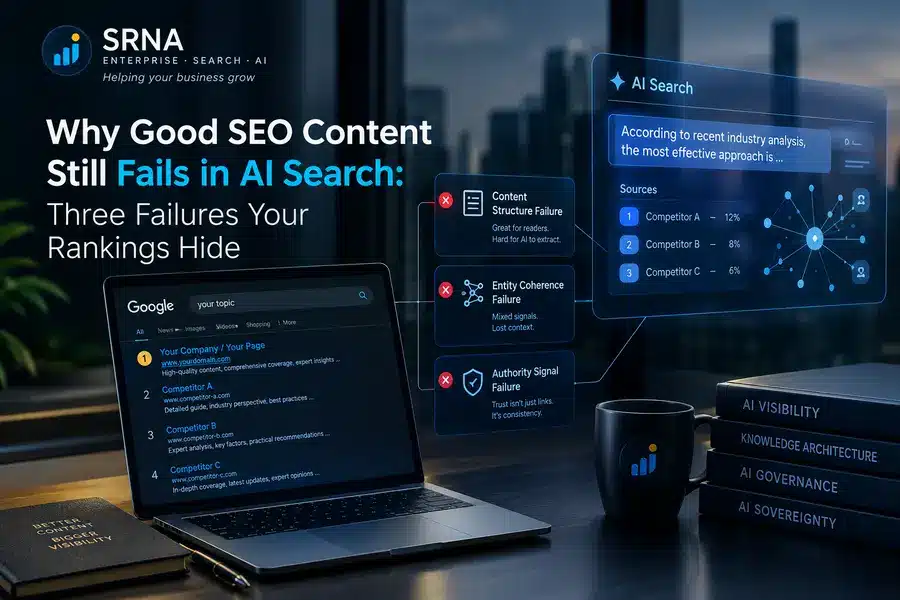
That is the whole problem in one sentence. Good SEO content wins a verdict on the page. AI search gives a verdict on a passage and on the entity behind it. Content built to pass the first test can fail the second one completely, and your rank tracker will never tell you. I wrote a first take on this topic in June. This one goes deeper into three specific failures I keep running into, and what the latest data says about how big the gap really is.
In-house at Adecco Group and Atlas Copco, I learned that a green rankings dashboard and real visibility are two different things. AI search just made the difference measurable.
What the AI Citation Gap Actually Is
The AI citation gap is the distance between where a page ranks in Google and whether an AI system quotes, cites or recommends it for the same question.
Two things sit inside that definition. First, ranking is still a page-level event: Google scores the whole URL. Second, an AI answer is assembled from short passages pulled from a few sources, and the system also decides which brand, product or person each passage is about. So a page can be strong as a document and weak as a source of quotable, attributable facts.
I covered the broader difference in AI visibility vs SEO visibility. Here I want to stay narrow and practical.
What the Numbers Say (and Why They Disagree)
The honest answer is that nobody agrees on the overlap, and the disagreement is itself the finding.
| Study | What was measured | Reported result |
| Ahrefs, mid-2025 (1.9M citations) | Google AI Overview citations vs organic top 10 | About 76% of cited pages ranked in the top 10 |
| Conductor, 2026 (about 168M citations) | Same question, newer data | About 57% of AI Overview citations came from outside the top 10 |
| BrightEdge, 2026 | Top-10 overlap by industry | Finance showed only about 11% overlap |
| Ahrefs, September 2025 (15,000 prompts) | ChatGPT, Gemini and Copilot citations vs Google top 10 | About 12% of cited URLs ranked in the top 10 (figure as reported by Frase) |
| On-Page.ai, July 2026 (50 keywords) | ChatGPT with web search | Only 1% of 213 cited URLs were page-one Google results |
Different engines, different keywords, different months, different methods. I would not quote any single row as “the truth” in a board meeting. But look at the direction. In a year, the Google-owned surface moved from “ranking mostly predicts citation” to “ranking predicts it only partly”, and the standalone assistants barely look at the Google top 10 at all.
If rank were a reliable predictor, these studies would not contradict each other this badly.
Now the three failures. I picked them because each one looks like a success on a normal SEO report.
Failure One: Great Backlinks, Terrible AI Extractability
You earned the links. The page has authority. And the answer is on screen four, after 600 words of context-setting.
That structure was rational for years. Long intros kept people on the page, and long guides collected links. An AI system does not read your page like a person scrolling. DataDab (an AI visibility vendor, so read it with that in mind) reports that ChatGPT cites a window of roughly 100 to 300 words inside a page, and usually only 3 to 7 sources per answer. If your answer is smeared across five paragraphs of build-up, there is no clean window to lift.
Links do not fix that. They got the page into the candidate pool, maybe. They do nothing for whether one passage stands alone and makes sense when quoted out of context.
What I check first: does the first 150 words under each H2 answer the heading’s question directly, with the subject named (not “this solution”, not “our platform”)? I wrote the technical side of this in the section hierarchy blueprint for GEO developers. Headings are not decoration for a retrieval system. They are the boundaries it uses to cut your page into pieces.
A page that is great for the reader who scrolls can be useless to the system that slices.
Failure Two: Perfect Schema, Broken Entity Coherence
This one annoys me the most, because teams do the schema work correctly and still lose.
Schema markup (structured data that labels what a page is about, in code) is a statement from you about yourself. It does not make the statement believable. If your Organization markup says one thing, your About page says a slightly different thing, LinkedIn uses a third description, and old press mentions use the old company name, you have a valid schema and an incoherent entity.
DataDab describes the same pattern from its audits: the assistant knows the product name but cannot reconcile it into one well-described thing across the web. I would add my own reading, which is a judgement and not a measured result: retrieval systems prefer a source they can attribute with confidence over one where they must guess who is being described. Is that proven in a controlled test? Not enough available data. But it matches what I see when I audit enterprise sites with several regional domains and four versions of the same product name.
I wrote the mechanics in entity ambiguity resolution, and the scoring side in the Schema Confidence Score piece. Short version: validate the markup, then compare it against every other place the entity is described. The conflicts are the work.
Valid schema tells the machine what you claim. Coherence tells it whether to believe you.
Failure Three: Strong Rankings, Zero Presence in AI Answers
Here the SEO side is clean. Position two for the head term. Nothing broken in Search Console. And in the AI answer for the same question, you are absent.
Part of the reason is the engine itself. The Google-owned surfaces still lean on the index, while ChatGPT, as the On-Page.ai result above shows, draws from a different slice of the web. The same study found that two-thirds of the pages AI Overviews cite from beyond page one have an estimated organic traffic of zero. Those are pages your SEO dashboard would never flag as competitors, and they are taking the slot.
Part of the reason is that you are measuring the wrong thing. Your tracker reports position for a keyword. The buyer asked a full question, and the AI turned it into several sub-questions behind the scenes. Ranking for the head keyword says nothing about whether you answer those sub-questions with a quotable passage.
This is also where the problem stops being an SEO problem. When a procurement team shortlists vendors from an AI answer, a missing brand is a revenue issue, not a reporting gap. I made that case in SEO as infrastructure, not a channel, and the structural version in enterprise visibility architecture.
A ranking is a position in a list. An AI answer has no list to be positioned in.
Where You Can Start Closing the Gap
If you recognise two of these three failures in your own site, a diagnostic is faster than guessing. At Enterprise Search Advisory I run exactly this comparison for enterprise teams: ranking data on one side, AI answer presence on the other, and the structural reasons for every mismatch. You can contact me here to talk through your situation.
If you want to look first on your own, the AI Visibility Inspector (my diagnostic tool that checks how AI systems read a website) is the place to start.
This is not an argument that SEO is dead. Ranking still helps, and in some Google-owned surfaces it still correlates with citation. It is not a claim that schema, links or long content are bad. And it is not a promise that a restructured page will be cited next week.
It also is not a case for throwing away your keyword research. Sub-questions come from somewhere, and that somewhere is mostly the same demand you already mapped. I explained how the old signals carry over in how traditional SEO signals transform into AI signals.
A Monday Morning Check
You do not need a tool for the first pass.
- Pick 20 to 30 real buyer questions from sales calls, support tickets and site search. Not keywords. Questions.
- Run each one in ChatGPT, Perplexity, Gemini and Google. Record which URLs and which brands appear.
- Mark every question where you rank well but are not cited. That list is your gap.
- For each marked page, test the three failures in order: is the answer extractable, is the entity described the same way everywhere, and does the page answer the sub-questions or only the head term?
- Fix the smallest, cheapest failure first (usually heading structure and the opening lines of each section), and re-run the same questions after a few weeks.
For the engineering of what to fix, see AI citation engineering.
Estimated Gain After Implementation
I will not give you a percentage that pretends to hold across companies. Not enough data confirm it, and anyone quoting you a precise uplift is selling something. What I can say honestly: pages where the failure is structural and cheap to fix (buried answers, conflicting entity descriptions) tend to respond first, often within one or two re-test cycles, while pages that fail because the engine simply draws from other sources may not move at all. Treat any gain as a range you measure against your own baseline, not a guarantee.
And one more thing about priorities. If your organisation has no owner for this, the checks above will stall. That is a governance problem, covered in why SEO fails without systems thinking and why digital marketing fails without a clear strategy.
FAQ
Yes. The studies above disagree on how often, but all of them show that ranking is only a partial predictor. Google’s own surface overlaps more with rankings than ChatGPT does, and the numbers shifted significantly between 2025 and 2026.
Backlinks help a page get into the candidate pool. They do not make one passage self-contained and quotable. A page with a strong link profile and a buried answer can still lose to a smaller page that states the answer plainly.
No. Schema is your own claim about the entity. If other pages and profiles describe the company or product differently, the claim conflicts with the rest of the evidence. Validate the markup, then check coherence across every place the entity appears.
Take real buyer questions, run them across several AI systems, and compare which URLs and brands appear against your Google rankings. Questions where you rank but are not cited are the gap.
No. This article argues that ranking is necessary context, not proof of AI visibility. Keyword demand research still feeds the questions you need to answer.
Not enough available data for a universal number. Structural fixes tend to respond first, but results depend on the engine and on your starting baseline.
What to Do Next
If your rankings and your AI answer presence tell two different stories, that gap is where the money leaks. Start with the Monday check, and if you want a second pair of eyes with enterprise experience, book a conversation. I will tell you straight what is structural, what is noise, and what is not worth fixing.
This article was researched and drafted with the assistance of AI tools and reviewed and edited by author prior to publication.
