

In This Article
Your CMO just asked you to approve another AI visibility subscription, and nobody in the room can tell you whether it is a cost, an investment or an expensive toy.
So here is the one thing I want you to keep from this article. Everything below is built around that test.
A CFO should not buy the tool with the best dashboard. A CFO should buy the stack where every number on the screen has a cause someone can fix and a source someone can audit.
What an AI Visibility Tool Actually Is
An AI visibility tool (software that measures or analyzes how a brand shows up in answers from systems like ChatGPT, Perplexity, Claude and Gemini) comes in two functionally different types.
Tracking tools sample prompts across AI engines and report whether, how often and in what context your brand is mentioned. They answer “are we visible?”
Diagnostic tools analyze the structure of the page or site itself, to explain why an engine would or would not retrieve and cite it. They answer “why not, and what do we fix?”
Most companies own only the first type. Finance usually gets shown only the first type too, because a trend line is easy to put on a slide. But a trend line you cannot act on is just a more expensive way of being worried.
One disclosure before we go further. I built two of the diagnostic tools in this comparison (the AI Visibility Inspector and NovaX), so I have a stake here. I would rather say that plainly than pretend to be neutral. Where a competitor is the better fit, I say so.
Why This Landed on Your Desk
Because buyers moved before the budget did. Gartner reported in April 2025 that finance leaders use public GenAI search tools to discover software nearly twice as much as traditional online search (Gartner abstract). If your company sells to finance people, the first shortlist is now written by a machine you do not control.
And the measurement side is a mess. In a Coupa survey of 600 finance leaders, 76% said the difficulty of quantifying AI ROI is holding back further investment, moderately or significantly (Coupa report page). You already know this feeling. I covered the attribution side in AI visibility is breaking revenue attribution, where I cited that only 13% of marketing leaders have a clear path from AI visibility to revenue. That is the gap you are being asked to fund blind.
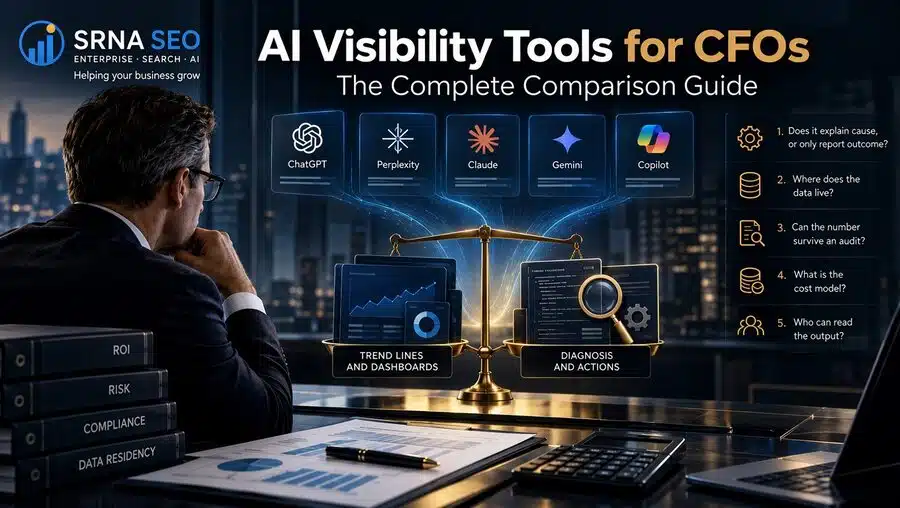
Five Questions a CFO Should Ask Before Signing
I spent years inside Adecco Group and Atlas Copco asking finance for search budget, so I know which questions come back across the table. These are the five that matter.
- Does it explain cause, or only report outcome? A flat citation line with no cause attached means you will pay for the subscription twice: once to watch it, once to fix it.
- Where does the data live? For regulated or residency-sensitive companies this is a procurement blocker, not a footnote.
- Can the number survive an audit? Ask for the method behind the score, the prompt set, and how often it is refreshed.
- What is the cost model? Add-on to an existing suite, enterprise quote, or one licence. These behave very differently at renewal.
- Who can read the output? If only the SEO team can interpret it, you cannot use it in a board pack.
The expensive mistake is not buying no tool. It is buying a tracking-only stack and concluding, two quarters later, that AI visibility “does not move the needle.”
The Comparison
This is the same five-tool set I compared in Which AI Visibility Tool Is Best for Enterprises, re-read through a finance lens.
| Tool | Type | Question it answers | Cost signal | CFO watch-out |
|---|---|---|---|---|
| Semrush AI Visibility Toolkit | Tracking | Are we appearing, and how do we score against competitors (0 to 100)? | Add-on to the Semrush suite. Listed at $99 per month according to a third-party review, verify current price. | Prompt monitoring mirrors keyword logic, you decide what gets watched. |
| Ahrefs Brand Radar | Tracking | How do we compare at scale across a large prompt database? | Premium add-on. Real spend climbs once AI indexes are stacked. Exact figure: Not enough available data. | Some features still in beta. Budget can drift. |
| Profound | Tracking (enterprise AEO) | AEO score across 10+ engines, share of voice, sentiment | Enterprise quote, demo-led sales. Price: Not enough available data. | Built for formal board-level programs. Overkill for early stage. |
| AI Visibility Inspector | Diagnostic (page) | Why is this specific page not being cited? | Pricing: Not enough available data in the sources I reviewed. | Page by page, so it does not scale to thousands of URLs alone. |
| NovaX | Diagnostic (site) | Where is structural decay concentrated across the whole site? | Self-hosted, one licence covers the installation. Price: Not enough public available data. | Competitor analysis covers only a small portion of a rival’s site. |
Tool by Tool: What You Actually Get
Semrush AI Visibility Toolkit
The convenience play. If your team already lives in Semrush, adding AI visibility to the same dashboard removes a tool switch and a vendor onboarding. It tracks daily brand visibility across ChatGPT Search and Google AI Mode. Good for a CFO who wants a low-friction first number. But it tells you the gap, not the reason for it.
Ahrefs Brand Radar
Strong on competitive benchmarking, with one of the largest prompt databases in the category. I like it for data-heavy teams. The catch for finance is the cost curve: base plan plus several AI platform indexes gets expensive faster than people expect. Ask for the all-in monthly figure in writing.
Profound
The purpose-built enterprise AEO platform (AEO means answer engine optimization). It offers prompt-level analysis, share of voice, sentiment on how AI describes your brand, and SOC 2 Type II compliance, which your security team will ask about before you do. It is sold through demos, not self-serve. Right for a large company with a formal program. Wrong for a team still figuring out what it needs.
AI Visibility Inspector
AI Visibility Inspector is diagnostic tool that audits any live page, yours or a competitor’s, and scores it across ChatGPT, Claude, Gemini and Perplexity. It pulls more than 100 structural, semantic, schema and freshness signals and scores four layers: Structural Integrity, Data Extractability, Entity Clarity and AI Visibility Signals. The output is not “you were not cited this week.” It is closer to “your Data Extractability score is 44, here are three fixes ranked by effort against impact.” That is a work order, and a CFO can fund a work order.
NovaX
NovaX (my own AI visibility intelligence platform) takes the same diagnostic logic and runs it across the whole site. It scores each page on five dimensions: Structural Integrity, Data Extractability, Entity Clarity, Schema and Metadata, Freshness and Decay. Two things matter for finance. First, it is self-hosted, so crawl data and scores stay on your infrastructure, which settles the data residency question. Second, its Executive Report translates technical findings into Missed Citation Estimates and Improvement Potential, so the output is readable outside the SEO team.
I do not pretend either diagnostic tool replaces the trackers. They sit underneath them. Diagnose first, then track, so every improvement you later measure has a traceable cause.
Not Sure Which Layer You Are Missing?
That is the most common situation I see, and it is a 30-minute conversation, not a procurement project. Start a Structural Conversation and I will tell you honestly whether you need a diagnostic layer, a tracker, or neither yet.
Putting a Number on It: A Worked Example
Finance trusts arithmetic more than adjectives, so here is the arithmetic. My AI Visibility Cost of Inaction Calculator uses a simple model: baseline monthly organic revenue, times the share exposed to AI answers, times a displacement rate.
The numbers below are hypothetical, for illustration only, not a client case:
- 100,000 monthly organic sessions
- 1% organic conversion rate
- 3,000 average revenue per conversion
- 30% of that revenue exposed to AI answers
Baseline monthly organic revenue is 3,000,000. Exposed revenue is 900,000. The calculator applies three displacement scenarios to the exposed part:
| Scenario | Displacement | Monthly revenue at risk | 12-month exposure |
|---|---|---|---|
| Conservative | 15% | 135,000 | 1,620,000 |
| Base | 30% | 270,000 | 3,240,000 |
| Aggressive | 50% | 450,000 | 5,400,000 |
Apply your gross margin and you get the profit version. At a 40% margin, the base case becomes 108,000 per month. Now you have a figure to hold against the cost of a tool, and the tool decision stops being a feeling.
Two honest caveats. The displacement rates (15, 30 and 50%) are scenario assumptions on that page, not forecasts. And please validate the average revenue per conversion and the margin with your own finance team, not with marketing. The page says the same thing.
What This Is NOT
This is not a claim that tracking tools are worthless. They earn their place once structure is fixed, because you do need to know over time whether citation rates improve.
It is not a ranking of “the best” tool for everyone either. The right answer depends on your stack, your budget and whether AI visibility has become a board topic yet.
And it is not a guarantee of revenue. AI visibility influences discovery upstream, often with no click recorded, which is exactly why last-click reporting will undercount it.
Estimated Gain After Implementation
Be skeptical here, and I will give you reasons. In my enterprise comparison I wrote that organizations running diagnostic remediation first (entity markup repair, schema alignment, extractability fixes) typically see meaningful movement in citation probability within 60 to 90 days. The NovaX page states a range of 15 to 25 percentage points of citation probability within 60 days for organizations that close signal gaps.
Both are my own stated ranges, from my own work, not independent benchmarks. Treat the top of the range as an upside case, not a budget line. The only full production dataset I can show you is my own site: an average AI-readiness score around 90 out of 100 across 95+ pages, 98% Inspector coverage, and 85% of pages ranking on page one of Google. That proves the method works on one site. It does not prove it works on yours. The exact numbers depend on the teams optimization skills, not on which dashboard you use.
My Recommendation by Situation
| Your situation | Start with | Then add |
|---|---|---|
| Established content program, no diagnostic layer | AI Visibility Inspector on highest-intent pages | NovaX if findings are systemic across many pages |
| Already deep in Semrush | Semrush AI Visibility Toolkit as a first number | A diagnostic layer once the number stops moving |
| Residency or security constraints | NovaX (self-hosted) | A tracker that passes your security review |
| AI visibility is a formal board initiative | Profound for tracking | AI Visibility Inspector diagnostic layer for causes |
If you want the board-pack side of this, AI visibility and executive reporting covers how to present it. And if you are unsure where your organization sits, the AI Visibility Maturity Model is a fair starting self-check. Procurement teams should also read AI is influencing procurement before procurement starts, because the shortlist problem runs in both directions.
FAQ
Five things: whether it explains cause or only reports outcome, where the data lives, whether the score can survive an audit, the cost model, and whether people outside the SEO team can read the output.
A tracking tool measures whether and how often your brand appears in AI answers over time. A diagnostic tool analyzes the structure of a page or site to explain why it is or is not being cited, and what to fix.
Diagnostic first. Fixing structural causes before you start tracking means every later improvement has a traceable cause. A tracking-only stack can leave you watching a flat line for months.
It varies by type. Semrush’s toolkit is reported at $99 per month by a third-party review, so verify the current price. For Ahrefs Brand Radar, Profound, the AI Visibility Inspector and NovaX, exact prices: Not enough available data in the sources reviewed here. Ask each vendor for an all-in figure in writing.
Multiply baseline monthly organic revenue by the share exposed to AI answers and by a displacement rate. The Cost of Inaction Calculator applies 15%, 30% and 50% scenarios, then shows a profit version using gross margin. These are scenario assumptions, not forecasts.
In my experience, measurable movement in citation probability appears within 60 to 90 days of implementing structural fixes. The NovaX page states 15 to 25 percentage points within 60 days. Both are my own ranges, not guarantees.
No. NovaX diagnoses structural causes. Those platforms track outcomes. Most teams that diagnose still run a tracker alongside to confirm the fixes worked.
NovaX is self-hosted. Crawl data, Inspector analysis and scores stay on your own infrastructure.
The Straight Answer
If you take one action this week, run the Cost of Inaction Calculator with your finance team’s numbers, then book thirty minutes with me. We will check whether your problem is a missing tracker, a missing diagnosis, or a budget you should keep in your pocket for now. Book the conversation, or start with the Free Assessment Center if you prefer to look first.
Read also: Which AI Visibility Solution Is Right for You, Best AI Visibility Tools, Which AI Visibility Tool Is Best for SME, NovaX AI Visibility Intelligence, AI Visibility Inspector
This article was researched and drafted with the assistance of AI tools and reviewed and edited by author prior to publication.
