

In This Article
You ask ChatGPT about your own company, and the answer is wrong in a way you cannot trace to anything you ever published.
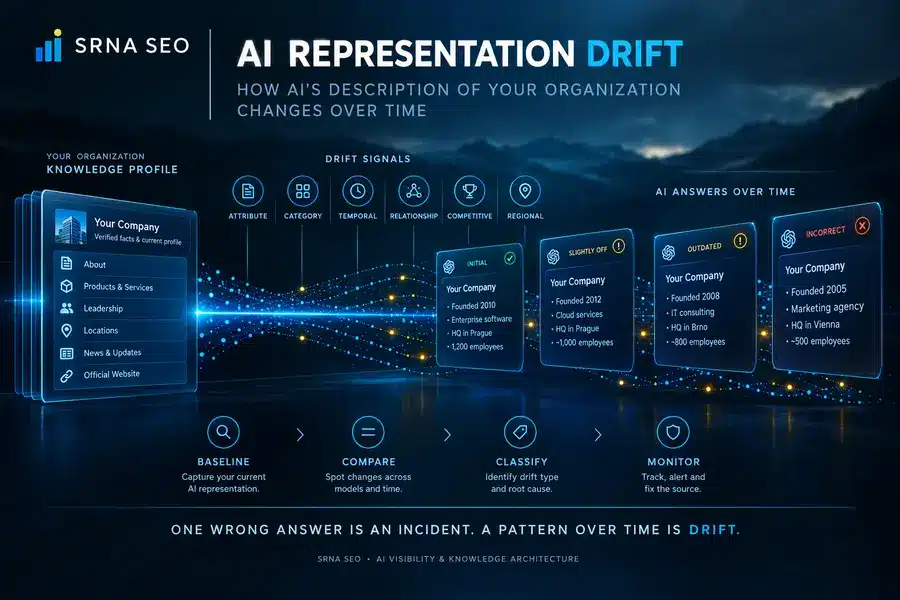
AI representation drift is the slow change in how AI systems describe your organization, and it happens even when your organization changed nothing. The model gets updated, the sources it retrieves shift, a competitor publishes a few good pages, and your description moves a little. Then a little more. Nobody sends you a notification. You find out when a buyer, a journalist or your own CEO pastes a wrong answer into a meeting.
I will be direct about what this article does. It explains how drift happens, which types you will actually meet, how to detect it without a big budget, and how to fix the cause instead of arguing with one answer. NovaX (my AI visibility intelligence platform) is built to cover the monitoring and fixing work, and I will say where it fits.
What AI representation drift actually is
AI representation drift is the gradual divergence, measured over time, between how an organization is documented and how AI systems describe it. “AI systems” here means ChatGPT, Perplexity, Gemini, Microsoft Copilot and Google AI Overviews (the generated answers shown above the normal Google results), plus the enterprise assistants your buyers use inside their own companies.
Two words in that definition matter. Gradual, because one wrong answer is an incident, and a pattern across weeks is drift. Over time, because a one-off audit cannot see it at all.
Drift is not the same as a hallucination (a model inventing a fact with no basis). A hallucination is random and often disappears if you ask again. Drift has direction. The description keeps moving the same way, toward the older category, toward the competitor’s vocabulary, toward the CEO who left two years ago. I covered the risk side in AI Misrepresentation Risk. Drift is the time dimension of the same problem.
One wrong answer is an incident. The same wrong answer moving in one direction for three months is drift.
Why organizations drift
I cannot see inside any model. What I can see is outputs over time and the source environment around the organization. So anyone who tells you exactly why a model changed one description is guessing, or selling something. What I can give you are the five causes I keep running into, ordered by how much control you have over them.
1. The model or the retrieval layer changes under you
The retrieval layer (the part of an AI search system that fetches sources before the model writes the answer) gets refreshed, and the model itself gets updated. Your website, your products and your messaging stay identical. The answer still changes. If your business leans on SaaS AI you do not control, you inherit this risk by default. I wrote about the practical response in Optimizing SaaS AI While Building Your Sovereign Fallback, and about a related dependency on a few central providers in The Vulnerability of Centralized Data Centers.
2. Your own content disagrees with itself
Anyone who has worked inside a global enterprise knows that one fact lives in many places. The global site, the regional sites, the PDFs, the press releases, the partner pages. Many places means many versions, sooner or later. A model reads all of them and blends them. That is how a company ends up described with the old name, the old category and the new product in the same paragraph.
This is a structural problem, not a content problem, and I described the pattern in Search Architecture Failures. It also connects directly to entities. An entity (a distinct thing a model can recognize and describe, such as a company, a product or a person) can be confused with another entity that has a similar name. I went deeper on that in Entity Ambiguity Resolution.
3. The evidence disappears
Migrations, rebuilds, mass de-indexing. When pages that carried the correct facts become unreachable, the description loses its anchor, and older or third-party versions fill the gap. This is my reasoning from how the mechanics work, not a measured result, so treat it as a working hypothesis. The collapse patterns themselves are in Indexation Collapse Patterns.
4. Other people write your story
Directories, aggregators, old reviews, competitor comparison pages. Wherever you leave a gap, someone else fills it, and not always accurately or kindly.
5. Nobody owns it
Marketing assumes IT owns the website. IT assumes marketing owns the message. Legal owns neither and only appears when something goes wrong. Unclear ownership is a theme I keep coming back to, for example in Why Digital Marketing Fails Without a Clear Strategy. Drift grows fastest exactly there.
The model is rarely the main culprit. In my experience the first suspect should be your own pages.
Six types of drift you will actually meet
Different drift needs different fixes, so classify before you react. The examples below are illustrative patterns, not client cases.
| Type | What moves | Illustrative pattern |
|---|---|---|
| Attribute drift | Facts such as dates, locations, ownership, capabilities | A founding year or headquarters stated wrongly and repeated |
| Category drift | The market the organization is placed in | An enterprise software vendor described as a consumer app |
| Temporal drift | Old and current states get blended | A retired product or former executive shown as current |
| Relationship drift | Links to parents, subsidiaries, partners, competitors | A subsidiary’s attributes credited to the parent, or the reverse |
| Competitive drift | Your differentiators migrate to a rival | A competitor is named for the strength you built |
| Regional and language drift | Different markets get different descriptions | The same company described one way in English and another in German |
The last row scales up. The same logic applies to whole countries, which is what I looked at in National AI Visibility and in the Building a Europe AI Can See series.
This is not a sentiment problem, and it is not classic reputation management. A neutral, polite and completely wrong description is still drift. It is not a ranking problem either, because you can hold position one in Google and still be described wrongly in an AI answer. It is not a one-time cleanup, it is not a reason to blame the model vendors, and it is not something that shows up in your analytics. If you came here looking for a trick to force one answer into a chatbot, this is the wrong article.
What drift costs you
I will not give you a euro figure. Not enough available data exists to defend one across organizations, and I do not publish numbers I cannot stand behind.
What I can say is where the cost lands. Buyers now form shortlists before they ever talk to you, which I wrote about in AI Is Influencing Procurement Before Procurement Starts. Your sales team meets the result late, in the conversation where the buyer already believes something wrong. I touched on that side in AI Search and Sales Enablement. And none of it appears in a traffic report, because the damage happens inside an answer nobody clicked.
Mention counts alone will not warn you either. AI Mention Velocity tells you how fast you are being discovered. Drift tells you whether what is said about you is still right. You need both, and most teams measure only the first.
If you want a starting point, run the AI Visibility Inspector or the AI Assessment Center on your own domain this week. It takes little time, and it shows you what the models are working with today.
How to detect drift
You can start manually. For one brand in one market, this works fine.
- Build a sentinel prompt set. Sentinel prompts (recurring diagnostic questions you ask every cycle) should cover four families: unaided discovery (“who are the leading suppliers of X”), direct questions about you, comparisons with named competitors, and local or language variants.
- Run every prompt several times on each major AI system. Answers vary between runs, so a single run proves nothing.
- Log everything. Prompt, system, model version if shown, date, full answer, and cited sources.
- Classify each answer. Keep the rubric simple: Accurate, Outdated, Inaccurate, or Not mentioned.
- Repeat on a fixed schedule, and again after major model releases, then compare against your first baseline.
- Set alert rules. My suggestion: the share of accurate answers falls across two cycles in a row, a new wrong claim appears, or a competitor repeatedly replaces you.
To find out which layer is failing, use the method in Retrieval Layer Diagnostics.
Manual testing breaks the moment you have many markets, many languages and many products. Nobody will keep a spreadsheet alive across forty prompts, six systems and twelve countries. That is the gap NovaX is meant to fill: tracking how AI systems represent an organization over time, and helping fix what the tracking finds.
How to fix drift
Fix the source environment, not the single answer. Telling a chatbot “that is wrong” in one session changes nothing about what it says to the next person, and I would not build a program on it.
- Name one authoritative source for each core fact. One page for who you are, what you do, which category you belong to, and who leads you.
- Make naming consistent everywhere. Same company name, same product names, same descriptions across regions.
- Remove or update contradicting and outdated pages. Retire them properly instead of leaving them live.
- Structure the pages so facts can be extracted cleanly. Section hierarchy matters here, and the developer side is in The Developer’s Guide to Section Hierarchy in Generative Engine Optimization.
- Strengthen corroboration from credible third parties, so the correct version is not only your own claim.
- Re-measure with the same sentinel prompts. If the numbers do not move, the fix was not a fix.
The formal question, whether an organization has any right to correct how an AI represents it, is separate, and I treat it in AI Correction Rights. Do not wait for that answer before cleaning your own house.
Who should own drift in a large organization
Pick one named owner. Not a committee, not “the digital team”. Define severity classes (a wrong office address is not a wrong ownership statement), agree who fixes each class, and agree how fast.
The structural side sits in Enterprise Visibility Architecture, and rolling it out inside a big company is a change management job, which is why I wrote Deploying AI Visibility Engineering. If you are unsure whether your organization is ready for any of this, start with Complete Guide to Evaluate an Organization’s AI Readiness. And keep humans reviewing the answers that carry real consequences, which is the logic behind AI in the Loop.
Estimated gain after implementation
Not enough available data for a defensible percentage range, and I prefer saying that over inventing one. What I would measure instead: the share of accurate answers in your sentinel set, the number of competitor substitutions in unaided discovery prompts, and the time between a wrong claim appearing and being corrected. If all three move in the right direction over two or three cycles, the work is paying off. If they do not, the cause is still sitting in your source environment.
Where to go from here
If you run SEO, digital or a large web estate and you suspect your organization is already being described wrongly, I do this work through Enterprise Search Advisory. We baseline how AI systems describe you, classify the drift, and agree who owns the fix. For continuous monitoring across markets and languages, that is what NovaX is for. Start with the baseline. You cannot fix a drift you have never measured.
FAQ
It is the gradual divergence, measured over time, between how an organization is documented and how AI systems describe it. It can happen even if the organization changed nothing.
A hallucination is a model inventing a fact with no basis, and it is usually random. Drift has direction: the description keeps moving the same way over weeks or months.
I see five causes: model and retrieval changes, content that contradicts itself, evidence that disappears after migrations or de-indexing, other people writing your story, and unclear ownership. I cannot see inside the models, so these are patterns from outside, not proven mechanisms.
Six that I use in practice: attribute, category, temporal, relationship, competitive, and regional or language drift.
Build a set of sentinel prompts, run each one several times on the major AI systems, log the answers, classify them as Accurate, Outdated, Inaccurate or Not mentioned, and repeat on a fixed schedule against a baseline.
No. Correcting one answer in one session does not change what the system says to the next person. Fix the source environment: authoritative pages, consistent naming, removal of outdated content, and credible corroboration.
Not enough available data for a defensible range. Track the share of accurate answers, competitor substitutions and time to correction instead.
One named owner with defined severity classes and response times. Spread across marketing, IT and legal, nobody fixes it.
This article was researched and drafted with the assistance of AI tools and reviewed and edited by author prior to publication.
