

In This Article
Your SEO team ships fixes every sprint, the dashboard looks busy, and yet the same structural problems come back every quarter because nobody outside the team owns them.
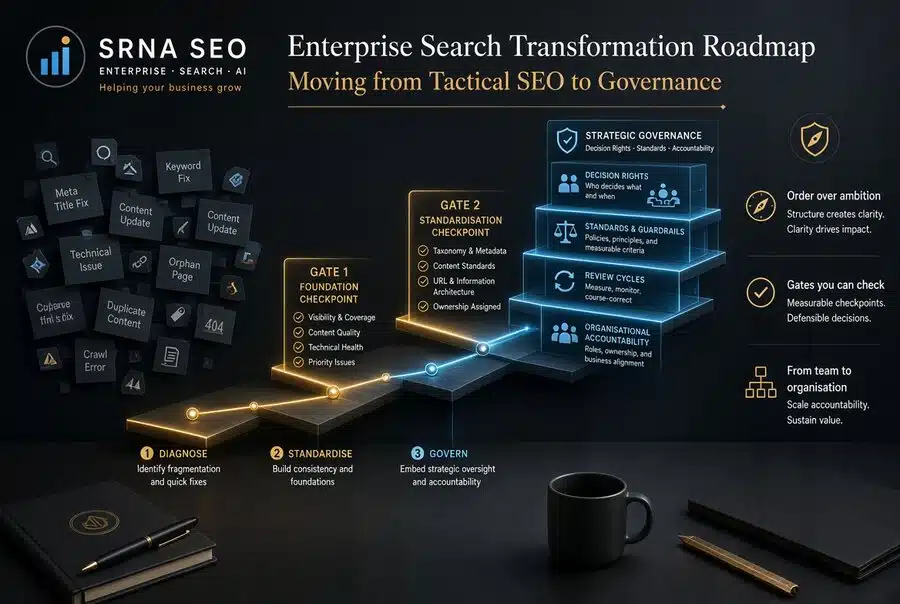
An enterprise search transformation roadmap is the sequenced plan that moves an organisation from fixing individual SEO issues (tactical SEO) to controlling the structures that produce those issues (strategic governance). The shift is not about doing more SEO. It is about moving ownership of search from one team to the organisation, in a defined order, with gates you can check. Most enterprises try to jump straight to “governance” with a policy document. That fails. The order matters more than the ambition.
I have written a lot about the destination: SEO Governance, the SEO Operating Model, and Visibility Governance in Large Organizations. This article is the missing piece between where you are and where those lead. The route.
Tactical SEO versus strategic governance
Tactical SEO (the work of finding and fixing individual search issues on pages, templates and tags, usually owned by an SEO team inside marketing) is necessary. It is also the ceiling for any team that has no authority outside its own function.
Strategic governance (the system of decision rights, standards, review cycles and executive accountability that controls how search visibility is built across an organisation) works one level upstream. It decides what the template can contain before the page exists.
| Dimension | Tactical SEO | Strategic governance |
|---|---|---|
| Unit of work | Page, tag, ticket | Template, taxonomy, entity, standard |
| Who owns it | SEO team | Named owners across product, dev, content, legal, markets |
| How problems are handled | Fixed when found | Prevented by release rules, fixed once at the source |
| Authority | Requests and recommendations | Mandatory standards with an escalation path |
| Reporting to leadership | Rankings, traffic, tickets closed | Structural eligibility, entity consistency, risk |
| Time horizon | Sprint or quarter | Multi-year |
| Failure mode | Same bugs return | Slow, bureaucratic if over-built |
I want you to notice the last row. Governance can fail too. A governance layer with no pragmatism becomes a committee that blocks releases and gets bypassed within a year. That risk is why the roadmap below is staged.
Tactical SEO fixes the page. Governance fixes the reason the page was wrong.
Why this shift is happening now
Two things changed. Search now interprets intent before retrieval, and AI systems read across many pages to build an answer about your brand. In a Search Engine Journal piece on enterprise SEO operating models, Bill Hunt argues that eligibility now comes before ranking, and that templates, data models, taxonomy and entity consistency decide whether content is retrieved at all. He also argues that enterprises will split into tactical optimisers and structural builders. I agree with the diagnosis. His article does not give the transition, though. It defines the target state and stops: no phases, no sequence, no milestones. That is the gap this roadmap fills.
A MarketScale report on a NEWMEDIA.COM analysis makes a related point from the B2B side. Large sites already have the authority to earn AI citations, but fail on fragmented ownership, slow cross-functional execution and structure machines cannot use. Four failure modes, all organisational. None of them is fixed by another audit.
Working inhouse in Atlas Copco Group as SEO Manager I have seen this situation from day to day. As SEO Manager I was responsible for driving organic traffic and conversions, working with stakeholders from multiple other divisions and departments, which all had their own priorities and roadmaps, which has caused the issues to return back from sprint to sprint, from month to month, from quarter to quarter. his is not theoretical issue, but realistic one, which I was living for two years.
It is not a maturity score. The SEO Maturity Model and the AI Visibility Maturity Model tell you where you stand. This tells you how to move. It is not a promise that governance will raise rankings. It is not a reorganisation plan, because most organisations cannot restructure for SEO and should not try. And it is not a guarantee of timing. The durations below are my proposal, and your organisation’s speed will set the real ones.
The four-phase roadmap
Four phases. Each has a goal, the work, an owner, and a gate. You do not enter the next phase until the gate is passed. That rule is the whole point.
| Phase | Name | Indicative duration (my proposal) | Goal |
|---|---|---|---|
| 0 | Diagnose | 4 to 8 weeks | Know what is broken at the source, and who owns it |
| 1 | Stabilise | 3 to 6 months | Stop new structural damage |
| 2 | Institutionalise | 6 to 12 months | Make decision rights and standards real |
| 3 | Govern | Ongoing | Run it as a system, report it as risk and value |
Phase 0: Diagnose
Goal: separate symptoms from causes, and find the people who control the causes.
The work is a structural inventory, not another technical audit. List the templates, the CMS and platform constraints, the markets and languages, the content owners and the agencies. For each recurring issue, trace it to its origin: which template, which team, which release process. Then map who can actually say yes or no to changes. That part is usually surprising. The Structural Decay in Enterprise SEO article shows how to spot the patterns, and my AI Assessment Center gives a first view of where your visibility position stands.
Owner: head of SEO or search lead, with a named sponsor.
Gate to Phase 1:
- A list of recurring issues traced to source templates or processes.
- A map of decision owners, even if incomplete.
- One executive who agrees to sponsor the next phase, in writing.
If you cannot get the sponsor, stop here. Everything after this depends on someone senior being willing to back a standard against a team that does not like it.
Phase 1: Stabilise
Goal: stop making it worse.
Before you fix history, stop new damage. Pick the few release points where structural errors enter: new templates, site migrations, new markets, new content types. Add a lightweight SEO check at those points only. Not everywhere. A short checklist and a named reviewer with the right to pause a release for a defined time.
This is also the phase to fix the source of your top recurring issues, once, in the template, instead of ten thousand times on the page. The Enterprise SEO Recovery Blueprint covers the repair work when the damage is severe.
Owner: search lead, with product or engineering counterparts.
Gate to Phase 2:
- Release checks running on the highest-risk release points.
- At least the top recurring issues fixed at the template level.
- A record of releases that were paused or changed because of the check. If the number is zero after several months, the check is decorative.
Phase 2: Institutionalise
Goal: convert goodwill into rules.
Here the roadmap becomes governance. Write the decision rights down: who owns template structure, entity definitions, taxonomy, technical standards, local variations, exceptions. For multi-market brands, that includes who decides what is translated and what is localised. Give each standard an owner, a review cycle and an exception path. Mandatory means someone can say no. If nobody can, it is a guideline.
This is also where you place search in the organisation correctly. I argued in The Role of SEO in Modern Organizations that placement decides authority, and in The Enterprise SEO Mistake of Calling It Marketing what goes wrong otherwise. Where the operating model itself needs rebuilding, see Enterprise SEO Operating Model: Build It Right or Pay the Price.
Owner: executive sponsor accountable, search lead responsible, functional heads consulted.
Gate to Phase 3:
- Written decision rights for the main areas, agreed by the functions affected.
- A working exception process with a log.
- Standards reviewed at least once on the agreed cycle.
Phase 3: Govern
Goal: run search as a system, and speak about it in the language of the board.
Now measurement changes. Traffic and rankings stay as diagnostics, but leadership reporting moves to structural measures: eligibility (can the content be retrieved), entity consistency across pages and markets, template compliance, and where visibility leaks. I covered the reporting side in AI Visibility and Executive Reporting and why clicks stop being the headline in The Death of Organic Clicks as a KPI. The AI layer, meaning who is accountable for what AI systems say about you, belongs in AI Governance for Enterprise Search Visibility and the AI Visibility Governance Blueprint.
Owner: executive sponsor, with governance reviewed in a standing forum.
Gate: there is no gate. It is a cycle. Review the system at least annually, and after any major platform change, rebrand or acquisition.
Phases are gates, not dates. If you pass the date and fail the gate, you stay.
How reporting changes at each phase
What you show leadership should change as you move. If it does not, nobody senior will notice the transformation is happening.
| Phase | What leadership sees |
|---|---|
| 0 | Root causes, not symptom counts, with owners named |
| 1 | Releases checked, issues prevented, template fixes shipped |
| 2 | Decision rights agreed, exceptions logged, standards reviewed |
| 3 | Structural eligibility, entity consistency, risk and value, trended |
I will not give you benchmark numbers for these. Not enough available data, and I do not trust any public figure I could quote.
Where roadmaps fail
Five patterns, in the order I would worry about them.
- No sponsor. The SEO team writes the standards, nobody backs them, and the standards are ignored.
- Policy before proof. A governance document appears before a single release has been checked. People treat it as paperwork.
- Everything at once. Governing every release point on day one creates friction and gets you bypassed. Start where the damage is worst.
- Reporting stays tactical. Leadership keeps seeing rankings, so they keep treating search as a marketing channel.
- No exit from exceptions. If every exception is granted, the standard means nothing. If none are, the business routes around you.
Governance that cannot say no is a suggestion. Governance that only says no is a bottleneck.
What gain to expect
I will not give a range. Not enough available data to state one honestly, because the result depends on how much structural damage you start with, and on how much authority your sponsor really has. What I can say is where the early signs appear: fewer repeat issues from the same templates, releases paused for good reasons rather than discovered after launch, and fewer contradictions in how your brand is described across pages and markets. Measure those at the end of Phase 1 and report the real numbers.
Your first 30 days
- Pick a candidate sponsor and ask for twenty minutes. Bring three recurring issues traced to their source.
- List your templates and who owns each.
- Choose the two release points that cause the most structural damage.
- Write a one-page check for those two points only.
- Agree who may pause a release and for how long.
If you want a second pair of eyes on that sequence, the Enterprise Search Advisory page explains how I work with enterprise teams.
Ready to build your roadmap?
If you are a Head of Digital, a VP or an SEO manager who recognises the opening of this article, contact me. I will tell you which phase I think you are really in, which is often not the one you would name. First conversation, no slide deck.
Frequently asked questions
It is the sequenced plan that moves an organisation from fixing individual SEO issues to controlling the structures that produce them. It has defined phases, owners and gates.
Tactical SEO works at the level of pages, tags and tickets, usually inside one team. Strategic governance works at the level of templates, taxonomy, entities and standards, with named owners across functions and mandatory rules with an escalation path.
A governance policy with no sponsor and no proof of value is treated as paperwork. The roadmap starts with diagnosis and stabilisation so that the rules arrive after you have shown they prevent real damage.
Diagnose, Stabilise, Institutionalise and Govern. Each has a goal, an owner and a gate, and you do not enter the next phase until the gate is passed.
My indicative proposal is 4 to 8 weeks for Phase 0, 3 to 6 months for Phase 1 and 6 to 12 months for Phase 2, with Phase 3 ongoing. These are starting estimates, not benchmarks, and the gates matter more than the dates.
One executive who is willing to back a standard against a team that does not like it, agreed in writing at the end of Phase 0. If you cannot find one, stop before Phase 1.
It moves from symptom counts to root causes, then to releases checked and issues prevented, then to decision rights and exceptions, and finally to structural eligibility, entity consistency and risk. Rankings and traffic stay as diagnostics.
Having no sponsor. The next most common are writing policy before proving value, governing everything at once, leaving leadership reporting tactical, and either granting every exception or none.
No. A maturity model tells you where you stand. This roadmap tells you how to move.
This article was researched and drafted with the assistance of AI tools and reviewed and edited by author prior to publication.
