

Ivica Srncevic | May 2026 | AI Visibility Research
The Industry That Heals the World Is Invisible to the AI That Now Shapes Its Audience
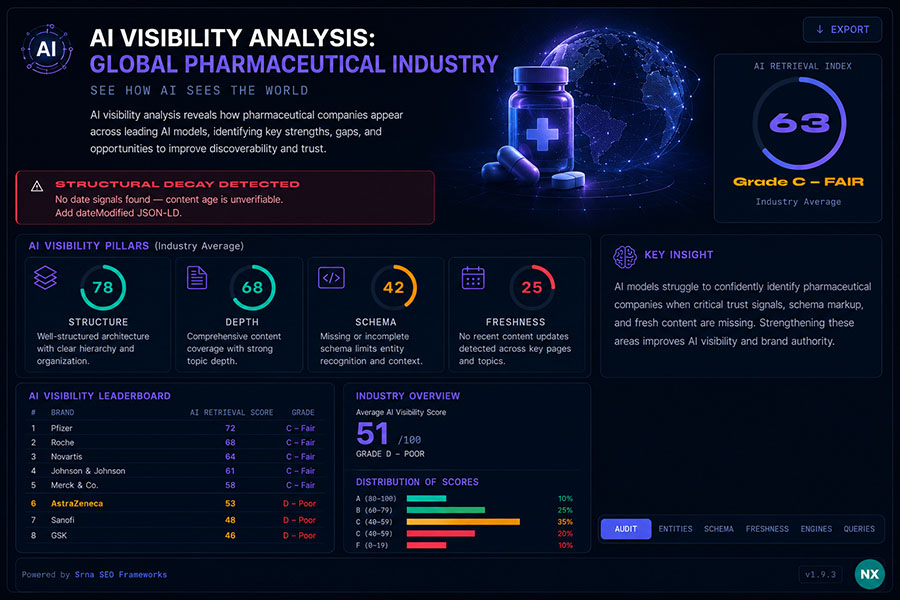
AI visibility in the pharmaceutical industry measures how effectively a company’s digital presence is structured for retrieval, interpretation, and citation by AI systems, the engines now mediating discovery for healthcare professionals, procurement teams, payers, and regulators worldwide.
These are not peripheral audiences. When a hospital formulary committee evaluates oncology treatments, when a health system’s procurement director shortlists biologics suppliers, or when a payer’s analyst researches pipeline assets, AI-assisted research is increasingly the first stop. The brands that those systems can parse with structural confidence appear in synthesized answers. The brands they cannot parse structurally, regardless of how significant their science is, do not.
This is the seventh installment of my independent AI visibility research series. Previous analyses have covered legal industry, global pharmaceutical, SaaS CRM, global banking, industrial tools manufacturing, life and health insurance, automobile industry, commercial vehicle sector, hospitality and tourism, and the cumulative 10 industries overview. The pharmaceutical industry now joins that dataset.
The findings are striking – not because the scores are catastrophically low, but because the structural failures are so consistent across brands with the resources, regulatory experience, and content infrastructure to do far better.
Methodology
I evaluated each company’s global corporate website using the AI Visibility Inspector and the Ivica Srncevic Framework. The assessment covers four structural dimensions that determine how confidently AI systems can retrieve, represent, and cite a brand:
- Structure – how content is architecturally organized for machine parsing
- Depth – the substantive quality and retrievability of content as AI systems process it
- Schema – the presence of structured data markup enabling confident entity identification
- Freshness – whether content age signals are present and verifiable to AI retrieval systems
The AI Retrieval Index runs from 0 to 100. Scores below 50 indicate significant structural invisibility. Scores between 50 and 74 represent fair to moderate visibility with material gaps. Scores at 75 and above indicate strong AI readiness.
The Scores
| Brand | AI Retrieval Score | Grade | Structure | Depth | Schema | Freshness |
|---|---|---|---|---|---|---|
| MSD | 73 | C – Fair | 100 | 85 | 35 | 85 |
| Novartis | 64 | C – Fair | 100 | 85 | 50 | 0 |
| Bayer | 63 | C – Fair | 100 | 85 | 35 | 37 |
| Astra Zeneca | 62 | C – Fair | 100 | 95 | 35 | 4 |
| Johnson & Johnson | 59 | C – Fair | 100 | 85 | 35 | 0 |
| GSK | 57 | C – Fair | 100 | 75 | 35 | 0 |
| Sanofi | 56 | C – Fair | 95 | 80 | 35 | 8 |
| Novo Nordisk | 50 | D – Poor | 70 | 85 | 35 | 4 |
| Pfizer | 49 | D – Poor | 100 | 75 | 10 | 0 |
| Roche | 47 | D – Poor | 55 | 85 | 35 | 3 |
Sector average: 57.8 – Grade C, AI Retrieval Index
Zero companies in Grade A. Zero in Grade B. Seven in Grade C. Three in Grade D. This is where global pharma stands in 2026 – better than trucks and automobiles, but still structurally failing an audience that now begins its research inside AI systems.
Five Findings the Industry Cannot Afford to Ignore
Finding 1: MSD Leads – But the Gap Between Leader and Ready Is Alarming
MSD scores 73, making it the sector’s clear leader. Its Structure score of 100 and Freshness score of 85, the highest Freshness reading in this dataset by a significant margin, explain most of that advantage. MSD demonstrates that pharma sites can carry date-verifiable content signals. That no other company in this dataset comes close to replicating that Freshness score is a structural choice, not a technical limitation.
The critical context: 73 still falls short of the 75-point threshold that constitutes genuine AI readiness. MSD leads an industry in which the strongest performer has not yet crossed into Grade B territory. That is the benchmark problem. The gap between sector leader and AI-ready is not a rounding error – it represents material structural work still undone.
Finding 2: Structural Decay Is Universal – Every Single Brand
Every company in this dataset triggered a Structural Decay warning. The causes differ: Roche was flagged for having no H1 tag at all – meaning AI parsers cannot anchor a primary topic on the site’s most critical pages. Novo Nordisk triggered the warning for three competing H1 tags, creating a fragmented intent that AI systems cannot resolve into a coherent entity representation. The remaining eight companies triggered the warning for absent date signals, content whose age AI systems cannot verify.
This pattern has appeared in every sector I have analyzed. What distinguishes the pharmaceutical dataset is the severity of the consistency. These are organizations that operate within some of the most rigorous regulatory content frameworks on earth. They produce documentation that satisfies FDA, EMA, and national regulatory body requirements for precision, auditability, and version control. They have the internal infrastructure to implement dateModified JSON-LD. They have simply not applied it to their public-facing digital presence.
The cost of that gap is AI systems that cannot determine whether they are reading a company’s current pipeline positioning or information from three years ago.
Finding 3: Schema Scores Reveal a Sector-Wide Identity Problem
The pharmaceutical sector’s average Schema score is 34.5. Novartis leads with 50, the only company to break above 35. Pfizer scores 10. The sector average sits nearly identical to the automobile industry (36.5) and the commercial vehicle sector (27.0) – industries with fundamentally different content infrastructure requirements.
Schema markup is the mechanism through which AI systems identify what a company is, what it manufactures, what conditions its therapies address, and what facts can be attributed to it with confidence. Without it, AI systems infer brand identity from unstructured page text. For pharmaceutical companies, where precision of attribution is not just commercially important but clinically significant, inferential parsing is a structural liability.
When an AI system cannot definitively distinguish between MSD’s oncology portfolio and a general summary of oncology drugs, or between Roche’s diagnostics division and the diagnostics category broadly, the brand loses the citation advantage it should hold by virtue of primary authority.
Finding 4: Freshness Failure Is the Most Actionable Gap – And the Most Neglected
Six of ten companies scored zero on Freshness. MSD at 85 and Bayer at 37 are the only brands demonstrating meaningful freshness signal implementation. Sanofi recorded 8. Novo Nordisk recorded 4. AstraZeneca recorded 4. Everyone else: zero.
The implementation required to address this gap is not complex. Adding dateModified JSON-LD to page templates is a technical task measurable in days, not months. The return on that implementation is direct: AI retrieval systems gain the ability to confirm content currency, which shifts the confidence threshold for citation in the brand’s favor.
The practical consequence of zero Freshness scores is that third-party sources, medical news outlets, healthcare trade publications, and formulary databases consistently outrank primary brand content in AI retrieval for pharmaceutical queries. Not because those sources carry more scientific authority, but because they carry date signals that the brands themselves do not provide.
Finding 5: Depth Is Strong – And Still Insufficient Without Structure
AstraZeneca leads the dataset on Depth with a score of 95, among the highest Depth readings across all sectors in this research series. Roche, Novo Nordisk, MSD, Johnson & Johnson, Novartis, and Bayer all scored 85. The pharmaceutical industry’s content depth is, by the standards of this research series, genuinely strong.
It does not translate into AI readiness. AstraZeneca’s overall score of 62, despite a Depth of 95, is the clearest illustration of the pattern I have observed across every sector I have analyzed: substantive content cannot compensate for structural signal failure.
Depth is necessary. Schema, Freshness, and H1 clarity are the structural conditions that allow depth to be extracted, attributed, and cited with confidence. Without them, a 95 Depth score produces a 62 overall rating, and leaves the brand’s scientific authority underrepresented in the AI systems its most important audiences now use first.
The Pharma-Specific Risk: When AI Misrepresents Clinical Authority
Every sector in this research series faces the commercial consequences of AI invisibility. The pharmaceutical industry faces an additional dimension that no other sector I have analyzed carries: clinical misattribution risk.
When an AI system cannot parse a pharmaceutical brand’s structured identity, because Schema is absent, because H1 tags are missing or fragmented, because content age is unverifiable, it does not return a blank. It infers. It synthesizes from unstructured text, from adjacent mentions, and from third-party sources that carry better structural signals. The output is a representation of the brand that the brand itself did not produce and cannot audit.
For a consumer brand, this produces a reputational disadvantage. For a pharmaceutical company, where the distinction between a therapy’s approved indications and off-label associations is a regulatory and clinical matter, AI-generated misattribution carries consequences that extend beyond marketing performance.
The brands that address structural AI visibility gaps earliest are not simply protecting their search performance. They are asserting control over how AI systems represent their scientific and clinical identity to the audiences that most determine their commercial success.
The balance between regulatory precision and AI-friendly clarity highlighted here is one of the core challenges addressed through AI Visibility Intelligence, where improving interpretation matters just as much as improving visibility.
What AI Actually Sees
The entity interpretation outputs from the AI Visibility Inspector reveal, directly, what AI systems extract when they attempt to identify what a pharmaceutical page is about.
Bayer’s site was parsed as being about “Pharmaceuticals”, the broadest possible category attribution, offering no differentiation, no therapeutic area specificity, and no competitive signal. A system asked to recommend a life sciences company with strength in cardiovascular or ophthalmology would extract nothing useful from this representation.
MSD was parsed as being about “MSD”, at least a coherent entity attribution, which explains its structural advantage. But even the sector leader produces an entity signal that AI systems treat as a brand name, not a structured capability declaration.
Roche, with no H1 tag detected, returned the starkest possible output: AI parsers cannot anchor a primary topic. For a company whose diagnostics and oncology portfolios represent decades of scientific leadership, this is a structural failure with no scientific justification, only an implementation gap.
Novo Nordisk, with three competing H1 tags, produced a fragmented intent that AI systems cannot resolve. The GLP-1 category has generated more AI-mediated research interest in the past 24 months than almost any other therapeutic area in history. Novo Nordisk’s structural H1 fragmentation means it does not benefit from that retrieval momentum in proportion to its category position.
The Gain of Fixing It – and the Cost of Not
Implementing the three primary structural fixes: dateModified JSON-LD across page templates, H1 consolidation on primary pages, and Organization/MedicalOrganization Schema markup, represents a technical investment that most enterprise pharmaceutical organizations can complete within a standard sprint cycle for the highest-priority pages.
The return is direct. AI systems that can verify content currency, anchor a primary topic, and confirm entity identity with structured declarations shift from inferential representation to cited attribution. For pharmaceutical brands, that shift produces visibility in AI-generated answers for formulary research, pipeline evaluation, therapeutic area comparisons, and procurement due diligence, the exact research workflows that precede high-value commercial decisions.
The cost of not implementing these fixes compounds quarterly. Every month that a third-party publication carries better freshness signals than Roche’s or Pfizer’s own corporate site is a month in which AI systems preferentially cite those third parties for queries that Roche and Pfizer should own by primary authority. That is not a hypothetical risk. It is the structural reality this dataset documents.
Brands that address these gaps in 2026 gain an early-mover advantage in AI-mediated pharmaceutical discovery. Brands that defer lose ground to competitors, and to secondary sources, that currently outrank them not on scientific merit, but on structural signal quality.
Want to know where your pharmaceutical or life sciences site sits on the AI Retrieval Index? My AI Search Readiness Audit gives you a full structural diagnostic and a prioritized implementation roadmap. Book a consultation.
Key Takeaways
- MSD leads the pharmaceutical sector at 73 (Grade C), driven by the strongest Freshness score in the dataset at 85. It is the only company approaching the Grade B threshold – and has not reached it.
- The sector average is 57.8, placing global pharma in the Grade C band – better than automobiles (55.8) and commercial vehicles (52.0), but still structurally underperforming relative to the research intensity of its audiences.
- Every company triggered a Structural Decay warning – a pattern now consistent across every sector in this research series. Roche and Novo Nordisk triggered the most severe variants: missing H1 and fragmented H1, respectively.
- Six of ten companies scored zero on Freshness, leaving AI systems unable to verify content currency for the majority of this sector’s most visited pages.
- The average Schema score is 34.5 – nearly identical to the automobile industry average. For an industry whose content precision is regulated to clinical standards, this implementation gap is a strategic choice with measurable structural consequences.
- Depth scores are the strongest in this research series – AstraZeneca leads all sectors analyzed at 95. High Depth without structural signals produces Fair-grade overall performance, not excellence.
- Pfizer scored 10 on Schema – the second-lowest Schema score across all companies in this entire research series, and a notable finding given that Pfizer publicly moved its SEO and AI discoverability function in-house in April 2026.
- The pharmaceutical industry carries a risk no other sector does: AI misattribution of clinical identity is not just a marketing problem – it is a regulatory and clinical authority risk.
Ready to see how AI sees you?
If you lead search, digital, or content strategy at a pharmaceutical or life sciences organization, the structural gaps documented here are addressable – and the window for early-mover advantage in AI-mediated discovery is open now, not indefinitely.
I work with heads of digital, SEO managers, and VPs at enterprise organizations to build the structural foundations that make AI retrieval work in their favor. Start with the AI Search Readiness Audit, explore the Visibility Strategy & System Design framework, or review the AI Dark Funnel – the research on why so much pharmaceutical AI visibility is being lost to sources you cannot currently see or measure.
Frequently Asked Questions
AI visibility in the pharmaceutical industry refers to how effectively a pharma company’s digital presence is structured for retrieval, interpretation, and citation by AI systems, including ChatGPT, Perplexity, Google AI Overviews, and emerging agentic research tools. It is distinct from traditional search ranking: a company can hold strong Google positions while remaining structurally invisible to AI retrieval systems that now mediate research for HCPs, payers, and procurement decision-makers.
The pharmaceutical sector’s structural scores, particularly Schema and Freshness, lag behind SaaS CRM and banking primarily because pharma’s digital investment has historically prioritized regulatory compliance, product information pages, and patient-facing content over machine-readable structural signals. The regulatory rigor that governs pharmaceutical content does not automatically produce an AI-readable structure; that requires deliberate technical implementation.
A Freshness score of zero means the site carries no verifiable date signals, specifically, no dateModified JSON-LD. AI retrieval systems cannot confirm whether the content is current. The practical consequence is that AI systems treat the content with lower confidence for citation purposes, and preferentially reference third-party sources, trade publications, formulary databases, news outlets, that do carry date signals, even when the brand’s own content is more authoritative.
Yes, and it carries particular weight in pharma. Organization and MedicalOrganization Schema declarations allow AI systems to confidently identify what a company is, what therapeutic areas it operates in, and what facts can be attributed to it with precision. Without a schema, AI systems infer brand identity from unstructured text, producing representations that may misattribute therapeutic focus, pipeline positioning, or clinical authority. For pharmaceutical companies, that misattribution carries regulatory and reputational consequences beyond standard marketing risk.
The AI Retrieval Index evaluated Pfizer’s global corporate website at the time of analysis. A Schema score of 10, the second-lowest in this entire research series, and a Freshness score of zero reflect structural implementation gaps that persist independently of organizational capability-building. Having an internal GEO team is a necessary condition for addressing these gaps. It is not sufficient until that team’s output is reflected in the structural signal quality of the site itself.
Procurement teams, formulary committees, and payer analysts are increasingly using AI-assisted research to shortlist suppliers, compare therapeutic portfolios, and evaluate total cost of ownership across treatment pathways. AI systems synthesize those research answers from sources they can retrieve with structural confidence. Pharmaceutical brands with strong Schema, Freshness, and structural clarity appear in those synthesized answers; brands without those signals do not, regardless of their actual pipeline strength or market position.
Where does this research sit within the broader AI visibility series?
This pharmaceutical analysis is the seventh study in an ongoing series. Previous analyses cover: Life & Health Insurance | World’s Largest Banks | Industrial Manufacturing | SaaS CRM | Automobile Industry | Truck & Commercial Vehicle Industry
Research Date: May 2026 | Methodology: Ivica Srncevic Framework + AI Visibility Inspector. This research is independent – not sponsored by any organization or legal entity. All company names are used for identification and analysis purposes only.
