


In This Article
The Pattern Keeps Repeating
Three industries analyzed. Thirty companies examined. One pattern confirmed across every dataset.
This installment follows analyses of the legal industry, global pharmaceutical, SaaS CRM, global banking, industrial tools manufacturing, life and health insurance, automobile industry, commercial vehicle sector, hospitality and tourism, global light vehicle manufacturers, chemicals and petrochemicals, media and entertainment, e-commerce and cloud computing, global payment networks and payment platforms, and most recently non-commercial real estate services.
In each case, the finding was structurally similar: well-resourced organizations with strong brand equity and sophisticated digital teams, consistently underperforming in the one dimension that is becoming most consequential – machine interpretability.
SaaS CRM is a different category. These are, by definition, technology companies. They build software for sales, marketing, and customer relationship workflows. Many of them have publicly committed to AI-first product strategies. Several have embedded AI into their core offerings. If any vertical should demonstrate advanced AI visibility, it is this one.
The data says otherwise.
Why CRM Platforms Are Especially Exposed
Before examining the findings, the strategic context matters.
SaaS CRM is a high-consideration purchase. Buyers research extensively before making decisions. They compare vendors across multiple dimensions: pricing, integration depth, scalability, support quality, and increasingly, AI capability. And they are doing an increasingly large share of that research inside AI systems, not search engines.
When a buyer asks ChatGPT, Perplexity, or Google AI Overviews to compare CRM platforms, to explain the difference between two products, or to recommend a solution for a specific use case, the answer they receive is not a list of links. It is a synthesized recommendation drawn from whatever the AI system can confidently interpret and extract.
For SaaS companies, the stakes compound quickly. The sales cycle for enterprise CRM can span months. The shortlisting phase, in which vendors are included or excluded from consideration, occurs early and is rarely revisited. If an AI system cannot confidently interpret what a platform does, who it serves, and why it is differentiated, that platform is not shortlisted. It is simply absent from the answer.
This is the environment in which the following ten companies were evaluated: Pipedrive, Salesforce, SugarAI, Copper, Microsoft Dynamics 365, Freshworks, HubSpot, Monday.com, Nimble, and Oracle CRM.
To understand which CRM platforms AI systems can reliably interpret, each company was evaluated across four structural dimensions tied directly to machine retrieval and synthesis.
Methodology
Each company’s website was evaluated across four structural dimensions using the AI Visibility Inspector and the Ivica Srncevic Framework:
- AI Readability – the overall interpretability of the site to AI retrieval systems
- Structural Integrity – how content is organized, segmented, and logically sequenced
- AI Extractability – how easily key information can be parsed and retrieved by AI systems
- Entity Clarity – how clearly the organization’s primary identity and function are defined
The scoring range runs from 0 to 100, where scores below 50 indicate significant structural invisibility, 50–78 represent moderate but incomplete visibility, and scores above 78 indicate strong AI readiness.
Five Findings That SaaS Digital Leaders Need to Understand
Finding 1: The Leaders Are Genuinely Leading – But the Gap Below Them Is Steep
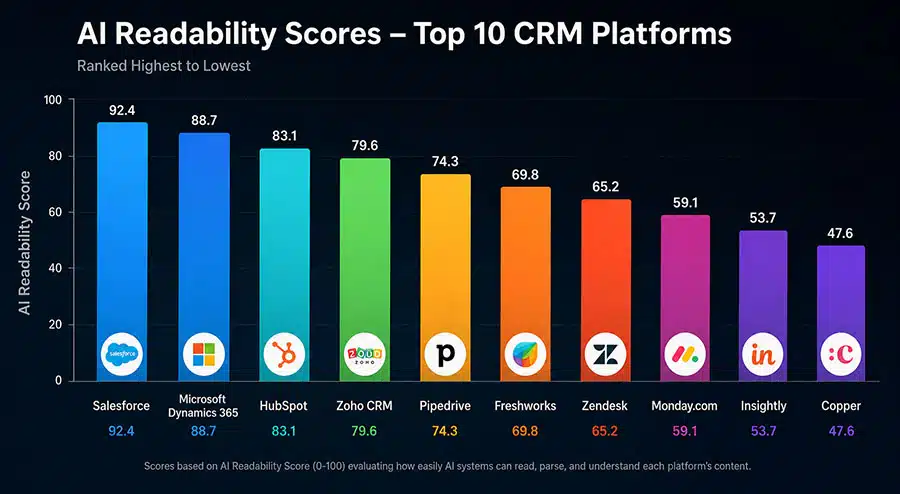
Two platforms achieved scores in the “Highly Visible to AI” band: Pipedrive (83) and HubSpot (83). Nimble followed at 80, also qualifying as highly visible.
These are not marginal leads. The next cluster – Copper (78), Salesforce (75), Freshworks (72), Monday.com (72) – sits in the moderate visibility range. Then a sharp drop: Dynamics 365 (67), Oracle (60), and SugarAI (48), which triggered a structural decay warning during scanning.
What separates the leaders is not brand size or content volume. HubSpot has 730 words on its scanned page. Pipedrive has 1,772. Monday.com has 1,494. Content volume alone does not determine readability. The leaders share something more specific: they have structured their content in ways that help AI systems answer fundamental questions about what they are and who they serve.
Finding 2: AI Extractability Is the Sharpest Performance Divider in This Dataset
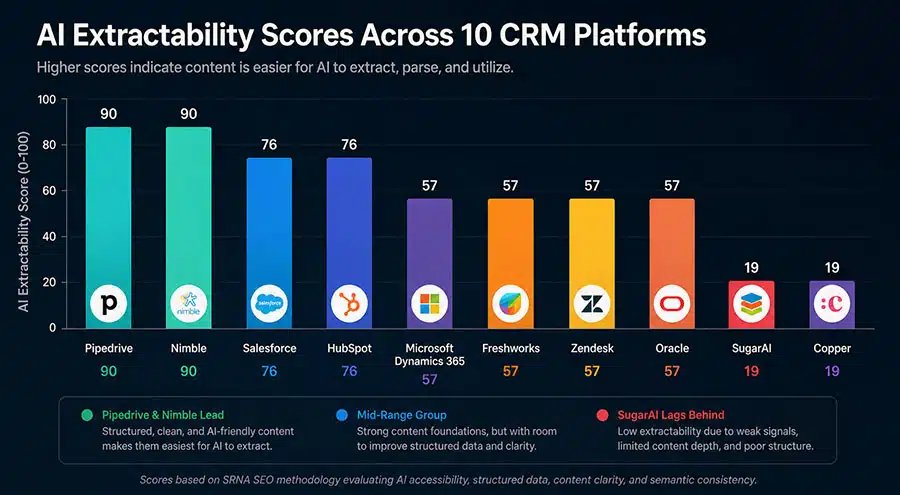
Extractability – the dimension measuring whether content can actually be parsed and reused by AI systems – is where this dataset splits most dramatically.
- Pipedrive: 90 (Highly Extractable)
- Nimble: 90 (Highly Extractable)
- HubSpot: 76 (Partially Extractable)
- Copper: 76 (Partially Extractable)
- Salesforce: 71 (Partially Extractable)
- Dynamics 365: 57, Freshworks: 57, Monday.com: 57, Oracle: 57
- SugarAI: 19 (Poorly Structured)
Pipedrive and Nimble achieving highly extractable status is meaningful. These are not the largest companies in the dataset. They are among the most interpretable, and interpretability at the extraction layer is what determines whether a platform appears in AI-synthesized answers.
SugarAI’s score of 19 reflects structural fragmentation severe enough that the AI Visibility Inspector flagged it explicitly: AI systems may struggle to clearly interpret its primary topic and relationships. For a company whose brand identity centers on AI capability, this is a positioning contradiction that the data makes visible in a specific and measurable way.
Finding 3: Entity Clarity Separates the Architecturally Sound from the Structurally Ambiguous
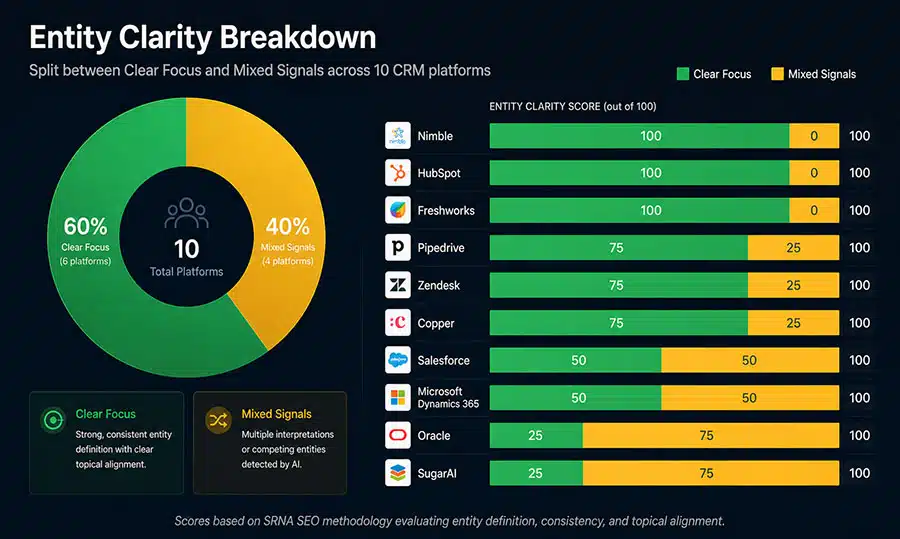
Entity clarity – how clearly an AI system can identify the organization’s primary identity and function – produces a clear divide in this dataset.
Clear Focus (100): Copper, Freshworks, Monday.com, Nimble Mixed Signals (75): Pipedrive, Salesforce, Dynamics 365 Clear Focus – but with a context problem (100): SugarAI scores 100 on entity clarity while scoring 48 overall. Its identity statement is legible, but the structure surrounding that identity is too fragmented for AI systems to use it with confidence.
Entity clarity at 100 does not guarantee strong overall visibility. It is a necessary component, not a sufficient one. Copper demonstrates this: 100 on entity clarity, 95 on structural integrity – yet only 78 overall, held back by weak AI visibility signals and the absence of FAQ schema and author attribution.
Finding 4: AI Visibility Signals Remain a Sector-Wide Weakness
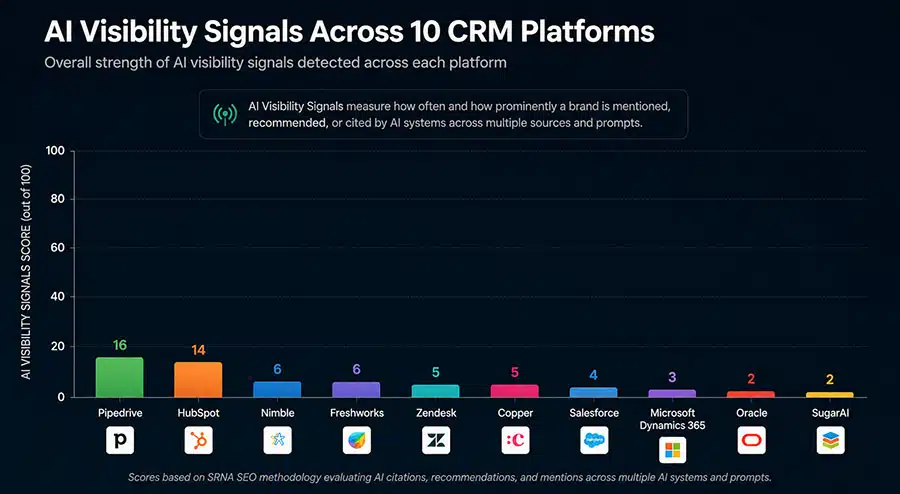
Across all ten platforms, AI visibility signals – the dimension capturing schema markup, author attribution, structured definitional statements, and consistently formatted lists – remain consistently weak.
Only Pipedrive (65) and HubSpot (65) reached moderate signal levels. Seven of the ten platforms scored 40 or below. Oracle, Dynamics 365, Freshworks, Copper, Monday.com, and SugarAI all registered at 40 – the floor of weak visibility.
This finding mirrors exactly what was documented in industrial manufacturing. Across banking, insurance, manufacturing, and now SaaS CRM, AI visibility signals remain the most consistently neglected dimension. These are not technically complex interventions. Schema markup, author attribution, and structured definitional content are implementable by any team that has been briefed on what AI systems are actually looking for.
The consistent absence of these signals across the industry suggests that most digital teams have not yet reframed their optimization targets to account for machine retrieval. They are still optimizing for human users and legacy search crawlers.
Finding 5: The SaaS Sector Outperforms Manufacturing – But Not by the Margin You Would Expect
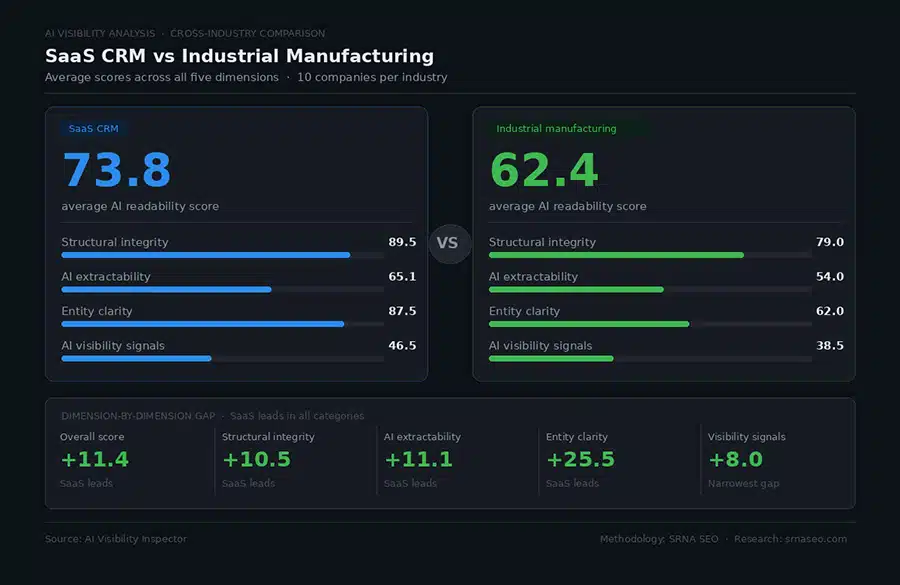
Comparing this dataset against the industrial manufacturing analysis reveals a meaningful but limited performance gap.
The SaaS CRM average AI readability score across these ten platforms is approximately 73.8. The industrial manufacturing average was in the low-to-mid 60s. SaaS performs better – but the structural weaknesses are identical. Missing author attribution, absent FAQ schema, weak visibility signals, and partially extractable content appear consistently in enterprise software as they do in heavy industry.
The difference is expectation. Industrial companies have historically operated in environments where digital presence was secondary to product capability and distributor relationships. SaaS companies exist entirely in the digital layer. Their go-to-market models depend on being found, evaluated, and chosen through digital surfaces.
That the gap is not wider suggests the SaaS sector has not yet made AI visibility a first-class optimization priority.
What AI Actually Sees When It Reads These Pages
The AI Visibility Inspector provides a “how AI sees this page” summary for each scanned site. These summaries are instructive:
- Pipedrive is described as discussing “the easy and effective CRM for closing deals” – well-structured and trustworthy to AI systems.
- HubSpot surfaces as discussing “where go-to-market teams go to grow, scale, close, retain, grow” – structured and trustworthy.
- Salesforce is read as “The #1 AI CRM” – moderate clarity but with signals missing.
- Copper appears as “be there for your clients, every step of the way” – moderate clarity, signals missing.
- Dynamics 365 reads as “the new era of AI-powered business” – moderate, signals missing.
- Oracle surfaces simply as “Oracle” – the most generic possible interpretation, signaling near-complete extractability failure.
- SugarAI appears as “CRM that actually helps” – partially visible, with structural decay warnings active.
The pattern across these summaries reflects a consistent dynamic: the platforms with clearer product-specific language in their primary page content produce more useful AI representations. Platforms that lead with abstract brand positioning statements – the kind optimized for human emotional resonance – produce interpretations that are generic, ambiguous, or incomplete.
AI systems do not process brand tone. They process structural signals. The gap between what a platform wants to communicate and what AI systems can actually extract is, in most of these cases, significant.
The results demonstrate why AI Visibility Intelligence isn’t just about tracking mentions, but about identifying the product, content, and entity inconsistencies that cause AI models to reference outdated information.
The Business Case: What This Costs and What It Gains
The implications for SaaS CRM companies are direct. These platforms are sold, evaluated, and shortlisted through digital channels. Increasingly, those channels include AI-mediated research processes that bypass traditional search entirely.
A buyer using an AI assistant to shortlist CRM vendors for a mid-market deployment is not clicking through ten blue links. They are receiving a synthesized recommendation. The platforms that appear in that recommendation are the ones AI systems can confidently interpret, extract from, and represent.
What the data shows is a meaningful opportunity gap. Strong AI visibility in a category where most competitors sit at moderate or weak levels is a structural competitive advantage – not in rankings, but in presence at the exact moment of shortlisting.
What proper content optimization delivers when applied correctly is not a marginal improvement. It is a categorical shift in how AI systems represent an organization – from ambiguous to authoritative, from partially visible to consistently cited.
Key Takeaways
Pipedrive and HubSpot lead the SaaS CRM sector on AI readability, both scoring 83 with strong structural integrity and the highest visibility signal scores in the dataset.
Nimble punches above its size, achieving 90 on both structural integrity and AI extractability – higher extractability than Salesforce, Oracle, and Dynamics 365.
SugarAI’s structural decay warning is the most significant data point in the dataset. A platform positioning on AI capability that AI systems cannot reliably interpret is not just underperforming – it is creating a measurable contradiction between brand promise and machine-readable reality.
AI visibility signals remain the universal gap across all four industries analyzed in this research series. Schema, author attribution, and structured definitional content are consistently absent even from category leaders.
SaaS CRM outperforms industrial manufacturing on average – but the structural failure modes are identical, and the strategic exposure is higher given the sector’s complete dependence on digital discovery.
Frequently Asked Questions
AI visibility in SaaS CRM refers to how easily AI systems such as ChatGPT, Perplexity, and Google AI Overviews can interpret, extract, and accurately represent a CRM platform in synthesized answers, recommendations, and comparison prompts.
Each CRM platform was evaluated using the AI Visibility Inspector and the Ivica Srncevic Framework across four dimensions: AI Readability, Structural Integrity, AI Extractability, and Entity Clarity. Scores were normalized on a 0–100 scale to measure machine interpretability and retrieval readiness.
Pipedrive and HubSpot achieved the highest AI readability scores in this study, both scoring 83. Nimble followed closely at 80, making these three platforms the most interpretable to AI systems in the dataset.
Pipedrive and Nimble scored highest for AI extractability because their content was easier for AI systems to parse, segment, and reuse in synthesized responses. Their page structures were clearer, more logically sequenced, and less dependent on abstract brand messaging than lower-performing competitors.
Most CRM platforms underperform on AI visibility signals because they lack the structural elements AI systems rely on for confident retrieval, including schema markup, author attribution, FAQ structure, and explicit definitional formatting.
Yes. This study shows that smaller CRM brands can outperform larger enterprise platforms in AI search when their content is more structured, more extractable, and easier for AI systems to interpret. In AI-mediated discovery, interpretability can outperform brand scale.
This research is part of an ongoing independent series analyzing AI visibility across global industries. Previous installments cover the legal industry, global pharmaceutical, SaaS CRM, global banking, industrial manufacturing, life and health insurance, the automobile industry, and the commercial vehicle sector. All assessments use the AI Visibility Inspector and the Ivica Srncevic Framework.
Research Date: 01.05.2026 | Methodology: Ivica Srncevic Framework + AI Visibility Inspector
NOTE: This research is independent — not sponsored by any organization or legal entity!
All company names and logos are used for identification and analysis purposes only.
