

Ivica Srncevic | June 2026 | AI Visibility Research
In This Article
An Industry That Moves the World, Invisible to the Machines Shaping Its Buyers
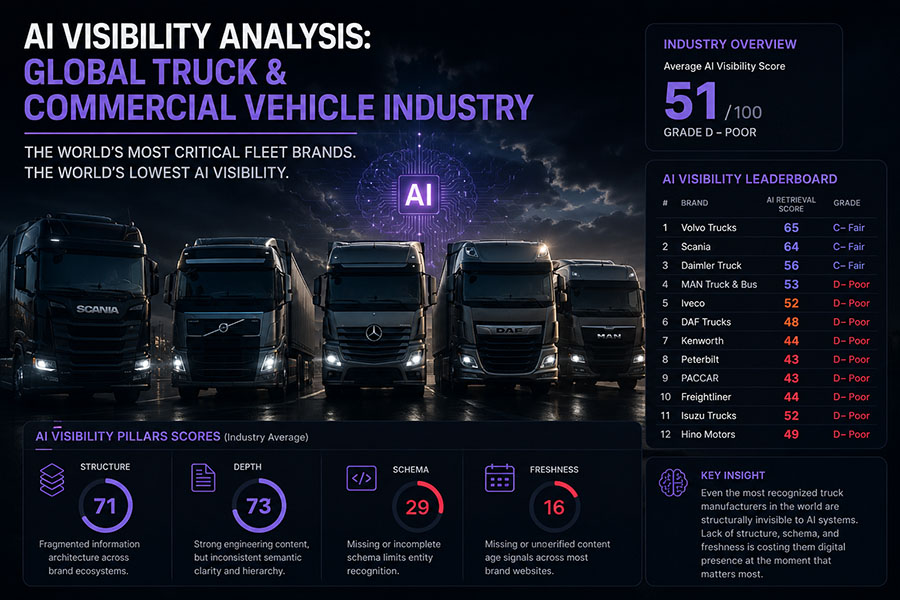
The global truck and commercial vehicle industry is the backbone of the physical economy. Scania. Volvo Trucks. Daimler Truck. PACCAR. Kenworth. Peterbilt. MAN. DAF. Iveco. Freightliner. These are not peripheral players; they are the manufacturers whose vehicles carry the world’s goods across continents, whose decisions shape logistics networks, fleet procurement budgets, and infrastructure investment across every major economy on earth.
Fleet buyers, transport operators, and logistics decision-makers are increasingly researching their multi-million-euro procurement decisions inside AI systems. And when they do, most of the industry’s biggest names are structurally invisible.
This is the sixth installment of an independent research series examining AI visibility across major industry verticals. Previous analyses covered global life and health insurance carriers, the world’s largest banks, industrial manufacturing leaders, leading SaaS CRM platforms, and the world’s largest automobile brands. The truck and commercial vehicle sector now joins that dataset, and its numbers are the worst recorded in this series.
This installment follows analyses of the legal industry, global pharmaceutical, SaaS CRM, global banking, industrial tools manufacturing, life and health insurance, automobile industry, commercial vehicle sector, hospitality and tourism, global light vehicle manufacturers, chemicals and petrochemicals, media and entertainment, e-commerce and cloud computing, global payment networks and payment platforms, and most recently non-commercial real estate services.
Methodology
Each company’s global corporate website was evaluated using the AI Visibility Inspector and the Ivica Srncevic Framework across four structural dimensions:
- Structure – how content is architecturally organized for machine parsing
- Depth – the substantive quality and retrievability of content as AI systems process it
- Schema – the presence of structured data markup that enables confident entity identification
- Freshness – whether content age signals are present and verifiable to AI retrieval systems
The overall AI Retrieval Index score runs from 0 to 100. Scores below 50 indicate significant structural invisibility. Scores between 50 and 74 represent fair to moderate visibility with material gaps. Scores at 75 and above indicate good to strong AI readiness.
The Scores
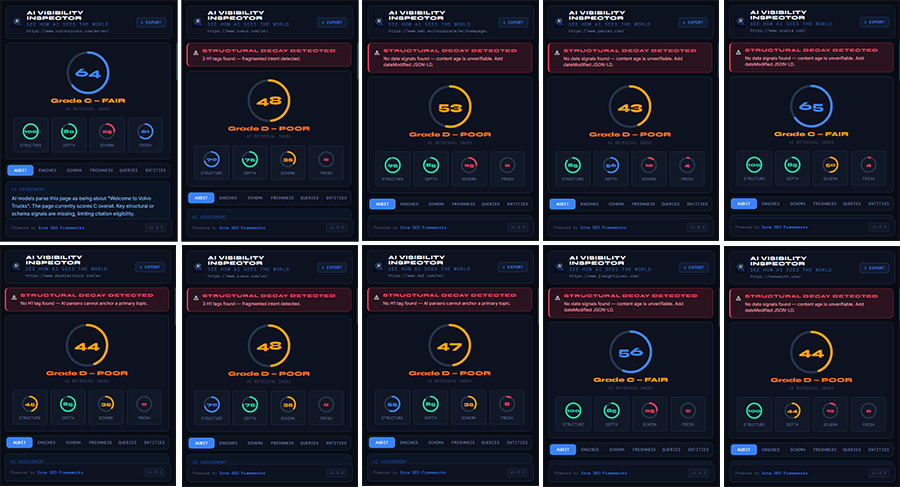
| Brand | AI Retrieval Score | Grade | Structure | Depth | Schema | Freshness |
|---|---|---|---|---|---|---|
| Scania | 65 | C – Fair | 100 | 85 | 50 | 4 |
| Volvo Trucks | 64 | C – Fair | 100 | 80 | 25 | 61 |
| Freightliner | 56 | C – Fair | 100 | 85 | 25 | 0 |
| MAN | 53 | D – Poor | 95 | 85 | 25 | 0 |
| Peterbilt | 52 | D – Poor | 100 | 85 | 15 | 0 |
| Iveco | 48 | D – Poor | 70 | 75 | 35 | 0 |
| DAF | 47 | D – Poor | 55 | 85 | 35 | 8 |
| Kenworth | 44 | D – Poor | 100 | 44 | 10 | 0 |
| Daimler Truck | 44 | D – Poor | 45 | 85 | 35 | 0 |
| PACCAR | 43 | D – Poor | 85 | 56 | 10 | 4 |
Sector average: 52.0 — Grade D, AI Retrieval Index
Zero companies in Grade A. Zero in Grade B. Three in Grade C. Seven in Grade D. This is the commercial vehicle industry’s AI visibility profile in 2026.
Five Findings the Industry Cannot Ignore
Finding 1: The Sector Average Is the Lowest in This Research Series
An average AI Retrieval Index of 52.0 is lower than the automobile industry’s 55.8 – itself the previous series low. It falls dramatically below SaaS CRM (approximately 73.8), industrial manufacturing, and the banking and insurance sectors. For an industry whose customers routinely research €100,000–€500,000+ purchasing decisions, this is a structural mismatch of the first order.
Finding 2: Structural Decay Is Universal
Every single company in this dataset triggered a Structural Decay warning. The causes vary: DAF and Daimler Truck were flagged for a missing H1 tag entirely – meaning AI parsers cannot anchor a primary topic on their most critical pages. Iveco triggered the warning for three competing H1 tags, creating fragmented intent. The remaining companies were flagged for absent date signals, making their content age unverifiable to machine retrieval systems.
In the automobile industry analysis, Volkswagen was the sole exception to this universal failure. In the commercial vehicle dataset, there are no exceptions.
Finding 3: Schema Is Catastrophically Weak – Even by the Standards of This Series
The automobile industry’s average Schema score of 36.5 was described as a universal failure mode. The commercial vehicle sector’s average Schema score is 27.0 – nearly ten points lower.
Scania leads the dataset with a Schema score of 50. PACCAR and Kenworth scored 10. Schema markup – the structured machine-readable declarations that tell AI systems what a company is, what it makes, and what facts can be confidently attributed to it – is nearly absent across the entire sector. Without it, AI systems are left to infer brand identity from unstructured page text, producing imprecise, low-confidence representations that rarely surface in synthesized research answers.
Finding 4: Freshness Failure Is Near-Total
Seven of ten companies scored zero on Freshness. Volvo Trucks is the notable exception at 61 – the highest Freshness score in the dataset and one of the primary reasons it ranks second overall despite a Schema score of only 25. Scania recorded 4. DAF recorded 8. Everyone else: zero.
Freshness signals – specifically dateModified JSON-LD – tell AI retrieval systems that a page’s content is current and verifiable. Without them, AI systems cannot confirm whether they are reading today’s product range or information from three years ago. The practical consequence is that third-party sources – trade publications, fleet review sites, logistics news outlets – consistently outrank primary brand content in AI retrieval, not because they carry more authority, but because they carry date signals that the brands themselves do not provide.
Finding 5: Depth Cannot Compensate for Structural Failure
Depth scores across the dataset are relatively strong: MAN, Freightliner, Peterbilt, and Scania all scored 85. DAF scored 85 despite an overall index of 47. This is the clearest illustration of a pattern that has recurred across every industry in this research series: substantive content quality cannot compensate for structural signal failure.
A page with excellent content and zero Schema, zero Freshness, and a missing H1 tag remains structurally invisible to machine retrieval. Depth is necessary but insufficient. AI systems require the full structural framework – Schema, Freshness, and H1 clarity – before they can extract and represent even well-written content with confidence.
What AI Actually Sees
The AI Visibility Inspector produces entity interpretation summaries that reveal, directly, what AI systems extract when they attempt to identify what a page is about. The commercial vehicle dataset produced some of the most revealing outputs in this research series.
Volvo Trucks was parsed as “Welcome to Volvo Trucks” – a greeting, not a brand description. An AI asked to recommend a heavy-duty long-haul truck manufacturer would extract no product context, no differentiation, and no structured capability signals from this representation.
DAF and Daimler Truck, both missing H1 tags entirely, returned the starkest possible output: “No H1 tag found – AI parsers cannot anchor a primary topic.” For Daimler Truck – a manufacturer with decades of engineering heritage, a global dealer network, and a portfolio spanning multiple major truck brands – this is as complete an AI identity failure as the metric can express.
Scania leads the sector, yet even its 65 reflects a Freshness score of 4 and structural gaps that limit citation confidence. The gap between the industry leader and what constitutes genuine AI readiness (75+) is significant, and no company in this dataset has bridged it.
The Commercial Vehicle Paradox
Fleet procurement decisions – for logistics operators, construction companies, municipalities, and transport networks – involve months of evaluation, multiple stakeholders, rigorous specification comparison, and total cost of ownership modelling across multi-year horizons. These buyers are precisely the high-consideration, research-intensive audience that AI-mediated discovery most directly affects.
When a fleet manager asks an AI system to compare Scania and Volvo Trucks on fuel efficiency for long-haul European routes, or to evaluate DAF’s total cost of ownership against MAN’s, the answer draws from whatever the system can retrieve with structural confidence. Brands with Schema-declared product categories, structured capability comparisons, and verifiable freshness signals have a direct advantage in that retrieval. Brands that rely on inferential parsing from unstructured page text are disadvantaged – regardless of their real-world engineering quality or market position.
The commercial vehicle industry has built its reputation for humans through reliability records, dealer relationships, trade show presence, and decades of fleet operator trust. It has not built its visibility for machines. In 2026, machines are increasingly the first audience that matters in the research journey that precedes every major procurement decision.
Key Takeaways
- Scania leads the commercial vehicle sector at 65 (Grade C), driven by the highest Schema score in the dataset at 50. It is the only company to achieve Fair-band performance.
- The sector average of 52.0 is the lowest recorded across all six industries in this research series – below automobiles, banking, insurance, manufacturing, and SaaS CRM.
- Every company triggered a Structural Decay warning – a first in this research series and the starkest indicator of sector-wide structural failure.
- Seven of ten brands scored zero on Freshness, leaving AI systems unable to verify whether their content reflects current product ranges and positioning.
- The schema averaged 27.0 across the sector – the lowest Schema average in this research series, and the primary technical gap separating these brands from confident AI representation.
- Depth scores are deceptively strong – several companies scored 85 on Depth while recording D-grade overall scores, confirming that content quality cannot substitute for structural signal implementation.
The commercial vehicle industry’s buyers are sophisticated, research-intensive, and increasingly AI-assisted. The brands that address these structural gaps earliest will hold a compounding advantage in the discovery and consideration phases that now precede every major fleet procurement decision.
Research Date: June 2026 | Methodology: Ivica Srncevic Framework + AI Visibility Inspector. This research is independent - not sponsored by any organization or legal entity. All company names and logos are used for identification and analysis purposes only.
This research is part of an ongoing independent series analyzing AI visibility across global industries. Previous analyses have covered legal industry, global pharmaceutical, SaaS CRM, global banking, industrial tools manufacturing, life and health insurance, automobile industry, commercial vehicle sector, hospitality and tourism, and the cumulative 10 industries overview. All assessments use the AI Visibility Inspector and the Ivica Srncevic Framework.
