

In This Article
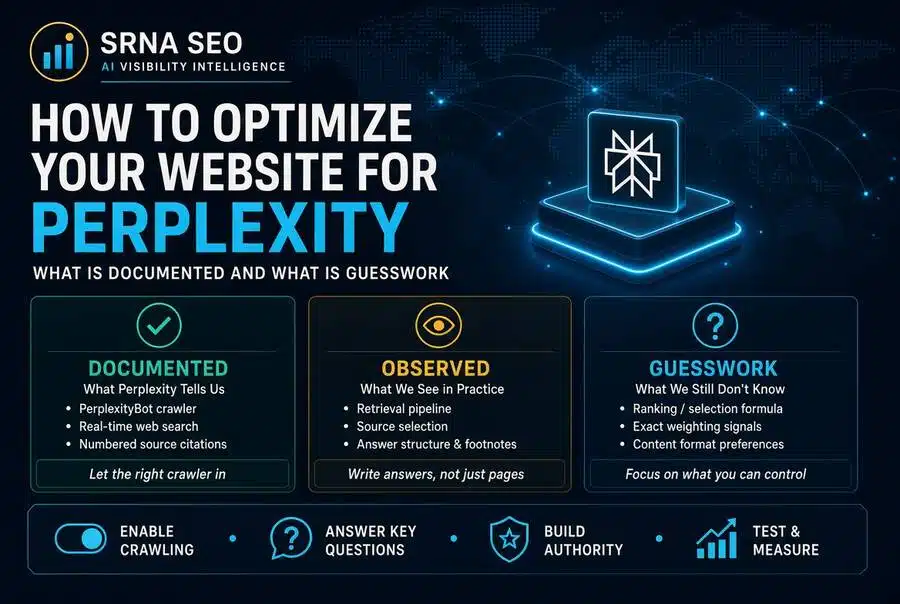
Before you rewrite anything, understand the one thing that decides how you work on this. Perplexity searches the live web for its answers, so a page you publish or fix can be retrieved without waiting for any model to be retrained, but Perplexity publishes no ranking formula, and only crawler access is actually documented. That means three things are in your hands: whether PerplexityBot can reach your pages, whether your pages give a retrieval system a clean, quotable answer, and whether other sources on the web back you up. Optimizing a website for Perplexity is work on those three, and everything beyond them is observation, not rule.
What is in This Series
This article is part of cluster How to Measure Your Presence in AI Search Engines, the series hub containing the: How to Optimize Your Website for ChatGPT, How to Measure Your Presence in ChatGPT, How to Optimize Your Website for Perplexity, How to Measure Your Presence in Perplexit, How to Optimize Your Website for Claude, How to Measure Your Presence in Claude.
Also read AI Search Visibility Share of Voice, for turning mentions into a competitive number
What Perplexity Is and How It Builds an Answer
Perplexity is an AI answer engine that searches the web in real time and writes one short answer with numbered links to the sources it used. Perplexity’s own help article describes it this way: it searches the internet in real time, condenses what it finds, and gives each answer numbered footnotes that link to the original sources.
Technically, it is a RAG system (retrieval-augmented generation: the model writes its answer from documents it has just retrieved, not from memory alone). That is the difference from a model answering out of training data, and it is the whole reason optimization for Perplexity is a retrieval problem.
Here is the pipeline as one vendor guide (LLM Pulse, which sells AI search tracking, so read it with that in mind) describes it:
- Query interpretation. The system works out what is being asked, whether it needs fresh data, and in advanced modes it may split the question into sub-queries.
- Retrieval. It searches the live web and returns many candidate pages.
- Source selection. Only a handful of the candidates are kept for the answer.
- Answer writing. A language model writes the answer with numbered inline citations, and is described as being kept to what was retrieved.
Which parts of that are documented? Perplexity documents the real-time search and the numbered citations. The query interpretation, the selection step and the “stay grounded” behavior come from the vendor’s description, not from a Perplexity specification. Treat them as a working model.
The Modes Change What Gets Retrieved
Per Perplexity’s help article, the default mode picks the model for you, Pro Search runs deeper multi-source research, and Research mode runs dozens of automatic searches and reviews hundreds of sources to produce a report in about 2 to 4 minutes. My inference, not a documented fact: more sources retrieved means a wider candidate pool, so a page that never makes a default answer might still appear in a deep research report. It also means the same question can be a different retrieval job depending on which mode your buyer uses.
Fewer Slots Than ChatGPT
Per a figure attributed to SE Ranking in a Discovered Labs guide (a secondary source, and that company sells AEO services), Perplexity averages about 5 links per response against about 10 for ChatGPT. I could not verify the original. If it holds, the shortlist is smaller, and absence costs more. How ChatGPT differs is covered in How to Optimize Your Website for ChatGPT.
Step 1: Let PerplexityBot In (This Part Is Documented)
Perplexity’s crawler documentation lists two user agents, and nothing else.
| Agent | What Perplexity says it is for | What it means for you |
|---|---|---|
| PerplexityBot | Surfaces and links websites in Perplexity’s search results. Not used to crawl content for AI foundation models | Allow it in robots.txt to be eligible for search results |
| Perplexity-User | User-initiated actions: when someone asks a question, it may visit a page and link to it | Generally ignores robots.txt rules because a user requested the fetch |
Both have published IP ranges, and the PerplexityBot guide says changes can take up to 24 hours to be reflected. An example, to adapt and not paste:
User-agent: PerplexityBot
Allow: /
Notice the difference from OpenAI. Perplexity states that PerplexityBot is not used for training foundation models, so for this bot the choice is closer to a pure visibility question than the two-bot split I described for ChatGPT. Your legal team may still want to be consulted, and I covered that angle in Everything You Need to Know About AI Intellectual Property.
Robots.txt is the polite gate, and your CDN is the real one. Perplexity’s guide describes allow rules for Cloudflare and AWS WAF that match the user agent and the published IP ranges, placed above any blocking rules. If your edge security treats unknown bots as hostile by default, a clean robots.txt changes nothing.
One more fact for enterprise teams. In August 2025, Cloudflare announced that it had delisted Perplexity’s crawler as a Verified Bot and added managed rules to block what it called stealth crawling. Cloudflare alleged that Perplexity ignored robots.txt and used undeclared IPs and a browser-style user agent. Perplexity disputed this and argued that user-driven AI assistants are not the same as crawlers. I take no side here, because the allegations were Cloudflare’s and I have not tested them. The practical point is narrower: if you are behind Cloudflare, check what your bot rules actually do to Perplexity traffic. For a structured check, start with my Indexation and Crawl Diagnostic.
Step 2: Write Pages a Retrieval System Can Quote
Nothing in this step is documented by Perplexity. It is what vendors observe, so use it as a hypothesis to test.
- Answer first. Put the direct answer at the start of each section, then the reasoning.
- Make claims quotable. One clear statement with a number or a named source is easier to lift into an answer than a vague paragraph.
- Use structure where it helps. Headings, short paragraphs, lists and tables, but only where the content is really a list or a comparison.
- State facts that change with a date. Prices, versions, rules. Then keep them current.
- Define entities once, early. Brand, product, framework. Disambiguate anything that shares a name with something else.
If this reads like good writing for a hurried reader, that is the point. A retrieval system is a hurried reader. The writing side is in How to Write a Blog Post for AI SEO and Citations, the structure side in AI Content Structure for Enterprise Visibility, and the engineering view in AI Citation Engineering.
Want to see how Perplexity currently describes your brand before you change a thing? Run the AI Visibility Inspector (my diagnostic tool for checking how AI systems see a brand). A baseline first, or you will credit your edits for noise.
Step 3: Which Signals People Claim Matter, and How Strong the Evidence Is
Perplexity does not publish its ranking weights, and the vendor guides say so themselves. Four signals come up again and again: relevance, freshness, authority and clarity of structure. No guide I read assigns them a measured weight. Here is how I would rate the claims:
| Signal | What is claimed | Evidence level | My read |
|---|---|---|---|
| Relevance to the query | Pages that answer the specific question are retrieved | Observed pattern, unquantified | Obvious, still the first thing to check |
| Freshness | Recent dates matter most for news, prices, releases and less for evergreen topics | Observed pattern, no time window given | Update what changes. Do not fake dates |
| Authority and trust | A trust filter favors established domains | Secondary statistics only, method unclear | Plausible. Slow to change |
| Structure | Lists, tables and answer-first openings help extraction | Vendor assertion. A cited list-format statistic does not show cause | Cheap, do it |
| Third-party consensus | Communities and independent publications that mention you matter. One guide cites BrightEdge for Reddit ranking sixth among cited sources | Secondary, unverified | Worth building, slowly |
| FAQ schema | One vendor cites a 3.2x citation correlation via Frase | Weak. The ChatGPT study I used in my other article went the opposite way | Treat as inconclusive |
Read that table as a to-do list ranked by how much you can verify. The signals you can prove are crawler access and a clean answer, and everything else is a bet. I would still make the bets that are cheap, which is structure and freshness, and be patient with the expensive one, which is authority. For the trust and authority side, see Authority Engineering and for the retrieval side Retrieval Layer Diagnostics.
If you want a straight read on whether your gap is access, answer quality, entity clarity or authority, that is the kind of work I do in Enterprise Search Advisory, and you can talk to me here.
This is not a ranking guide, because there is no published ranking to follow. It is not a trick list, and nobody can promise you a citation. It does not replace SEO, since Perplexity retrieves from the web and a page that cannot be found by search cannot be found by retrieval (my reading of how RAG works, not a Perplexity statement). And it is not finished when the page is published. You change something, then you check whether the answers changed, over repeated runs, which is exactly what How to Measure Your Presence in Perplexity covers.
Estimated Gain After Implementation
Not enough available data. The vendor guides I read give timelines of a few weeks, but they are self-reported, and one of them states that it has no dependable uplift figure or fixed timeline. I will not invent a number.
What I can say is directional. A blocked crawler is the only fix with a clear before and after. Freshness and structure changes are quick to make and quick to test, so you will see early signal on those. Authority is the long game, and anyone promising a percentage on it is guessing.
The Uncomfortable Part
Because Perplexity retrieves live, a citation is rented, not owned. A competitor can replace you next Tuesday with a better page, and you will not receive a notice. That is the upside and the downside of real-time retrieval in one sentence. It rewards the team that keeps shipping and checking, and it punishes the team that treats one citation as a result. So do not celebrate a single screenshot. Run it again next week.
Where to Go From Here
Start with the AI Visibility Inspector for a first read. When you need Perplexity tracked over time against named competitors, NovaX (my AI Visibility Intelligence Platform) covers it. And if you want the access, content and authority gaps scoped for your market, contact me.
FAQ
An AI answer engine that searches the web in real time and writes a single answer with numbered links to its sources, according to Perplexity’s own help article. Technically it is a retrieval-augmented generation (RAG) system.
No ranking formula is published. What is documented is the crawler setup: PerplexityBot for search results and Perplexity-User for user-initiated fetches. The rest is observed pattern.
If you want to be eligible for Perplexity’s search results, Perplexity recommends allowing it in robots.txt. It states that PerplexityBot is not used to crawl content for AI foundation models. Changes can take up to 24 hours to be reflected.
Per Perplexity’s documentation, it generally ignores robots.txt rules because a user requested the fetch. Control at the firewall level instead, using the published IP ranges.
Your CDN or firewall may still be blocking it, or your pages may not answer the question in a form that is easy to retrieve and quote. Check access first, then content, then authority.
A figure attributed to SE Ranking says about 5 links per response, against about 10 for ChatGPT. I could not verify the original, so treat it as indicative.
Vendors report both as observed patterns, with freshness mattering most for news, prices and releases. No time window or weight is published, so test on your own pages.
One vendor cites a correlation. I regard it as inconclusive, and the ChatGPT study I used elsewhere found the opposite for that engine.
No. Not enough available data exists for an honest range. Promise a baseline, a fixed set of changes and repeated measurement.
This article was researched and drafted with the assistance of AI tools and reviewed and edited by author prior to publication.
