

In This Article
A small nation does not need to build a bigger AI. It needs to build an AI that knows its country better and speaks its language.
If a citizen asks an AI assistant what documents are needed to file a tax return, the answer should come from their own tax authority, current national legislation and official government guidance. Not from a general explanation assembled from information about another country. That is the practical difference between using global AI and building national AI knowledge infrastructure.
What is Gov Realm?
Gov Realm is a proposed national-government AI knowledge and retrieval environment built around a country’s own authoritative information, institutions, languages and governance rules.
It would give government institutions a controlled way to make national knowledge accessible through specialised AI capabilities. Rather than relying entirely on the general knowledge of an external model, Gov Realm would retrieve relevant information from approved government sources and use that material to formulate answers.
The central idea is straightforward: A nation should not have to surrender control of its knowledge, language or digital identity to participate in the AI revolution.
Gov Realm is not intended to compete with the world’s largest AI models in parameter count, computing power or general-purpose capabilities. Its purpose is different. It is designed to deliver relevant, traceable and nationally grounded answers in areas where local context matters more than global scale.
Why national governments need a different approach to AI
Ask a general-purpose AI model about tax reporting, business registration, employment legislation or public benefits in a smaller country.
The model may understand the general subject. It may even produce a convincing answer. But does it have access to the latest national legislation, the correct government forms, local administrative procedures and the exact terminology used by the relevant authority? Not necessarily.
The problem is not that global models are useless. They are powerful general-purpose systems. The problem is that broad global knowledge does not automatically provide reliable national knowledge.
Smaller countries face an additional challenge. Their languages, institutions, legislation and public information may receive less representation in the training material and retrieval environments of large international AI systems.
Translation is not the same as understanding a country.
A national tax term, legal concept or administrative procedure can have a meaning that does not translate cleanly into another language or jurisdiction. A system that understands the local language but retrieves foreign information can still produce the wrong answer.
And this is where a national knowledge environment becomes relevant.
From global AI dependency to national knowledge control
The discussion around AI sovereignty has moved beyond owning computing infrastructure or hosting a model inside national borders.
A country can operate its own data centre and still depend on external models, external platforms and information sources it does not control. Physical infrastructure is only one part of the question.
I have previously written about national information sovereignty, which addresses who controls how a country’s information is represented, retrieved and corrected by AI systems.
The national digital knowledge layer is another part of that picture. It provides the structured institutional information that AI systems need to retrieve and interpret.
Gov Realm would sit on top of this foundation as an operational intelligence layer. It would turn approved national knowledge into something government employees, public institutions and, where appropriate, citizens could actually use.
The connection to digital colonisation
This is also connected to a concern frequently expressed in Global South discussions about digital colonization.
I attended and spoke at the AIFOD Geneva Summit in August 2026. Representatives from countries across the Global South discussed the concentration of AI capabilities, infrastructure and decision-making among a relatively small number of powerful companies and countries.
The direction of those discussions was clear: smaller nations want greater control over their AI development, local data, languages and technological choices. They do not want to remain passive consumers of systems designed elsewhere.
The summit’s theme, Small Takes the Lead, reflected that ambition. AIFOD’s published Geneva Summit programme and manifesto also set out demands around open weights, sovereign compute, local data governance and multilingual AI.
I do not interpret this as a demand for technological isolation. Countries will continue to need international cooperation, research, hardware and external technology, but cooperation should not mean permanent dependency.
A country should be able to participate in the global AI economy without outsourcing its national knowledge and identity.
How Gov Realm work
The architecture is built on the same principles as Edu Realm, my local AI environment designed around specialised agents, retrieval capabilities, approved knowledge and defined tools. The educational environment and the national government environment would have different responsibilities, but much of the underlying logic could remain.
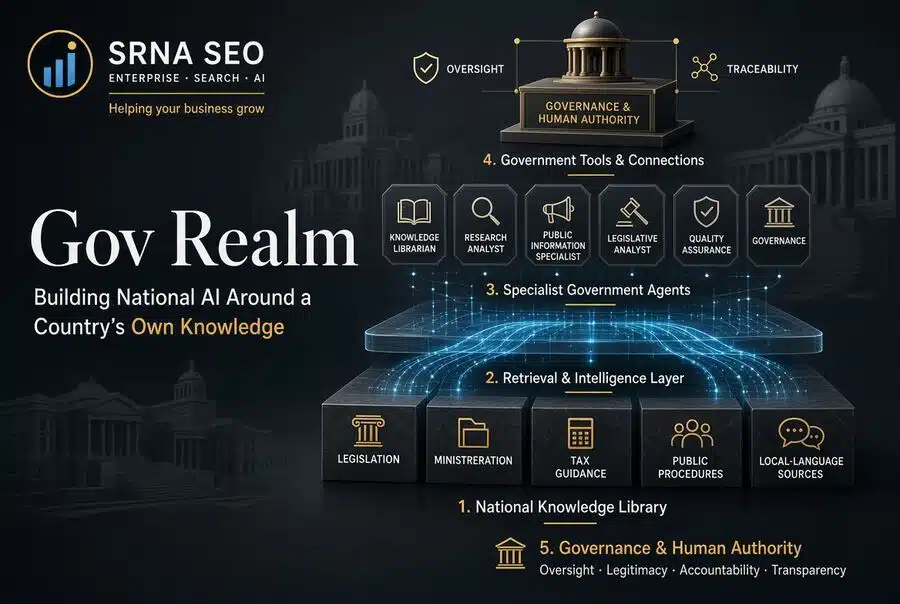
Gov Realm have five principal components.
1. A national knowledge library
The foundation is curated collection of authoritative national information. Depending on the institution and the scope of deployment, this include:
- National legislation and regulations.
- Government policies and official decisions.
- Ministry and agency documentation.
- Tax authority guidance and reporting requirements.
- Public service procedures.
- Business registration and licensing information.
- National statistics and public datasets.
- Education, healthcare and social service documentation.
- National strategies and development programmes.
- Local-language government publications.
The source of each document matters. A ministry publication, an official regulation and an old third-party article should not be treated as equally authoritative. Gov Realm need clear source classification, ownership, publication dates, document versions and maintenance responsibilities.
2. A retrieval and intelligence layer
When someone asks a question, the system would search the approved knowledge sources, retrieve relevant passages and use them as context for generating an answer.
For example: A citizen asks: “What do I need to fill in my tax report?”
Gov Realm could identify the relevant tax authority, determine which reporting category applies, retrieve the current official instructions and provide the required documents, deadlines and submission procedures. It should also link to the original sources.
If the question is missing an essential detail, such as the tax year or taxpayer category, the system ask for clarification rather than guess. This is the difference between an answer that merely sounds correct and one that can be traced back to an authoritative source.
3. Specialist government agents
Not every government task requires the same capabilities. A national environment could use specialized agents for different areas:
| Agent role | Main responsibility |
|---|---|
| Knowledge Librarian | Organise, classify and assess national knowledge sources |
| Research and Intelligence Analyst | Retrieve and compare information across approved institutions |
| Public Information Specialist | Prepare clear, accessible answers for citizens |
| Legislative and Policy Analyst | Analyse legislation, policy documents and changes |
| Quality Assurance Agent | Check source relevance, consistency and answer reliability |
| Governance Agent | Enforce permissions, institutional rules and oversight |
| Orchestrator | Coordinate tasks and route requests to the appropriate agents |
These are proposed roles, not a claim that all agents have already been developed or deployed, and the exact number and responsibilities would depend on the country’s needs, available tools and institutional structure.
4. Government tools and institutional connections
The system would also need tools adapted to government operations. These could include controlled document retrieval, legislation lookup, source verification, date and version checks, structured information extraction and authorized connections to institutional repositories. Access would need to reflect the responsibilities of each institution.
A public-facing assistant does not have the same access as an internal government research assistant. Nor should one ministry automatically gain access to another ministry’s restricted information. The architecture must make these boundaries explicit.
5. Governance and human authority
This is not an optional layer. Government information can affect taxes, legal obligations, public benefits, healthcare and citizens’ rights. An AI-generated answer must not become an unofficial replacement for legislation or an authorized government decision.
Gov Realm provide traceable sources, clear uncertainty indicators, access controls, audit records and escalation to qualified human officials when required.
AI can help government understand and retrieve its knowledge. It must not quietly become the authority that decides what the law means.
Why smaller nations could benefit particularly
A smaller nation does not need to own the largest model in the world to build useful national AI capabilities. It needs an architecture that reflects its actual institutions, language, legislation and public information.
There are several potential benefits.
Better national-language support. Local terminology, administrative language and national context can become part of the knowledge environment instead of relying entirely on the coverage of global models.
More relevant public information. Citizens could access answers grounded in their own country’s official sources, rather than having to translate generic international guidance into local procedures.
Institutional knowledge continuity. Government knowledge could remain accessible when employees change roles, departments are reorganised or administrative responsibilities move between institutions.
Less fragmented information. Approved retrieval could connect knowledge across ministries and agencies without requiring citizens or government employees to search every website separately.
Greater control over AI dependencies. Governments could choose their models, infrastructure, data boundaries and operational arrangements rather than depending on a single external provider for every capability.
A foundation for national AI development. Universities, research institutions, local technology companies and public agencies could potentially build additional services around the same national knowledge infrastructure.
The potential value is not limited to government efficiency. It also concerns how a country maintains control over its own digital representation.
One national system does not mean one enormous database
I is not automatically put every government document into a single central repository. A federated approach is more appropriate for many countries. Each institution could retain responsibility for its own information while making approved sources discoverable through a shared retrieval architecture.
This would allow different access levels:
- Public information available to everyone.
- Internal government information available to authorised employees.
- Restricted institutional information available only to approved roles.
- Sensitive information excluded from general retrieval entirely.
The national layer provide a common way to discover and retrieve approved knowledge, while institutional ownership and permissions remain in place.
The precise deployment model depend on national infrastructure, legislation, security requirements and available resources.
Gov Realm and Edu Realm: the same principle at different levels
The idea behind Gov Realm start with a government procurement project, but has grown out of building a local AI environment for educational knowledge.
Edu Realm applies specialized AI, a curated knowledge library, retrieval and defined agents to an educational environment. The underlying principle is transferable.
A university has its own research, academic material, policies and institutional knowledge. A government has legislation, public services, national strategies and institutional records. Both need a way to make that knowledge accessible without relying entirely on the general knowledge of a global model. The difference is the level of responsibility, the sensitivity of information and the governance required.
What Gov Realm is not
Gov Realm is not a replacement for ChatGPT, Claude, Gemini or other general-purpose AI systems, nor it is an attempt to build a national model that knows everything. It is not an autonomous government decision-maker, a substitute for public servants or a way to bypass institutional accountability. And it is also not a guarantee that AI hallucinations will disappear.
Retrieval can reduce dependence on unsupported general knowledge, but the result still depends on source quality, retrieval accuracy, model behavior and validation. A poorly maintained national knowledge library can produce poor answers just as easily as an unreliable external source.
The objective is to create a controlled and maintainable environment where the origin of information is known and the rules governing its use are explicit.
How a country could begin
I would not start by attempting to connect every ministry and public institution. A sensible first step would be a bounded pilot.
For example, a government could select one public service domain with a clear set of authoritative sources and recurring citizen questions.
Tax reporting, business registration or public service eligibility could provide suitable starting points, subject to the institution’s approval and the sensitivity of the information.
The pilot would establish:
- Which sources are authoritative.
- Who owns and maintains those sources.
- Which questions the system is expected to answer.
- Which retrieval and validation tools are required.
- Which users can access each information category.
- How answers are tested against official information.
- How errors, outdated documents and conflicting sources are handled.
Only after the pilot demonstrates reliable results should the architecture expand into other government domains.
There is not enough implementation data to provide a credible national cost or performance improvement estimate at this stage. Those figures depend on the country’s infrastructure, the number of institutions, the volume and quality of its information, and the scope of deployment.
But the approach allows a country to start with a defined problem rather than committing immediately to a massive national AI program.
The larger question is who controls national intelligence
I have written about the AI Sovereignty Framework, and about why the real AI danger is not the model itself. Gov Realm connects those discussions to a practical implementation idea.
A country can have modern infrastructure, access to global models and a national AI strategy. But if its institutions cannot control the knowledge that shapes AI answers, it still has an important dependency.
And that dependency is not only technical. It affects language, public information, institutional memory and the way the country is understood by its own citizens and by the outside world. The next stage of national AI sovereignty should therefore include the knowledge layer, not only compute and models.
A small nation does not need to build a bigger AI. It needs to build an AI that knows its country better and speaks its language.
That is the proposition behind Gov Realm.
Could your country build its own Gov Realm?
A national AI knowledge environment does not need to begin as a huge infrastructure program. It can start with one institution, one approved knowledge domain and a carefully controlled retrieval architecture.
If you represent a government, ministry, national digital agency or public institution and are exploring how to establish greater control over national knowledge and AI capabilities, I would welcome a conversation.
Let’s examine what a national knowledge intelligence architecture could look like for your country.
FAQ
Gov Realm is a proposed national-government AI knowledge and retrieval environment designed to provide access to authoritative national information through specialized AI capabilities.
Not necessarily. It could use a suitable local or approved model connected to a curated national knowledge library through retrieval. Model selection would depend on language capability, deployment requirements and institutional governance.
That is one of its central objectives. It would require a model with adequate language capability, national terminology, authoritative local-language sources and evaluation by native speakers and subject-matter experts.
No. Government websites and institutional repositories would remain important sources of official information. Gov Realm would make approved information easier to retrieve and understand.
Potentially, yes. A shared architecture could support multiple institutions, provided that permissions, information ownership and access boundaries are properly designed.
No. Retrieval and source validation can reduce the risk of unsupported answers, but they cannot guarantee that every answer will be correct. Human oversight and ongoing quality assurance remain necessary.
No. It means having meaningful control over national knowledge, infrastructure, governance and strategic dependencies. International technology and cooperation can remain part of that approach.
This article was researched and drafted with the assistance of AI tools and reviewed and edited by author prior to publication.
