

In This Article
A first-party case study documenting 936.7% growth in monthly website traffic, the structural development of SRNA SEO, and the shift from traditional search optimization towards a broader AI visibility and knowledge architecture strategy.
A website can rank in Google, attract visitors from multiple channels, become a source of information for AI systems, and develop commercial visibility at the same time. But none of that happens reliably by publishing articles and waiting for search engines to notice.
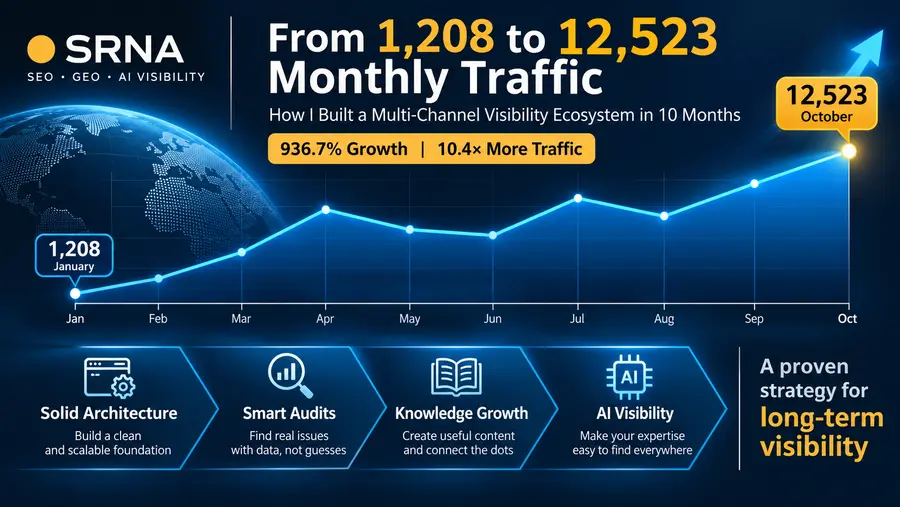
Between January and October 2026, monthly traffic to my own website, SRNA SEO, increased from 1,208 to 12,523. That is an increase of 11,315, or 936.7%, in ten months. I rebuilt the website in February, developed its new logic and architecture, expanded its knowledge base, introduced specialized audit tools, and continuously optimized the way information is structured, connected and presented.
This case study documents what I did, what the numbers show, what changed along the way, and why I believe structured optimization without shortcuts still produces measurable results, even as traditional search becomes only one part of the discovery process.
The Results: 10.4 Times More Monthly Traffic
Let’s start with the numbers. No complicated interpretation needed.
The following figures represent cumulative monthly website traffic from all channels, as reported in my analytics. They are not Google Organic sessions alone.
| Month 2026 | Monthly traffic |
|---|---|
| January | 1,208 |
| February | 1,395 |
| March | 3,331 |
| April | 8,661 |
| May | 7,629 |
| June | 7,160 |
| July | 11,982 |
| August | 9,591 |
| September | 11,544 |
| October | 12,523 |
The ten-month total is 75,024.
The comparison between January and October is particularly interesting:
| Performance indicator | Result |
|---|---|
| January baseline | 1,208 |
| October result | 12,523 |
| Absolute increase | +11,315 |
| Relative growth | +936.7% |
| Growth multiplier | 10.37× |
| October vs September | +8.5% |
| Highest monthly result | October 2026 |
The website reached more than ten times its January monthly traffic by October.
I don’t want to present this as a perfectly linear growth story. It wasn’t. May and June were below April, August was below July, and September recovered again. Real websites fluctuate. What matters is the broader direction and the new baseline being established.
July was the first month to cross 11,000. October then became the strongest month in the reporting period.
There is another important detail: the website was rebuilt on February 24, 2026. January therefore represents the pre-rebuild reference point, while February contains a mixture of pre- and post-rebuild activity. This is not a controlled before-and-after experiment with identical conditions. It is a documented development timeline.
Starting Point: Rebuilding the Website, Not Just Changing Its Appearance
I started rebuilding SRNA SEO from zero on February 24, 2026.
The objective was not to give an existing website a new visual identity. I wanted to build a completely different type of professional destination, one that could support enterprise advisory, search architecture, AI visibility research, specialized tools and my own frameworks.
The website runs on WordPress, hosted through Namecheap. I deliberately kept the technical setup relatively lean, using a very limited number of plugins and developing additional functionality where the available solutions did not meet my requirements.
I was not interested in adding another collection of plugins, dashboards and subscriptions just because someone recommended them. Instead of, I did built my own WordPress theme, light and fast, stripped from all that generic things I didn’t needed.
For the plugins, I have deliberately removed everything that was not essential, including the Yoast and all other 3rd party plugins except CookieAdmin, Imagify, LiteSpeed, SiteKit, and IndexNow, and instead built my own ones, naturally implemented and lightweight, to not overload the website and slow it down.
The architecture needed to support several different types of information:
- Expert articles explaining strategic and technical problems.
- Frameworks providing repeatable methodologies.
- Blueprints translating those methodologies into implementation.
- Research projects with independently documented findings.
- Specialized tools for website and AI visibility assessment.
- Advisory and enterprise consulting services.
These are not interchangeable content formats. They serve different purposes and different stages of the decision-making process.
An article can explain a problem. A framework can define how to approach it. A blueprint can describe how to implement it. A diagnostic tool can help identify where the problem exists in a particular organization.
I wanted those elements connected rather than published as isolated pieces.
A website should not be a warehouse of articles. It should be an organized body of knowledge with clear relationships between its components.
Phase 1: Structural Architecture and Technical Foundations
Before expanding content, I needed an architecture capable of supporting it.
One of the mistakes I repeatedly encounter in enterprise websites is that content production grows faster than the underlying information architecture. Departments publish pages, agencies add landing pages, regional teams create local variations, and eventually nobody has a complete understanding of how the website fits together.
I wanted to avoid that problem from the beginning, and focused my work on several areas.
Information architecture
I established clear content categories and relationships between strategic articles, research, frameworks, blueprints, tools and commercial pages. The objective was to make information easier to discover, both for human visitors and for automated retrieval systems.
Internal linking
Internal links were treated as structural connections, not decorative SEO elements.
A relevant article should lead readers towards the framework that explains the methodology, the tool that helps evaluate the problem, or the advisory service that can support implementation.
This creates meaningful pathways through the website, and it also helps search engines and other retrieval systems understand the relationship between related pages.
Technical integrity
I kept the technical foundation relatively simple.
The website needed to be fast, crawlable, indexable, consistently structured and maintainable without unnecessary dependencies. I paid attention to page structure, metadata, URLs, navigation, indexation and the way the site exposes its content.
There is no point building an impressive knowledge base if the underlying infrastructure makes that knowledge difficult to retrieve.
Continuous maintenance
I treated optimization as an ongoing process rather than a one-time launch activity. A website is never finished in the sense that its architecture, internal connections and content relationships can no longer be improved.
And I believe this is where many optimization projects lose momentum. The initial audit is delivered, a list of recommendations is sent, some changes are implemented, and the project is considered completed.
That is not how I approach it.
Phase 2: Building Topical Coverage and Original Knowledge
Once the foundation was established, I expanded the content.
My approach was not to chase every trending keyword or publish hundreds of variations of the same article. Instead, I focused on subjects where I could contribute something beyond another rewritten explanation of existing material.
My professional background comes from working inside organizations, including Adecco Group and Atlas Copco, as well as earlier experience with startups and SMEs. I understand the operational problems that appear when search, content, technology, international markets and governance are managed by different teams. That experience influenced the subjects I chose to develop.
The content covered several connected areas:
- Enterprise search architecture.
- AI visibility and Generative Engine Optimization.
- Knowledge architecture and retrieval.
- AI governance and organizational readiness.
- International search management.
- Technical and structural website optimization.
- AI agent exposure and assessment.
- Information sovereignty.
The objective was to build depth rather than simply increase the number of indexed URLs.
Articles, frameworks and blueprints
I developed several different content formats.
- 1. Expert articles explain specific problems and practical approaches.
- 2. Frameworks establish structured methodologies that can be applied repeatedly.
- 3. Blueprints translate strategic concepts into more concrete implementation guidance.
This distinction matters because an enterprise reader looking for a practical solution has different requirements from someone researching a new concept.
I also wanted the website to contain original intellectual work rather than depend entirely on subjects already covered by other publishers.
Original research
One particularly important development was the research initiative Building a Europe AI Can See. This research examines how AI systems can identify and interpret information published by European institutions and companies. It introduces a repeatable assessment approach, with country profiles and company-level analyses.
I also developed Building an Asia AI Can See, extending the research into another geographical region. These initiatives add something different to the website. They are not simply commentary about AI visibility. They involve collecting and evaluating information, applying a consistent methodology and publishing comparative findings. That creates additional opportunities for topical connections, citations and references.
My objective was to build something that other people could use as a source of information, not just another website competing for clicks.
Phase 3: Developing Specialized Audit Tools
Publishing information about optimization is one thing. Being able to identify problems on an actual website is another. This is why I invested time in building specialized tools.
The first important component is the AI Visibility Inspector, a diagnostic tool designed to evaluate how website content is structured and exposed for AI retrieval. It examines more than 100 signals using deep analysis. It is designed to provide diagnostic information about the page being inspected rather than operate as a conventional rank tracker.
I also developed NovaX, the AI Visibility Intelligence Platform. NovaX takes a broader approach to AI visibility intelligence, providing a self-hosted environment for analyzing website visibility and identifying structural issues. The intention is to move beyond the question of whether a page is visible and investigate why its information may or may not be understood and retrieved.
Another component is the Knowledge Exposure Audit, which addresses the information an organization makes available to AI systems and the risks associated with uncontrolled exposure.
I also introduced the AI Assessment Center, providing structured assessments around AI readiness, governance, visibility and related organizational capabilities.
These tools serve different purposes. I don’t treat them as interchangeable products. They are components of a broader diagnostic and advisory approach.
Why specialized audits matter
A generic website audit often produces a familiar list:
- Improve title tags.
- Add internal links.
- Increase content length.
- Improve page speed.
- Add structured data.
- Publish more articles.
Some of these recommendations may be valid. But they don’t necessarily identify the actual reason a website is underperforming.
An audit should establish what is wrong, where the problem exists, how significant it is, and what should be addressed first. Otherwise, optimization becomes a collection of activities without a clear connection to the underlying problem. I prefer evidence before recommendations, and recommendations before implementation.
Phase 4: Optimizing for More Than Traditional Search
This is probably the most significant strategic difference between the original website approach and what I am building now. Traditional SEO remains relevant. Google still matters, Bing still matters, and organic discovery continues to bring potential visitors. But I no longer consider organic clicks the only meaningful measure of visibility.
The way people discover information is changing.
Someone researching a software solution may start with Google, continue with ChatGPT, ask Perplexity for comparisons, consult an industry publication and eventually visit a company’s website directly.
Another person may never click a traditional search result at all, but may encounter a company through an AI-generated answer.
These are different discovery paths, and a strategy built exclusively around traditional rankings and clicks will not measure all of them.
Making information easier for AI systems to interpret
My approach has been to improve several aspects of information presentation simultaneously:
- Clear identification of the author, organization, tools and frameworks.
- Explicit definitions of important concepts.
- Consistent terminology across related pages.
- Meaningful relationships between entities and content.
- Structured information that can be interpreted without relying on ambiguous context.
- Clear explanations supported by evidence and examples.
- Consistent internal references between related resources.
This is not a replacement for technical SEO, but is an extension of the way I think about search architecture.
The engineering definition of GEO explores the distinction between traditional link-based authority and vector-space retrieval. The analysis of why good SEO content still fails in AI search examines another problem: ranking well does not automatically mean being selected as a source in an AI answer. These are connected problems, but they require different measurements.
Exposing the website’s knowledge structure
I also maintain a dedicated llms.txt file. It provides a machine-readable directory of important website resources, including articles, frameworks, research and tools.
The file is not a magic ranking mechanism, and I don’t treat it as one. Its purpose is to provide an additional, organized entry point into the website’s knowledge inventory.
The sitemap serves a different purpose, helping search engines discover published URLs, and both are part of the broader technical and information architecture. I want the website’s important resources to be discoverable and their relationships to be understandable. It cost nothing to add it and it may (and it does) bring value.
Phase 5: What the Search Visibility Data Shows
The cumulative traffic figures are only one part of the story. Google Search Console provides another useful measurement of how the website’s visibility developed during the same period. The three-month report, covering approximately August 3 to November 2, 2026, showed:
| Search Console metric | Result |
|---|---|
| Total impressions | 34,000 |
| Total clicks | 69 |
| Average CTR | 0.2% |
| Average position | 27.7 |
The daily impression graph shows an initial period of stronger visibility in August, followed by a substantial decline during September. The lowest period occurred around September 20, when daily impressions approached 180. But something changed afterwards: the visibility began recovering.
The improvement continued through October, with smaller fluctuations along the way. On November 2, the latest day in the report, daily impressions reached 521. That is almost three times the September low. I find the duration of this recovery more interesting than the individual peaks. A single good day can be statistical noise. Several weeks of a gradually improving baseline are a more useful signal.
Why I am not worried about the 0.2% CTR alone
I am not ignoring the CTR. It is low, and I would like to improve it, but looking at this number in isolation would be a mistake.
My website attracts visitors through multiple channels, and traditional organic clicks represent only one part of its overall distribution.
Google impressions are not equivalent to total website visibility. Equally, an AI citation is not equivalent to a website visit.
I measure these separately because they describe different outcomes, and I would rather understand the entire discovery process than optimize one metric at the expense of everything else.
Phase 6: What Actually Made the Difference?
I want to be careful here.
I cannot isolate the exact contribution of every article, technical change, internal link, audit tool or external reference to the total traffic increase. I did not run a controlled experiment in which one variable was changed while everything else remained constant. The website was developed continuously, with multiple improvements overlapping.
So I will not claim that the AI Visibility Inspector generated a specific percentage of traffic growth, or that publishing a particular number of articles produced a guaranteed result. That would be misleading.
What I can document is the combination of activities and the results observed during the period. I see five important principles behind the development.
1. Structural work comes before scaling content
Publishing more pages on top of a weak architecture does not necessarily create a stronger website. The relationships between pages, categories, tools, research and commercial resources need to make sense. I invested in that structure rather than treating every new article as an independent publishing task.
2. Audits should identify real problems
I prefer specialized diagnostics over generic recommendations.
A tool should help establish where a problem exists and provide enough information to decide what needs to be changed. The recommendations should follow the evidence, not the other way around.
3. Content needs a purpose beyond keyword coverage
I don’t believe that producing another article for every variation of a keyword is a sustainable knowledge strategy. Some pages explain concepts. Others document research. Some introduce frameworks, and others address commercial requirements. They should complement one another.
4. Internal linking is part of knowledge architecture
A well-structured website should make relationships explicit. If an article discusses AI visibility assessment, there should be a meaningful connection to the diagnostic tools, relevant frameworks and implementation guidance. The visitor should not have to start another search to discover the next useful resource.
5. Optimization requires continuous attention
The September decline is a good reminder that publishing more content does not guarantee that visibility will continue increasing.
I had to monitor the changes, observe which pages were gaining exposure, identify where visibility was developing and continue improving the website. There is no single final optimization task.
The difference is not how many changes you make. It is whether you understand why you are making them and whether you measure what happens afterwards.
What This Case Study Does Not Prove
I want to make a distinction between what the available data demonstrates and what it does not.
This is a first-party case study of my own website. It is not an independent third-party audit, and the traffic figures are not a guarantee of what another organization can or can’t achieve.
The data demonstrates:
- Monthly traffic increased from 1,208 in January to 12,523 in October.
- The increase represents 936.7% growth.
- October was the strongest month in the reporting period.
- Google Search Console recorded 34,000 impressions over the three-month reporting window.
- Daily search impressions recovered after the September decline.
- Three AI visibility tool comparison pages generated 1,756 impressions in the latest seven-day reporting period.
The available data does not establish:
- The exact contribution of each individual optimization.
- The percentage of traffic originating from each channel.
- A quantified increase in external AI citations.
- A direct relationship between every traffic increase and a particular technical change.
- A guaranteed outcome for another website using the same approach.
I consider this distinction important. A credible case study should not turn correlation into causation simply to make the results look more impressive. There is already enough here to demonstrate substantial growth.
What I Would Do Differently, and What Comes Next
I would not stop at 12,523 monthly visits. The next stage is to improve the measurement of how people and AI systems discover and use the information published on SRNA. There are several areas I want to develop further.
Commercial performance measurement
Traffic is useful, but it is not the final business outcome. I want to connect discovery with meaningful commercial actions, including advisory inquiries, tool adoption, partnerships and enterprise conversations. A website can attract thousands of visitors and still fail commercially if the right people cannot understand what it offers.
AI visibility measurement
I will continue developing methods to evaluate how AI systems identify, retrieve and reference the knowledge published on SRNA. This includes monitoring citations, mentions, entity recognition and the accuracy of information associated with my work. These measurements need their own methodology. They should not be inferred from Google Search Console impressions.
Continued development of the knowledge ecosystem
I will continue expanding the research, frameworks, blueprints and diagnostic tools. Not because publishing more is automatically better, but because there are still important problems in enterprise search architecture, AI visibility and governance that need practical answers. And I intend to keep working on them.
Final Thoughts: Growth Without Shortcuts
When I rebuilt SRNA SEO in February 2026, I was not trying to create another website that would generate a few thousand organic visits and depend on Google for its entire existence. I wanted to build something more substantial, a knowledge destination. A place where enterprise professionals could find research, practical methodologies, specialized tools and original thinking about search architecture and AI visibility. Ten months later, the monthly traffic has increased from 1,208 to 12,523. That is a measurable result.
But the more interesting development is the combination of growing distribution, an expanding knowledge base, original research, specialized diagnostic tools and improving search visibility.
I don’t consider traditional SEO dead. Far from it. I have spent 25 years of my life in SEO and know it’s value and strengths very well. But I do believe that measuring the success of a modern digital knowledge ecosystem exclusively through organic clicks is becoming increasingly inadequate.
Search engines remain important. AI systems are becoming another discovery and retrieval layer. Direct recognition and professional referrals matter as well. The organizations that understand how these elements connect will have more opportunities to build lasting visibility.
And one last thing. I did not achieve this by buying a shortcuts or backlinks, publishing hundreds of AI-generated pages without review, or chasing every new algorithm update. I built the architecture, developed the tools, researched the problems, published original work, connected the information and kept optimizing. It takes time. Sometimes the graph goes down before it goes up again. But if the foundation is right, the work is consistent, and the decisions are based on evidence, meaningful growth is possible.
Don’t optimize for a single traffic report. Build something worth discovering, something worth referencing, and something worth returning to.
What’s Next?
If your organization is facing a visibility plateau, struggling to understand its AI search exposure, or investing in optimization without seeing meaningful structural improvements, I would be happy to discuss the underlying problems and what can be done about them.
This article was researched and drafted with the assistance of AI tools and reviewed and edited by author prior to publication.
