

In This Article
Your board has approved the AI rollout, three workflows now depend on one provider, and nobody in the room can say how long recovery would take if that provider disappeared tomorrow.
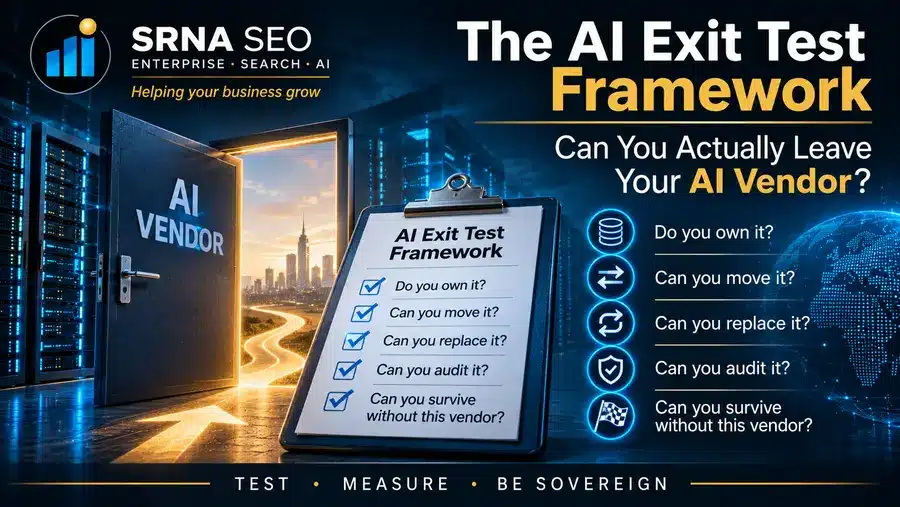
The AI Exit Test Framework asks one question and then proves the answer: if your primary AI vendor stopped operating tomorrow, how many days would it take to restore your AI capabilities? The honest answer for most organisations is “never”, and they only find out when it happens. The framework turns that guess into a score you can defend to an executive, a regulator or a board.
The one question every executive understands
Here is the test. Pick your primary AI vendor. Imagine it stops operating tomorrow. How long until your AI capabilities are back?
- 1 day
- 1 week
- 1 month
- Never
Executives get this immediately. No glossary, no architecture diagram, no need to understand a vector database first.
The risk is the answer they pick. “1 month” feels safe, and that is where it gets uncomfortable. A Zapier survey of about 500 US enterprise leaders, as summarised by Digital Applied, found that 89 percent believed they could switch vendors within a month. Only 6 percent believed they could do it without real interruption. And among those who had actually migrated, 58 percent hit failures or a bigger lift than expected.
So the headline question is useful for exactly one reason. It starts the conversation. It does not give you an answer, because a recovery time nobody has tested is an opinion, not a measurement.
What the AI Exit Test Framework is
The AI Exit Test Framework (my framework for measuring whether an organisation can leave a specific AI provider, workload by workload, with evidence instead of assumptions) has two parts.
- The headline test. The 1 day, 1 week, 1 month, Never question above. You ask it per workload, not per company.
- The five-question diagnostic. Five ownership questions that explain why your answer is what it is, and what to fix first.
It sits underneath the wider sovereignty work I have published. The AI Sovereignty Framework defines what sovereignty means. The AI Sovereignty Assessment Framework scores your overall position. This one is narrower and harder to argue with. It tests one thing, which is exit.
I built it around control, not compliance. Compliance asks whether a document exists. Control asks whether you can act. A policy that says “we can migrate within 30 days” costs nothing to write and proves nothing.
Why the exit test is the real sovereignty test
AI sovereignty (the ability to decide where your AI runs, which models it uses and what data it touches, and to change those decisions without anyone else’s permission) is easy to claim and hard to verify. Exit is where you verify it. If you cannot leave, you are not deciding anything. You are renewing.
This stopped being theoretical on 12 June 2026. Anthropic suspended access to Claude Fable 5 and Claude Mythos 5 that day to comply with US Department of Commerce export controls, and restored it on 1 July after the Department lifted them on 30 June. Roughly 19 days. I covered the strategic side in Why June 12 Changed Everything for Enterprise AI Strategy, so I will not repeat it here.
I am not telling this as a story about one vendor. It could have been any provider and any directive. The framework does not care why access ends. It cares what you can do on the morning it does.
The five questions
Every question in the assessment ultimately answers one of five. They map directly to sovereignty, and an executive can hold all five in their head.
- Do you own it?
- Can you move it?
- Can you replace it?
- Can you audit it?
- Can you survive without this vendor?
Ask each one per workload. A drafting assistant and a customer-facing agent do not carry the same exposure, and averaging them hides the problem.
1. Do you own it?
Ownership is not about who signed the contract. It is about which assets sit in your control: business data, conversation logs, prompts and system instructions, evaluation sets, knowledge indexes, fine-tuned models, agent configurations.
The test is simple. If the vendor vanished at midnight, which of those could you still open on Monday morning? Fine-tuned weights are the usual surprise. One analysis of AI lock-in costs points out that months spent tuning a model on proprietary data buy no portability when the weights sit on vendor infrastructure. Check your own terms, because I cannot tell you what yours say.
Red flag: you “own your data” by contract but have never held a copy of it.
2. Can you move it?
Owning an asset and moving it are different things. A full export in a format nothing else can read is ownership in name only.
Moving means a tested path: export, transform, load into a second environment, and confirm it works. Embeddings are the classic trap. They are tied to the embedding model, so a move means re-embedding the whole knowledge base. And prompts are text, yes, but tuned to one model’s habits, so they behave differently elsewhere.
Red flag: your export plan is a clause in a contract and nothing else.
3. Can you replace it?
This is the question most organisations fail, and it is the one that decides your headline answer.
Replacing means a second option that has already done real work. Not a router with a spare API key. An alternative that has been validated on your own evaluation set and has carried live traffic. Engineering write-ups on LLM switching costs argue that a routing layer handles only a fraction of the real cost. The rest sits in prompt behaviour, evaluation and tool calling. In my view, a fallback you have never run is a hope with a budget line.
Red flag: “we are multi-model” and nobody can name the last time the second model served production traffic.
4. Can you audit it?
If you leave a vendor, or a vendor leaves you, can you still prove what the system did? Which model version answered. What it was given. What it decided. Who approved the change.
This matters twice. During the exit, because you need a baseline to compare the replacement against. After it, because regulators and customers ask what happened. Audit also covers the vendor’s side of the exit: can you verify deletion, retention and subprocessors, or do you take their word for it?
I wrote about the agent side in How to Audit an AI Agent, and the knowledge side in the Knowledge Exposure Audit (my audit that asks which organisational knowledge AI systems can reach, and what is exposed).
Red flag: the only record of what the model did lives in the vendor’s dashboard.
5. Can you survive without this vendor?
The first four questions are about assets. This one is about the business. If the AI capability disappears for a week, does the process stop, slow down, or fall back to people?
Survival needs three things written down: a named owner who can trigger the fallback, a manual or degraded mode that people have actually practised, and a time limit the business has agreed to. Without a named owner, the plan belongs to nobody. And a plan that belongs to nobody does not run at 3 a.m.
Red flag: your continuity plan says “IT will switch it” and no individual name appears.
If you cannot name the person who flips the switch, you do not have an exit plan. You have a document.
Scoring it: from opinion to number
[AUTHOR TO ADD: one real moment from your in-house years when a vendor, platform or tool you depended on changed or disappeared. Two or three sentences. I did not invent one.]
Score each question from 0 to 3 for each workload. Evidence counts, assertions do not.
| Score | What it means |
|---|---|
| 0 | Vendor holds it, or nobody knows |
| 1 | Exists on paper, never tested |
| 2 | Tested once, partially, or in a lab |
| 3 | Tested end to end, documented, owned by a named person |
That gives each workload a total from 0 to 15. Here are the bands I propose.
| Total | Label | Meaning |
|---|---|---|
| 0 to 4 | Captive | Your honest headline answer is “Never” |
| 5 to 9 | Exposed | Recovery is possible, but nobody knows how long it takes |
| 10 to 12 | Prepared | A tested path exists with known gaps |
| 13 to 15 | Sovereign for this workload | You can leave and the business keeps running |
Two rules keep the score honest.
Rule one: any zero caps the label at Exposed. A total of 12 with a zero on “Replace” is not Prepared. Averages hide holes, and the hole is where the incident happens.
Rule two: if Survive scores 0 or 1, your headline answer is “Never”. It does not matter how good the rest looks.
These bands are mine. Calibrate them to your own risk appetite and keep them stable between assessments, otherwise you cannot compare year over year.
An illustration (not client data)
To show how the numbers behave, here is a made-up example. These are invented scores for three typical workload types, not a real organisation.
| Workload | Own | Move | Replace | Audit | Survive | Total | Label |
|---|---|---|---|---|---|---|---|
| Internal drafting assistant | 2 | 2 | 3 | 1 | 2 | 10 | Prepared |
| Customer support agent | 1 | 1 | 0 | 1 | 1 | 4 | Captive |
| Document search over internal knowledge | 2 | 1 | 1 | 2 | 1 | 7 | Exposed |
Look at the middle row. The support agent is the workload customers see, and it scores the worst. That is a common shape, because the most visible workloads tend to be built fastest and with the most vendor-specific tooling. I would not claim it holds everywhere. Not enough available data.
Turning the score into recovery targets
The headline test becomes useful when you tier workloads by how long the business survives without them, and set a recovery target per tier.
| Tier | Business tolerance | Target answer to the headline test |
|---|---|---|
| Tier 1: customer-facing or revenue-critical | Hours to a day | 1 day |
| Tier 2: operationally important | Days | 1 week |
| Tier 3: productivity and convenience | Weeks | 1 month |
Compare your score and your honest headline answer against the target. A Tier 1 workload sitting at “1 month” is a gap, and the gap is your priority list.
Where to start this week
Ready to see where your own workloads land? My free AI Assessment Center gives you a first view of your position. And if you want the exit test run on your real workloads by someone who has done this inside global enterprises, the Enterprise Search Advisory page is the direct route.
How to run the test, step by step
- List every workflow that calls an AI model. Provider, model version, data it touches, business owner. Competitor checklists start here too, and they are right to.
- Tier each one. Hours, days, or weeks of business tolerance.
- Score the five questions with evidence. Ask to see the export, the log, the second model’s results. If nobody can show it, it scores 1 at best.
- Ask the headline question per workload, then compare it to the score. When they disagree, trust the score.
- Rehearse the top tier. Force the fallback in a controlled setting and measure quality, latency and cost against the original. The first rehearsal will find something the inventory missed. That is the point of running it.
- Fix the lowest score first, not the easiest one.
- Put the result in front of the people who own the risk. Not in an IT report. In the board or risk committee pack.
I would run this at least once a year, and again after any major model change or contract renewal. Treat it like a fire drill. Nobody does it because they expect a fire.
Where this framework sits next to the others
The framework is deliberately small. It does not replace a full sovereignty programme, and it does not replace a data protection review.
- For the strategic view, use the Sovereignty Gap Framework.
- For the practical fallback pattern, read optimising SaaS AI while building a sovereign fallback.
- For the governance layer, the AI Visibility Governance Blueprint covers how decisions get owned and recorded.
- If European rules matter to you, note that from 12 January 2027 in-scope data processing services may not charge switching fees under the EU Data Act. Whether your AI service is in scope is a question for counsel.
It is not a compliance checklist. Passing it does not make you compliant with anything, and failing it does not make you non-compliant. It is not a recommendation to leave your vendor, either. Most organisations should stay with the provider they have, and the point is to be able to say so from a position of choice. It is not an argument for self-hosting everything, which most organisations cannot afford. And it is not legal advice. Contracts, retention terms and regulatory scope need your own counsel.
The honest part about results
I will not give you an estimated gain range. Not enough available data to state one without inventing it. What I can say is that the only hard figure I have is the gap above: 89 percent of surveyed leaders believed they could switch within a month, while 6 percent believed they could do it without real interruption. Whatever your first score shows, it will be closer to the truth than the answer you would have given before testing.
The most dangerous number in your AI strategy is the recovery time you assume.
Ready to run the test?
If you are a Head of Digital, a VP or a C-level executive who suspects your answer to the headline question is “Never”, contact me. I will tell you straight where I think your exposure sits. First conversation, no slide deck.
Frequently asked questions
It is a framework for measuring whether an organisation can leave a specific AI provider, workload by workload, with evidence instead of assumptions. It combines a headline question (1 day, 1 week, 1 month or Never) with a five-question diagnostic scored from 0 to 15.
If your primary AI vendor stopped operating tomorrow, how many days would it take to restore your AI capabilities? The options are 1 day, 1 week, 1 month or Never.
Do you own it? Can you move it? Can you replace it? Can you audit it? Can you survive without this vendor? Each one is scored from 0 to 3 per workload.
Each question scores 0 to 3, and the total runs from 0 to 15. The bands are Captive (0 to 4), Exposed (5 to 9), Prepared (10 to 12) and Sovereign for this workload (13 to 15). Any zero caps the label at Exposed, and a Survive score of 0 or 1 means the honest headline answer is “Never”.
A drafting assistant and a customer-facing agent carry different risk. Averaging them hides the workload where an exit would hurt most.
Most pick “1 month”. In the Zapier survey summarised by Digital Applied, 89 percent believed they could switch within a month, but only 6 percent believed they could do it without real interruption. An untested recovery time is an opinion.
Not by itself. A fallback only counts once it has been validated on your own evaluation set and has carried live traffic. Running one model across several clouds also does not help if the restriction applies to the model itself, as the June 2026 suspension showed.
At least once a year, and after any major model change or contract renewal. Rehearse the top tier by forcing the fallback in a controlled setting.
No. It is not a compliance checklist. From 12 January 2027 in-scope data processing services may not charge switching fees, but whether your AI service is in scope is a question for counsel.
This article was researched and drafted with the assistance of AI tools and reviewed and edited by author prior to publication.
