

In This Article
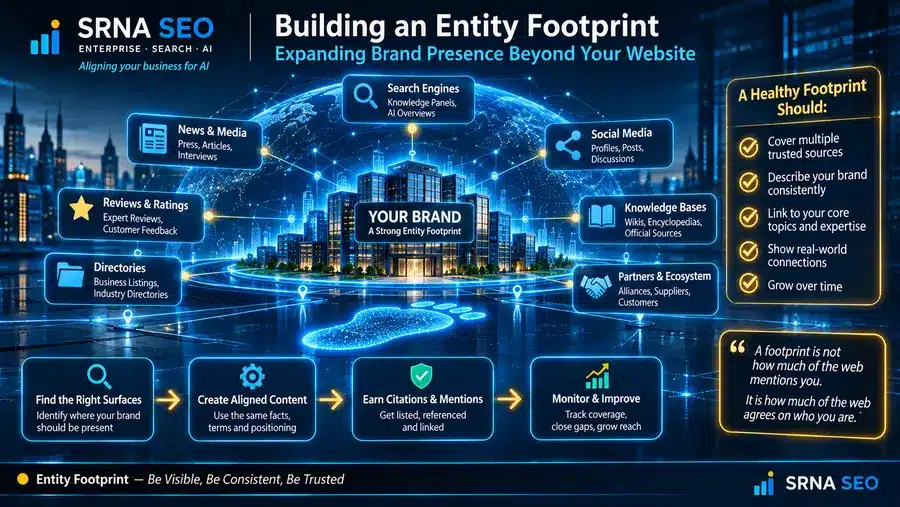
An entity footprint is the set of places beyond your own website where your brand is named, described and cited, and building one means making those places exist, agree with each other, and say what you want machines to repeat. A strong site with no footprint is a claim nobody confirms. A strong site with a footprint is a claim that checks out.
I have 25 years in SEO and 7 inside global enterprises, and the pattern is consistent: companies pour budget into owned content and leave the outside picture to chance. This article covers what a footprint is made of, where to build it first, and what not to waste money on.
What an entity footprint actually is
An entity (a clearly identifiable thing, such as a company, a person or a product, that search systems can recognize and tell apart from similar ones) leaves traces wherever it is mentioned. The sum of those traces, and how well they agree, is the footprint.
One guide on the topic defines it as the total semantic presence of a brand across the AI ecosystem. I find that too broad to act on, so I split it into three questions. Does the brand exist on surfaces you do not own? Do those surfaces describe it the same way? Do they connect it to the topics it wants to be known for?
A fair warning on sources. That guide lists the surfaces generative engines check (citations, news mentions, expert reviews, interviews, directory listings) but cites no studies and names no independent data. I use the definition and treat the claims as opinion.
A footprint is not how much of the web mentions you. It is how much of the web agrees on who you are.
Why your website alone cannot carry it
The best data I found comes from an analysis by xfunnel.ai, reported by Search Engine Journal in February 2025. It looked at 40,000 AI responses containing 250,000 citations. Earned content, meaning third-party and affiliate sites, was the largest share of citations across all platforms, and user-generated content was growing. The article gives no exact owned-versus-third-party split, and it notes ChatGPT was tested in standard mode, not with search explicitly switched on, so treat the comparison between engines loosely.
One detail changes how I would plan. According to the same report, in the final evaluation stage of a buying journey, citations came mainly from brand websites and competitors. So the footprint does the work early, when a buyer is still forming a shortlist, and your own site does the work later. If the footprint is empty, you may not reach the shortlist where your site could win.
Two more vendor figures point the same way. AirOps reports that 85% of brand mentions in early-stage discovery queries come from third-party sources. A Search Engine Land contributor cites an Ahrefs analysis of about 75,000 brands where branded web mentions, branded anchors and branded search volume correlated most strongly with AI Overview appearance. Both are correlation, and both come with commercial interests. The direction is still consistent. If you want the retrieval logic underneath, I wrote it up in Engineering Definition of GEO: Vector Space Retrieval vs PageRank.
The surfaces that make up a footprint
| Surface | What it proves | A first action |
|---|---|---|
| Professional profiles | The company and its people exist and are connected | Align company page and leader profiles to one approved description |
| Directories and registries | The company is a real, listed business | Claim and correct the listings buyers and journalists actually use |
| Third-party publications | Someone independent considers you worth quoting | Pitch expert commentary, not product news |
| Events and speaking | Named experts are active in the field | Get your name and topic onto organizers’ own pages |
| Reviews and communities | The market has experience of you | Make sure review profiles exist, are current and match your description |
Notice that the list is boring. That is deliberate. None of these surfaces is a trick, and most of them are available to any company that bothers.
How to build it, in order
1. Audit what is already out there
Search your company name in two or three AI engines and in a normal search engine. Write down what each says, which sources it uses, and where the descriptions disagree. This takes about an hour and it is usually painful. If you want a structured version, my Knowledge Exposure Audit is built for it.
2. Fix the surfaces you control
Do this before you earn anything new. An outdated directory entry or an old product description on a partner site is a footprint that works against you. I cover the mechanics in Entity Ambiguity Resolution and measure the result with the Entity Clarity Index. If systems find conflicting sources, they may repeat the wrong one, and I wrote about what that looks like in When AI Gets It Wrong, Humans Make It Dangerous.
Curious what AI systems say about your company right now, and where they got it?
My Knowledge Exposure Audit (my structured check of what AI systems can find, and misread, about your organization) maps the gaps. If you are an SEO Manager or Head of Digital who has to explain it to a CMO, talk to me.
3. Pick three surfaces, not thirty
Choose the places where your buyers actually research. For a B2B enterprise that usually means professional profiles, one or two trade publications, and events. Spreading thin across 30 surfaces gives you 30 half-finished profiles, which is a footprint with 30 places to be wrong.
4. Earn corroboration with expertise
The strongest outside confirmation comes from being useful to someone else. When I spoke at the AIFOD Summit at the UN in Geneva, I got a page on a domain I do not own that states who I am and what I work on. My memberships of AIFOD and the AI Governance Network are the same kind of confirmation. None of this was a link campaign. It was work that someone else chose to record. I make the same argument from the credibility side in How to Gain Credibility on Search Engines for Humans and AI.
5. Track it, and extend it market by market
Ask the same 20 to 30 buyer questions every month in more than one AI engine and record whether your company is named and how. My AI Mention Velocity method does this. If you sell in several countries, the footprint has to exist in each market, which I take up for one market in Building a Europe AI Can See: United Kingdom. Related reading is National Digital Knowledge Layer.
What this is NOT
This is not mass directory submission. Fifty identical listings are not corroboration, they are fifty more places to go stale.
It is not buying mentions either. Paying for volume of mentions that nobody trusts adds noise, not credibility.
It is not a tool you subscribe to. A tool can measure the footprint and show gaps, and I looked at that question in Best AI Visibility Tool for CFOs, but a dashboard does not create a single outside mention.
And it is not a guarantee of citation. Nobody controls what an AI system quotes, and anyone promising otherwise is selling a story.
A big footprint with conflicting descriptions is worse than a small footprint that agrees with itself.
A 90-day order of work
This is my suggested sequence from enterprise work. It is not a measured benchmark.
| Phase | Focus | Output |
|---|---|---|
| Days 1 to 30 | Audit and repair | Written list of every surface, what it says, and corrected owned profiles and listings |
| Days 31 to 60 | Choose and build | Three target surfaces with named owners and one approved company description |
| Days 61 to 90 | Earn and track | First outside placements pitched, baseline of 20 to 30 buyer questions recorded |
If your organization has several brands, countries or agencies, phase one takes longer. Someone has to own the approved description, and that is a governance problem before it is an SEO problem.
What gain to expect
I will not give you a percentage. Not enough available data to state one I would defend.
What I can say is that earned placements take time, and the evidence on how long is thin. One industry guide suggests roughly 4 to 8 weeks between changes and appearing in AI answers. It is a single source, so treat it as rough. Your starting point matters more. A company with clean profiles and a few real third-party mentions will move faster than one that has to repair years of stale listings first.
Want this done in order, with your own numbers?
My Enterprise Search Advisory starts with a diagnostic and ends with a plan your comms, legal and SEO teams can all sign. Book a conversation.
FAQ
It is the set of places beyond your own website where your brand is named, described and cited, and how well those places agree with each other.
An xfunnel.ai analysis reported by Search Engine Journal found earned, third-party content was the largest share of citations across platforms. Your site still matters, but it appears to do its work later in the buying journey.
Start with the ones you control: professional profiles, directories and review profiles. Make them match one approved description. Then choose three surfaces where your buyers research and earn placement there.
Not enough available data for a number. I would rather have three consistent surfaces than thirty half-maintained ones.
A Search Engine Land contributor cites an Ahrefs analysis in which branded web mentions correlated strongly with AI Overview appearance. It is correlation from one study, but it suggests mentions matter even without a link.
I would not. Paying for volume of mentions that nobody trusts adds noise, and the better route is being useful to the people who write about your field.
Not enough available data for a firm answer. One guide suggests roughly 4 to 8 weeks from change to appearing in AI answers, but it is a single source.
Track a fixed set of 20 to 30 buyer questions every month across more than one AI engine, using the same method each time, and record whether and how your company is named.
Next step
If you can only do one thing this week, search your company name in two AI engines, write down what each says, and mark every line that does not match how you describe yourself. Those lines are your first repair list. For a second pair of eyes from someone who has done this inside global enterprises, start with a Search Visibility Diagnostic or contact me directly.
This article was researched and drafted with the assistance of AI tools and reviewed and edited by author prior to publication.
