

In This Article
You search your category in Perplexity, see your site listed as source number two, and assume you are doing fine. Then you rephrase the question and you are gone.
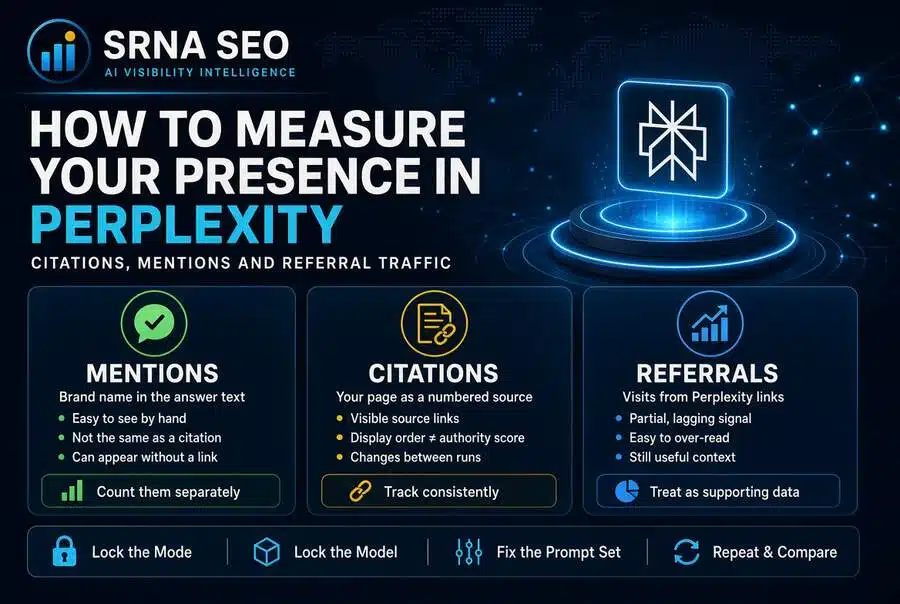
Perplexity is the easiest of the five big engines to audit by hand, because it shows numbered source links in the answer. That is exactly why it is easy to fool yourself. Perplexity can return different citations for the same question on different runs, and the citation number is a display order, not an authority score, so a single glance proves nothing. Measuring your presence in Perplexity means running a fixed prompt set repeatedly, locking the mode and model, counting mentions and citations as separate numbers, and reading referral traffic as a small, partial extra.
What is in This Series
This article is part of cluster How to Measure Your Presence in AI Search Engines, the series hub containing the: How to Optimize Your Website for ChatGPT, How to Measure Your Presence in ChatGPT, How to Optimize Your Website for Perplexity, How to Measure Your Presence in Perplexit, How to Optimize Your Website for Claude, How to Measure Your Presence in Claude.
Also read AI Search Visibility Share of Voice, for turning mentions into a competitive number
What “Presence in Perplexity” Means
Presence in Perplexity is how often your brand is named in its answers, how often your pages are cited as sources, and in what context, measured over repeated runs of a fixed prompt set, plus the visits that Perplexity links send you.
Perplexity itself (an AI answer engine that searches the web in real time and cites sources with numbered links) gives you something most engines do not: visible sources in every answer. So the raw material is easy to collect. The hard part is the discipline around it.
Definitions I use throughout:
- Mention: your brand name appears in the answer text.
- Citation: one of your pages appears as a numbered source. Stricter than a mention.
- Referral: a visit that arrived through a Perplexity link.
You can have any one without the others. A guide from LLM Pulse (a vendor that sells Perplexity tracking, so weigh it) lists the same traps: treating mentions and citations as one metric, reading the citation number as your position in the answer, and checking once and reacting to noise. I agree with all three.
I know of no first-party Perplexity report that gives site owners brand-level citation data, unlike Bing Webmaster Tools for Copilot. If one exists, tell me. So, as with ChatGPT, you have two imperfect instruments: sampling the answers, and reading your analytics. The ChatGPT version of this problem, including its routing noise, is in How to Measure Your Presence in ChatGPT.
Lock Three Things Before You Collect Anything
1. Lock the mode. Per Perplexity’s help article, the default mode picks the model for you, Pro Search runs deeper multi-source research, and Research mode runs dozens of searches and reviews hundreds of sources. Those are different retrieval jobs, so they are different measurements. Never mix them in one dataset.
2. Lock the model. Pick one variant for your tracking so week-to-week results stay comparable.
3. Lock the prompt list. The same guide suggests starting with 20 to 50 buyer-intent prompts, mixing commercial, comparison and how-to questions, and versioning the list because silent edits break the time series. That is also my advice. Keep branded prompts apart from non-branded ones, because branded prompts mostly show that your name is known.
A trend line is only as honest as the settings behind it. Change the mode, the model or the prompts mid-quarter and you are comparing two different experiments.
How to Run the Sampling
- Use a fresh session with no logged-in context or chat history, and run each prompt on the same day each week.
- Run each prompt several times per cycle. The guide I used does not give a run count. My own working range is three to five, which is my judgment, not a standard, and it is the same reasoning as the hub: answers vary, so you report a range.
- Log, for every answer: whether your brand was named, whether your domain was cited, which other brands appeared, and which sources were cited for them.
- Read the answers. Counts hide wrong facts and bad framing. A mention that gets your product wrong is a problem, not a win.
- Keep a change log of your own publishing and updates next to the trend, so that later you can ask what changed.
A little arithmetic shows why repeats matter. Take 30 prompts run three times each: that is 90 answers per cycle, so one answer moves a rate by about 1.1 points. Run each once and a single answer moves it by about 3.3 points. With one run per prompt, a few points of “growth” is one answer changing its mind.
Manual tracking works for a first look, but it becomes impractical past roughly 50 to 100 prompts a week, and I would expect it to strain sooner if you repeat each prompt. For a quick first read before building anything, the AI Visibility Inspector (my diagnostic tool for checking how AI systems see a brand) is the fastest start, and there is a guide to using it here.
The Numbers I Would Track
| Number | How to calculate it | What it answers | The trap |
|---|---|---|---|
| Mention rate | Answers naming your brand ÷ total answers, non-branded prompts | Does Perplexity know you in this category? | Branded prompts inflate it |
| Citation rate | Answers citing your domain ÷ total answers | Does Perplexity use your pages as sources? | Stricter than mentions, and unstable between runs |
| Citation source gap | Which third-party pages are cited for competitors but not for you | Where are you missing from the web, not only from the answer? | Needs reading, not just counting |
| Share of voice | Your mentions ÷ your mentions plus named competitors’ mentions | Who owns the category answer? | Moves with the competitor set you choose |
| Referral visits | Sessions from Perplexity in analytics | Does any of it send people to you? | Clicks only |
The source gap is the one I would add that most guides skip. If a competitor keeps being cited through a third-party page, rewriting your own pages will not fix it. That is a different job, and I explained the mechanism in AI Competitive Displacement. For turning mentions into a competitive number, see AI Search Visibility Share of Voice, and for the speed of change, AI Mention Velocity.
Measuring Traffic From Perplexity
Referral traffic is the smaller but cleaner half.
- The referrer. According to RightBlogger’s GA4 guide (also a vendor, and the author describes this partly from experience), Perplexity visits usually appear as
perplexity.ai / referralunder Session source / medium. - A custom channel. The same guide groups Perplexity with other AI sources in a custom channel using a source rule that matches “perplexity”, and says to put that channel above the Referral rule because GA4 checks channels in order.
- The default AI channel. The guide says GA4’s AI Assistant channel, added in May 2026, tags certain AI referrers as “ai-assistant”, and that Perplexity was not on Google’s named list at the time of writing, so its visits still landed in Referral. That can change, and then a saved filter on “referral” would miss those visits. Check Google’s current documentation before you build reports on it.
Now the limits, which are real. Privacy settings, copied links and app handoffs can strip the source, so some Perplexity visits land as Direct. Analytics records only clicks, so every answer that names you without a link is invisible there. You can tag links you control with UTMs, but not organic citations. And so referral data probably undercounts, by an amount nobody has quantified (the guide does not either).
Do not use Perplexity referral traffic as your presence metric, because it counts only the people who clicked. I explained why this part of the funnel stays dark in The AI Dark Funnel, and how to handle attribution honestly in AI Visibility Is Breaking Revenue Attribution.
One More Signal: Your Server Logs
Perplexity’s crawler documentation lists PerplexityBot (surfaces sites in search results) and Perplexity-User (visits a page when a user asks a question) and publishes IP ranges for both. My inference, not a documented use: hits from Perplexity-User in your logs may show which pages are fetched for live questions, and the IP ranges let you check that a hit is genuine and not just a user agent string. It will not tell you the prompt or whether you were cited. And since Cloudflare alleged in 2025 that Perplexity used undeclared crawlers (Perplexity disputed this, and I have not tested it), a user agent alone is not proof of anything. Treat logs as a lead to investigate.
Tools: When to Stop Doing It by Hand
Run a quick count. 40 prompts, three runs each, is 120 answers every cycle, and someone has to read them and log the sources. That is why I built tooling. For ongoing tracking with repeated runs and competitors, NovaX (my AI Visibility Intelligence Platform) covers Perplexity among the five engines in this series. I built it, so judge me accordingly, and compare it with others in Best AI Visibility Tools. If you would rather have a baseline set up and read by someone who has worked inside enterprise teams, see Enterprise Search Advisory or get in touch.
This is not a ranking check. A numbered citation is a display order, not a position on a results page. It is not a traffic report, since most presence never becomes a visit. It does not prove your content changes caused your results, only that two things happened in sequence (see Why SEO Tools Cannot Audit AI Visibility). And it is not a one-off audit. One run on one day is a screenshot.
Mistakes I Would Check For First
- One run per prompt. Perplexity’s retrieval is non-deterministic, so single runs mislead.
- Mixing modes or models. Default, Pro and Research are different measurements.
- Editing the prompt list quietly. The trend line breaks and nobody notices.
- Reading citation number as authority. It is display order.
- Merging mentions and citations. Different events, different fixes.
- Leaving out competitors. Share of voice needs a competitor set.
- Treating referral visits as presence. Clicks are a small, partial slice.
- Tracking only Perplexity. Strong here says nothing about the other four engines.
Estimated Gain After Implementation
Measurement does not raise your presence. It shows you which prompts and sources a competitor holds instead of you. Any gain comes from the fixes you make afterwards, and for those I have no honest cross-company range: Not enough available data. Expect the first reliable read after a baseline and several repeated cycles, and treat any early swing, up or down, with suspicion.
The Uncomfortable Part
Perplexity is the easiest engine to check and the easiest one to fool yourself with, because the sources are right there on the screen. Seeing your site at number two once feels like evidence. It is an anecdote with a footnote. Ask whoever reports your numbers how many runs sit behind each point on the chart. If the answer is “one”, it is noise.
Where to Go From Here
Begin with the AI Visibility Inspector for a first read. When you need Perplexity tracked over time against named competitors, NovaX does that. And if you want it scoped for your market, contact me.
FAQ
How often your brand is named, how often your pages are cited and in what context, measured over repeated runs of a fixed prompt set, plus the referral traffic Perplexity sends. I track mentions and citations separately.
Retrieval is non-deterministic, so the same query can return different citations on different runs. The citation number is also a display order, not an authority score.
The mode (default, Pro or Research), the model variant, and the prompt list. Changing any of them mid-quarter breaks comparability.
Start with 20 to 50 buyer-intent prompts, and it says manual tracking becomes impractical past roughly 50 to 100 prompts a week. Keep branded prompts in a separate list.
The guide I used does not give a run count. My working range is three to five per cycle, which is my judgment, not a standard.
Per one vendor guide, Perplexity visits usually appear as perplexity.ai / referral, and you can build a custom channel that matches “perplexity”. Some visits land as Direct, so the total is probably understated. Check Google’s current documentation, since the AI Assistant channel may change how these visits are labeled.
No. Analytics records only clicks, so an answer that names you without a link does not appear there. That is why prompt sampling is the other half of the measurement.
I know of none that shows brand-level citations. If one exists, I have not found it: Not enough available data.
No. Promise a baseline, a locked method, repeated runs and a clear cadence, and report gains with the method attached.
This article was researched and drafted with the assistance of AI tools and reviewed and edited by author prior to publication.
