

In This Article
You check your brand in ChatGPT, you are in the answer, someone screenshots it for the board, and then a colleague asks the same question in Perplexity and you are nowhere.
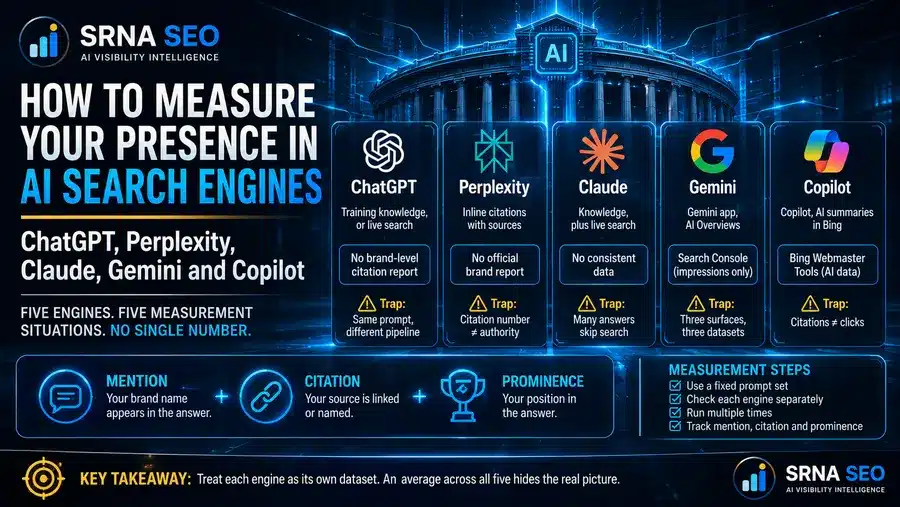
That is the core problem. There is no single place to look up your presence in AI search, because ChatGPT, Perplexity, Claude, Gemini and Copilot are five different measurement situations. Only Google (through Search Console) and Microsoft (through Bing Webmaster Tools) give you any first-party data, and neither one gives you share of voice. For everything else you measure by running a fixed set of prompts, several times, engine by engine. Measuring your presence in AI search engines means doing that properly, and not averaging five engines into one comfortable number.
What “Presence” Actually Means in an AI Engine
Presence is whether your brand appears in an AI engine’s answer, in what role, and supported by which sources, measured per engine over repeated runs.
Three things sit inside that definition:
- – Mention: your brand name appears in the answer text.
- – Citation: the engine names or links one of your pages (or a third-party page about you) as a source.
- – Prominence: where you sit in the answer, first recommendation or one name in a list of eight.
You can have one without the others. And in some engines they come from completely different mechanisms, which is the whole reason this article exists. This piece is only about measuring.
What is in This Series
This article is part of cluster How to Measure Your Presence in AI Search Engines, the series hub containing the: How to Optimize Your Website for ChatGPT, How to Measure Your Presence in ChatGPT, How to Optimize Your Website for Perplexity, How to Measure Your Presence in Perplexit, How to Optimize Your Website for Claude, How to Measure Your Presence in Claude.
Also read AI Search Visibility Share of Voice, for turning mentions into a competitive number
Five Engines, Five Measurement Situations
Here is the short version. The details follow below the table.
| Engine | How presence shows up | First-party data | Biggest measurement trap |
|---|---|---|---|
| ChatGPT | Training knowledge, or live search through several retrieval pipelines | No brand-level citation report that I know of | Same prompt, different pipeline, different citations |
| Perplexity | Numbered inline citations you can read directly | None that I know of | Reading citation number as authority |
| Claude | Training knowledge, plus selective live search | None that I know of | Many answers never trigger a search |
| Gemini (and Google AI surfaces) | Gemini app, plus AI Overviews and AI Mode in Google | Search Console, impressions only | Three separate surfaces, three separate data sources |
| Copilot | Copilot, AI summaries in Bing, select partners | Bing Webmaster Tools AI Performance | Citations are not clicks, and no explanation of why they move |
Treat each engine as its own dataset. An average across all five hides exactly the gap you need to find.
ChatGPT
ChatGPT answers either from what the model already knows or from live web search, and the free tier and the paid tier can behave differently. Averi’s audit guide notes the free tier leans on training data that may be months old, while the paid tier searches live. So a clean measurement states which tier you tested.
The bigger issue is routing. According to PinMeTo’s write-up of two researchers’ separate work (this is a secondary account, so I would read the originals before quoting numbers in a client deck), ChatGPT’s web search uses at least four backend retrieval pipelines. In one test of 1,000 prompts, repeated up to ten times, one pipeline handled about 88% of primary sources. About one prompt in nine switched its primary source between runs, and when that happened URL overlap dropped by roughly 45%.
So what does that mean for you? A brand can appear and vanish between two runs of the same prompt with no change to your content. One check is an anecdote. Run each important prompt several times and look at the spread.
Perplexity
Perplexity is the easiest engine to audit by hand, because it usually shows numbered source links inline, so you can read what it cited. But the citation number reflects display order, not a published authority score (LLM Pulse, a vendor that sells tracking, so weigh the advice accordingly). Results also vary from run to run.
Two practical traps from the same source. Do not mix Perplexity’s default and Pro model settings inside one dataset, because the trend line becomes meaningless. And do not quietly edit your prompt list mid-quarter. Both break comparability, and you will not notice until someone asks why your share jumped.
Claude
Claude is the one I would be most careful with. TripleDart’s explanation describes two sources of knowledge: what is built into the model, and live retrieval when search is enabled. Retrieval is selective, so many answers may come purely from training knowledge. That has a direct measurement consequence. Track linked citations separately from unlinked mentions, because they likely come from different places.
The same article says Claude gives no direct signal that it ran a retrieval. And it does not name a search backend. I could not find a reliable source that does either: Not enough available data. Also note that much of that article rests on the author’s own monitoring with no described method, so treat the figures with suspicion and use the mechanics only as a hypothesis to test on your own prompts.
Gemini and Google’s AI Surfaces
This is where people mix things up, so be precise. The Gemini app is one thing. AI Overviews and AI Mode in Google Search are two other things. LLM Pulse’s breakdown says Search Console’s Generative AI report covers AI Overviews and AI Mode together, reports impressions only (no clicks, no CTR, no position), and cannot tell you which of the two produced an impression. Its export is capped at 1,000 rows and date buckets use Pacific Time.
The Gemini app does not show up in that report at all. In GA4, per the same source, it falls under an “AI Assistant” channel, while the Google surfaces count as Organic Search. The source does not explain Gemini referral behavior in detail, so verify that in your own analytics before reporting it.
And please do not blend these three data sources into one figure. They differ in time zones, sampling and definitions.
Copilot
Copilot is the only engine on this list with a free first-party citation report. Bing Webmaster Tools has an AI Performance dashboard, launched in February 2026 according to Exploding Topics. It covers Copilot, AI summaries in Bing and some partner integrations. It reports total citations, average cited pages per day, grounding queries (short phrases the AI used to retrieve your content), page-level citation activity and citation share (how often you were appearing in total citations). You need a verified property.
Now the limits. Citations are not clicks. Grounding queries are generalized topic phrases, not the full prompts users typed. And the dashboard cannot explain why citations moved. Use it for trend and benchmarking, and check Microsoft’s own documentation for the current metric definitions, since I am relying on a third-party description.
The Method That Works on All Five
The shared method is short, and I covered its logic in more depth in Retrieval Layer Diagnostics. The steps:
- 1. Build a prompt library from buyer questions. Around 30 to 50 prompts is a sensible manual start (Averi suggests the same range). Mix category, use-case, comparison and problem-aware questions. Do not use only branded prompts, because that mostly confirms your name is recognized.
- 2. Run each prompt in a clean session, on every engine. Logged out or incognito where possible. Same model or tier every time.
- 3. Run each prompt at least three times. Answers vary. Three is my practical minimum, not a statistical standard.
- 4. Log the same fields everywhere: brand mentioned (yes or no), cited (yes or no), position in the answer, how accurately you are described, which competitors appear, which sources are cited.
- 5. Keep the prompt list fixed and versioned. Every edit breaks the trend line, so keep a change log.
- 6. Add first-party data where it exists. Bing Webmaster Tools for Copilot, Search Console for Google surfaces, GA4 referrals for traffic. Report them next to the prompt data, not merged into it.
For how the mention counts turn into a competitive number, I wrote about share of voice separately, and the speed side of it in AI Mention Velocity.
Where to Start Without Building Anything
Manual audits work, up to a point. Around 20 to 50 prompts is manageable by hand according to LLM Pulse, and beyond roughly 75 to 100 the same source recommends automation. Honestly, I think anyone running five engines, three runs each, will want automation much sooner than that. Do the arithmetic: 40 prompts across five engines at three runs is 600 checks per cycle.
That is the reason I built tooling for it. The AI Visibility Inspector (my diagnostic tool for checking how AI systems see a brand) is the fastest first read, and there is a guide to using it here. For ongoing tracking, NovaX (my AI Visibility Intelligence Platform) covers all five engines in this article, so the per-engine split is built in, not something you stitch together in a spreadsheet. If you want a baseline across all five, set up properly and read by someone who has done this inside enterprise teams, contact me or look at Enterprise Search Advisory.
This is not a ranking exercise. None of these engines has a stable “position one” the way a SERP did. It is not a traffic report either, since a citation is not a visit and most of this activity never shows in analytics (I explained why in The AI Dark Funnel). It is not proof that content changes caused your gains, only that two things happened in sequence. And it is not a one-off audit. A single run on a single day is a screenshot, and screenshots are what get people into trouble in board meetings.
Mistakes I Would Check For First
- – Checking once and reacting. Normal variation looks like a trend if you only look once.
- – Averaging the engines. Strong in ChatGPT tells you nothing about Perplexity.
- – Mixing tiers or model settings. Free versus paid in ChatGPT, default versus Pro in Perplexity.
- – Treating mentions and citations as one metric. Especially in Claude.
- – Reading impressions or citations as clicks. Google’s report has no clicks, and Bing’s counts citations.
- – Blending first-party data with prompt sampling. Different definitions, different clocks.
- – Ignoring tools that cannot show history. A snapshot cannot tell you momentum. See Best AI Visibility Tools for how I compare them, and Why SEO Tools Cannot Audit AI Visibility for why classic tools fall short.
Estimated Gain After Implementation
I will not give you a percentage. Not enough available data exists for an honest range across companies, and you should be suspicious of anyone who offers one.
What I can say is narrower. Measuring does not move your presence. It shows you which engine you are missing from, and which prompts, and that is where the work starts. Expect the first dependable picture after a baseline plus a few repeated cycles. Before that, most of what you see is noise. And if you later connect this to revenue, do it carefully, I explained how in AI Visibility Is Breaking Revenue Attribution.
The Uncomfortable Part
Stop asking which engine matters most. Ask which one your buyers actually use, and measure that one properly before touching the other four. Five thin audits are worse than one honest one. Everyone wants the dashboard with all five logos on it. I would rather you had one engine measured with repeated runs and a fixed prompt set than five measured once on a Tuesday afternoon.
What Comes Next in This Series
This is the hub. Each of the five engines gets its own guide, covering only what is specific to that engine: how to audit it by hand, what its first-party data (if any) shows, and where its numbers mislead. The shared method stays here, so those guides stay short.
Where to Go From Here
Start with the AI Visibility Inspector for a first read on how AI systems see you. When you need all five engines tracked over time with the per-engine split intact, that is what NovaX is for. And if you want it scoped and read for your specific market, get in touch.
FAQ
Because the engines differ in how presence appears and what data you can get. Only Google and Microsoft offer first-party reports, and the other engines need prompt sampling. An average across engines hides the gap you need to find.
Whether your brand appears in the answer, in what role, and supported by which sources, measured per engine over repeated runs. In practice that means mention, citation and prominence.
Answers vary between runs. In ChatGPT, one reported test found that about one prompt in nine switched its primary source between runs. Three runs is my practical minimum, and the spread matters as much as the average.
It usually shows numbered source links inline, so you can read the citations directly. But the citation number reflects display order, not an authority score, and mixing default and Pro settings breaks your data.
Claude’s retrieval is selective, so many answers may come from training knowledge alone. Linked citations likely come from retrieval and unlinked mentions likely come from training, so combining them hides what is actually happening.
Its Generative AI report combines AI Overviews and AI Mode, shows impressions only, and cannot separate the two surfaces. The Gemini app is not included, and no click, CTR or position data is available.
Total citations, average cited pages, grounding queries and page-level citation activity for Copilot, Bing AI summaries and select partners. Citations are not clicks, and the dashboard does not explain why citations change.
Manual works at around 20 to 50 prompts. Five engines at three runs each multiplies the workload quickly, so most teams will want automation sooner than they expect.
No. I do not have enough data for an honest cross-company range. Promise a baseline, a per-engine gap list and a regular cadence.
