

In This Article
India has given artificial intelligence a funded national mission, a governance framework and a global summit in New Delhi. The five homepages that carry that story online score 48.6/100 on average (Grade D) in an AI Visibility Inspector audit, and only one of them clears the Grade C line.
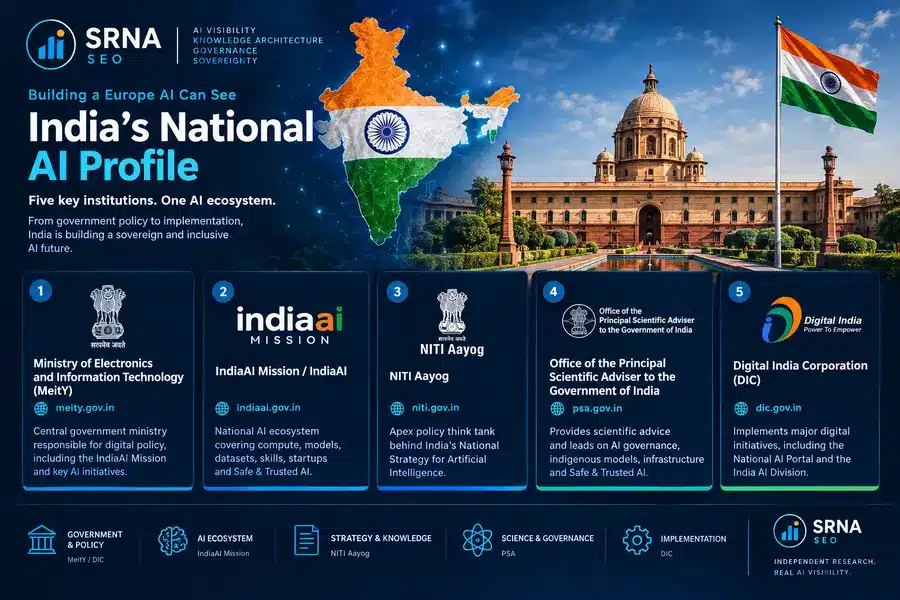
The audit covers five institutions across five government domains: Digital India Corporation (DIC), the Office of the Principal Scientific Adviser (PSA), NITI Aayog, IndiaAI and the Ministry of Electronics and Information Technology (MeitY). Together they sit at the centre of the IndiaAI Mission, the India AI Governance Guidelines, the national AI roadmaps and the science advisory machinery behind them. Their pages range from 42 to 61. One reaches Grade C. Four do not.
In This Article
- National average: 48.6, Grade D. That is exactly Estonia’s average in the previous series and 3.8 points below Japan’s 52.4. The spread between best and weakest page is 19 points, close to Japan’s 21.
- One Grade C page, four Grade D. DIC leads at 61. PSA follows at 48, then NITI Aayog (47), IndiaAI (45) and MeitY (42).
- Structure is uneven and identity is thin. Structural integrity averages 70.0 (Japan: 99.0). Entity clarity averages 47.0 and schema and metadata average 22.0.
- One page speaks machine. Only DIC carries JSON-LD, five valid blocks. The other four have none, and entity connectivity scores 0/100 on all four.
- Every page is flagged for structural decay. Four for heading problems (two H1 tags on DIC, none on IndiaAI and PSA, thirteen on NITI Aayog) and one, MeitY, for missing date signals.
- AI is missing on two of the pages that govern it. The Inspector lists artificial intelligence as a missing topic on NITI Aayog and MeitY, and detects it on DIC, IndiaAI and PSA.
Why India, and why now
India’s AI framework is built on a mission rather than a statute. The IndiaAI Mission, approved by the Union Cabinet in March 2024 with an outlay of about ₹10,372 crore, is implemented by the IndiaAI division within Digital India Corporation. By June 2026 MeitY reported more than 45,000 GPUs of shared compute, 20 indigenous foundation model proposals selected from 506 applications, and, by July, an AIKosh repository of more than 14,000 datasets and 331 models.
Governance has followed a voluntary, sector-led path. MeitY released the India AI Governance Guidelines on 5 November 2025, choosing principles and existing law over a standalone AI Act. In April 2026 it constituted the AI Governance and Economic Group under Minister Ashwini Vaishnaw, supported by a Technology and Policy Expert Committee, and an IndiaAI Safety Institute has since been set up. In February 2026 India hosted the AI Impact Summit at Bharat Mandapam in New Delhi, which closed with a New Delhi Declaration endorsed by close to 90 countries and international organisations.
The institutional map is still being redrawn. In July 2026 IT Secretary S. Krishnan said the time may have come to look at separate AI legislation, and no draft has been published. NITI Aayog’s Frontier Tech Hub has issued AI roadmaps, including one for Viksit Bharat and one for the technology services sector, and the Office of the Principal Scientific Adviser, led by Prof. Ajay Kumar Sood, chairs the Prime Minister’s Science, Technology and Innovation Advisory Council. Ministers, bodies and policy documents are changing in real time, and these are exactly the facts that AI systems are asked about when someone searches for India’s AI strategy.
The homepages matter more than their traffic suggests. They are the first pages international investors, researchers, journalists and, increasingly, retrieval engines consult to understand who does what in Indian AI policy. This profile looks at how those pages read to the machines.
This research series continues from Building an Asia AI Can See, which includes National AI Profiles of Japan and India.
You can also explore the AI Search Readiness Audit, the Knowledge Exposure Audit and the AI Visibility Inspector.
The profile in one view
The table below shows the five audited institutions (rows) and the five dimension scores that determine the overall index. Scores are from the AI Visibility Inspector (v1.9.3), audited on 8 October 2026.
| Institution (URL) | Structural integrity | Data extractability | Entity clarity | Schema and metadata | Freshness signals | Overall index |
|---|---|---|---|---|---|---|
| dic.gov.in | 65 | 75 | 65 | 50 | 51 | 61 (C) |
| psa.gov.in | 60 | 85 | 45 | 35 | 4 | 48 (D) |
| niti.gov.in | 65 | 75 | 40 | 0 | 57 | 47 (D) |
| indiaai.gov.in | 60 | 85 | 45 | 25 | 0 | 45 (D) |
| एमईआईटीवाई.सरकार.भारत (MeitY) | 100 | 49 | 40 | 0 | 4 | 42 (D) |
| Average | 70.0 | 73.8 | 47.0 | 22.0 | 23.2 | 48.6 (D) |
Shading convention (for your CMS): 75 and above strong, 50 to 74 moderate, 20 to 49 weak, below 20 absent.
The pattern differs from Japan. Where Japan’s pages were near-perfect on structure and empty on identity, India’s are uneven on both. The one page with a clean heading structure, MeitY, is the weakest overall. The one page with machine-readable identity, DIC, has a split H1. Structure is solved on one page and identity on one page, and they are not the same page.
How the five engines read the Indian pages
The Inspector reports compatibility scores for five engines: Perplexity, OpenAI/ChatGPT, Claude, Google Gemini and Microsoft Copilot. The table below shows the five institutions (rows) and the five engine scores (columns).
| Institution (URL) | Perplexity | ChatGPT | Claude | Gemini | Copilot |
|---|---|---|---|---|---|
| dic.gov.in | 60 | 69 | 68 | 56 | 66 |
| psa.gov.in | 47 | 66 | 62 | 35 | 50 |
| niti.gov.in | 43 | 62 | 60 | 31 | 44 |
| indiaai.gov.in | 43 | 66 | 62 | 30 | 38 |
| एमईआईटीवाई.सरकार.भारत (MeitY) | 32 | 62 | 69 | 26 | 44 |
| Average | 45.0 | 65.0 | 64.2 | 35.6 | 48.4 |
ChatGPT (65.0) and Claude (64.2) read India’s pages most comfortably, but Claude sits ten points below its Japan average of 74.2. The gap is consistent with headings: Claude rewards a stable document hierarchy, and four of the five pages have no H1, two H1s or thirteen. Claude leads ChatGPT on only one page, MeitY (69 against 62), which is the one page with a clean single H1. Gemini (35.6) and Perplexity (45.0) are again the hardest engines, in line with Japan’s 36.6 and 45.2.
DIC is the only page where Gemini clears 50 (56), and it is also where Perplexity peaks (60) and Copilot reaches 66. MeitY’s 26 on Gemini is the lowest single engine score across the Japan and India audits.
What the five audits reveal
1. A 19-point spread, and the implementing body leads the ministry
DIC scores 61 and MeitY scores 42. The IndiaAI Mission is implemented by a division inside DIC, the Mission’s own portal scores 45, and the ministry that issued the guidelines scores lowest. For anyone asking a retrieval system “who runs India’s AI mission?”, the answer depends on which of these homepages the engine reads first, and two of the three carry no readable date.
2. Broken anchors, one page with an identity
Only MeitY has a single H1 and a structural score of 100. DIC has two H1 tags, NITI Aayog has thirteen, and IndiaAI and PSA have none. That is why structural integrity averages 70.0 here against 99.0 in Japan. Every page is flagged for structural decay: four for heading structure, and MeitY for the absence of any date signal.
Identity is stronger than in Japan but concentrated in one place. DIC carries five valid JSON-LD blocks (WebPage, ImageObject, BreadcrumbList, WebSite and Organization), which lifts schema and metadata to an average of 22.0 against Japan’s 15.0 and gives DIC the audit’s highest entity clarity (65). The other four have no JSON-LD at all. Entity connectivity is 20/100 on DIC and 0 on the rest, and knowledge-graph anchoring is 60 on DIC and 0 elsewhere. Even DIC has no Person or Article schema, so the Inspector reads authorship and expertise as absent.
The result: a machine can follow the layout on one page and recognise the organisation on one page, but not on the same page.
3. Freshness splits two against three
NITI Aayog (57) and DIC (51) carry date signals. The other three score 4, 4 and 0. NITI Aayog’s score comes from dates in page text and meta tags rather than JSON-LD, and its homepage surfaces Cabinet Secretariat notifications from 2025 and 2026 and a Q1 FY27 trade watch. DIC’s date cuts the other way: the Inspector estimates its content at about 1.4 years old with no recorded update, the kind of age engines de-prioritise.
On IndiaAI, PSA and MeitY no machine-readable date could be found. IndiaAI is the starkest case at 0/100. Its page describes the compute pillar around a figure of 10,000+ GPUs, which matches the Mission’s original 2024 target, while MeitY reported more than 45,000 in June 2026. A page with no date gives an engine no way to know which number is current. On the PSA page, one item the Inspector picks up is a National Science Day tribute to Sir C.V. Raman. National Science Day falls on 28 February, and without a date the Inspector cannot tell whether the page has moved on since.
4. The AI story is found on three pages and missing on two
The Inspector detects artificial intelligence on DIC (73% clarity), IndiaAI and PSA (55% each), and lists it as a missing topic on NITI Aayog and MeitY. That is a better position than Japan’s, where AI was missing on three homepages, but the two gaps sit on institutions with central AI roles. MeitY runs the IndiaAI Mission, and its minister chairs the new governance group. NITI Aayog’s Frontier Tech Hub is the source of the national AI roadmaps, and the Hub is NITI Aayog’s own strongest candidate query (47%), yet the AI concept is not registered on the page.
The MeitY page is in Hindi and the gap analysis works from English-language entity names, so part of that flag may reflect language rather than content. For a retrieval system matching English-language entities, the practical effect is similar.
5. What engines think the pages are about
The Inspector generates candidate queries from what each page exposes. DIC’s 32 candidates include 12 job titles from a vacancies block, among them Content Writer, UX Designer and Senior AI/ML Engineer, the only query that names AI directly. Language-switcher names (Assamese, Bengali, Bodo, Dogri) generate candidates on both MeitY and PSA. PSA’s also include a LinkedIn handle and MeitY’s include its Hindi cookie banner. NITI Aayog’s 52 candidates include one for the word “footer” and three for Cabinet Secretariat notifications by date. “Rate this translation”, a widget label, surfaces as a candidate on four of the five pages (all but NITI Aayog).
These are heuristic estimates, not predictions of real user behaviour. They do show where the machine’s attention falls, and it falls on interface and recruitment text far more than on policy.
6. Entity stability agrees with the score at both ends
Entity graph stability runs from 63 (MeitY) to 79 (DIC), and all five are rated moderate. Unlike Japan, where the best page had the least stable graph, India’s two ends match the overall scores: DIC leads on both and MeitY trails on both. The difference is schema. DIC earns 14 of 20 on the schema component and the other four earn 0, so four pages that do not tell machines who they are rely on co-occurrence and clarity alone to stay coherent.
Institution profiles
dic.gov.in (Digital India Corporation) – Grade C – 61/100
The only page with machine-readable identity, and the only one above the line
Strengths: The highest overall score, and the highest schema and metadata (50), entity clarity (65) and entity graph stability (79) in the set. Five valid JSON-LD blocks, an Organization entity at 95% clarity and one knowledge-graph link give it the only non-zero entity connectivity (20) and knowledge-graph anchoring (60). Freshness is 51 and extractability 75. It is the best page on four of five engines, with Perplexity at 60, ChatGPT at 69, Gemini at 56 and Copilot at 66, and Claude at 68, one point behind MeitY.
What AI sees: A page about “Digital India Corporation: Driving India’s Digital Transformation”, with artificial intelligence detected as a technology concept at 73% clarity. Its strongest candidate query, about how DIC leads and guides the Digital India vision, reaches 55% eligibility, and a query built from its service list (API Setu, DigiLocker, MeriPehchaan, OpenForge, Poshan Tracker) reaches 47%. Of its 32 candidates, 12 are job titles.
What stays unseen: Two H1 tags (structural integrity 65, flagged for fragmented intent), no Article or Person schema, and 75 images without alt text (44% coverage). The Inspector estimates the content at about 1.4 years old with no recorded update. E-E-A-T density is 10/100, with no expertise, experience, authority or trust signals detected. IndiaAI, the Mission that DIC implements, does not register as an entity on the page.
psa.gov.in (Office of the Principal Scientific Adviser) – Grade D – 48/100
Top-tier extractability and the richest content in the set, with no heading anchor and no date
Strengths: Data extractability of 85, tied with IndiaAI for the highest, and semantic richness of 68, the highest in the audit. Entity graph stability is 70/100, and named entities such as Principal Scientific Adviser, Prime Minister and Innovation Advisory register at 80% clarity. Schema and metadata reach 35 without any JSON-LD. Copilot scores 50, second best in the set, and ChatGPT 66.
What AI sees: A page the Inspector labels simply “Home”, built around PM-STIAC, the Prime Minister and the Principal Scientific Adviser, with Innovation Conclave and Science Vision among its named entities. AI is detected as a technology concept at 55% clarity. The strongest candidate queries concern PM-STIAC (46%), and the 16 candidates also include language-switcher names and a LinkedIn handle.
What stays unseen: No H1 tag (structural integrity 60), no machine-readable date (freshness 4, flagged for structural decay) and no JSON-LD. Entity connectivity and knowledge-graph anchoring are 0, E-E-A-T density is 3/100 and five images lack alt text. Gemini scores 35, and the Inspector names the page “Home” rather than the Office of the Principal Scientific Adviser.
niti.gov.in (NITI Aayog) – Grade D – 47/100
The strongest freshness signal in the audit, on a page with thirteen H1 tags
Strengths: Freshness of 57, the highest in the set, and extractability of 75. Semantic richness is 60 and entity graph stability 76. Named entities such as Cabinet Secretariat Notification register at 80% clarity. ChatGPT scores 62.
What AI sees: NITI Aayog as the organisation, with 52 candidate queries, most at 42%. The Frontier Tech Hub is the strongest at 47%. Other candidates come from division names, Cabinet Secretariat notifications dated 2025 and 2026, a Q1 FY27 trade watch and the India Electric Mobility Index 2025. Entity extraction also picks up fragments such as “Reg Re” and “Constitution Of” as named entities at 72% clarity.
What stays unseen: Thirteen H1 tags (structural integrity 65, flagged for fragmented intent), no meta description, no canonical URL and no JSON-LD, so schema and metadata score 0/100. Dates are detected through text and meta tags only. Artificial intelligence is listed as a missing topic, despite the Hub’s AI roadmaps. E-E-A-T density is 4/100, entity connectivity and knowledge-graph anchoring are 0, and the engine scores are low where structure matters: Claude 60 (the lowest in the set), Perplexity 43 and Gemini 31.
indiaai.gov.in (IndiaAI) – Grade D – 45/100
The national AI portal reads as a page about AI that no engine can date or attribute
Strengths: Extractability of 85 (tied highest) and entity graph stability of 76/100. E-E-A-T density of 24 is the highest in the audit, built from 3 expertise signals, 1 experience signal and 10 trust signals even without schema. AI and Large Language Model are both detected as concepts, and primary, secondary, co-occurrence and clarity components all score full marks. ChatGPT scores 66.
What AI sees: A page about “INDIAai”, with the Impact Summit, New Delhi, an innovation centre and compute capacity building among its detected concepts. ChatGPT is detected as a product. The page produces only six candidate queries, the fewest in the audit, led by a compute-pillar sentence about 10,000+ GPUs at 49%. The highest-clarity entity is “Contribute Contact” (80%), a navigation label, ahead of the IndiaAI brand at 68%.
What stays unseen: No H1 tag (structural integrity 60), no canonical URL and no JSON-LD (schema 25, from page-level metadata). Freshness is 0/100 with no date signal, and the page is flagged for structural decay. Entity connectivity and knowledge-graph anchoring are 0. Gemini scores 30 and Copilot 38, and one image lacks alt text.
एमईआईटीवाई.सरकार.भारत (Ministry of Electronics and Information Technology) – Grade D – 42/100
A perfect heading structure on a page too thin and too silent to cite
Strengths: The only page with a single H1 and a structural integrity of 100. The primary entity signal scores 20/20 and clarity 15/15. Claude scores 69, the highest Claude score in the audit, and ChatGPT 62.
What AI sees: A page the Inspector labels “Home”. Its strongest candidate query (48%) is the ministry’s own name in Hindi. The other candidates come from Hindi navigation, a cookie banner, language names and two lead messages on semiconductors and building a complete ecosystem. A “Last Updated On” label registers as a concept, but no date could be found.
What stays unseen: At 282 words the page is below the 300-word minimum, and extractability is 49, the lowest in the set. There is no meta description, no canonical URL and no JSON-LD, so schema and metadata score 0/100. Freshness is 4/100 and the page is flagged for structural decay. Entity connectivity, knowledge-graph anchoring and E-E-A-T density are all 0, and semantic richness is 45, the lowest. AI is listed as a missing topic, with the language caveat noted above. Perplexity scores 32 and Gemini 26. MeitY runs the IndiaAI Mission, issued the AI Governance Guidelines and has its minister chair the AI Governance and Economic Group, and the homepage registers none of that.
What this means
India’s AI policy is clearly articulated on paper, though the shape differs from Japan’s. There is no statute. There is a funded mission, voluntary guidelines, a new governance group, a safety institute and an open question about future legislation. The audits show the front pages of the responsible institutions reading as a mixed set: one reasonably complete page, one ministry page with a flawless heading structure and almost nothing else, and three pages that lack a usable heading anchor, a date or both.
That is a different problem from Japan’s, and the lever is different. DIC shows what progress looks like. It is the only page with JSON-LD, and the Inspector’s remaining actions for it are specific: one H1, Article and Person schema, alt text and a refreshed dateModified. The spread between DIC and MeitY is the measure of what is still uneven, and DIC’s 61 is still below the 65 of Japan’s best page.
The timing is notable. The AI Governance and Economic Group is only months old, the Safety Institute is new, officials have opened the question of a dedicated AI law, and the Mission’s compute and model figures keep rising. The facts engines will be asked about are being rewritten right now. Which version of those facts reaches the answer depends on what the machines can see and date.
Scope and method
Each page was audited once on 8 October 2026 with the AI Visibility Inspector (v1.9.3) and the Srna SEO Framework. This is a snapshot of five page audits across five domains, not a full-site audit. The pages are the homepages of dic.gov.in, indiaai.gov.in, niti.gov.in, psa.gov.in and MeitY’s Hindi-language domain, www.एमईआईटीवाई.सरकार.भारत (punycode: www.xn--m1bdba5a7gresc7dsa.xn--11b7cb3a6a.xn--h2brj9c). They were chosen because they belong to institutions directly involved in India’s AI policy and implementation. The MeitY page is in Hindi, unlike the others, and the Inspector’s topic and gap analysis works from English-language entity names, so its results on those items should be read with that in mind.
Entity clarity scores of 40 to 65 are partly a feature of the scoring model. Only DIC reports JSON-LD. This profile treats schema as absent on the other four and reads their schema credit as coming from page-level metadata and entity tokenisation. Query categories and engine citation percentages are the tool’s estimates and are heuristic. Facts about India’s AI framework come from public sources checked on 8 October 2026, and where sources differ on small details, such as the number of Declaration signatories, this profile uses rounded figures. The Inspector measures what a page exposes, not what an institution does.
The national average of 48.6 is the arithmetic mean of the five overall index scores: 61, 48, 47, 45 and 42.
These sit between “6. Entity stability agrees with the score at both ends” and “How does your institution read to AI?” in the article.
How does your institution read to AI?
The scores above describe what a page exposes. They do not explain why a given page lands where it does, how its signals interact, or what the right order of work would be. That analysis sits behind the numbers, and it is specific to each institution.
If you work for a Japanese ministry, agency, enterprise or any organization whose public pages are meant to be understood, cited and trusted by AI systems, I would be glad to talk. I can clarify any of the findings in this profile, walk you through how your own pages are read, and run an audit tailored to your institution.
Calculate your potential exposure below
Inputs
Enter your own data where possible. Hover over labels or open “Methodology” for details on how each field is used.
From GA4, GSC, or your SEO platform. Use a 30–90 day average.
Session → lead / signup / purchase. Use decimal (e.g. 1.2 for 1.2%).
For B2B, use average deal value or LTV. Currency is symbolic here.
Used to show profit‑based cost of inaction. Leave at 100 to ignore.
Share of organic traffic from queries/pages likely to be influenced by AI answers and retrieval systems.
Based on observed traffic loss patterns in AI search and structural decay cases.
Expected organic growth if you do nothing special about AI visibility.
Plausible uplift over the chosen horizon based on case studies.
How these numbers are calculated (methodology)
Let:
- O₀ = monthly organic sessions
- CVRₒ = organic conversion rate (as a decimal)
- ARPC = average revenue per conversion
- GM = gross margin (as a decimal)
- E = AI exposure share (as a decimal)
- D = displacement rate (as a decimal)
- T = time horizon in months
Baseline monthly revenue:
- Revenue: \(R_0 = O_0 imes CVR_o imes ARPC\)
- Profit: \(R_{0,profit} = R_0 imes GM\)
Monthly revenue at risk (for a given D):
- \(R_{risk} = R_0 imes E imes D\)
- Profit version: \(R_{risk,profit} = R_{risk} imes GM\)
The tool computes R_risk for three scenarios:
- Conservative: D = 0.15
- Base: D = 0.30 (or your selected scenario)
- Aggressive: D = 0.50
Cost of Inaction over T months is approximated as:
- \(CoI(T) = R_{risk} imes T\)
- Shown as a range from conservative to aggressive.
The growth inputs (g₀, g₁) are currently used for narrative context and can be incorporated into a more advanced version that models opportunity cost explicitly.
