

In This Article
South Korea has given artificial intelligence a binding statute, a presidential strategy committee, a record budget request and a national race to build sovereign models. The five pages that carry that story online score 42.4/100 on average (Grade D) in an AI Visibility Inspector audit, and none of them reaches the Grade C line.
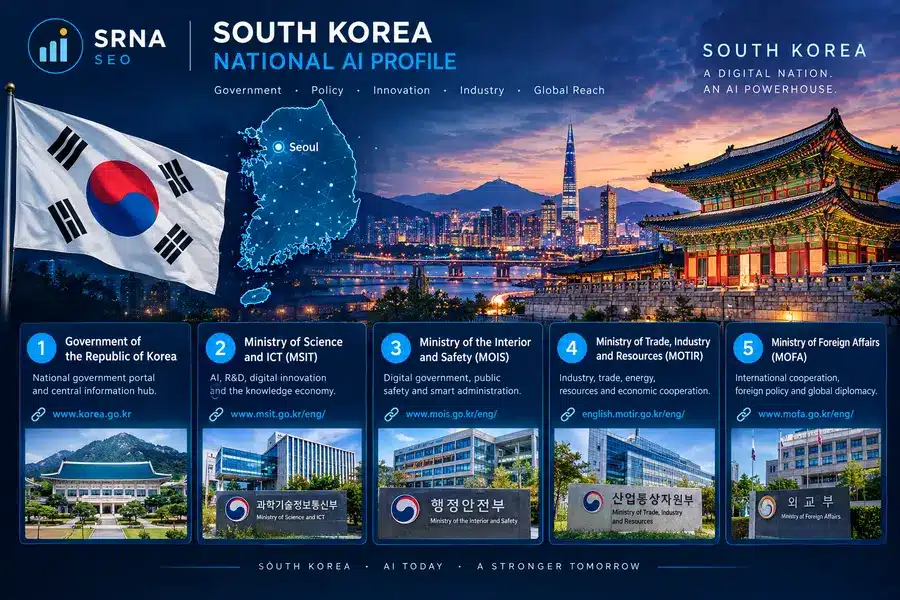
The audit covers five institutions across five government domains: the Ministry of Science and ICT (MSIT), the Ministry of the Interior and Safety (MOIS), the Ministry of Foreign Affairs (MOFA), the Ministry of Trade, Industry and Resources (MOTIR) and the Public Service Integrated Management System at ns.service.go.kr. Together they cover the AI Basic Act and the sovereign model programme, digital government, AI diplomacy, industrial AI transformation and the public-service registry. Their pages range from 37 to 50. All five are Grade D.
In This Article
- National average: 42.4, Grade D. That is 6.2 points below India’s 48.6 and 10.0 points below Japan’s 52.4. The spread between best and weakest page is 13 points, the narrowest in the Asia series so far.
- No Grade C page. MOTIR leads at 50, then MOFA (44), MOIS (41), MSIT (40) and ns.service.go.kr (37). Japan and India each had at least one page above 60.
- Structure is the one solid layer. Structural integrity averages 77.0 (India: 70.0, Japan: 99.0), with MOTIR at 100 and MOFA at 90. Entity clarity averages 42.0.
- Nobody speaks machine. None of the five pages carries JSON-LD. Entity connectivity and knowledge-graph anchoring are 0/100 on all five, and schema and metadata average 7.0 (India: 22.0, Japan: 15.0).
- Time is invisible. Freshness averages 0.8/100. Four pages score 0 and MOTIR scores 4. Every page is flagged for structural decay: two for split H1 tags (three on MSIT, eight on MOIS) and three for missing date signals.
- Gemini is the hardest engine yet. Its average is 25.0, against 35.6 for India and 36.6 for Japan. Four of the five Korean pages score below 26, the lowest single Gemini score in the earlier Japan and India audits.
- AI is found on three pages and missing on two. The Inspector detects artificial intelligence on MSIT, MOIS and MOTIR, and lists it as a missing topic on MOFA and ns.service.go.kr.
Why South Korea, and why now
South Korea’s AI framework is the most legally formal in the Asia series. The Framework Act on the Development of Artificial Intelligence and Establishment of Trust, known as the AI Basic Act, took effect on 22 January 2026. It covers high-impact AI, safety duties for high-performance models and transparency duties for generative AI, and Seoul presents it as the first comprehensive AI law to take effect in full, since the EU AI Act is being applied in phases through 2027. Administrative fines are capped at KRW 30 million, and MSIT has said they will not be imposed during a grace period of at least a year, with a possible extension still under review. The Enforcement Decree puts the threshold for high-performance AI at cumulative training compute of 10²⁶ FLOPs.
The institutional layer is new and still moving. President Lee Jae-myung launched the National AI Strategy Committee on 8 September 2025. Bae Kyung-hoon serves as Deputy Prime Minister and Minister of Science and ICT, and marked his first year in office in July 2026. In October 2025 Nvidia announced up to 260,000 Blackwell GPUs for Korea at the APEC summit in Gyeongju, split between the government, Samsung, SK, Hyundai and Naver Cloud, which would lift national capacity from roughly 65,000 to more than 300,000 units.
The model race has changed shape in recent weeks. The Sovereign AI Foundation Model Project, launched in June 2025, cut its field in January 2026, when Naver Cloud failed to advance, and again on 18 August 2026, when SK Telecom, LG AI Research and Upstage advanced and Motif Technologies was eliminated. On 2 October MSIT said it would redesign the project into a frontier model track and an industrial deployment track, with two final teams to be chosen around February. The 2027 budget proposal approved by Cabinet on 1 September sets aside KRW 9.4 trillion for AI within MSIT’s KRW 29.6 trillion, an increase of 84.3 percent, and KRW 21.3 trillion for three megaprojects in semiconductors, physical AI and AI data centres. It still needs National Assembly approval.
The other four institutions sit inside that picture. MOTIR took its current name on 1 October 2025, when energy functions moved to a separate ministry, and a December 2025 reorganisation created an Industrial AI Policy Directorate. MOFA runs an International AI Diplomacy Division and held its first AI working-level meeting with Japan’s foreign ministry in February 2026. MOIS carries the government’s digital-government mandate, and its most visible recent test was the fire at the National Information Resources Service in Daejeon on 26 September 2025, which took 647 government systems offline at once, among them Government24 and the mobile ID app. The Public Service Integrated Management System, run under MOIS’s Government24 operations, is where public bodies register and manage their service lists.
Commitments, deadlines and budget lines are changing in real time, and these are exactly the facts AI systems are asked about when someone searches for Korea’s AI strategy. The homepages matter more than their traffic suggests. They are the first pages international investors, researchers, journalists and retrieval engines consult to understand who does what in Korean AI policy. This profile looks at how those pages read to the machines.
This research series continues from Building an Asia AI Can See, which includes National AI Profiles of Japan, India and South Korea.
You can also explore the AI Search Readiness Audit, the Knowledge Exposure Audit and the AI Visibility Inspector.
The profile in one view
The table below shows the five audited institutions (rows) and the five dimension scores that determine the overall index. Scores are from the AI Visibility Inspector (v1.9.3), audited on 8 October 2026.
| Institution (URL) | Structural integrity | Data extractability | Entity clarity | Schema and metadata | Freshness signals | Overall index |
|---|---|---|---|---|---|---|
| english.motir.go.kr (MOTIR) | 100 | 75 | 45 | 10 | 4 | 50 (D) |
| mofa.go.kr (MOFA) | 90 | 71 | 40 | 0 | 0 | 44 (D) |
| mois.go.kr (MOIS) | 55 | 85 | 40 | 15 | 0 | 41 (D) |
| msit.go.kr (MSIT) | 65 | 70 | 45 | 10 | 0 | 40 (D) |
| ns.service.go.kr | 75 | 57 | 40 | 0 | 0 | 37 (D) |
| Average | 77.0 | 71.6 | 42.0 | 7.0 | 0.8 | 42.4 (D) |
Shading convention (for your CMS): 75 and above strong, 50 to 74 moderate, 20 to 49 weak, below 20 absent.
The pattern differs from both Japan and India. Japan’s pages were near-perfect on structure and empty on identity, and India’s were uneven on both, with one page carrying machine-readable identity. Korea’s pages are fairly sound on structure and extractability, and then fall off a cliff: 7.0 on schema and metadata, 0.8 on freshness. The two layers that tell a machine who a page belongs to and when it was true are almost entirely absent.
How the five engines read the Korean pages
The Inspector reports compatibility scores for five engines: Perplexity, OpenAI/ChatGPT, Claude, Google Gemini and Microsoft Copilot. The table below shows the five institutions (rows) and the five engine scores (columns).
| Institution (URL) | Perplexity | ChatGPT | Claude | Gemini | Copilot |
|---|---|---|---|---|---|
| english.motir.go.kr (MOTIR) | 42 | 74 | 77 | 31 | 46 |
| mofa.go.kr (MOFA) | 35 | 67 | 70 | 24 | 46 |
| mois.go.kr (MOIS) | 38 | 63 | 58 | 24 | 38 |
| msit.go.kr (MSIT) | 34 | 61 | 60 | 25 | 44 |
| ns.service.go.kr | 29 | 57 | 60 | 21 | 44 |
| Average | 35.6 | 64.4 | 65.0 | 25.0 | 43.6 |
Claude (65.0) and ChatGPT (64.4) read Korea’s pages most comfortably, and this is the only audit in the series where Claude edges ahead on average. Claude leads ChatGPT on three pages: MOTIR (77 against 74), MOFA (70 against 67) and ns.service.go.kr (60 against 57). It trails on the two pages with split headings, MOIS (58 against 63) and MSIT (60 against 61), which fits the way the Inspector describes Claude: it rewards a stable document hierarchy and penalises heading disorder. MOTIR’s 77 is the highest Claude score in this audit and sits above Japan’s average of 74.2.
Gemini (25.0) is the hardest engine, 10.6 points below India’s 35.6 and 11.6 below Japan’s 36.6. The Inspector says Gemini wants Article and Person JSON-LD, a Person and Organization pairing, and alt text, and no Korean page offers the first two. The 21 on ns.service.go.kr is the lowest engine score in the audit. Perplexity (35.6) is also lower than in Japan (45.2) and India (45.0), and Copilot (43.6) sits below India’s 48.4. The Inspector’s citation-share estimates tell the same story: roughly 39 to 50 percent for ChatGPT, 23 to 46 percent for Claude and 13 to 20 percent for Gemini. These are heuristic estimates.
What the five audits reveal
1. A 13-point spread, and the trade ministry’s English site leads
MOTIR scores 50 and ns.service.go.kr scores 37. The page that leads is an English-language ministry site with a flawless heading structure, and the ministry that enforces the AI Basic Act and runs the sovereign model competition, MSIT, comes fourth at 40. For anyone asking a retrieval system “who regulates AI in Korea?”, the answer depends on which of these pages the engine reads first, and none of them carries a date or a machine-readable organisation record.
The cluster is also tight and low. All five land within 13 points of each other, and the best page is still 10 points short of the Grade C line. India’s DIC reached 61 and Japan’s best page reached 65. Korea is the first profile in the Asia series without a single Grade C page.
2. Structure is Korea’s strongest layer, with two exceptions
Structural integrity averages 77.0, above India’s 70.0 and below Japan’s 99.0. MOTIR scores 100 and MOFA 90, both with a single H1 and clean nesting. ns.service.go.kr scores 75 with a single H1 and no H2 sub-sections. The two exceptions are the ministries that carry the most weight in AI governance and digital government. MSIT has three H1 tags (65) and MOIS has eight (55, the lowest in the set), and both are flagged for fragmented intent.
Extractability is the second sound layer, at 71.6, with MOIS highest at 85. All five pass the word-density and list-structure checks, and all five fail the table or structured-data check. The weak point is ns.service.go.kr at 57, a page of 448 words that the Inspector calls moderate in depth.
3. Zero machine-readable identity
No Korean page carries a JSON-LD block. The Inspector reports “no schema” on all five, so Person, Organization and Article are all missing, entity connectivity is 0/100, knowledge-graph anchoring is 0/100 and the schema component of entity graph stability is 0/20 everywhere. India had one page with five valid blocks. Korea has none.
The small schema and metadata scores come from page-level signals only. MSIT and MOTIR have Open Graph tags (10 each), MOIS has the only usable meta description (15), and MOFA and ns.service.go.kr have neither (0). Four of the five lack a meta description, all five lack a canonical URL, and three lack Open Graph tags. Entity clarity is 40 to 45 on every page, which comes from the primary entity being recognised and, on MSIT and MOTIR, from an Open Graph title. No page has an Organization record that tells an engine which body it belongs to.
4. Freshness is effectively zero
Freshness averages 0.8/100. MSIT, MOIS, MOFA and ns.service.go.kr score 0, and MOTIR scores 4, the only credit in the set and based on an update-frequency signal. Every page fails the machine-readable date checks, and the Inspector lists the same action on each: add datePublished and dateModified.
This matters because the facts around these pages have short shelf lives. The AI Basic Act’s fine grace period runs to roughly January 2027, the sovereign model project was redesigned on 2 October, and the 2027 budget proposal is still before the National Assembly. The MOIS homepage surfaces a headline about core information systems being recoverable within an hour after the Daejeon fire, a one-year-on item that is only meaningful against its date. Without a date an engine cannot tell which version of a fact is current, and it may prefer an older, dated source in its place.
5. The AI story is found on three pages and missing on two
The Inspector detects artificial intelligence on MOTIR (65% clarity), MSIT (55%) and MOIS (55%), and lists it as a missing topic on MOFA and ns.service.go.kr. MOTIR’s result is the strongest, which fits a ministry that created an Industrial AI Policy Directorate and doubled its manufacturing AI transformation budget for 2026. On MSIT the concept is detected, but it is one of only two entities the Inspector finds, the other being “Technology”, and the AI Basic Act and the sovereign model project do not register as entities.
MOFA is the sharper gap. It has an AI Diplomacy Division and an active AI agenda with Japan and APEC partners, yet its Korean-language homepage registers only Foreign Affairs, Northeast Asia and a Southeast and Southwest Asia grouping, each at 48% clarity.
Four of the five pages are in Korean, and the Inspector’s gap analysis works from English-language entity names. Part of the “missing” flags on MOFA and ns.service.go.kr may therefore reflect language rather than content. MOTIR, the only English-language page, also leads the audit, and the audit cannot separate how much of that comes from language and how much from structure. For a retrieval system matching English entities, the practical effect is similar.
6. What engines think the pages are about
The Inspector generates candidate queries from what each page exposes. MSIT’s 12 candidates are mostly navigation labels: nine of them at 42% are menu items such as participation, information disclosure, policy and statistics, institution introduction and news centre. The ministry’s own name leads at 47%. The only candidate that names AI is a state-achievements headline about science, technology and AI, which scores the lowest in the set at 37%.
MOIS produces 20 candidates, and almost all are interface text: a favourites menu, a notice that this is the official e-government site, links to open its Facebook, X and blog pages in a new window, and instructions for customising the main-screen menu. Two news items stand out, one on a ministerial commendation for livestock-disease response and one on the Daejeon fire anniversary. MOTIR’s nine candidates include press releases, graphic news, photo news, Korea’s FTA network and Invest Korea, which is closer to its mission than most. MOFA’s three are templated variants of the page’s greeting sentence, including a “how-to” and a “best practices” form. ns.service.go.kr’s three come from its footer, and two are a helpdesk phone number and its opening hours.
These are heuristic estimates, not predictions of real user behaviour. They do show where the machine’s attention falls: on interface text, press-room labels and phone numbers far more than on policy.
7. Entity stability is low across the board
Entity graph stability runs from 15 (ns.service.go.kr) to 50 (MOFA), and none of the five is rated moderate. MOFA (50), MOTIR (46) and MSIT (41) are fragmented, and MOIS (38) and ns.service.go.kr (15) are unstable. In India all five pages sat between 63 and 79. The difference is schema: Korea earns 0 out of 20 on that component everywhere, and the primary-entity and clarity components carry the whole score. ns.service.go.kr earns nothing on primary or secondary entities at all, because the Inspector detects none.
Institution profiles
english.motir.go.kr (Ministry of Trade, Industry and Resources) – Grade D – 50/100
The best page in the set, built on a perfect heading structure and little else
Strengths: The highest overall score and the only structural integrity of 100, with a single H1, clean nesting and balanced heading density. Extractability is 75 and the page passes the word-density, list, alt-text and internal-link checks. It has Open Graph tags, the only update-frequency signal in the audit (freshness 4) and the only E-E-A-T credit (2/100, from one trust signal). Claude scores 77, ChatGPT 74, and AI is detected at 65% clarity, the strongest AI signal in the set.
What AI sees: A page the Inspector labels with the ministry’s name, which is also its strongest candidate query (55%). Eight further candidates sit at 50 to 54%, including press releases, graphic news, photo news, Korea’s FTA network and Invest Korea, plus the e-government notice. Entities are artificial intelligence (65%), trade and industry (56%) and the organisation as a brand (55%).
What stays unseen: No JSON-LD, no meta description, no canonical URL and no machine-readable date. Entity connectivity and knowledge-graph anchoring are 0, entity graph stability is 46 (fragmented) and there are no H2 sub-sections. Semantic richness is 53. Gemini scores 31 and Perplexity 42, and the Industrial AI Policy Directorate, the M.AX programme and the ministry’s manufacturing AI agenda do not register as entities on the page.
mofa.go.kr (Ministry of Foreign Affairs) – Grade D – 44/100
A clean heading anchor on a page that introduces itself with a greeting and no AI
Strengths: Structural integrity of 90 (single H1, logical nesting, no fragmented intent) and extractability of 71 with full alt-text coverage. It has the highest entity graph stability in the set (50), with the best secondary (9/20) and co-occurrence (6/15) scores, and Claude scores 70 and ChatGPT 67, with citation estimates of about 45 and 48 percent.
What AI sees: A page the Inspector reads as a welcome message to the ministry’s homepage rather than as the ministry itself. Its three candidate queries are variants of that sentence (50%, 53% and 45%). Detected entities are Foreign Affairs, Northeast Asia and a Southeast and Southwest Asia grouping, each at 48% clarity.
What stays unseen: Schema and metadata are 0/100, with no JSON-LD, no meta description, no canonical URL and no Open Graph tags. There is no date signal (freshness 0) and no H2 sub-sections. Semantic richness is 24, the second-lowest in the set, and entity connectivity, knowledge-graph anchoring and E-E-A-T are all 0. AI is listed as a missing topic, despite the ministry’s International AI Diplomacy Division. Gemini scores 24.
mois.go.kr (Ministry of the Interior and Safety) – Grade D – 41/100
The richest and most extractable page, split into eight H1 tags
Strengths: Extractability of 85 and semantic richness of 60, both the highest in the set, with full pass on word density, lists and internal links. It is the only page with a usable meta description, and Perplexity’s citation estimate (about 30%) is the highest of the five. AI is detected at 55% clarity and ChatGPT scores 63.
What AI sees: A page the Inspector labels as the ministry. Its 20 candidates lead with an information-disclosure link (47%), and the rest sit at 42%. They are almost entirely interface text and press-room labels, with two news items: a commendation for livestock-disease response and a one-year-on headline about the Daejeon data-centre fire and recovery.
What stays unseen: Eight H1 tags (structural integrity 55, flagged for fragmented intent), no H2 sub-sections and failed nesting. Sixteen images lack alt text (88% coverage), and there is no canonical URL, no Open Graph tags, no JSON-LD and no date (freshness 0, flagged for structural decay). Entity connectivity, knowledge-graph anchoring and E-E-A-T are 0, and entity graph stability is 38 (unstable) with no query alignment. Claude scores 58 and Gemini 24.
msit.go.kr (Ministry of Science and ICT) – Grade D – 40/100
The AI ministry reads as a navigation menu with three competing H1 tags
Strengths: Extractability of 70 and an Open Graph title and tags, which lift entity clarity to 45 and schema and metadata to 10. ChatGPT scores 61 and Claude 60, and AI is detected as the primary concept at 55% clarity and aligned with the page’s queries.
What AI sees: A page about the ministry, with 12 candidates. The ministry’s name leads at 47%, nine navigation labels follow at 42%, one item about the Deputy Prime Minister presenting at the 23rd Science and Technology Society Forum sits at 42%, and the state-achievements headline on science, technology and AI sits at 37%. The only entities are artificial intelligence and technology.
What stays unseen: Three H1 tags (structural integrity 65, flagged for fragmented intent), no meta description, no canonical URL, no JSON-LD and no date (freshness 0). Four images lack alt text (79% coverage). E-E-A-T is 0, semantic richness is 37 (thin) and entity graph stability is 41 (fragmented). Gemini scores 25 and Perplexity 34. The AI Basic Act, the sovereign model project and the National AI Strategy Committee do not register on the page, although MSIT administers the first two.
ns.service.go.kr (Public Service Integrated Management System) – Grade D – 37/100
A login gateway that gives an engine nothing to cite
Strengths: A single H1 (structural integrity 75), full alt-text coverage and extractability of 57 from 448 words, lists and internal links. Claude scores 60, Copilot 44 and ChatGPT 57.
What AI sees: A page the Inspector labels “Login”. It detects no primary or secondary entities, and entity graph stability is 15, the lowest in the audit. The three candidate queries come from the footer: a privacy-policy, FAQ and application-download line (55%), the helpdesk phone line (54%) and its opening hours (50%).
What stays unseen: No meta description, no canonical URL, no Open Graph tags and no JSON-LD (schema and metadata 0/100), and no date (freshness 0). There are no H2 sub-sections, entity connectivity, knowledge-graph anchoring and E-E-A-T are 0, and semantic richness is 16, the lowest in the set. Perplexity scores 29 and Gemini 21, both the lowest in the audit. AI is listed as a missing topic. This is a functional sign-in page and not an editorial homepage, so its score measures what a login form exposes, which is almost nothing.
What this means
South Korea’s AI policy is articulated more formally than almost anything else in the series. There is a statute in force, a presidential strategy committee, a Deputy Prime Minister who owns the portfolio, a sovereign model competition and a budget proposal that nearly doubles AI spending. The audits show the front pages of the responsible institutions reading as a set of competent layouts with no identity record and no date.
That is a different problem from Japan’s, and from India’s. Korea’s pages do not mainly lack structure: MOTIR and MOFA already have clean heading anchors, and extractability is solid. They lack the two signals that cost least to add and that engines rely on most, which are Organization-level schema and machine-readable dates. The actions the Inspector lists are the same on every page: one H1, a meta description, a canonical URL, Organization, Article and Person JSON-LD, and datePublished and dateModified. MSIT and MOIS also need to consolidate heading tags and repair alt text.
The timing is notable. The AI Basic Act’s grace period runs out around January 2027, the sovereign model project has just been redesigned, the 2027 budget is moving through the National Assembly and the final two model teams are due around February. The facts engines will be asked about are being rewritten right now. Which version of those facts reaches the answer depends on what the machines can see and date.
Scope and method
Each page was audited once on 8 October 2026 with the AI Visibility Inspector (v1.9.3) and the Srna SEO Framework. This is a snapshot of five page audits across five domains, not a full-site audit. The pages are https://www.msit.go.kr/index.do, https://www.mois.go.kr/frt/a01/frtMain.do, https://www.mofa.go.kr/www/index.do, https://english.motir.go.kr/ and https://ns.service.go.kr/usr/login. They were chosen because they belong to institutions directly involved in Korea’s AI policy, digital government and public-service delivery.
Four of the five pages are in Korean and MOTIR’s is in English, and the Inspector’s topic and gap analysis works from English-language entity names, so results on those items should be read with that in mind. ns.service.go.kr is the sign-in page of an administrative registry rather than a public homepage, and the Inspector reads it as “Login”, so its score should not be compared one-for-one with the ministry homepages. The Inspector lists the freshness dimension twice in its report, with identical scores, and this profile counts it once.
This profile treats schema as absent on all five pages, because the Inspector found no JSON-LD on any of them, and reads their schema credit as coming from Open Graph tags, meta descriptions and robots settings. Query categories, citation percentages and engine scores are the tool’s estimates and are heuristic. Facts about Korea’s AI framework come from public sources checked on 8 October 2026, including the Cooley overview of the AI Basic Act, Korea JoongAng Daily on the sovereign model redesign, Asia Times on the National AI Strategy Committee, the Korea Times on MOTIR’s reorganisation, the Ministry of Foreign Affairs and Korea Herald coverage of the NIRS fire. Where sources differ on small details, such as the date of the Nvidia announcement, this profile uses rounded or less specific wording. The Inspector measures what a page exposes, not what an institution does.
The national average of 42.4 is the arithmetic mean of the five overall index scores: 50, 44, 41, 40 and 37.
How does your institution read to AI?
The scores above describe what a page exposes. They do not explain why a given page lands where it does, how its signals interact, or what the right order of work would be. That analysis sits behind the numbers, and it is specific to each institution.
If you work for a South Korean ministry, agency, enterprise or any organization whose public pages are meant to be understood, cited and trusted by AI systems, I would be glad to talk. I can clarify any of the findings in this profile, walk you through how your own pages are read, and run an audit tailored to your institution.
Calculate your potential exposure below
Inputs
Enter your own data where possible. Hover over labels or open “Methodology” for details on how each field is used.
From GA4, GSC, or your SEO platform. Use a 30–90 day average.
Session → lead / signup / purchase. Use decimal (e.g. 1.2 for 1.2%).
For B2B, use average deal value or LTV. Currency is symbolic here.
Used to show profit‑based cost of inaction. Leave at 100 to ignore.
Share of organic traffic from queries/pages likely to be influenced by AI answers and retrieval systems.
Based on observed traffic loss patterns in AI search and structural decay cases.
Expected organic growth if you do nothing special about AI visibility.
Plausible uplift over the chosen horizon based on case studies.
How these numbers are calculated (methodology)
Let:
- O₀ = monthly organic sessions
- CVRₒ = organic conversion rate (as a decimal)
- ARPC = average revenue per conversion
- GM = gross margin (as a decimal)
- E = AI exposure share (as a decimal)
- D = displacement rate (as a decimal)
- T = time horizon in months
Baseline monthly revenue:
- Revenue: \(R_0 = O_0 imes CVR_o imes ARPC\)
- Profit: \(R_{0,profit} = R_0 imes GM\)
Monthly revenue at risk (for a given D):
- \(R_{risk} = R_0 imes E imes D\)
- Profit version: \(R_{risk,profit} = R_{risk} imes GM\)
The tool computes R_risk for three scenarios:
- Conservative: D = 0.15
- Base: D = 0.30 (or your selected scenario)
- Aggressive: D = 0.50
Cost of Inaction over T months is approximated as:
- \(CoI(T) = R_{risk} imes T\)
- Shown as a range from conservative to aggressive.
The growth inputs (g₀, g₁) are currently used for narrative context and can be incorporated into a more advanced version that models opportunity cost explicitly.
