

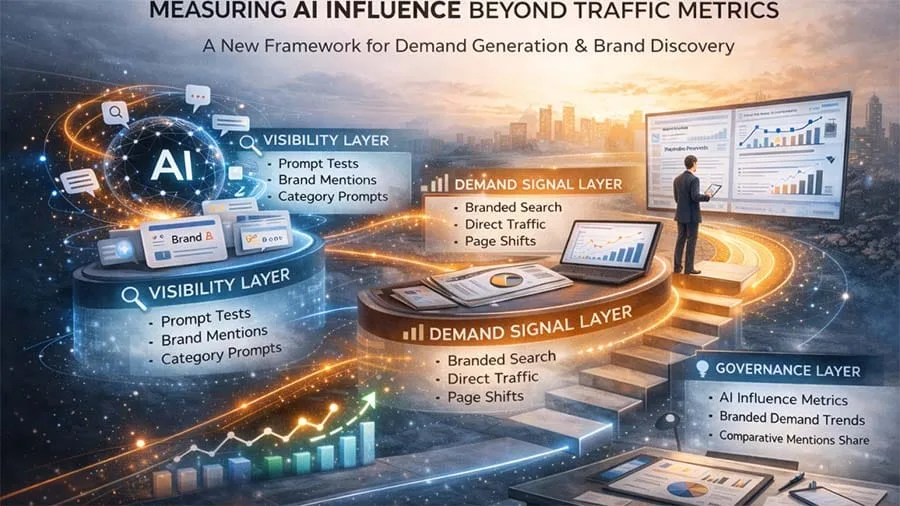
AI Influence Measurement
AI influence measurement is the discipline most enterprise analytics stacks are not built for – and the gap it creates is already distorting strategic decisions across organisations. If your reporting shows traffic holding steady while branded demand behaves unexpectedly, or if your leadership cannot explain why pipeline quality shifts without corresponding campaign changes, this is the article you need. The measurement model your organisation is using was designed for a click-based web. The web has moved on, and the measurement framework needs to move with it.
I have spent 25 years inside organisations at every scale of digital complexity. The pattern I see repeating right now is familiar. It mirrors what happened when organisations failed to adapt measurement during the mobile transition, the featured snippet era, and the zero-click shift. The teams that waited for clean attribution data before acting ceded ground that took years to recover. What is happening with AI influence today is faster and structurally deeper than any of those transitions.
The attribution gap that is already costing you
Your analytics platform is doing exactly what it was designed to do. It is recording sessions, attributing channels, tracking conversions, and reporting on engagement. The problem is not your analytics. The problem is that a growing portion of decision-making now happens before a measurable session begins – inside AI systems, across multi-step conversational research, in environments that do not send referrer data to your GA4 property.
Around 93% of AI Mode searches end without a click – more than twice the zero-click rate of AI Overviews. Users spend an average of 77 seconds comparing brands inside AI Mode before making a decision. That is over a minute of influence formation happening in an environment your analytics cannot see. When that user subsequently opens a new tab and searches your brand name directly, your reporting attributes the resulting visit to organic branded search or direct traffic. The AI system that shaped the decision is invisible in the data.
Traditional reporting models were built for a click-based web. Discovery now happens inside AI answers, across multi-step sessions, and before a user ever lands on your site. This is the core measurement challenge, and it is not a tool problem. No dashboard upgrade resolves it. It requires a fundamental expansion of what organisations choose to measure.
Why the standard reporting conversation misleads leadership
The conversation I hear most often goes like this: someone at the manager level reports that AI contributes less than 1% of measurable referral traffic. Leadership interprets that as evidence AI is not commercially significant. Both statements are technically accurate. The conclusion is strategically wrong.
AI does not primarily function as a referral source. It functions as an influence layer – a category framing and brand positioning environment that precedes the visit, shapes the intent of the visit, and determines whether your brand is in the consideration set at all. Measuring its impact through referral sessions is like measuring the influence of industry events by counting how many people mentioned the event’s URL when they called your sales team.
Monthly sessions from AI tools are now 56% the size of all searches worldwide. Search-related AI usage – people asking research prompts in AI tools – is 28% the size of traditional search globally. That is not a marginal channel. That is a parallel research environment operating at scale, running upstream of your current measurement perimeter.
Instead of competing for a position on a results page, organisations are competing to be referenced as a trusted source inside the answer itself. The organisations that understand this are building influence measurement frameworks. The organisations that do not are reporting confidently on outcomes they increasingly do not control.
What AI influence actually changes in demand generation
The demand generation funnel as most enterprise organisations model it runs: visibility → click → conversion. That model assumes the decision-making process begins when a user arrives on your site or enters your CRM. It does not. Research-intensive buying decisions – particularly in B2B, professional services, and high-consideration categories – now routinely involve AI consultation before any vendor property is visited.
People are not using LLMs like search engines. They are asking contextual, trust-heavy, consultative questions – the kind they would normally ask a real expert. In enterprise technology, financial services, and professional services categories, buyers are asking AI systems to evaluate vendors, compare capabilities, and synthesise category knowledge. The brand that is cited accurately and consistently in those conversations has already won a positioning advantage before your sales team makes first contact.
The correct model for AI-era demand generation is: visibility → influence → validation → conversion. Your analytics currently measures the last two stages reliably. The first two are where competitive differentiation increasingly begins, and where most enterprise measurement frameworks are blind.
AI recommendations are highly inconsistent – there is less than a 1-in-100 chance that ChatGPT or Google AI, asked the same question 100 times, will produce the same brand list in any two responses. That inconsistency makes systematic AI influence measurement more important, not less. You cannot manage a volatile environment by ignoring it. You manage it by building measurement systems that detect its patterns.
This connects directly to what I outlined in the AI influence playbook – influence architecture requires its own measurement layer, separate from traditional performance reporting.
The four measurement layers your framework needs
I developed this framework from direct enterprise experience – from inside organisations where this measurement gap was creating genuine strategic confusion. It does not require replacing your analytics stack. It requires expanding it.
Layer one: Visibility – are you present in AI systems?
Before measuring impact, measure presence. AI systems frequently mention brands without linking, prioritise third-party sources over vendor properties, and compress consideration sets in ways that traditional ranking tools do not capture. Establish a structured prompt testing programme across the major AI platforms – at a minimum, ChatGPT, Gemini, Perplexity, and Claude. Test category definition queries, comparison queries, and problem-framing queries relevant to your commercial intent. Document which brands appear, how they are described, which sources are cited, and where your organisation sits in the competitive frame.
AI visibility should be tracked across four dimensions: frequency, consistency, share, and volatility. Frequency tells you whether you appear at all. Consistency tells you whether your positioning holds across repeated queries. Share tells you where you sit relative to competitors. Volatility tells you whether your presence is structurally stable or algorithmically fragile.
ChatGPT only cites 15% of the pages it retrieves. 85% of sources retrieved during a user’s research session are never cited. That gap – between what AI systems access and what they surface – is where AI search readiness work determines competitive outcomes.
Layer two: Demand signals — detecting indirect effects
Because AI influence typically resolves into branded search, direct traffic, and high-intent first visits, your existing analytics data already contains the signal. The challenge is interpreting it correctly. Monitor branded search velocity week-over-week, independent of campaign activity. Track direct traffic anomalies, particularly first-session conversion rates – users arriving already informed convert at structurally different rates than cold organic visitors. Watch for landing page mix shifts: if previously low-traffic pages begin receiving high-intent visits, an AI system is likely surfacing them in relevant queries.
The key interpretive principle is this: if branded demand grows without proportional campaign investment, upstream AI influence is the most probable explanation. Most attribution models misread this signal as SEO improvement. The correct interpretation is that AI-driven education is feeding branded search behaviour – and that distinction matters for budget allocation and channel strategy.
Layer three: Source authority – where AI learns about you
Large language models and AI retrieval systems strongly favour industry publications, neutral third-party sites, comparison platforms, and review ecosystems over vendor-owned content. Sites with over 32,000 referring domains are 3.5 times more likely to be cited by ChatGPT than those with up to 200 referring domains, according to Position Digital. Your organisation’s AI presence is therefore heavily dependent on its external authority profile – not on the content your team publishes to your own domain.
This is not traditional link building. It is an influence on surface engineering. Audit where your competitors dominate authoritative external sources. Identify the publications, analyst platforms, and comparison sites that AI systems consistently cite in your category. Build a systematic presence there. Your internal authority distribution shapes what you own. Your external authority profile shapes what AI systems say about you.
Layer four: Governance – aligning reporting with how influence actually works
This is where measurement strategy becomes an executive conversation. As long as internal reporting treats AI as a traffic source measured in referral sessions, leadership will systematically underestimate its commercial significance and misdirect resources accordingly.
Reporting must evolve to include an AI brand presence index – a tracked measure of citation frequency and positioning quality across key queries. Add a comparative mention share metric: how often does your brand appear versus competitors in category-defining AI responses? Track branded search acceleration rate as a proxy for upstream influence. Report influence-to-conversion lag patterns, which reveal how long the AI influence cycle runs before it produces measurable pipeline activity.
This shifts the executive conversation from “where did the click come from?” to “what shaped the decision before the click?” That is a strategically mature framing, and it is the one that accurately reflects how B2B buying decisions increasingly form.
The cost of not building this framework
The financial exposure from ignoring AI influence measurement is not hypothetical. It compounds silently across two dimensions.
The first is competitive positioning loss. Brands mentioned in AI responses experience 91% higher paid CTR – the halo effect extends beyond organic. Competitors who build and maintain an AI presence enjoy elevated conversion rates across every channel, not just AI-sourced traffic. That asymmetry accumulates. An organisation absent from AI-generated consideration sets in its category is not just losing AI traffic. It is losing the authority multiplier that AI presence creates across all channels.
The second dimension is strategic misallocation. Organisations without AI influence measurement cannot distinguish between genuine organic performance improvement and AI-driven demand uplift. They allocate budget against the wrong levers, set targets based on incomplete models, and make channel investment decisions using frameworks that systematically undercount where influence actually forms. By the time the misallocation is visible in revenue data, competitor positioning is already established.
Organisations that implement structured AI influence measurement within the next two quarters will have established baseline data, competitive benchmarks, and trend visibility before this measurement gap becomes a boardroom conversation. Those that wait for the measurement landscape to standardise will find that competitive positioning has already been decided upstream.
The practical implementation sequence
Start with what costs nothing and reveals the most. Run structured prompt tests across five to ten category-defining queries in each major AI platform. Document the results systematically. Compare your presence against two or three key competitors. That baseline exercise takes a few hours and produces the most strategically useful data most enterprise SEO teams have never seen.
From there, add branded search velocity monitoring to your weekly reporting rhythm. Instrument direct traffic anomaly detection – this requires no new tools, only a new interpretation layer on data you already collect. Over the following quarter, build out the source authority audit and begin systematic external presence work in the publications and platforms AI systems cite most frequently in your category.
By quarter three, your reporting framework should include an AI influence section alongside traditional channel performance. Not because AI referral traffic has become large enough to justify it, but because the decisions AI systems are shaping in your category have been significant for longer than your reporting has acknowledged.
The teams building this measurement infrastructure now are not just protecting visibility. They are redesigning how performance is understood – and that understanding will compound into structural advantage as AI’s role in demand formation continues to deepen. If you want to assess where your organisation currently sits in this transition, the search visibility system assessment is a useful diagnostic starting point.
Your analytics are showing you outcomes
The decisions shaping those outcomes are forming upstream, in environments your current framework cannot see. If you want to understand the AI influence gap in your specific market and category, let’s talk.
Frequently asked questions
AI influence measurement tracks how AI systems – ChatGPT, Gemini, Perplexity, Claude, and others – mention, describe, and position your brand in responses to category-relevant queries, before any user clicks through to your site. Standard SEO reporting measures what happens after a user arrives. AI influence measurement captures what shapes the decision to arrive at all. The two frameworks are not in competition; they are sequential layers of the same demand generation process, and most organisations are currently measuring only the downstream half.
When branded search accelerates without proportional campaign spend, the most common upstream cause is AI-driven education. A user asks an AI system a category or comparison question, encounters your brand in the response, and later searches your brand name directly to validate what they learned. Your analytics records a branded organic visit. The AI system that created the intent is invisible in the attribution. Monitoring this pattern – branded velocity growth independent of campaign activity – is one of the most actionable signals in the AI influence measurement framework.
Brands with consistent AI presence show 91% higher paid CTR and structurally higher conversion rates across channels, not just in AI-sourced traffic. Organisations measuring AI influence now will have baseline data, competitive benchmarks, and trend visibility before competitors begin building the same infrastructure. The organisations that wait for measurement standards to stabilise will find that category positioning in AI systems has already been established by the competitors who moved earlier.
Report AI influence as a brand presence metric, not a traffic source metric. The relevant measures are: how often your brand appears in category-defining AI queries, how your citation share compares to competitors, whether your branded search velocity is accelerating at a rate that suggests upstream AI influence, and how the lag between AI exposure and conversion correlates with campaign cycles. This reframes the conversation from “AI sends less than 1% of traffic” to “AI is shaping the intent that drives traffic across all our channels,” – which is the strategically accurate framing.
Begin with structured prompt testing. Choose five to ten queries that reflect how buyers in your category research decisions. Test them in ChatGPT, Gemini, and Perplexity. Document your brand’s presence, the language used to describe you, the sources cited, and your competitors’ positioning. Run the same test weekly or fortnightly. That baseline costs nothing and immediately reveals whether your brand is present in the environments where category decisions are forming. Add branded search velocity monitoring to your existing reporting. Those two steps produce more strategic insight than most enterprise teams currently have on AI influence, and neither requires new tooling.
No. The AI influence measurement framework is additive, not a replacement. Your existing GA4, Search Console, and CRM data continue to measure downstream performance. AI influence measurement adds an upstream layer – prompt testing, citation tracking, external authority auditing, and branded demand signal interpretation – on top of the existing stack. The investment is in methodology and measurement discipline, not in replacing tools that are still doing their original job correctly.
Directly and significantly. AI systems favour content that is structurally clear, semantically coherent, and supported by authoritative external citation. The same technical SEO foundations that improve traditional search performance – clean information architecture, structured data, crawlability, semantic cluster organisation – also improve AI retrieval confidence. Content that lacks structural clarity is less likely to be cited, regardless of how relevant it is to the query. Building AI influence, therefore, begins with the same structural foundations as SEO governance, not as a separate discipline layered on top.
